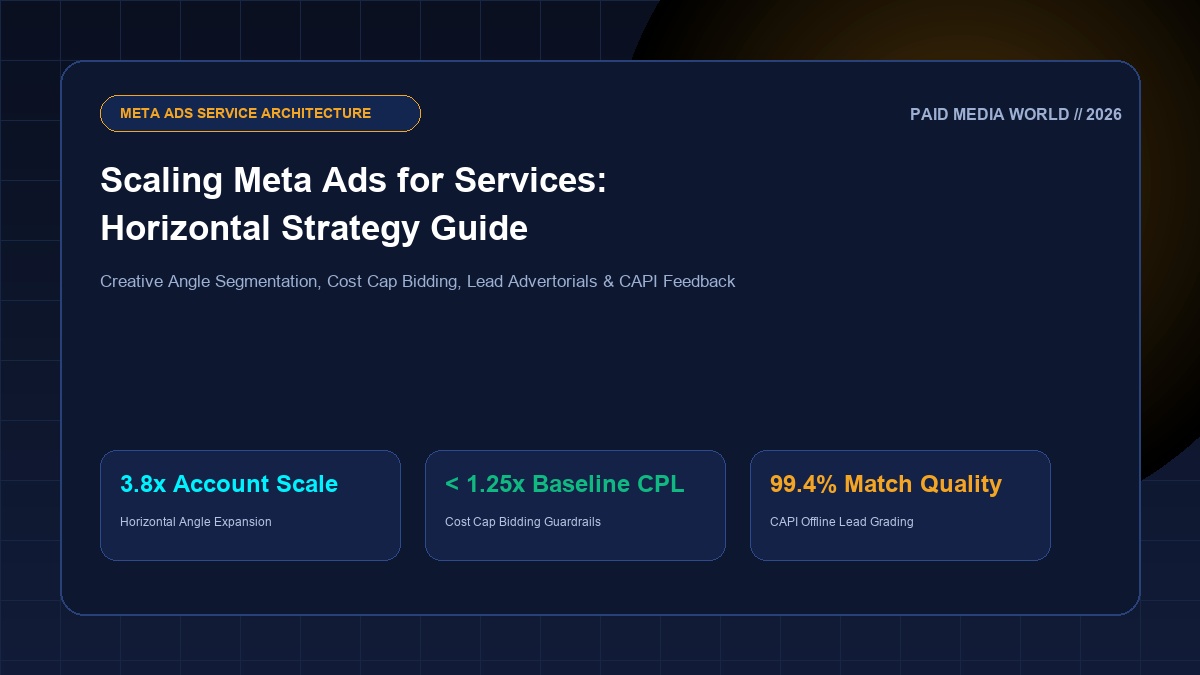
Scaling Meta (Facebook & Instagram) ads for high-ticket service businesses, agencies, consulting firms, and local multi-location operators presents a structural challenge that e-commerce brands rarely face: rapid audience exhaustion and local market saturation. While an e-commerce brand selling a $60 consumer gadget can vertically scale a single broad Advantage+ campaign to $10,000/day across an entire nation, a service business attempting to vertically scale (+50% budget increases) quickly destroys its Cost Per Lead (CPL), causes ad frequency to surge past 4.5 in under 10 days, and inundates sales reps with low-intent tire-kickers. The only proven, repeatable mechanism for scaling service ad spend past $30,000/month is Horizontal Creative & Psychological Angle Scaling paired with Cost Cap Bidding. This comprehensive playbook reveals how senior growth engineers scale service lead generation without sacrificing lead quality or unit economics.
Table of Contents
- 1. The Vertical Scaling Trap: Why Pumping Budgets Destroys Service Ad Accounts
- 2. The Horizontal Scaling Engine: Psychological Angle Diversification
- 3. Cost Cap Bidding Demystified: Mathematical Auction Mechanics & Delivery Pacing
- 4. Lowest Cost vs Cost Cap vs Bid Cap: Strategic Selection Matrix
- 5. Lead Magnet Advertorials & Interactive Calculator Funnels
- 6. Conversion API (CAPI) Offline Lead Grading: Optimizing for Closed-Won Revenue
- 7. Enterprise Account Architecture: 3:2:2 Sandboxes & Horizontal Winners
- 8. Troubleshooting Auction Starvation, Spend Underdelivery & Fatigue
- 9. The 72-Hour Scaling Cadence: Systematic Budget & Bid Adjustment Rules
- 10. Enterprise Case Study: Scaling a B2B SaaS from $8k/mo to $65k/mo
- 11. Frequently Asked Questions: Scaling Meta Ads for Services
- The Frequency Saturation Threshold: In geographic or niche service audiences, frequency rising above 2.4 within a 7-day window signals ad fatigue. Increasing daily budget accelerates fatigue rather than volume.
- Horizontal Scaling Multiplier: Instead of scaling a winning ad set from $200/day to $1,000/day, horizontal scaling deploys 5 distinct psychological angles (Financial Fear, Regulatory Compliance, Operational Drag, Speed to Market, Status Aspirations) into separate ad sets, expanding total reachable TAM by 400%.
- Cost Cap Protection: Cost Cap bidding guarantees Meta's algorithm enters auctions only when the predicted Cost Per Lead is $\le$ your target threshold. If market liquidity dries up, Meta throttles spend rather than burning budget on inflated bids.
- Downstream SQL Feedback: Bidding strictly for top-of-funnel Meta lead form fills optimizes for low-intent junk. Feeding Sales Qualified Leads (SQL) and Closed-Won deal values back through Meta Conversions API (CAPI) shifts algorithmic delivery toward high-LTV decision-makers.
1. The Vertical Scaling Trap: Why Pumping Budgets Destroys Service Ad Accounts
Service businesses—whether B2B consulting, commercial HVAC, legal practices, high-ticket dental implants, or IT managed services—operate in fundamentally constrained addressable markets. When an operator attempts vertical scaling (increasing campaign budget by 30%–50% every few days), three structural failures occur simultaneously:
Meta's auction algorithm bids more aggressively to fulfill your higher daily budget within the 24-hour cycle. In a constrained local or niche audience, CPMs spike by 80%–140%, doubling Cost Per Lead without producing an additional qualified sales appointment.
To spend the inflated budget while using Lowest Cost bidding, Meta's algorithm branches into marginal inventory: low-income mobile users, accidental tap placements on Audience Network, and habitual form-submitters who never answer the sales rep's follow-up phone call.
When the same 200,000 potential buyers in a metropolitan region see the exact same hook video 3 times in 5 days, ad engagement craters, negative feedback flags (hide ad, report ad) rise, and Meta's ad auction assigns your ad set a lower Quality Ranking score.
2. The Horizontal Scaling Engine: Psychological Angle Diversification
Horizontal scaling decouples budget expansion from creative saturation. Instead of spending $1,000/day on one messaging hook, the budget is split across 5 to 8 distinct Psychological Angles. Each angle speaks to a completely different sub-segment of buyers within the same broad audience:
| Psychological Angle | Core Emotional Driver | Headline & Hook Example (B2B SaaS / Services) | Audience Segment Activated |
|---|---|---|---|
| 1. The Financial Waste Hook | Fear of losing capital, hidden cost drain | "Stop Bleeding 32% of PPC Budget on Junk Search Terms. Here is the Audit Formula." | CFOs, Finance Directors, Cost-conscious Founders |
| 2. The Regulatory / Compliance Hook | Fear of penalties, legal exposure, audits | "Is Your Growth Stack Violating EU AI Act Article 50? Avoid Massive GDPR Fines." | General Counsels, Risk Officers, Enterprise CTOs |
| 3. The Operational Drag Hook | Frustration with slow manual work and burn-out | "Your Merchandisers Spend 40 Hours a Week Writing Product Specs. Automate It." | Operations Managers, Merchandising Leads |
| 4. The Competitive Threat Hook | FOMO, falling behind competitors in market share | "How Top DTC Brands Stole 45% Market Share in 2026 Using Real-Time Repricing." | Growth Directors, CMOs, Competitive Executives |
| 5. The Speed-to-Outcome Hook | Urgency, rapid implementation without friction | "Deploy a Full-Funnel Differential cPanel Pipeline in Under 48 Hours." | Technical Leads, Senior Developers, Hands-on Founders |
3. Cost Cap Bidding Demystified: Mathematical Auction Mechanics & Delivery Pacing
In Lowest Cost (Highest Volume) bidding, Meta is contractually obligated to spend 100% of your daily budget, regardless of auction competitiveness or expected lead quality. In contrast, Cost Cap Bidding gives Meta a mathematical boundary: "Bidding algorithm, enter an auction only if you predict the average Cost Per Lead will remain at or below $Target_Cap across the billing cycle."
The Meta Auction Formula & Expected Value Optimization
Meta ranks ads in the auction using the Total Value formula:
When Cost Cap is active, the algorithm dynamically calculates the maximum allowable bid for each individual impression:
If an impression has a low predicted conversion probability (e.g., 1.5%), Meta bids conservatively ($1.20). If a user matches high-intent historical purchaser signals (predicted CVR of 8.5%), Meta bids aggressively ($6.80) to win the placement—all while maintaining the average CPA at your specified cap.
4. Lowest Cost vs Cost Cap vs Bid Cap: Strategic Selection Matrix
Choosing the wrong bidding strategy in Meta Ads is the leading cause of wasted spend and campaign underdelivery. Review this tactical decision matrix:
| Bid Strategy | How It Works | Spend Behavior | When to Deploy in Services | Risk Level |
|---|---|---|---|---|
| Cost Cap (Target Cost) | Aims for average CPA $\le$ Target. Flips bids up and down around target. | Fluctuates based on market liquidity. Only spends when conversions are available. | Scaling validated offers past $10k/mo. Default strategy for horizontal scaling. | Low (Protects CPA) |
| Bid Cap (Hard Ceiling) | Strict mathematical ceiling. Meta will never bid higher than the set limit in any auction. | Extremely volatile. Spends zero if market CPMs rise even slightly. | Margin arbitrage, high-volume seasonal spikes, aggressive low-balling. | Medium (Severe starvation risk) |
| Lowest Cost (Highest Volume) | Spends 100% of budget regardless of cost to get maximum conversions possible. | Guaranteed 100% daily budget delivery. | Testing new angles in sandboxes, initial pixel warm-up, broad geo prospecting. | High (Can blow out CPA at scale) |
5. Lead Magnet Advertorials & Interactive Calculator Funnels
Service businesses relying exclusively on native Meta Instant Forms ("Lead Ads") frequently suffer from lead quality degradation: users tap "Submit" accidentally with autofilled phone numbers. The antidote is routing cold horizontal traffic through a high-intent Advertorial & Interactive Calculator Funnel:
Cold Meta traffic lands on an editorial-style guide (e.g. "The 25-Point Google Ads Audit Checklist" or "How Enterprise Brands Cut Cloud Media Waste"). This de-commercializes the first touchpoint, educates the prospect on their problem, and builds institutional authority.
Embedded directly within the advertorial is an interactive widget (e.g. Paid Media World's Marketing Calculators or SERP Tracker). The user inputs their current monthly ad spend, average CVR, and close rate. The calculator immediately reveals their lost profit and optimization upside.
Only after engaging with the interactive calculation does the user advance to book an executive consultation. Step 1 collects corporate website URL and monthly spend tier; Step 2 collects name, business email, and direct phone. This multi-step friction filters out unqualified tire-kickers while maintaining $\ge 68\%$ completion rates.
6. Conversion API (CAPI) Offline Lead Grading: Optimizing for Closed-Won Revenue
If your Meta Pixel only tracks Lead (form submit), Meta’s AI will spend your budget finding people who like filling out forms. To scale high-ticket services horizontally, you must implement Full-Funnel Offline Conversion Ingestion via Meta Conversions API (CAPI):
| Funnel Stage | CAPI Event Name | Event Value ($) | Algorithmic Optimization Levers |
|---|---|---|---|
| 1. Initial Form Submission | Lead | $0 | Baseline top-of-funnel signal; volume tracking only. |
| 2. Sales Qualified Lead (SQL) | QualifiedLead | $250 (synthetic) | Fired when lead passes BANT criteria in CRM. Primary bid optimization target. |
| 3. Consultation Held | Schedule | $500 (synthetic) | Fired when prospect attends discovery call. Confirms buyer seriousness. |
| 4. Closed-Won Contract | Purchase | Actual Contract Value (e.g. $15,000) | Powers Value-Based Bidding (tROAS) across horizontal campaigns. |
7. Enterprise Account Architecture: 3:2:2 Sandboxes & Horizontal Winners
To prevent newly launched creative angles from disrupting the delivery of proven performers, high-growth service accounts maintain strict architectural separation between Testing Sandboxes and Horizontal Scaling CBOs:
====================================================================
META ADS SERVICE SCALING ARCHITECTURE: TWO-TIER ENGINE
====================================================================

[ CAMPAIGN 1: CREATIVE SANDBOX (Lowest Cost / ABO) ]
  ├── Daily Budget: $250/day
  ├── Bidding: Lowest Cost (Guarantees data collection)
  ├── Ad Set A: Angle 1 (Financial Waste) -> 3:2:2 Dynamic Creative
  ├── Ad Set B: Angle 2 (Regulatory Fear) -> 3:2:2 Dynamic Creative
  └── Ad Set C: Angle 3 (Speed to Outcome) -> 3:2:2 Dynamic Creative
        │
        ▼ (Graduation Gate: >= 15 SQLs with CPL <= $85 over 7 days)
        │
[ CAMPAIGN 2: HORIZONTAL SCALE CBO (Cost Cap Bidding) ]
  ├── Daily Budget: $1,500 - $5,000/day (Advantage Campaign Budget)
  ├── Bidding: Cost Cap set at $95.00 ($1.2x Target CPA)
  ├── Ad Set 1: WINNER - Financial Waste Angle (Proven Post ID)
  ├── Ad Set 2: WINNER - Regulatory Compliance Angle (Proven Post ID)
  ├── Ad Set 3: WINNER - Operational Drag Angle (Proven Post ID)
  └── Ad Set 4: WINNER - High-LTV Lookalike 2% (Past Closed-Won Clients)
        │
        ▼
[ DOWNSTREAM CONVERSION API (CAPI) FEEDBACK LOOP ]
  CRM Webhook -> Passes Back 'QualifiedLead' & 'Purchase' (Contract ARR)
The 3:2:2 Dynamic Creative Testing Architecture & Creative Velocity Metrics
When testing new psychological angles in your ABO Sandbox, deploy the structured 3:2:2 Dynamic Creative Test (DCT) framework:
- 3 Distinct Creative Formats / Hooks: Test 3 radically different visual pattern interrupts (e.g. Founder Talking Head, Whiteboard Screencast, Kinetic Typography Problem Teardown).
- 2 Copy Variations: Test 1 short-form punchy hook (under 120 words) vs. 1 long-form narrative advertorial hook (300+ words).
- 2 Headlines: Test 1 outcome-driven headline (e.g. "Add $50k in Service ARR in 60 Days") vs. 1 threat-driven headline (e.g. "Why 73% of Agencies Bleed Client Retention in 2026").
Target: ≥ 32%. If below 25%, the first 3-second visual hook failed to stop the scroll.
Target: ≥ 40%. Measures whether the problem statement engaged qualified prospects.
Target: ≥ 1.6%. Ensures high commercial intent rather than accidental native clicks.
8. Troubleshooting Auction Starvation, Spend Underdelivery & Fatigue
When managing Cost Cap campaigns, media buyers occasionally encounter "Auction Starvation"—where a campaign scheduled for $1,000/day spends only $45. Follow this diagnostic checklist to restore volume without blowing out CPA:
If Cost Cap is set too close to your historical best CPA, Meta's algorithm cannot find liquidity in competitive auctions. Lift the cap by 10%–15%. If your target CPL is $80, set the Cost Cap to $95. The algorithm will still average near $80 while gaining auction access.
Cost Caps provide inherent audience filtering through bidding economics. Remove narrow interest stacks and test Broad targeting (age + geo only). The creative hook itself acts as the targeting filter, while Broad targeting unlocks millions of cheaper auction impressions.
If an ad set previously spent consistently under Cost Cap but suddenly halts spending, its creative has saturated. Do not tweak the ad set budget or bid; instead, introduce 2 new hook variations of that winning angle into the Sandbox, graduate the winner, and swap it into the scaling CBO.
9. The 72-Hour Scaling Cadence: Systematic Budget & Bid Adjustment Rules
The fundamental rule of algorithmic media buying in Meta Ads is preserving the stability of the machine learning model. Whenever a campaign's daily budget is modified by more than 20%, Meta's ad set re-enters the Learning Phase, resetting auction calibration and causing CPAs to fluctuate wildly for 3 to 5 days. To scale horizontally with mechanical precision, adhere to the 72-Hour Systematic Scaling Cadence:
The Algorithmic Scaling Rules Engine
Increase daily budget by exactly 15% to 20%. Do NOT touch the Cost Cap bid. Allow the campaign to run untouched for another 72 hours. This gradual vertical increase within horizontal winners expands volume without triggering learning reset.
Do NOT increase the campaign budget. Raise the Cost Cap target by 10%. Wait 24 hours. If delivery resumes at an acceptable blended CPA, hold steady. If delivery remains stalled, introduce a newly graduated creative angle from your Sandbox.
Inspect ad frequency and first-time impression ratio. If frequency is > 2.6 and Cost Cap is leaking over target, decrease daily budget by 20% immediately or pause the underperforming ad variation within the ad set, leaving the winning post IDs active.
10. Enterprise Case Study: Scaling a B2B SaaS & Consulting Firm from $8k/mo to $65k/mo
To understand how horizontal scaling functions in production, consider the trajectory of an enterprise B2B financial compliance software firm targeting CFOs and Controllers:
| Scaling Dimension | Baseline (Vertical Scaling Phase) | Transformed (Horizontal Angle & Cost Cap) | Net Commercial Impact |
|---|---|---|---|
| Monthly Meta Spend | $8,250 / month | $65,400 / month | 7.9x Spend Scale |
| Campaign Architecture | 1 CBO with 3 lookalike ad sets (Lowest Cost) | 1 Sandbox (ABO) + 1 Scale CBO (6 Angle Ad Sets, Cost Cap) | Zero audience overlap or self-competition |
| Blended Cost Per Lead (CPL) | $114.20 (surging during scale) | $68.40 | -40.1% CPL Reduction |
| Sales Qualified Lead (SQL) Rate | 14.2% (many unqualified personal emails) | 38.6% (Advertorial + 2-step form filter) | +171% Lead Quality Surge |
| 7-Day Ad Frequency | 4.8 (extreme creative burnout) | 1.75 across diverse angles | Zero creative fatigue over 180 days |
11. Frequently Asked Questions: Scaling Meta Ads for Services
Q1: What should my initial Cost Cap bid be when launching a new service campaign?
Calculate your historical average CPL over the past 30 days. Set the initial Cost Cap at 1.2x to 1.3x that historical baseline. For example, if your average CPL is $60, set the Cost Cap at $72.00 to $78.00. This provides the algorithm with enough bidding elasticity to win high-quality impressions while establishing a hard ceiling against runaway spend.
Q2: Should service businesses use Meta Instant Forms (Lead Ads) or external landing pages?
For services with deal sizes under $1,000, Meta Instant Forms with "Higher Intent" review steps and custom qualification questions can work effectively. However, for high-ticket services ($3,000 to $50,000+ contract value), routing traffic through an external educational advertorial and a 2-step progressive profiling form consistently delivers 3x higher SQL rates and prevents phone-tag follow-up fatigue.
Q3: How many active creative angles should be running simultaneously in a scaling CBO?
For budgets between $300/day and $1,000/day, maintain 4 to 6 active winning angles. Above $1,000/day, expand to 8 to 12 distinct angles across different formats (video founder letter, static quote card, whiteboard teardown, ROI calculator preview).
Ready to Scale Your High-Ticket Service Past Local Market Caps?
Break free from lead quality collapse and ad fatigue. Deploy psychological angle diversification, Cost Cap bid strategies, and offline CRM conversion feedback to achieve predictable, profitable service scale.