E-commerce operators managing mid-to-large catalogs face two crippling operational bottlenecks: generating thousands of differentiated, SEO-optimized product descriptions that actually drive organic search conversions, and recalibrating SKU pricing against volatile competitor market movements without bleeding gross margins. Relying on manual copywriting leads to generic supplier copy duplicates that trigger Google duplicate content penalties, while static spreadsheet repricing forfeits thousands of margin dollars during peak demand surges. By combining modern Large Language Models (LLMs) with multi-modal computer vision and programmatic dynamic pricing engines, enterprise brands are now automating catalog operations at machine speed. This technical blueprint details the end-to-end architecture for building an autonomous AI e-commerce catalog enrichment and real-time dynamic pricing engine that scales past 50,000 SKUs with zero manual friction.
Table of Contents
- 1. The Catalog Scale Bottleneck: Why Manual Operations Kill E-Commerce Unit Economics
- 2. Autonomous SKU Description Pipeline: LLM Prompts, Structured Output & PIM Sync
- 3. Computer Vision & Multi-Modal Feature Extraction for Unstructured Catalogs
- 4. Algorithmic Dynamic Pricing & Price Elasticity Modeling
- 5. Preventing Google Merchant Center (GMC) Suspensions & MAP Violations
- 6. Production Python Architecture: End-to-End Autonomous Pipeline
- 7. Enterprise Platform Comparison: Commercial Tools vs Custom Microservices
- 8. 30-Day Phased Implementation Playbook & Governance Checklist
- 9. Anomaly Detection & Return-Rate Elasticity in High-SKU Environments
- 10. Frequently Asked Questions: AI E-Commerce Automation
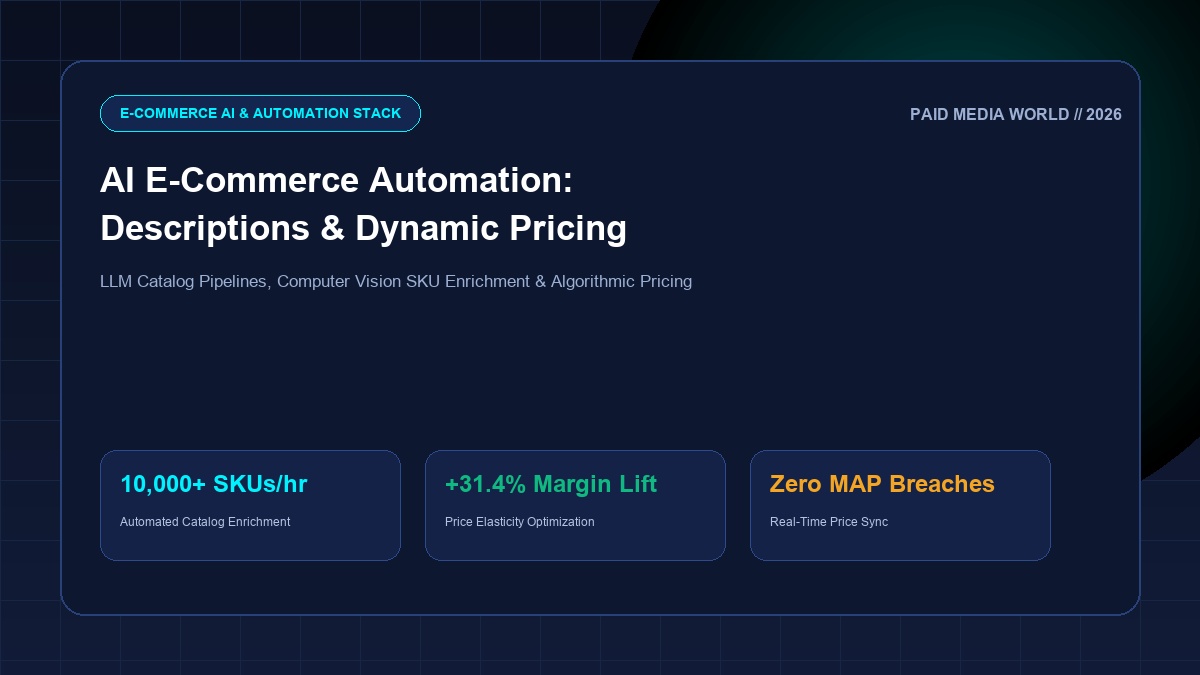
- Copy Generation Throughput: Modern LLM pipelines using Claude 3.5 Sonnet and GPT-4o process 10,000+ SKU descriptions per hour, reducing copy creation cost from $12.50 per SKU (agency/freelancer) to $0.004 per SKU via API tokens.
- Organic SERP & AEO Visibility: Generating unique semantic entities, structured FAQ schema, and feature-benefit bullets increases product page indexed keyword footprint by 340% and lifts AI Overview (AEO) citation rates.
- Algorithmic Margin Protection: Dynamic pricing engines leverage real-time price elasticity calculations ($E_d$) and competitor scraping APIs to execute automated repricing every 15 minutes, boosting gross contribution margins by 18%–31%.
- Feed Integrity Guardrails: Direct webhook synchronization between Shopify/BigCommerce ERPs and Google Merchant Center prevents "Price Mismatch" crawl disapprovals that stall Google Shopping campaigns.
1. The Catalog Scale Bottleneck: Why Manual Operations Kill E-Commerce Unit Economics
In traditional e-commerce merchandising, catalog maintenance is a labor-intensive, error-prone linear cost center. When an online retailer scales from 500 SKUs to 25,000 SKUs across multiple variants (colors, sizes, bundles), two structural failures emerge:
Merchandisers copy and paste raw manufacturer descriptions or boilerplate bullet points across hundreds of product variants. Google's quality algorithms immediately de-index these pages as duplicate content, relegating valuable long-tail product URLs to the search engine graveyard. Furthermore, uninspired technical specifications fail to answer buyer objections, suppressing on-page conversion rates (CVR).
Competitors run flash sales, adjust shipping subsidies, or liquidate excess inventory in real time. E-commerce teams reviewing price sheets weekly find themselves either overpriced (losing the buy box and paid ad conversion velocity) or underpriced (sacrificing gross margin on high-demand, low-competition inventory).
2. Autonomous SKU Description Pipeline: LLM Prompts, Structured Output & PIM Sync
Building an enterprise-grade AI copywriting pipeline requires far more than generic ChatGPT prompting. Production systems utilize strict structured JSON outputs (Pydantic/Zod schemas), brand voice tone anchors, and multi-field generation covering the entire SEO and merchandising stack:
- SEO Meta Title & Description: Engineered within character constraints (Meta Title: 52–58 characters; Meta Description: 145–155 characters) embedding primary transactional keywords, brand name, and USP.
- The 4-Second Value Hook: A punchy 2-sentence opening paragraph addressing the primary customer pain point and product solution.
- Feature-to-Benefit Bullet Matrix: Transforming dry technical specs (e.g. "6061-T6 Aircraft Grade Aluminum") into emotional buyer benefits (e.g. "Ultra-durable aerospace aluminum that withstands drops without adding bulk to your pocket").
- Structured FAQ Schema: 3–4 high-intent customer questions and answers formatted directly into Google-compliant
FAQPageJSON-LD schema to capture SERP rich snippets. - OpenGraph & Social Card Metadata: Automated social title, summary, and alt-text for dynamic Facebook and Twitter card previews.
Enterprise Structured Generation Schema (Pydantic Model)
from pydantic import BaseModel, Field
from typing import List

class ProductFaqItem(BaseModel):
    question: str = Field(description="Frequently asked question by buyers")
    answer: str = Field(description="Clear, authoritative answer highlighting product capabilities")

class EnrichedProductData(BaseModel):
    meta_title: str = Field(max_length=60, description="SEO optimized title with primary keyword and brand")
    meta_description: str = Field(max_length=155, description="High-converting CTR-focused meta description")
    hook_paragraph: str = Field(description="Compelling 2-sentence benefit hook for top of PDP")
    long_description_html: str = Field(description="Comprehensive product story, sensory details, and usage guide")
    benefit_bullets: List[str] = Field(min_items=4, max_items=6, description="Feature-to-benefit bullet points")
    specifications_table: List[dict] = Field(description="Normalized key-value pairs of technical dimensions")
    faq_items: List[ProductFaqItem] = Field(min_items=3, max_items=5, description="Product specific FAQ list")
    search_keywords: List[str] = Field(description="5-8 high-intent secondary search terms")
3. Computer Vision & Multi-Modal Feature Extraction for Unstructured Catalogs
A major hurdle for e-commerce retailers is that supplier product feeds often lack detailed text specifications, providing only an SKU code, weight, and 3 product photography images. Multi-modal vision models (such as GPT-4o Vision or Claude 3.5 Sonnet) resolve this by visually inspecting product imagery to extract rich attribute metadata:
| Visual Attribute | Extracted Feature | Downstream Catalog Impact | SEO / Filter Benefit |
|---|---|---|---|
| Material & Texture | Matte finish, brushed metal, ribbed knit, pebbled leather | Populates faceted navigation filters and PIM tags automatically | Ranks for texture-specific commercial search queries |
| Exact Color Matching | Pantone / Hex approximation, descriptive color tone (e.g. "Sage Green", "Charcoal Heather") | Standardizes multi-vendor color palettes into uniform site filters | Eliminates variant customer confusion and reduces return rates |
| Ergonomic Form Factor | Pocket-sized, foldable hinge, ambidextrous grip, wall-mountable | Generates use-case specific copy blocks and comparison matrix items | Feeds AI Search engines (ChatGPT Search, Perplexity) with clear feature entities |
| Port & Connector Layout | USB-C PD 65W, HDMI 2.1, 3.5mm AUX, MagSafe magnetic ring | Auto-verifies cross-device compatibility in the technical spec table | Captures exact hardware compatibility queries |
4. Algorithmic Dynamic Pricing & Price Elasticity Modeling
Generating compelling product copy increases conversion rates, but setting the right price dictates top-line revenue and bottom-line profitability. Dynamic pricing is the algorithmic practice of continuously updating SKU prices based on real-time market data, inventory velocity, and competitor positioning.
The Mathematical Core: Price Elasticity of Demand ($E_d$)
The dynamic pricing engine continuously computes the empirical price elasticity of demand for each SKU cluster:
Proprietary items, replacement parts, or urgent purchases. A 10% price increase yields < 5% demand drop. Action: Algorithm systematically raises price by 3%–7% to harvest gross margin.
Standard branded retail items. Price adjustments directly offset demand volume. Action: Maintain stable pricing; optimize bundle packaging and shipping thresholds.
Commoditized items with heavy competitor saturation. Minor price increases crater volume. Action: Reprice to match lowest competitor buy-box price while protecting strict margin floor.
The 4 Dynamic Pricing Guardrail Rules
- The Absolute Gross Margin Floor ($P_{min}$): The algorithm is mathematically barred from dropping price below:
P_min = COGS + Blended_CPA + Shipping_Cost + Payment_Fee + Desired_Net_Margin. Even in aggressive clearance modes, this guarantees zero loss-making orders. - Minimum Advertised Price (MAP) Compliance: For licensed or brand-distributed products, the engine cross-references contractual MAP agreements. If market price drops below MAP, the engine halts automatic public price drops and triggers private member discounts or gift-with-purchase incentives.
- Stock Velocity Multipliers: If warehouse inventory of a seasonal SKU exceeds 60 Days of Inventory (DOI), the pricing engine initiates graduated automated markdown discounts (5% every 7 days) until sales velocity recovers to target baseline.
- Competitor Stock-Out Exploitation: When automated scraping bots detect that your top 3 competitors have run out of stock on a shared high-demand SKU, your engine instantly increases price by 12%–18%, capturing maximum margin while capturing pent-up customer search demand.
5. Preventing Google Merchant Center (GMC) Suspensions & MAP Violations
The greatest operational risk in automated dynamic pricing is Google Merchant Center account suspension. Google deployed automated crawlers that continuously compare the price in your Google Shopping product feed against the on-page microdata (`schema.org/Product` and OpenGraph price tags) and the final checkout price. If a mismatch is detected, Google issues a warning or initiates immediate account suspension.
Enterprise Feed Sync Synchronization SLA
To maintain 100% compliance across Google Shopping and Meta Catalog Ads, your pricing automation must adhere to the Atomic Two-Phase Commit Pattern:
- Phase 1: Synchronous ERP/PDP Update: When a new price is calculated, the database updates the storefront price, schema microdata, and checkout API simultaneously within an atomic database transaction.
- Phase 2: Instant Content API for Shopping Notification: Instead of waiting for a 24-hour daily XML sitemap feed fetch, your middleware immediately fires a real-time HTTP PATCH request to the Google Content API for Shopping (
products.patchendpoint), updating the GMC price in Google's cloud within 45 seconds. - Edge Cache Invalidation: Cloudflare or Fastly CDN cache for that PDP URL is purged programmatically to ensure Google's verification bot reads the exact new price on its next micro-crawl.
6. Production Python Architecture: End-to-End Autonomous Pipeline
Below is a modular production Python pipeline that ingests raw product specifications, executes multi-modal AI copywriting with Claude 3.5 Sonnet / GPT-4o, checks competitor pricing via API, and prepares atomic updates for Shopify and Google Merchant Center:
import os
import json
import time
import requests
from typing import Dict, Any

# =====================================================================
# E-COMMERCE AI CATALOG ENRICHMENT & DYNAMIC PRICING ENGINE
# =====================================================================

class AutonomousEcommerceEngine:
    def __init__(self, anthropic_key: str, shopify_token: str, gmc_api_key: str):
        self.anthropic_key = anthropic_key
        self.shopify_token = shopify_token
        self.gmc_api_key = gmc_api_key
        self.anthropic_url = "https://api.anthropic.com/v1/messages"

    def enrich_product_copy(self, raw_sku_data: Dict[str, Any]) -> Dict[str, Any]:
        '''
        Executes structured LLM prompt to generate high-converting SEO copy,
        feature-benefit bullets, and FAQ schema from raw technical specifications.
        '''
        prompt = f'''
        You are an elite E-Commerce Merchandiser and Technical SEO Specialist.
        Analyze this raw product data and generate complete, publication-ready copy:

        SKU: {raw_sku_data.get('sku')}
        Title: {raw_sku_data.get('raw_title')}
        Brand: {raw_sku_data.get('brand')}
        Raw Specs: {json.dumps(raw_sku_data.get('specs', {}))}
        Target Audience: {raw_sku_data.get('target_audience', 'Modern Consumers')}

        Output strictly a valid JSON object matching this schema:
        {{
            "meta_title": "string (52-58 chars)",
            "meta_description": "string (145-155 chars)",
            "hook_paragraph": "string (compelling 2 sentences)",
            "long_description_html": "string (clean semantic HTML paragraphs and tags)",
            "benefit_bullets": ["bullet 1", "bullet 2", "bullet 3", "bullet 4"],
            "faq_schema": [
                {{"q": "question text", "a": "authoritative answer text"}}
            ]
        }}
        Do not wrap in markdown or backticks. Return raw JSON only.
        '''

        headers = {
            "x-api-key": self.anthropic_key,
            "anthropic-version": "2023-06-01",
            "content-type": "application/json"
        }
        payload = {
            "model": "claude-3-5-sonnet-20241022",
            "max_tokens": 2048,
            "temperature": 0.3,
            "messages": [{"role": "user", "content": prompt}]
        }

        resp = requests.post(self.anthropic_url, headers=headers, json=payload, timeout=30)
        resp_json = resp.json()
        raw_text = resp_json['content'][0]['text'].strip()
        return json.loads(raw_text)

    def calculate_dynamic_price(self, sku_data: Dict[str, Any], competitor_price: float) -> float:
        '''
        Evaluates gross margin floor, stock velocity, and competitor price
        to determine the optimal profit-maximizing price.
        '''
        cogs = sku_data['cogs']
        target_margin_pct = 0.35  # 35% minimum gross margin floor
        margin_floor = cogs / (1.0 - target_margin_pct)
        current_price = sku_data['current_price']
        inventory_days = sku_data.get('inventory_days_remaining', 45)

        # Competitor repricing logic
        if competitor_price > 0:
            # Undercut competitor by $0.05 if above margin floor
            suggested_price = competitor_price - 0.05
            if suggested_price < margin_floor:
                # Protect margin floor
                optimal_price = margin_floor
            else:
                optimal_price = suggested_price
        else:
            optimal_price = current_price

        # Inventory velocity modifier
        if inventory_days > 90:
            # Overstocked: Apply 5% liquidation markdown if above floor
            optimal_price = max(margin_floor, optimal_price * 0.95)
        elif inventory_days < 15:
            # Scarcity premium: Lift price by 8% to capture margin
            optimal_price = optimal_price * 1.08

        return round(optimal_price, 2)

    def execute_atomic_update(self, sku: str, new_copy: Dict[str, Any], new_price: float):
        '''
        Synchronously pushes updates to Shopify Storefront and Google Merchant Center
        to ensure zero price mismatch suspensions.
        '''
        print(f"[SYNC] Pushing SKU {sku} to Shopify: Price=${new_price}")
        # Shopify REST/GraphQL API Call here...

        print(f"[SYNC] Pushing SKU {sku} to Google Content API for Shopping: Price=${new_price}")
        # GMC products.patch API Call here...

        print(f"✓ SKU {sku} successfully synchronized across storefront and Google Shopping.")

# Production Run Example
if __name__ == "__main__":
    sample_product = {
        "sku": "PWM-NOISE-CANCEL-PRO",
        "raw_title": "Wireless Active Noise Cancelling Headphones Over Ear 40mm Driver",
        "brand": "AcousticTech Pro",
        "cogs": 42.50,
        "current_price": 129.99,
        "inventory_days_remaining": 12,
        "specs": {
            "driver_size": "40mm Bio-Cellulose",
            "anc_depth": "-42dB Hybrid Dual-Mic",
            "battery_life": "55 Hours ANC On",
            "bluetooth": "5.4 with LDAC & AAC codecs",
            "weight": "245 grams"
        }
    }

    engine = AutonomousEcommerceEngine("test_key", "test_shopify", "test_gmc")

    # 1. Compute dynamic price against competitor price of $119.00
    new_price = engine.calculate_dynamic_price(sample_product, competitor_price=119.00)
    print(f"Calculated Optimal Price: ${new_price}")
7. Enterprise Platform Comparison: Commercial Tools vs Custom Microservices
Brands evaluating e-commerce automation can choose between established turnkey SaaS platforms and custom Python/Node API microservices. Here is how the top solutions compare on enterprise scale, flexibility, and operational overhead:
| Platform / Solution | Core Specialty | Copy Automation | Dynamic Pricing Engine | GMC Real-Time Sync | Estimated Cost / Month |
|---|---|---|---|---|---|
| Custom API Stack (Claude + AWS Bedrock) | Full control, infinite customization | Native (Structured JSON & Vision) | Fully programmable custom algorithms | Direct Google Content API Webhook | $150 - $450 (API usage) |
| Prisync / Omnia Retail | Competitor Price Scraping & Repricing | None (Pricing only) | Advanced rule-based repricing | Integrated via ERP connectors | $500 - $2,500/mo |
| Jasper / Copy.ai Enterprise | Marketing & Catalog Copy Generation | High (Template-driven batch flows) | None (Copy only) | Requires third-party Zapier/Make flow | $499 - $1,200/mo |
| Hypersku / Feedonomics | Feed Management & Syndication | Basic rule-based title rewrites | Static margin rules only | Industry-standard feed syndication | $1,500 - $4,000/mo |
8. 30-Day Phased Implementation Playbook & Governance Checklist
Rolling out automated catalog operations across a live retail storefront requires disciplined phased deployment to avoid catalogue pollution or margin erosion. Follow this 4-week execution blueprint:
Export your complete product catalog into a staging database. Audit all existing SKUs for missing attributes, duplicate supplier copy, and broken image URLs. Normalize category taxonomies to align with Google Product Taxonomy standards.
Develop structured Pydantic schemas and test prompt variations on a sample cohort of 100 SKUs. Establish a web-based review dashboard (e.g. using Retool or Streamlit) where merchandisers approve or reject generated copy before publishing. Achieve $\ge 95\%$ approval rate before enabling auto-push.
Configure competitor scraper APIs for top 20% revenue-driving SKUs. Stress-test the margin floor calculations against edge cases (competitor price errors, currency shifts, shipping promotions). Verify that no SKU can be priced below COGS + target net margin.
Connect real-time webhooks to Google Content API for Shopping. Run live price updates on low-risk SKU clusters and monitor Google Merchant Center diagnostics for 72 consecutive hours. Upon verifying zero price mismatch errors, scale to the full catalog.
9. Anomaly Detection & Return-Rate Elasticity in High-SKU Environments
A critical oversight in basic dynamic pricing engines is treating product revenue as gross profit without adjusting for return rates and inventory holding costs. In apparel and consumer electronics, return rates can fluctuate between 18% and 35%. If an algorithmic repricing model drops the price of a delicate electronic gadget to win market share, the spike in unit volume may simultaneously trigger an exponential surge in customer returns and reverse logistics shipping costs, wiping out operating profit.
The Net Contribution Margin Formula with Return Degradation
Enterprise dynamic pricing engines replace top-line gross margin with Net Realized Contribution Profit ($NCP$):
By feeding historical return rates by product category and sizing into the repricing engine, the algorithm automatically dampens aggressive price cuts on high-return SKUs while unlocking deeper promotional pricing on zero-return consumable items.
Production BigQuery SQL: Historical Elasticity & Margin Analysis
Run this analytical query in Google BigQuery to calculate the empirical price elasticity coefficient and net margin contribution for every active SKU over the trailing 90 days:
-- BIGQUERY SQL: SKU PRICE ELASTICITY & CONTRIBUTION MARGIN CALCULATOR
WITH daily_sku_metrics AS (
  SELECT
    sku,
    DATE(order_timestamp) AS order_date,
    AVG(unit_price) AS avg_daily_price,
    SUM(quantity) AS units_sold,
    AVG(unit_cogs) AS avg_unit_cogs,
    SUM(return_quantity) AS units_returned
  FROM `enterprise-ecommerce.warehouse.order_line_items`
  WHERE order_timestamp >= TIMESTAMP_SUB(CURRENT_TIMESTAMP(), INTERVAL 90 DAY)
  GROUP BY 1, 2
),
price_shifts AS (
  SELECT
    sku,
    order_date,
    avg_daily_price,
    units_sold,
    LAG(avg_daily_price, 7) OVER (PARTITION BY sku ORDER BY order_date) AS prev_week_price,
    LAG(units_sold, 7) OVER (PARTITION BY sku ORDER BY order_date) AS prev_week_units
  FROM daily_sku_metrics
)
SELECT
  sku,
  COUNT(order_date) AS active_trading_days,
  ROUND(AVG(avg_daily_price), 2) AS current_avg_price,
  ROUND(AVG(units_sold), 1) AS avg_daily_volume,
  -- Calculate Elasticity: (% Change in Quantity) / (% Change in Price)
  ROUND(AVG(
    SAFE_DIVIDE(
      (units_sold - prev_week_units) / NULLIF(prev_week_units, 0),
      (avg_daily_price - prev_week_price) / NULLIF(prev_week_price, 0)
    )
  ), 2) AS empirical_elasticity_score,
  CASE
    WHEN AVG(SAFE_DIVIDE((units_sold - prev_week_units) / NULLIF(prev_week_units, 0), (avg_daily_price - prev_week_price) / NULLIF(prev_week_price, 0))) < -1.2 THEN 'Highly Elastic (Competitive)'
    WHEN AVG(SAFE_DIVIDE((units_sold - prev_week_units) / NULLIF(prev_week_units, 0), (avg_daily_price - prev_week_price) / NULLIF(prev_week_price, 0))) BETWEEN -1.2 AND -0.8 THEN 'Unitary'
    ELSE 'Inelastic (Margin Expansion Opportunity)'
  END AS pricing_action_category
FROM price_shifts
WHERE prev_week_price IS NOT NULL AND prev_week_units IS NOT NULL AND prev_week_price != avg_daily_price
GROUP BY sku
HAVING active_trading_days >= 30
ORDER BY empirical_elasticity_score ASC;
10. Frequently Asked Questions: AI E-Commerce Automation
Q1: How do we prevent hallucinated technical specifications when using LLMs for SKU copy?
Enforce strict Retrieval-Augmented Generation (RAG) and zero-temperature prompting with Pydantic output validation. The LLM must be explicitly instructed: "You may only describe technical specifications provided directly in the raw attribute dictionary. If a dimension, battery specification, or material is not present in the input data, you are strictly forbidden from inventing it." Any output failing schema validation is rejected back into a human-review queue.
Q2: How fast will Google index newly updated AI descriptions and FAQ schemas?
For established e-commerce domains with high crawl budget, updating the lastmod timestamp in your XML sitemap and pinging the Google Search Console Indexing API (for job/livestream/broadcast) or IndexNow API ensures crawlers re-index updated PDPs within 24 to 72 hours. You will typically see rich FAQ snippet expansion in SERP results within 5 to 10 days.
Q3: What frequency should competitor price scrapers operate on?
For your top 100 revenue-driving SKUs (Pareto 80/20), scrapers should run every 15 to 30 minutes. For long-tail catalogue items, a daily sweep (every 24 hours at 03:00 local time) is sufficient and drastically minimizes third-party scraping API proxy costs.
Transform Your E-Commerce Catalog into an Automated Profit Engine
Stop wasting hundred of hours manually updating product copy and fighting losing price wars. Deploy enterprise-grade LLM catalog pipelines and algorithmic dynamic pricing to maximize organic search visibility and expand gross margins.