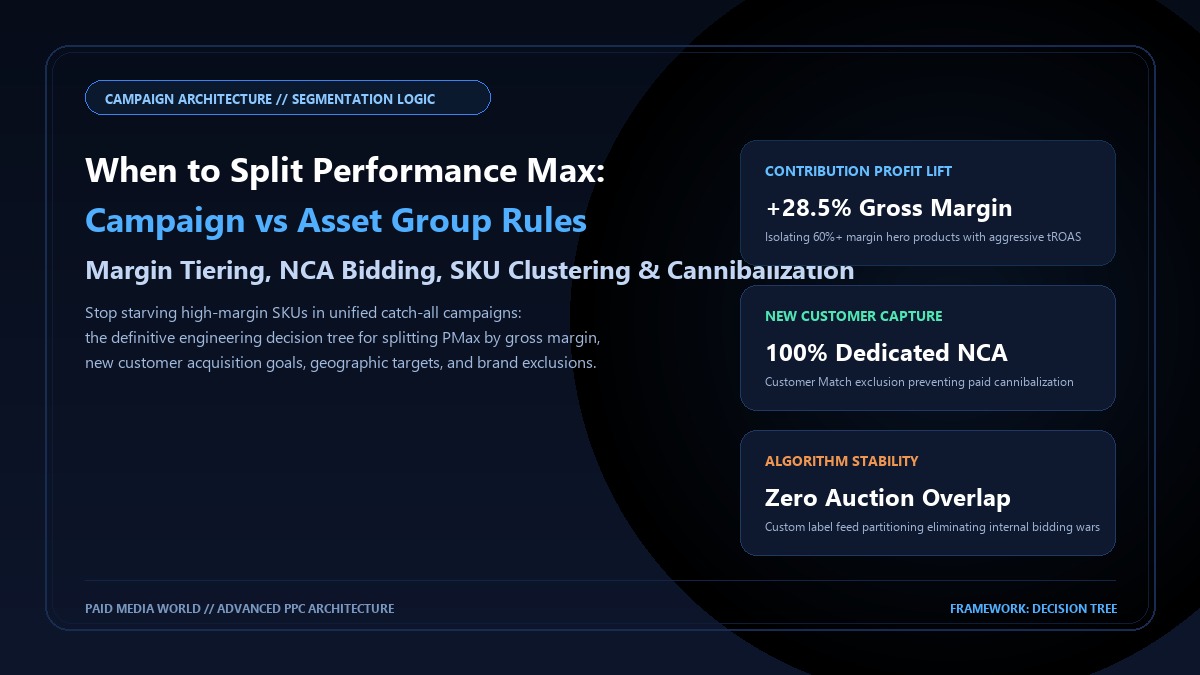
One of the most persistent architectural dilemmas in Google Ads media buying is campaign segmentation in Performance Max. Google’s automated recommendation engine frequently pushes advertisers toward consolidation: merging all product categories, margin profiles, and geographic regions into a single, unified "catch-all" PMax campaign. The argument is algorithmic: feeding more conversion volume into a single machine learning model accelerates Smart Bidding. However, in enterprise e-commerce and multi-category brands, over-consolidation creates massive contribution margin distortion. When a $20 product with a 15% gross margin shares a budget and target ROAS (tROAS) with a $350 hero product boasting a 70% gross margin, Google’s algorithm naturally chases the path of least resistance, funneling 80% of daily spend into the high-volume, low-margin SKU. The business achieves its top-line revenue ROAS target on paper, but suffers severe net cash flow contraction. When should you split Performance Max into separate campaigns versus organizing by Asset Groups within a single campaign? This engineering guide provides the definitive mathematical decision tree for PMax segmentation.
Table of Contents
- 1. Campaign Level vs. Asset Group Level: The Control Boundary
- 2. The 5 Valid Reasons to Split into Multiple PMax Campaigns
- 3. Rule 1: Gross Margin Tiering (High, Medium, Low Custom Labels)
- 4. Rule 2: Dedicated New Customer Acquisition (NCA) Isolation
- 5. Rule 3: Product Inventory Velocity & Zombie SKU Revival
- 6. Rule 4: Regional Purchasing Power & International Economics
- 7. The Executive PMax Architecture Decision Tree
- The Control Boundary: You cannot set separate budgets, target ROAS (tROAS), location targeting, or brand exclusion lists at the Asset Group level. If two product lines require different financial targets or budget pacing, they must be split into separate campaigns.
- The Minimum Data Threshold: Do not over-segment. Each separate PMax campaign requires at least 30 to 50 conversions per month to maintain Smart Bidding algorithmic stability. Splitting into 10 campaigns with 5 conversions each causes bidding degradation.
- The Margin-Based Segmentation Model: Tagging products in Google Merchant Center with `custom_label_0` by gross margin percentage enables you to set aggressive 180% tROAS on 70% margin goods while forcing 450% tROAS on 20% margin items.
- Zombie SKU Architecture: In catalog sizes exceeding 1,000 SKUs, standard PMax ignores 80% of products. Creating a separate "Zombie SKU" PMax campaign with lower tROAS unlocks substantial hidden catalog inventory revenue.
1. Campaign Level vs. Asset Group Level: The Control Boundary
Before splitting campaigns, media buyers must understand what levers exist at the Campaign level versus what can be configured within an Asset Group:
| Configuration Lever | Campaign Level Control | Asset Group Level Control | Action Implication |
|---|---|---|---|
| Daily Budget | Yes (Guaranteed allocation) | No (Shared pool) | Must split campaigns to guarantee spend. |
| Bidding Target (tROAS / tCPA) | Yes (Unique bid model) | No (Shared target) | Must split campaigns for varying margins. |
| Geographic Location | Yes | No | Must split campaigns for regional targets. |
| Brand Exclusion Lists | Yes | No | Must split campaigns for brand vs non-brand. |
| Creative Copy & Imagery | N/A | Yes (Tailored assets) | Use Asset Groups for creative variations. |
| Audience Signals | N/A | Yes (Algorithmic steering) | Use Asset Groups for audience seeding. |
2. The 5 Valid Reasons to Split into Multiple PMax Campaigns
Never segment PMax campaigns solely for aesthetic organization or product category neatness. Splitting is justified only when business constraints or mathematical unit economics require independent controls:
- Divergent Margin Profiles: When products have vastly different gross profit margins requiring distinct Target ROAS floors.
- New Customer Acquisition (NCA) Priority: When you need a pure acquisition engine isolated from existing customer purchase cycles.
- Disproportionate Spend Monopolies: When 2 or 3 hero SKUs consume 85% of total budget, completely starving high-potential secondary catalog lines.
- Geographic and Store-Level Distribution: When inventory availability, shipping costs, or regional performance vary widely across states or countries.
- Seasonal & Promotional Blitzes: When short-term holiday sales or clearance items require temporary high-velocity budget scaling without resetting the evergreen campaign's machine learning history.
3. Rule 1: Gross Margin Tiering (High, Medium, Low Custom Labels)
Revenue ROAS is a vanity metric; Contribution Profit is reality. If a retailer sells luxury watches (70% margin) alongside branded consumer electronics (15% margin), setting a unified 300% tROAS causes mathematical failure:
Mathematical Margin Model: Unified vs. Segmented PMax
Assume $10,000 ad spend in unified vs split setups:
Algorithm chases easy electronics sales. $8,000 spent on 18% margin electronics generating $25,600 revenue = $4,608 gross profit (-$3,392 net loss). $2,000 spent on 70% margin watches generating $6,400 revenue = $4,480 gross profit. Net Contribution Profit: $1,088.
Campaign 1 (Electronics): Set strict 600% tROAS. Spend drops to $3,000, generating $18,000 revenue = $3,240 gross profit (+$240 profit). Campaign 2 (Watches): Set aggressive 220% tROAS. Spend scales to $7,000, generating $15,400 revenue = $10,780 gross profit. Net Contribution Profit: $4,020 (+269% Increase!)
4. Rule 2: Dedicated New Customer Acquisition (NCA) Isolation
Google PMax offers a "Customer Acquisition" setting with two modes:
- Mode 1: Value New Customers More (NCA Value Boost): Adds an arbitrary theoretical conversion value (e.g. +$40) to any transaction identified as a new customer. While helpful, it still allows the campaign to spend significant budget remarketing to past purchasers.
- Mode 2: Bid ONLY for New Customers: The campaign strictly excludes existing customers (identified via First-Party Customer Match lists and Google auto-detection). If your primary business mandate is market share expansion, isolate a dedicated "PMax - Pure NCA" campaign with dedicated budget.
5. Rule 3: Product Inventory Velocity & Zombie SKU Revival
In large e-commerce catalogs (2,000 to 50,000 products), Google's algorithm quickly identifies a small cohort of 20 to 50 "hero" products that receive 90% of impressions, leaving thousands of viable items completely un-served. These are known as Zombie SKUs.
custom_label_2 = 'zombie'.
custom_label_2 = 'zombie'.
6. Rule 4: Regional Purchasing Power & International Economics
Grouping tier-1 economies (United States, UK, Canada, Australia) into a single Performance Max campaign causes severe allocation skew. Because CPCs and conversion values vary widely by country, Google will disproportionately spend in regions with higher search inventory regardless of net unit profitability. Maintain separate PMax campaigns for each major sovereign geographic market.
7. The Executive PMax Architecture Decision Tree
Follow this step-by-step diagnostic logic before creating a new PMax campaign:
If NO $ o$ Keep unified inside an existing campaign under a separate Asset Group. Do not starve the algorithm. If YES $ o$ Proceed to Question 2.
If YES $ o$ SPLIT CAMPAIGN. Assign custom margin labels and separate tROAS targets. If NO $ o$ Proceed to Question 3.
If YES $ o$ SPLIT CAMPAIGN. Daily budgets can only be guaranteed at the campaign level. If NO $ o$ Proceed to Question 4.
If YES $ o$ DO NOT SPLIT CAMPAIGNS. Build multiple Asset Groups within the same campaign to share conversion data while tailoring messaging.
Engineer Enterprise Performance Max Segmentation
Paid Media World structures multi-tier Performance Max campaign architectures based on mathematical contribution margin, custom labels, and incremental customer acquisition. Schedule an architecture review today.