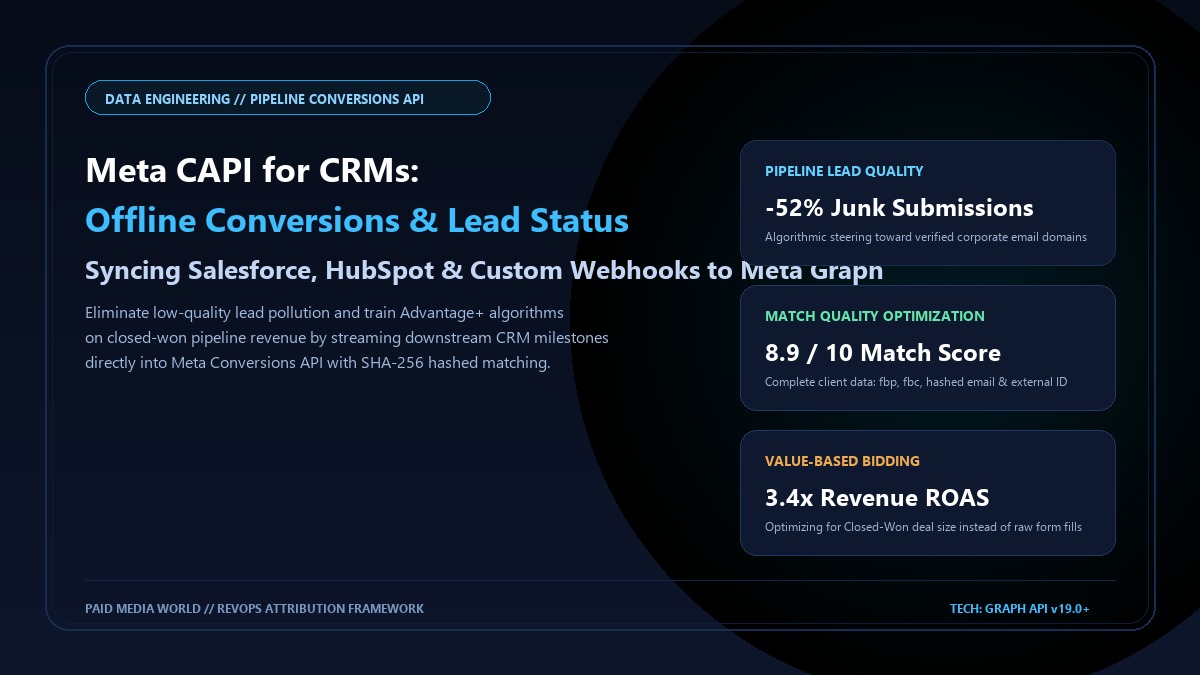
For enterprise B2B software companies, medical clinics, and high-ticket service providers, running lead generation campaigns on Meta Ads (Facebook and Instagram) frequently descends into operational chaos. The core problem is not the inability of Meta’s algorithms to generate leads—it is the algorithm’s hyper-efficient ability to optimize for the cheapest, lowest-quality form submissions imaginable. When an ad account is configured to optimize for standard on-page form submissions or Meta Instant Forms (Lead Ads), Meta’s machine learning engine ruthlessly identifies users who habitually fill out forms without commercial intent: bot traffic, job seekers, students, and tire-kickers with disconnected telephone numbers. The marketing team celebrates a $15 Cost Per Lead (CPL), while the sales development team spends 40 hours a week dialing non-existent prospects. Meta Conversions API (CAPI) for CRMs solves this structural breakdown. By establishing an automated server-side data pipeline from your CRM (Salesforce, HubSpot, Zoho, or GoHighLevel) back to Meta’s Graph API, you feed verified downstream pipeline milestones—such as Sales Qualified Lead (SQL), Demo Completed, and Closed-Won Deal—back into the ad auction. This comprehensive technical guide provides the exact architecture, data hashing requirements, and webhook implementations necessary to optimize Meta Ads on actual revenue.
Meta CAPI for CRMs: Passing Offline Conversio: Table of Contents
- 1. The Form-Fill Trap: Why Optimizing for Cheap Leads Destroys Pipeline
- 2. Designing the Downstream Lifecycle Event Taxonomy
- 3. SHA-256 Hashing & Customer Information Parameter Standards
- 4. Architectural Pipeline: Webhook to Middleware to Meta Graph API
- 5. Production Code: Node.js & Python Graph API Server Payload
- 6. Configuring Value-Based Optimization (VBO) in Ads Manager
- 7. Monitoring Event Match Quality & Troubleshooting Graph API Errors
- Algorithmic Alignment: Meta’s delivery algorithm does exactly what you instruct it to do. If you optimize for the `Lead` event, it finds users who submit forms. If you optimize for `Closed_Won_Deal` via CAPI, it steers impression delivery toward enterprise decision-makers who sign contracts.
- Signal Preservation (fbp & fbc): Capturing the browser’s `_fbp` (browser cookie) and `_fbc` (click identifier from `fbclid`) on the initial form fill and storing them inside custom CRM fields is mandatory. Passing these parameters back in server payloads elevates Event Match Quality (EMQ) from 4.5 to 8.8+.
- The 7-Day Attribution Window: While sales cycles may extend 60 to 90 days, feeding intermediate qualification milestones (e.g. `MQL_Accepted` within 48 hours or `Discovery_Call_Completed` within 7 days) provides the algorithm with rapid feedback loops before attribution windows expire.
- Value-Based Bidding (VBO): Passing numerical deal values (`currency: 'USD', value: 8500.00`) activates Value-Based Bidding in Advantage+ campaigns, training Meta to maximize contract revenue rather than raw lead quantity.
1. The Form-Fill Trap: Why Optimizing for Cheap Leads Destroys Pipeline
In standard lead generation setups, the tracking loop ends the second a prospect clicks "Submit" on a landing page form. The browser pixel fires `fbq('track', 'Lead')`, and Meta logs a successful conversion. However, this creates a toxic incentive structure:
| Attribute | Client-Side Lead Tracking Only | Full-Funnel CRM Conversions API (CAPI) |
|---|---|---|
| Optimization Signal | Raw Form Submissions (Includes bots & spam) | Verified Sales Qualified Leads (SQL) & Deals |
| Lead-to-Opportunity Rate | 4% – 8% | 22% – 38% |
| SDR Time Wastage | 60%+ spent disqualifying bad data | < 15% spent on unqualified contacts |
| Algorithm Bidding Strategy | Lowest Cost per Form Submission | Value-Based Bidding on Contract Pipeline Value |
2. Designing the Downstream Lifecycle Event Taxonomy
To stream offline conversions effectively without confusing the algorithm, establish a clear hierarchy of standard and custom events that correspond to CRM lifecycle stage transitions:
- Stage 1: Initial Form Submission (`Lead`): Fires via browser and server CAPI simultaneously upon initial form completion. Collects `_fbp`, `_fbc`, and client IP.
- Stage 2: Sales Qualified Lead (`Contact` or Custom `SQL_Accepted`): Triggers when an SDR reviews the firmographic fit (company size > 50, valid corporate domain) and moves the deal stage to "Accepted". Fired within 24–48 hours.
- Stage 3: Demo / Consultation Completed (`Schedule`): Triggers when the prospect attends a scheduled product demonstration or technical discovery call. Strongest mid-funnel conversion signal.
- Stage 4: Proposal Issued (`SubmitApplication`): Triggers when an official quote or Master Services Agreement (MSA) is generated and sent to procurement.
- Stage 5: Closed-Won Customer (`Purchase`): Triggers when the contract is signed and payment is processed. Transmits the actual contract value (e.g. $12,500.00 USD).
3. SHA-256 Hashing & Customer Information Parameter Standards
Meta Conversions API requires all personally identifiable information (PII) to be normalized and hashed using the SHA-256 algorithm before transmission. Meta rejects unhashed text or malformed data. Follow these strict formatting rules:
- Email (`em`): Trim leading/trailing whitespace, convert all characters to lowercase, then SHA-256 hash. Example: `[email protected]` $ o$ `654f...`
- Phone (`ph`): Strip all spaces, dashes, parentheses, and leading zeros. Must include international country code (E.164 format). Example: `+14155552671` $ o$ `e3b0...`
- Click ID (`fbc`): Do NOT hash. Must pass raw string format: `fb.1.1711234567.AbCdEf123456`
- Browser ID (`fbp`): Do NOT hash. Must pass raw string format: `fb.1.1711234567.987654321`
- External ID (`external_id`): Pass the CRM Contact ID or Account ID (hashed or unhashed) to maintain persistent deterministic matching across multi-touch lifecycles.
4. Architectural Pipeline: Webhook to Middleware to Meta Graph API
The enterprise integration flow operates as an asynchronous, event-driven architecture:
- Data Capture: When a user submits an inbound form, hidden input fields capture `_fbc` (from URL parameter `fbclid` or cookie) and `_fbp` (from cookie). These values are written to custom contact properties in HubSpot or Salesforce (`meta_fbc`, `meta_fbp`).
- CRM Automation: When an account executive updates the deal stage to "Closed Won", an automated CRM workflow fires an outbound webhook containing the contact properties and deal amount.
- Middleware Processing: A lightweight cloud serverless function (AWS Lambda, Google Cloud Run, or Make/Zapier) ingests the webhook, validates parameters, applies SHA-256 hashing to email/phone, and constructs the Meta Graph API payload.
- Graph API Transmission: The middleware sends an authenticated HTTPS POST request to Meta’s endpoint: `https://graph.facebook.com/v19.0/{PIXEL_ID}/events?access_token={ACCESS_TOKEN}`.
5. Production Code: Node.js & Python Graph API Server Payload
Below is a production-ready Node.js middleware script illustrating how to process an inbound CRM webhook and stream a `Purchase` (Closed-Won Deal) event into Meta Conversions API with full data validation and hashing:
const crypto = require('crypto');
const axios = require('axios');

function sha256(value) {
  if (!value) return null;
  return crypto.createHash('sha256').update(value.trim().toLowerCase()).digest('hex');
}

async function sendCrmOfflineConversionToMeta(dealData) {
  const PIXEL_ID = process.env.META_PIXEL_ID;
  const ACCESS_TOKEN = process.env.META_CAPI_ACCESS_TOKEN;
  const GRAPH_URL = `https://graph.facebook.com/v19.0/${PIXEL_ID}/events`;

  const payload = {
    data: [
      {
        event_name: 'Purchase',
        event_time: Math.floor(new Date(dealData.closed_at || Date.now()).getTime() / 1000),
        event_id: `crm_deal_${dealData.deal_id}`, // Unique ID for deduplication
        action_source: 'system_generated',
        user_data: {
          em: [sha256(dealData.email)],
          ph: [sha256(dealData.phone)],
          fn: [sha256(dealData.first_name)],
          ln: [sha256(dealData.last_name)],
          external_id: [sha256(dealData.crm_contact_id)],
          fbp: dealData.fbp || undefined,
          fbc: dealData.fbc || undefined,
          client_ip_address: dealData.ip_address || undefined,
          client_user_agent: dealData.user_agent || undefined
        },
        custom_data: {
          currency: 'USD',
          value: parseFloat(dealData.amount || 0.00),
          content_type: 'product',
          content_name: dealData.pipeline_name || 'Enterprise SaaS Contract',
          order_id: `deal_${dealData.deal_id}`
        }
      }
    ],
    // Optional: test_event_code: 'TEST12345'
  };

  try {
    const response = await axios.post(GRAPH_URL, payload, {
      params: { access_token: ACCESS_TOKEN },
      headers: { 'Content-Type': 'application/json' }
    });
    console.log('Successfully pushed CRM conversion to Meta CAPI:', response.data);
    return response.data;
  } catch (error) {
    console.error('Meta CAPI Error:', error.response ? error.response.data : error.message);
    throw error;
  }
}
6. Configuring Value-Based Optimization (VBO) in Ads Manager
Once downstream offline events begin streaming consistently into Events Manager, transition campaign bidding away from volume optimization:
- Verify Event Status: In Meta Events Manager, confirm that the `Purchase` or custom `Deal_Won` event shows green status with incoming server activity.
- Assign Value Rules: In Events Manager > Aggregated Event Measurement, configure value sets. Ensure your pixel is certified for Value Optimization (requires at least 30 value-bearing conversions over a 7-day rolling window).
- Launch Advantage+ Campaign: In Ads Manager, set Campaign Objective to Sales (or Leads with Value), and select Maximize Value of Conversions. Meta’s AI will actively steer impression budget away from small accounts and toward enterprise prospects with high contract potential.
7. Monitoring Event Match Quality & Troubleshooting Graph API Errors
Maintain your data pipeline by monitoring these critical health metrics:
- Event Match Quality (EMQ) Target $\ge 8.0$: Check Events Manager weekly. If EMQ dips below 7.0, audit your CRM forms to ensure `fbc`, `fbp`, and phone country codes are being captured reliably.
- Event Time Lag (≤ 7 Days): Meta only attributes events occurring within 7 days of the ad click. For deals closing on Day 45, ensure you are also sending intermediate milestone events (`MQL`, `Discovery_Call`) to feed shorter optimization feedback loops.
- Graph API Error Codes: Handle Code 100 (Invalid Parameter - check SHA-256 formatting), Code 190 (Expired Access Token - use permanent System User Access Tokens), and Code 200 (Permission Denied).
Engineer Full-Funnel CRM Conversions API for Your Team
Paid Media World deploys enterprise-grade server-side tracking pipelines connecting HubSpot, Salesforce, and custom CRMs directly to Meta CAPI. Eliminate junk lead waste and train algorithms on closed-won revenue.