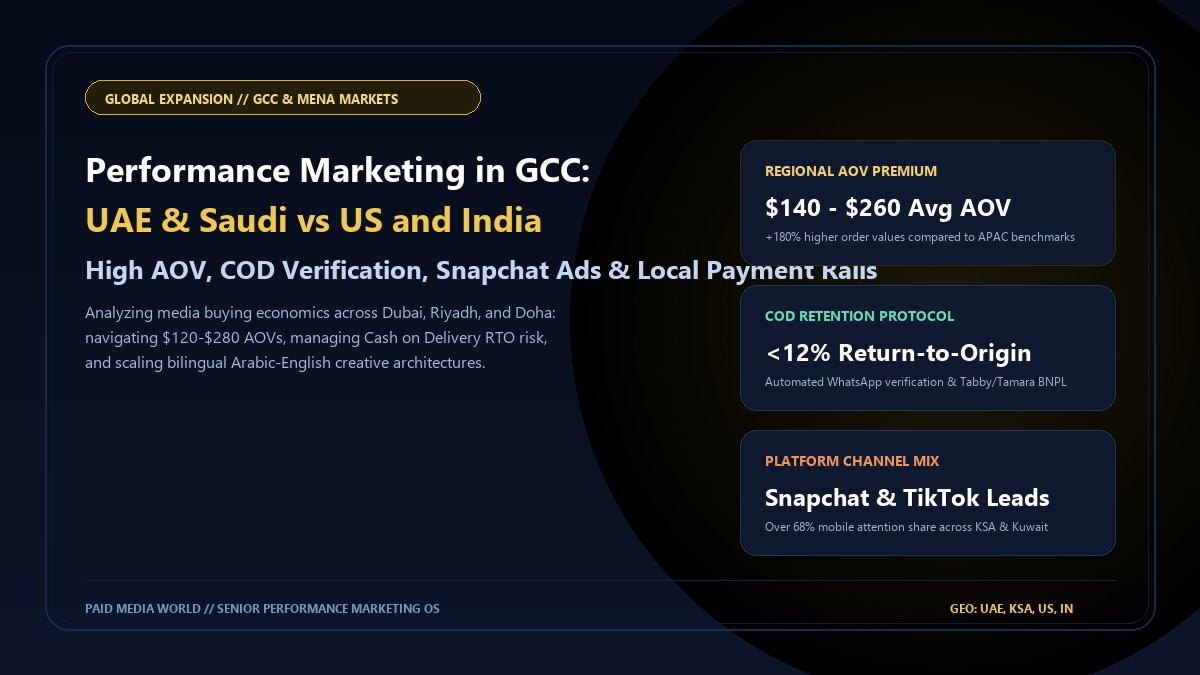
Expanding digital advertising operations across international borders is often treated as a simple exercise in currency conversion and ad copy translation. In reality, cross-border performance marketing reveals massive divergence in consumer purchasing behavior, payment rail adoption, logistics frictions, and platform attention share. Nowhere is this contrast sharper than when comparing the Gulf Cooperation Council (GCC)—primarily the United Arab Emirates (UAE) and the Kingdom of Saudi Arabia (KSA)—against mature Western ecosystems (the United States) and high-volume, price-sensitive developing markets (India). With gross domestic product per capita exceeding $52,000 in the UAE and $32,000 in Saudi Arabia, the GCC boasts extraordinary purchasing power and average order values (AOVs) ranging from $120 to $280. However, media buyers who deploy standard US or Indian performance playbooks into Dubai or Riyadh routinely burn through hundreds of thousands of dollars due to catastrophic Cash on Delivery (COD) Return-to-Origin (RTO) rates, misunderstood social platform dynamics, and rigid cultural nuances. This guide breaks down the comparative unit economics, payment architectures, channel preferences, and creative strategies required to win in the GCC.
Performance Marketing in GCC (UAE, Saudi) vs: Table of Contents
- 1. Macro Unit Economics: GCC vs. United States vs. India
- 2. The COD Crisis: Managing 25–40% RTO Risk via Automated Verification
- 3. Local Payment Rails: Mada, Tabby, Tamara & Apple Pay Dominance
- 4. Social Channel Dominance: Snapchat & TikTok vs. Meta & Google
- 5. Creative Architecture: Gulf Arabic (Khaleeji), RTL UX & Cultural Nuance
- 6. Seasonality & Ramadan: Managing 3x–5x Budget Surges
- 7. Regulatory Compliance: UAE VAT, Saudi ZATCA & Ad Licensing
- AOV & Purchasing Power: GCC e-commerce transactions average $140–$260, representing a 1.8x premium over the United States ($75–$130) and a 6x–8x premium over India ($18–$40). This allows advertisers to absorb higher Cost Per Clicks (CPCs) while maintaining exceptional gross margins.
- The Cash on Delivery (COD) Trap: In Saudi Arabia and secondary GCC markets, COD still represents 35%–55% of physical goods orders. Without automated multi-step WhatsApp or SMS confirmation protocols, unfulfilled RTO rates routinely exceed 30%, destroying operational profitability.
- Platform Divergence: Unlike the US where Meta and Google dominate, or India where Meta and YouTube lead, Saudi Arabia and Kuwait are driven by Snapchat and TikTok. Snapchat reaches over 90% of the 13–34 demographic in KSA with staggering daily engagement.
- Payment Gateway Mandatory Setup: Offering standard credit card checkout alone causes up to 60% cart abandonment. Brands must integrate Apple Pay (representing 65%+ of mobile transactions in the UAE), Mada (the national debit network in KSA), and Tamara/Tabby (BNPL).
1. Macro Unit Economics: GCC vs. United States vs. India
Evaluating media buying efficiency requires analyzing the mathematical relationship between CPM, CPC, On-Site Conversion Rate (CVR), Average Order Value (AOV), and Net Realized Revenue. Below is an audited comparative benchmark across key DTC verticals:
| Performance Metric | GCC (UAE & KSA) | United States (US) | India (IN) |
|---|---|---|---|
| Average Order Value (AOV) | $140 – $260 | $75 – $135 | $18 – $45 |
| Average CPM (Meta / TikTok) | $12.00 – $24.00 | $28.00 – $55.00 | $1.50 – $4.00 |
| Average CPC (Search Non-Brand) | $1.10 – $2.80 | $2.80 – $6.50 | $0.15 – $0.65 |
| E-commerce CVR (eComm / DTC) | 1.2% – 2.1% | 1.8% – 3.2% | 2.2% – 4.5% |
| Target Blended ROAS | 3.5x – 5.2x | 2.4x – 3.5x | 3.0x – 4.8x |
| Primary Payment Method | Apple Pay / Mada / COD | Credit Card / Shop Pay / PayPal | UPI (Google Pay, PhonePe) / COD |
| Return-to-Origin (RTO) Risk | 18% – 35% (High on COD) | < 3% (Standard returns) | 20% – 35% (High on COD) |
The fundamental advantage of the GCC market lies in basket size leverage. Because customer acquisition costs (CAC) in Dubai and Riyadh are comparable to tier-2 US metros, but the consumer basket size is nearly double, brands with strong unit economics can unlock substantial contribution margin even at lower on-site conversion rates.
2. The COD Crisis: Managing 25–40% RTO Risk via Automated Verification
In the United States, Cash on Delivery is virtually non-existent; nearly 99% of transactions are prepaid. In India, UPI has rapidly eroded COD, reducing it to under 35% for tier-1 brands. However, in the GCC—particularly Saudi Arabia, Oman, and Kuwait—many consumers still prefer paying when the courier arrives at their doorstep.
The danger of unmitigated COD is Return-to-Origin (RTO). When an impulse buyer orders a luxury watch or skincare kit on Instagram without entering credit card details, their psychological commitment is low. By the time the courier attempts delivery 3 to 5 days later, the customer frequently ignores phone calls, rejects delivery, or changes their mind. The merchant loses two-way courier shipping fees, packaging costs, and inventory lock-up.
The Automated WhatsApp Verification & Prepaid Upsell Protocol
Top-performing GCC merchants employ a multi-layered verification automation that compresses COD RTO from 32% down to 9.4%:
Within 60 seconds of checkout, an automated WhatsApp Business API webhook triggers in Arabic/English with two interactive buttons: [Confirm Order] or [Cancel Order].
The message offers an immediate 7%–10% instant discount if the buyer converts to Apple Pay or Mada online: "Pay now via Apple Pay and save 35 SAR + get priority courier dispatch."
Orders unconfirmed after 4 hours receive an automated outbound IVR call. If unconfirmed after 24 hours, the order is cancelled automatically, preventing wasted shipping dispatch.
3. Local Payment Rails: Mada, Tabby, Tamara & Apple Pay Dominance
Running a media campaign in the GCC without integrating regional payment rails is the single fastest way to destroy paid traffic ROI. In Western markets, Stripe, Visa, and Mastercard suffice. In the Gulf, checkout requires three specialized rails:
- Apple Pay (65%+ Share in UAE/KSA): GCC consumers exhibit the highest per-capita iPhone penetration in the world. Requiring a mobile user to type a 16-digit credit card number into a mobile form results in catastrophic drop-off. One-touch Apple Pay integration increases checkout completion rates by over 42%.
- Mada (Saudi National Payment Network): In Saudi Arabia, over 80% of domestic debit cards are issued under the Mada payment network. If your payment gateway (e.g., Checkout.com, Telr, HyperPay, Tap) does not support native Mada routing with zero friction, the majority of Saudi domestic debit cards will decline.
- Buy Now, Pay Later (Tamara & Tabby): BNPL adoption in KSA and UAE is explosive. For ticket sizes between $150 and $600, displaying the Tamara or Tabby widget (split into 4 interest-free installments) elevates on-site conversion rates by 28% and lifts AOV by up to 34%. Furthermore, the BNPL provider assumes 100% of the customer credit default risk.
4. Social Channel Dominance: Snapchat & TikTok vs. Meta & Google
Media planners conditioned on US or UK budgets typically allocate 60% to Meta Ads and 30% to Google Search. In the GCC, this media mix severely underperforms due to distinct cultural attention habits:
Snapchat Ads: The Uncontested King of KSA & Kuwait
Saudi Arabia is one of Snapchat's top global markets. Over 22 million daily active users open Snapchat more than 30 times a day. While Snapchat in the US is often viewed as a teen communication app, in the Gulf it is an executive, family, and e-commerce shopping engine. AR Try-On Lenses, Story Ads, and Spotlight video campaigns routinely deliver 4.5x–7.0x ROAS when paired with local Arabic voiceovers.
TikTok Ads: Viral Commerce & Creator Culture
TikTok penetration in the UAE and Saudi Arabia is near 100% of adult social users. Native GCC creator content—informal, comedic, high-energy product demonstrations in colloquial Khaleeji Arabic—consistently produces CPMs between $6 and $14, outperforming standard Meta Feed video ads by over 60% on raw traffic velocity.
Meta Ads (Instagram Reels): Luxury & Fashion Pillar
Facebook usage among GCC nationals is minimal (largely utilized by expatriate blue-collar communities). However, Instagram remains the premier platform for luxury goods, premium fashion, aesthetics clinics, fine dining, and real estate. Instagram Direct Message (DM) and WhatsApp click-to-chat ads generate elite lead flow for high-ticket services.
Google Ads: Search & Performance Max for Intent Capture
Google Ads in the GCC captures high-intent commercial volume, but requires strict bilingual campaign structuring. English search terms dominate Dubai expat traffic (representing 85% of UAE residents), whereas Arabic search terms dominate Riyadh, Jeddah, and Kuwait City. Blending both languages into single ad groups degrades Quality Scores and wastes budget.
5. Creative Architecture: Gulf Arabic (Khaleeji), RTL UX & Cultural Nuance
One of the most frequent mistakes made by international agencies is employing Modern Standard Arabic (Fus-ha) or Levantine/Egyptian dialect voiceovers for campaigns targeted exclusively at Saudi nationals. While understandable, Fus-ha sounds formal, stiff, and robotic, resembling a government legal announcement rather than an authentic peer recommendation.
- Dialect Accuracy (Khaleeji vs. MSA): For Saudi Arabia, Kuwait, and the Emirates, hire local Gulf creators who speak natural Khaleeji dialect. Reserve Modern Standard Arabic for written technical product descriptions, medical disclosures, and terms of service.
- Right-to-Left (RTL) Layout Engineering: Simply translating text into Arabic on a Left-to-Right (LTR) Shopify or Next.js layout creates broken typography, inverted buttons, and awkward reading flow. Implement CSS `direction: rtl;` with mirrored flexbox directions, localized Arabic fonts (e.g., Tajawal, IBM Plex Arabic, or Almarai), and appropriate padding.
- Visual Cultural Respect: Ad creative must align with local values. Avoid hyper-revealing attire, insensitive imagery, or inappropriate social situations, especially during holy periods. Modest, elegant, and aspirational luxury aesthetics resonate most effectively across both male and female demographics.
6. Seasonality & Ramadan: Managing 3x–5x Budget Surges
In Western markets, Q4 (Black Friday, Cyber Monday, Christmas) accounts for the vast majority of annual retail revenue. In the GCC, the retail calendar is anchored by Ramadan and Eid al-Fitr, alongside White Friday (the regional November shopping holiday) and Saudi National Day (September 23).
During the month of Ramadan, consumer behavior shifts drastically. Fasting hours alter daily routines, shifting peak mobile engagement and e-commerce shopping to late night and early morning hours (between 10:00 PM and 3:30 AM). Advertisers running automated dayparting schedules designed for 9-to-5 Western habits miss the highest-converting hours of the day. Budget pacing during the final two weeks of Ramadan often scales 300%–500% to capture pre-Eid gifting demand.
7. Regulatory Compliance: UAE VAT, Saudi ZATCA & Ad Licensing
Finally, advertisers must structure financial and legal operations in compliance with regional tax authorities:
- VAT Invoicing (5% UAE / 15% Saudi Arabia): In the UAE, digital advertising is subject to 5% VAT. In Saudi Arabia, the Zakat, Tax and Customs Authority (ZATCA) enforces a 15% VAT rate. Non-resident advertisers selling into the Kingdom must obtain a ZATCA VAT registration number to remain compliant and avoid customs impoundment of physical goods.
- Commercial Influencer Licensing (Mawthooq in KSA): Under Saudi law, creators and influencers who promote commercial products must hold a valid Mawthooq license issued by the General Authority for Media Regulation (GAMR). Contracting unlicensed influencers can result in hefty regulatory fines and immediate ad campaign removal.
Scale Your Brand Across UAE, Saudi Arabia & the Gulf
Paid Media World architects omnichannel performance marketing engines customized for GCC consumer psychology, high-AOV unit economics, local payment gateways, and WhatsApp COD verification. Book an international growth consultation today.