Navigating indirect taxation, value-added taxes (VAT), and withholding regulations on digital advertising spend is one of corporate accounting's most complex challenges. When a brand spends $10,000 to $500,000+ monthly on Google Ads, finance directors and media buyers are confronted with fundamental compliance questions: Is there VAT on Google Ads? Are Google Ads vatable? How do we account for reverse charge rules in Europe? Can enterprise businesses claim 100% Input Tax Credit (ITC) on Indian GST, and how do we deduct 2% TDS under Section 194C without account disruption? Misunderstanding these international tax frameworks leads to unexpected tax liabilities, unclaimable expenses, and costly cross-border audit penalties. This definitive global guide analyzes Google Ads tax compliance across the European Union, United Kingdom, United States, Australia, and India, detailing invoicing legalities, billing profile setups, reverse charge mechanics, and quarterly TDS withholding reconciliation.
- The Core Inquiry Answered: Yes, Google Ads is subject to indirect taxation globally, but the legal mechanism depends strictly on whether you register as a verified Business (B2B) or an Individual (B2C) consumer.
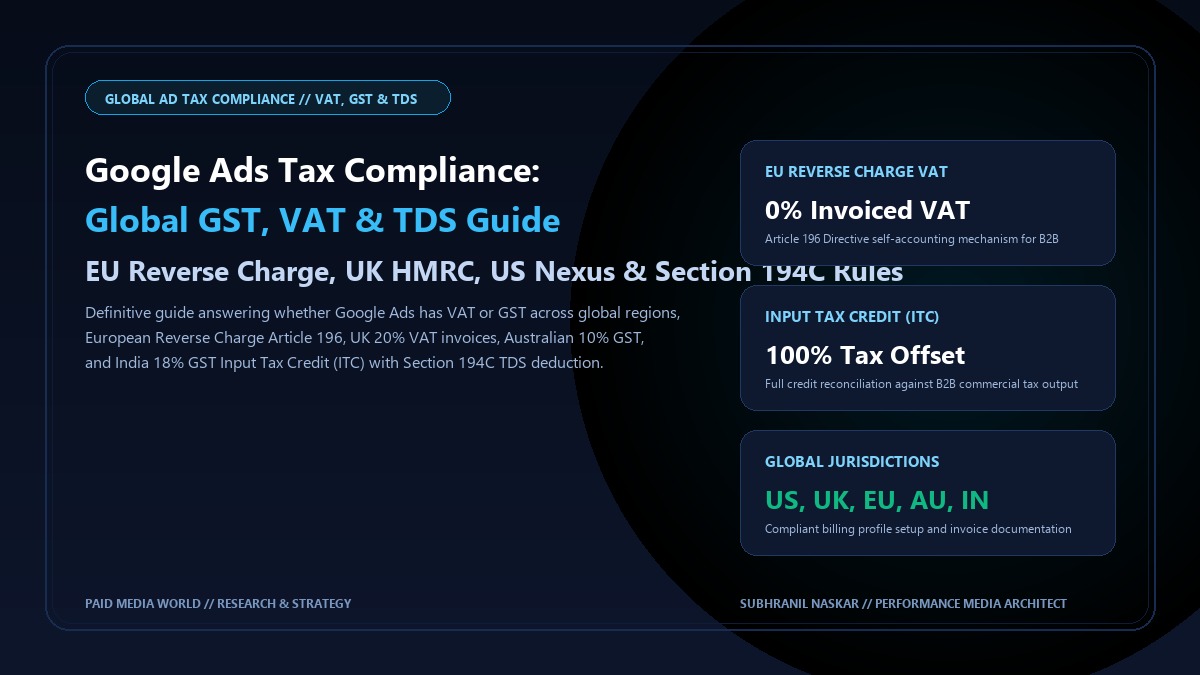
- European Union & UK (Reverse Charge VAT): For registered B2B entities in the EU, Google Ireland Ltd issues invoices with 0% VAT under Article 196 of the EU VAT Directive. The merchant self-accounts for VAT on local tax returns with zero cash outflow.
- United States (State Nexus Rules): Digital advertising services are generally exempt from federal sales tax, but several states (Maryland, New Mexico, Hawaii) impose gross receipts taxes or digital ad levies that require local compliance tracking.
- India (18% GST + 2% TDS 194C): Google India Pvt Ltd invoices 18% GST, which is 100% eligible for Input Tax Credit (ITC). Corporate advertisers must deduct 2% Tax Deducted at Source (TDS) under Section 194C, deposit it quarterly, and file Form 16A to reclaim ad credit balance.
Global Comparison Matrix: How Google Ads Taxes Vary by Jurisdiction
Tax obligations depend on your corporate registration jurisdiction and billing account configuration:
| Jurisdiction | Contracting Google Entity | Tax Rate & Invoicing Mechanism | Input Credit / Reclaim Rule |
|---|---|---|---|
| European Union (EU) | Google Ireland Ltd | 0% VAT (Reverse Charge Article 196) | Self-account in periodic VAT return (Zero cash drag) |
| United Kingdom (UK) | Google Ireland Ltd / UK Branch | 20% VAT (or Reverse Charge if B2B) | Reclaimable as input tax on quarterly HMRC VAT return |
| United States | Google LLC | 0% Federal (State Gross Receipts Vary) | Deductible as ordinary B2B business advertising expense |
| Australia | Google Asia Pacific Pte Ltd | 10% GST (Invoiced to Australian businesses) | Claimable as GST credit on Business Activity Statement (BAS) |
| India | Google India Pvt Ltd | 18% GST (CGST+SGST or IGST) + 2% TDS | 100% ITC offset; 2% TDS reimbursed via Form 16A submission |
European Union & UK: The Reverse Charge VAT Mechanism
If your business is located in France, Germany, Spain, Italy, or any EU member state, Google Ads contracts through Google Ireland Limited (Barrow Street, Dublin). Under the European Union cross-border B2B digital services framework:
- Validating Your VAT ID: When setting up your Google Ads billing profile, select Account Type: Organization and enter your country's registered VAT Number (e.g.,
FR12345678901orDE987654321). Google verifies this against the European Commission's VIES (VAT Information Exchange System) database. - Invoice Format: Once verified, Google issues monthly tax invoices stating "Reverse Charge: Customer to account for VAT under Article 196 of Council Directive 2006/112/EC" with a 0% tax line item.
- Accounting Entry: In your local general ledger, record the ad expense and apply both input and output VAT simultaneously at your local rate (e.g., 20% in France or 19% in Germany). The net cash tax payable to the government is exactly zero.
- The Consumer Penalty: If you fail to enter a verified VAT ID, Google classifies your account as an individual consumer and charges Irish VAT (23%) directly to your credit card, which cannot be recovered on B2B tax filings.
India Tax Compliance: 18% GST and 2% TDS Section 194C
For advertisers operating corporate entities in India, contracting with Google India Private Limited involves dual statutory requirements under the Central Goods and Services Tax (CGST) Act and the Income Tax Act:
The Indian Corporate Invoicing & TDS Flow
- 18% GST Invoicing & ITC: Google India charges 18% GST on all ad spend. By providing your verified 15-digit GSTIN (Goods and Services Tax Identification Number) in your billing settings, Google reports these invoices to the GST portal under Form GSTR-1. Your business claims 100% Input Tax Credit (ITC) via GSTR-2B / GSTR-3B, completely offsetting the GST against your output tax liabilities.
- Section 194C 2% TDS Withholding: Under Section 194C of the Income Tax Act (Contracts for Advertising), corporate entities are legally mandated to deduct 2% TDS on gross advertising payments exceeding ₹30,000 single or ₹100,000 aggregate annually.
- The Net Invoicing Protocol: For enterprise accounts with monthly invoicing credit lines, advertisers remit 98% of the net invoice amount to Google and deposit 2% to the Indian Income Tax Department under Challan ITNS 281 using Google India's TAN (
BLRG01353C). - Form 16A Reclaim Procedure: Following the end of each financial quarter, advertisers download Form 16A from the TRACES portal and upload it to the Google Ads TDS submission portal. Once verified, Google credits the 2% deducted balance directly back to your Google Ads account within 14 to 21 business days.
5 Costly Tax Traps and Audit Pitfalls to Avoid
- Trap 1: Individual vs. Organization Account Setup: Never configure a corporate advertising account under an "Individual" billing profile. Once created, Google Ads permanently locks the tax status, preventing you from adding corporate tax IDs or claiming business input credits.
- Trap 2: Legal Entity Name Mismatches: Ensure the legal name on your Google billing profile matches your official government tax certificate character-for-character. Discrepancies cause automated tax authority rejections during input credit audits.
- Trap 3: Cross-Border Card Settlement Markups: If a US company pays Google Ireland or an Australian entity pays Google Singapore via credit card, banks routinely add a 2.5% to 3.5% foreign transaction fee. Always configure local billing entities or ACH/wire transfers for budgets exceeding $20,000/mo.
- Trap 4: Missing Form 16A Submission Deadlines: In India, Google enforces strict annual cutoff windows for TDS certificate submission. Unclaimed TDS certificates older than one fiscal year are forfeited by Google's automated finance operations.
- Trap 5: Neglecting State Digital Ad Taxes in the US: US advertisers operating in states with gross receipts taxes on digital ads (such as Maryland) must verify whether pass-through advertising taxes are being assessed on invoices.
Ensure Complete Tax Compliance & Maximum Ad Spend Efficiency
Paid Media World architects deterministic paid acquisition systems that align technical media buying with rigorous corporate accounting, input tax credits, and financial governance. Request a performance consultation.