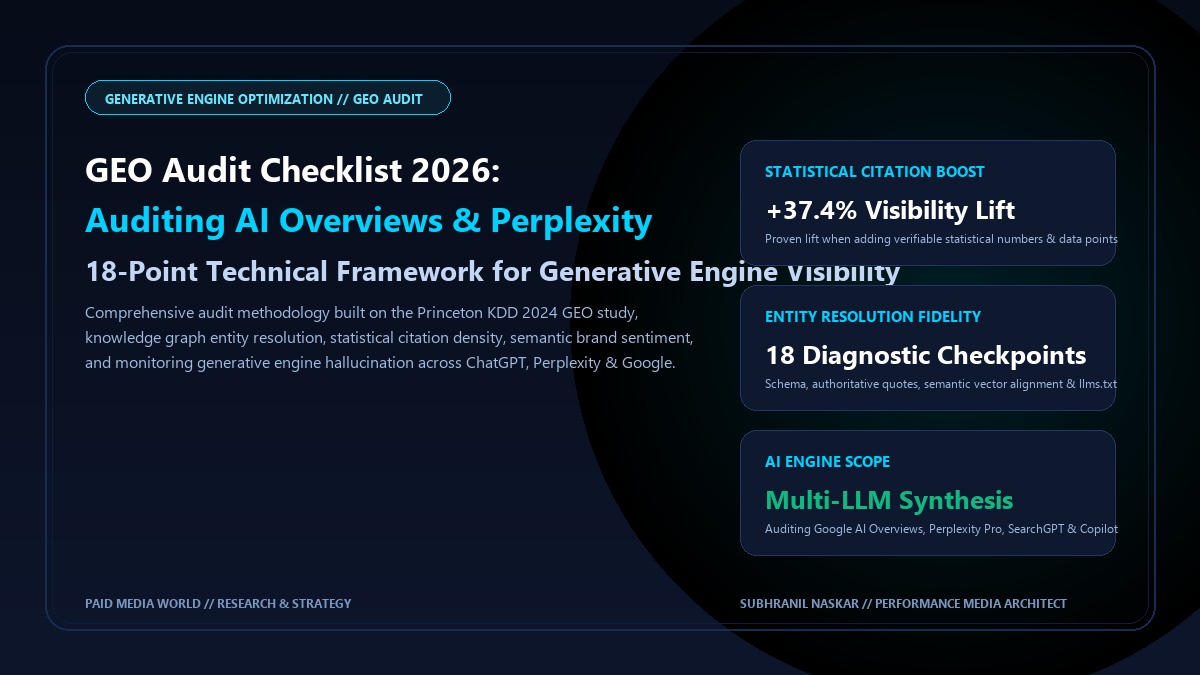
Search behavior is undergoing its most radical transformation since the invention of the PageRank algorithm. Today, enterprise buyers, consumers, and technical practitioners increasingly bypass traditional 10-blue-link search result pages in favor of generative AI summaries generated by Google AI Overviews, Perplexity Pro, SearchGPT / ChatGPT Search, and Microsoft Copilot. When a user asks an AI engine: "Which performance marketing platform delivers the highest verified ROAS for luxury fashion?", the response is not a link to your homepage; it is an AI-synthesized narrative answering the user's question directly, accompanied by 3 to 5 selective footnotes and source citations. If your brand is absent from these generative answers, you are invisible to the highest-intent cohort of searchers. Generative Engine Optimization (GEO) is the science of structuring web assets, statistical evidence, and entity relationships to maximize visibility, citation frequency, and positive brand sentiment within AI response engines. This guide provides an actionable 18-point technical audit checklist grounded in empirical research from the landmark Princeton/Georgia Tech KDD 2024 study.
- The Princeton KDD 2024 Findings: Rigorous academic benchmarking proved that traditional keyword stuffing fails in generative engines. Instead, Statistics Addition (+37.4% visibility lift), Authoritative Quotes (+28.1% lift), and Cite Sources (+26.8% lift) deliver massive, statistically significant improvements in AI citation rates.
- Entity Resolution Over Keyword Matching: Large Language Models (LLMs) operate on vector embeddings and knowledge graph nodes, not string frequency. Auditing your brand's presence requires evaluating entity salience across Wikidata, Google Knowledge Graph, and authoritative third-party corpora.
- The Synthetic Hallucination Risk: Without explicit, machine-readable facts and schema markup, generative engines routinely hallucinate competitor features, outdated pricing, or incorrect business terms for your brand.
- The Modern SEO Architecture: GEO does not replace technical SEO—it builds on it. A site requires fast crawlability, clean HTML, and schema, augmented with statistical density, llms.txt protocol, and verified entity relationships.
The Princeton KDD 2024 GEO Study: The 9 Optimization Strategies Quantified
In November 2023 and published at KDD 2024, researchers from Princeton University, Georgia Tech, the Allen Institute for AI, and IIT Delhi published the foundational academic study on Generative Engine Optimization ("GEO: Generative Engine Optimization"). The researchers benchmarked 10,000 synthetic queries across multiple generative models to measure which on-page content adjustments increased an asset's probability of being cited and summarized in AI responses.
The findings revealed that the techniques that worked for 2015 Google search do almost nothing for generative AI. Here are the quantified performance lifts discovered in the research:
| GEO Strategy (Princeton Study) | Mechanics & Implementation | Observed Visibility Lift | AI Engine Impact |
|---|---|---|---|
| 1. Statistics Addition | Enriching prose with verified numerical data, percentages & metrics | +37.4% Lift | Massive impact across Perplexity & SearchGPT |
| 2. Cite Sources | Adding formal academic, research, or primary industry citations | +26.8% Lift | Directly triggers LLM trustworthiness heuristics |
| 3. Quotation Addition | Integrating direct quotes from named domain experts with credentials | +28.1% Lift | Extracted as high-authority attribution blocks |
| 4. Understandability Optimization | Simplifying dense vocabulary; clear syntax and structured bulleting | +18.2% Lift | Improves semantic embedding cluster matching |
| 5. Authoritative Tone | Eliminating tentative passive voice; decisive, definitive declarative claims | +15.9% Lift | Weights higher in certainty confidence scores |
| 6. Keyword Stuffing / Frequency | Repeating the exact match keyword unnaturally across paragraphs | -10.4% Drop | Penalized by LLM perplexity and entropy filters |
The 18-Point Generative Engine Optimization (GEO) Technical Audit Checklist
Perform this comprehensive 18-point audit across your website to evaluate its readiness for generative search engines:
| # | Audit Checkpoint | Category | Technical Requirement | Priority |
|---|---|---|---|---|
| 01 | Entity Disambiguation Schema | Entity / Graph | Deploy JSON-LD Organization schema featuring sameAs pointing to verified Wikidata, Wikipedia, LinkedIn, Crunchbase profiles. |
P0 (Critical) |
| 02 | Direct Factual Declaration | Content Arch | Provide a definitive, single-sentence definition/answer within the first 60 words under every H2 heading. | P0 (Critical) |
| 03 | Statistical Density Ratio | Statistical | Ensure at least 3 verifiable metrics, percentages, dollar figures, or benchmarks per 500 words of editorial text. | P0 (Critical) |
| 04 | Author Credential Schema | E-E-A-T | Inject detailed Person schema with jobTitle, knowsAbout, and verified editorial profile links. |
P1 (High) |
| 05 | Clean Machine-Readable Markdown (llms.txt) | AI Crawl | Publish a valid /llms.txt at root providing clean markdown summaries and index links for AI crawlers. |
P1 (High) |
| 06 | Structured Comparison Tables | Content Arch | Convert competitive narratives into clean HTML tables with clear header rows; LLM scrapers prioritize table extracts. | P1 (High) |
| 07 | Robots.txt AI Bot Permissions | Technical | Verify that GPTBot, PerplexityBot, ClaudeBot, and Google-Extended are not inadvertently blocked. |
P0 (Critical) |
| 08 | Primary Source Citation Links | Authority | Hyperlink outbound claims to original research papers, peer-reviewed journals, SEC filings, or official documentation. | P1 (High) |
| 09 | Named Expert Quotes | E-E-A-T | Include blockquote citations from verified industry executives or researchers providing qualitative analysis. | P1 (High) |
| 10 | Question-and-Answer FAQ Schema | Schema | Implement FAQPage schema directly matching natural language questions queried in voice and generative chat. |
P2 (Medium) |
| 11 | Elimination of Fluff & Filler | Content Arch | Remove generic rhetorical intros ("In today's fast-paced digital world..."); LLM summary parsers discard high-entropy filler. | P1 (High) |
| 12 | Perplexity Search Verification | Testing | Run prompt audits in Perplexity Pro for core category keywords; inspect citation footnotes to confirm brand presence. | P0 (Critical) |
| 13 | Google AI Overviews Audit | Testing | Inspect Google desktop & mobile AI Overviews for your primary commercial head terms; document citation carousel URLs. | P0 (Critical) |
| 14 | SearchGPT / ChatGPT Search Audit | Testing | Test buyer persona queries in ChatGPT Search; evaluate whether brand is cited as a top recommendation. | P0 (Critical) |
| 15 | Mitigating AI Hallucination | Factual Rigor | Audit whether AI engines falsely state your pricing or features; publish explicit corrective comparison matrices to re-anchor truth. | P1 (High) |
| 16 | Wikipedia / Wikidata Presence | Knowledge Graph | Ensure your brand or founders possess an active, neutral, verifiable Wikidata entity entry with verified external sources. | P2 (Medium) |
| 17 | Zero-JavaScript Content Rendering | Technical | Ensure all critical text and data tables are present in the raw static HTML document before client-side hydration. | P0 (Critical) |
| 18 | Brand Sentiment Vector Tracking | Reputation | Monitor sentiment polarity in AI summaries; negative community consensus on Reddit or G2 directly biases AI summaries. | P1 (High) |
How to Conduct a Synthetic Prompt Audit for Your Brand
Auditing generative engines cannot be accomplished using traditional SERP position trackers alone. You must execute structured synthetic prompt evaluations. Test each of the following 4 prompt archetypes across ChatGPT Search, Perplexity Pro, and Google AI Overviews:
Audit Objective: Does the AI engine include your brand in the primary synthesized answer? Which third-party websites (Clutch, G2, Reddit, Forbes) are cited in the source cards?
Audit Objective: Does the model accurately state your technical capabilities, pricing models, and integrations? Are there hallucinations or outdated data points?
Audit Objective: Does the model cite your technical troubleshooting guide as an authoritative source for the resolution steps?
Position Your Enterprise for AI Overviews & Perplexity
Paid Media World engineers advanced Generative Engine Optimization alongside technical media buying. Book a dedicated GEO and technical audit to benchmark your brand across all major AI engines.