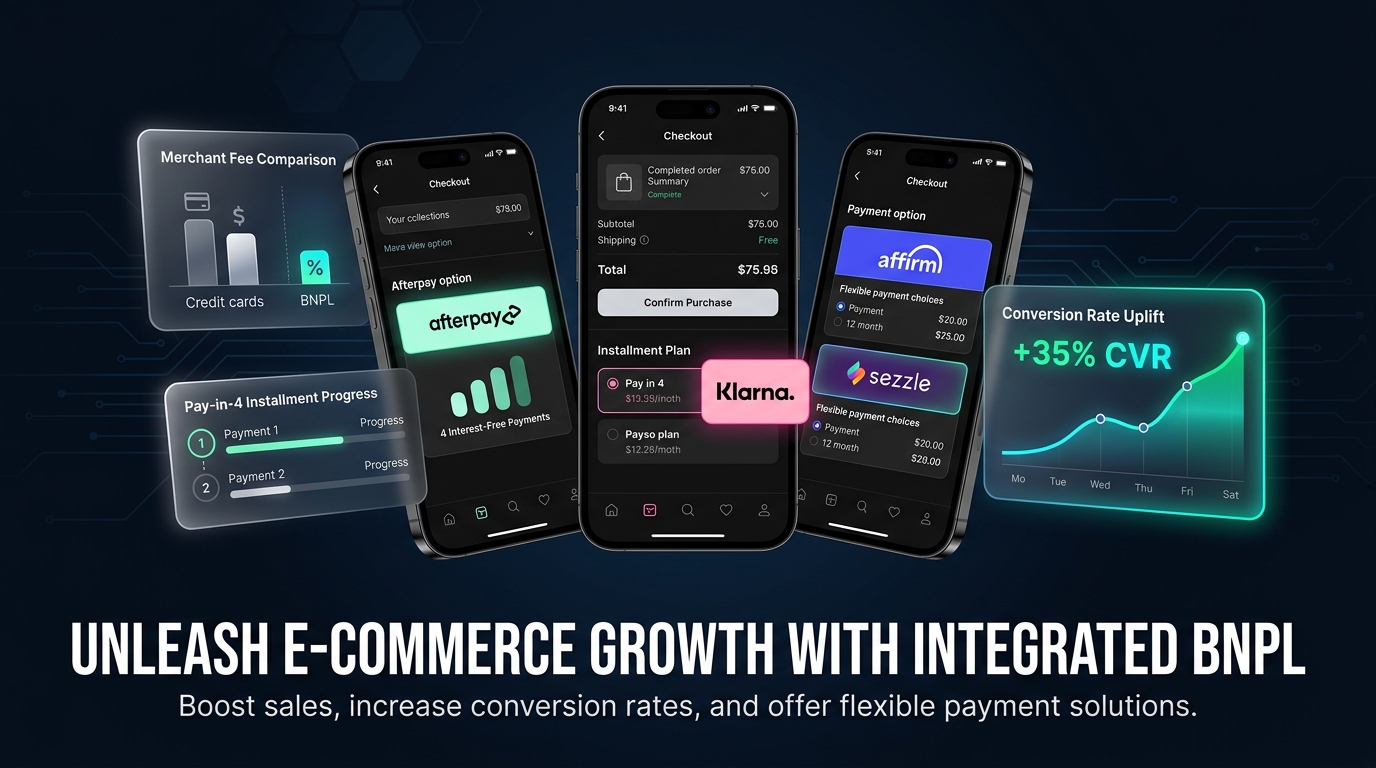
For direct-to-consumer (DTC) brands, omnichannel retailers, and B2B digital merchants, flexible checkout financing is no longer a luxury feature—it is an essential conversion engine. Over 42% of Millennial and Gen Z consumers in the United States and Europe actively abandon checkouts if a trusted Buy Now, Pay Later (BNPL) provider is absent. Yet, integrating a BNPL solution introduces complex financial unit economics: merchant fees range from 2.99% to nearly 6.0% plus fixed per-transaction fees, directly competing with your gross profit margins. Choosing between the three dominant enterprise providers—Klarna, Afterpay (Cash App/Block), and Affirm—requires balancing consumer brand recognition, credit underwriting architecture, Average Order Value (AOV) thresholds, and merchant discount rate (MDR) fee structures. This exhaustive commercial guide compares all three platforms across 8 critical dimensions, provides enterprise fee negotiation benchmarks, and models the exact conversion lift required to achieve profitable net ROI.
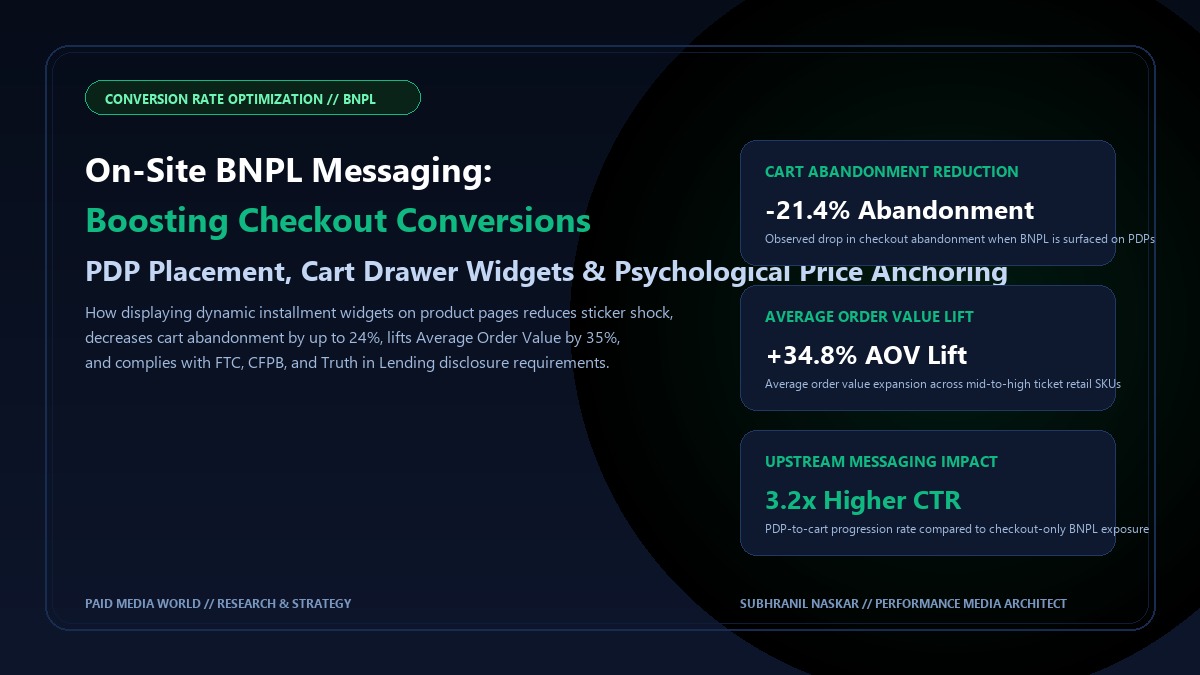
- The Core Trade-off: BNPL carries a higher merchant fee (avg. 3.5%–5.5%) than traditional credit card processing (2.2%–2.9%). To justify the higher take rate, BNPL must deliver true incremental conversion lift (+15% to +25%) and higher Average Order Value (+20% to +45%), rather than merely cannibalizing existing card transactions.
- Platform DNA & Best-Fit Verticals: Klarna dominates beauty, apparel, and European cross-border retail. Afterpay leads US/Australian youth fashion with strict zero-interest Pay in 4. Affirm dominates high-ticket furniture, fitness equipment, and consumer electronics ($500 to $10,000+) via 3-to-36 month interest-bearing installment loans.
- Zero Merchant Credit Risk: All three major providers absorb 100% of consumer credit and fraud default risk. The merchant is paid out in full upfront (minus the merchant discount fee) within 1 to 3 business days.
- Negotiation Benchmarks: Once your brand surpasses $1M in annual GMV, standard published rates are negotiable. Tier-1 enterprise retailers routinely negotiate blended rates down to 2.8% to 3.4% + $0.30.
The Macro Economics of BNPL: Why Installment Financing Expands Purchasing Power
Why does offering installment payments dramatically lift e-commerce metrics? The commercial psychology relies on Temporal Discounting and Price Fractioning. When a consumer views a premium $280 leather jacket, cognitive price resistance is triggered. However, when the product displays "or 4 interest-free payments of $70 with Klarna", the immediate perceived cost drops below the consumer's impulse expenditure threshold. Across aggregate merchant datasets, brands that introduce BNPL consistently document a 22% to 45% lift in Average Order Value (AOV) as consumers add complementary accessories to reach financing thresholds.
Klarna vs Afterpay vs Affirm: 8-Dimension Enterprise Comparison Matrix
The following master comparison analyzes the core financial, operational, and technical specifications of all three providers:
| Operational Dimension | Klarna | Afterpay (Block) | Affirm |
|---|---|---|---|
| Standard Merchant Fee (Published) | 3.29% – 5.99% + $0.30 | 4.00% – 6.00% + $0.30 | 5.99% + $0.30 (or custom APR share) |
| Enterprise Negotiated Rates ($5M+ GMV) | 2.8% – 3.4% + $0.25 | 3.2% – 3.8% + $0.25 | 3.5% – 4.2% + $0.25 |
| Primary Financing Structure | Pay in 4 (bi-weekly) + Monthly Financing | Strict Pay in 4 (zero consumer interest) | 3, 6, 12, 24, 36-Month Loans + Split Pay |
| Optimal Order Value (Sweet Spot) | $50 – $350 | $35 – $250 | $400 – $5,000+ |
| Underwriting & Credit Check | Soft credit check (Pay in 4) | Soft check / proprietary algorithm | Soft check (standard) / Hard check (large loans) |
| Default & Fraud Risk Liability | 100% Provider Assumed | 100% Provider Assumed | 100% Provider Assumed |
| International / Cross-Border Reach | Massive EU, UK, US, Nordics (45+ countries) | Dominant in US, UK, Australia, NZ, Canada | Primarily US & Canada |
| Merchant Payout Settlement | 1 to 3 Business Days | 1 to 2 Business Days | 1 to 3 Business Days |
Deep Dive: When to Choose Klarna
Key Strength: The Global Shopping Super-App. Klarna boasts over 150 million active global consumers and an exceptionally sticky consumer mobile app. For retailers, Klarna functions not just as a checkout gateway, but as an outbound discovery engine. Millions of consumers initiate product searches directly inside the Klarna app, which drives substantial organic referral traffic to merchant storefronts.
- Ideal Merchant Profile: Fashion apparel, cosmetics, footwear, consumer lifestyle goods, and international retailers selling across North America and Europe.
- Downside: In-app messaging and Klarna's push to keep consumers inside their proprietary ecosystem can sometimes dilute direct merchant brand loyalty.
Deep Dive: When to Choose Afterpay (Cash App)
Key Strength: Strict Ethical Credit Discipline & Gen Z Loyalty. Afterpay pioneered the pure Pay in 4 model with a philosophy centered on avoiding revolving consumer debt. If a consumer misses an installment, Afterpay immediately freezes their account from making new purchases, preventing debt compounding. Following its acquisition by Block (formerly Square), Afterpay is deeply integrated into the Cash App ecosystem, giving merchants direct exposure to tens of millions of mobile-first Gen Z shoppers.
- Ideal Merchant Profile: Fast fashion, streetwear, Gen Z cosmetics, and lower-to-mid ticket lifestyle retail ($35 to $200 basket size).
- Downside: Strict $1,500 to $2,000 maximum order limits make Afterpay unsuitable for luxury furniture, enterprise tech, or high-ticket B2B transactions.
Deep Dive: When to Choose Affirm
Key Strength: High-Ticket Term Financing & Enterprise Underwriting. Affirm was founded by PayPal co-founder Max Levchin with an explicit focus on replacing traditional predatory credit cards for large purchases. Affirm offers flexible monthly installment terms ranging from 3 to 36 months, supporting cart values up to $17,500+. Consumers pay transparent fixed interest (or 0% APR subsidized by the merchant) with zero late fees or compounding compound interest.
- Ideal Merchant Profile: Luxury home furnishings, Peloton-style fitness hardware, enterprise consumer electronics, jewelry, and high-ticket B2B service subscriptions.
- Downside: Affirm's merchant fee structure for 0% APR financing on expensive items can reach 6% to 9% if the merchant chooses to absorb all consumer interest costs.
How to Negotiate Enterprise BNPL Volume Tiers: The 4 Contract Levers
Enterprise merchants processing over $2M annually in GMV should never accept standard click-wrap pricing. When negotiating with Klarna, Afterpay, or Affirm, leverage these four contractual levers:
Enterprise Contract Negotiation Levers
- Blended Volume Commitment: Offer exclusivity or preferred top-position placement in your checkout stack in exchange for a 50 to 80 bps discount on the merchant discount rate (e.g., dropping from 4.2% down to 3.4%).
- Co-Marketing & App Placement Credits: Mandate that the provider commit $15,000 to $50,000 in dedicated in-app push notifications, homepage banner features, and dedicated email blasts to their consumer database during Q4 peak holiday sales.
- Settlement Velocity: Standard agreements allow providers up to 3 business days to remit funds. Negotiate next-day settlement (T+1) to preserve working capital and ad spend cash flow.
- Return & Refund Fee Treatment: Clarify whether the provider refunds the percentage-based processing fee when a customer returns a product. Several providers quietly retain the 4% transaction fee on returned merchandise, eroding retail margins.
Optimize Checkout Conversions & Unit Economics
Paid Media World engineers high-converting e-commerce funnels, connecting paid media traffic to high-converting payment architectures. Request a performance audit to calculate your breakeven BNPL thresholds and scale profitability.