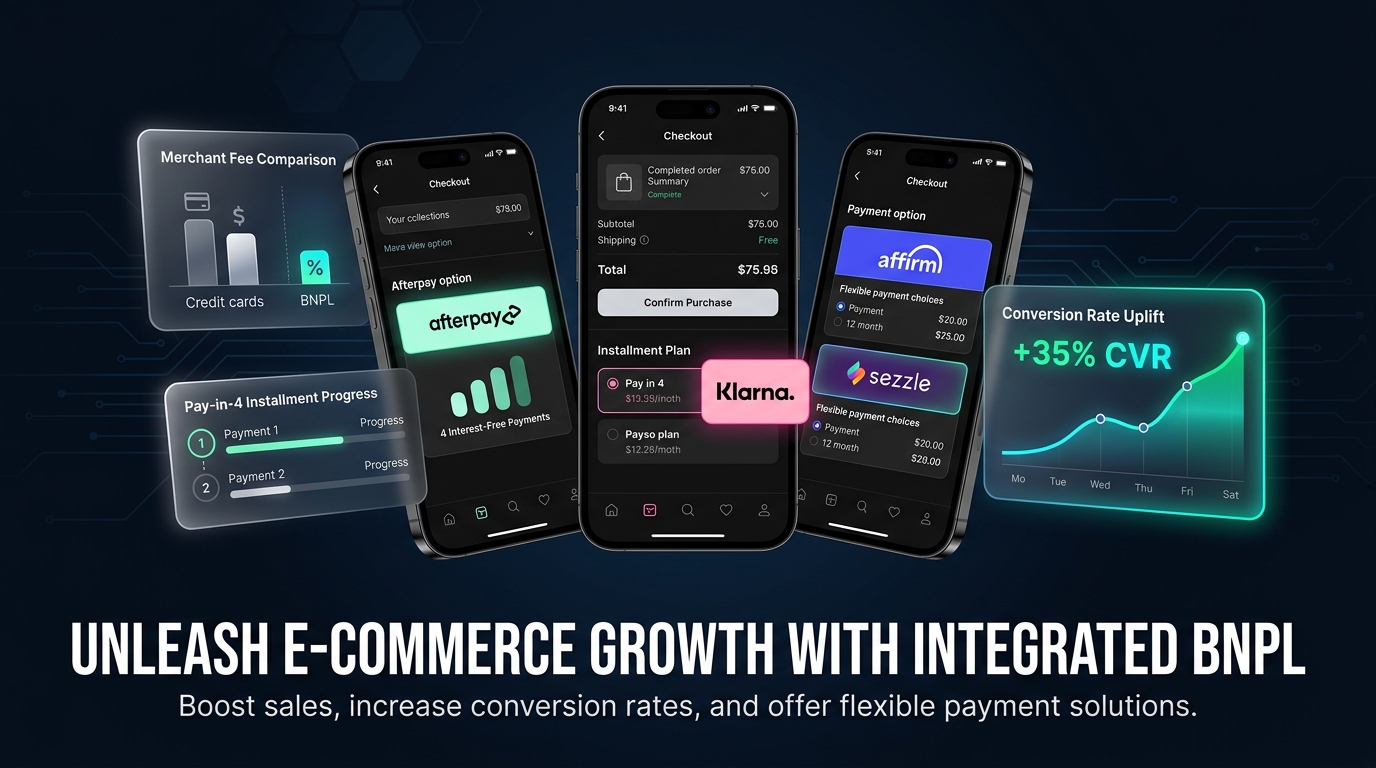
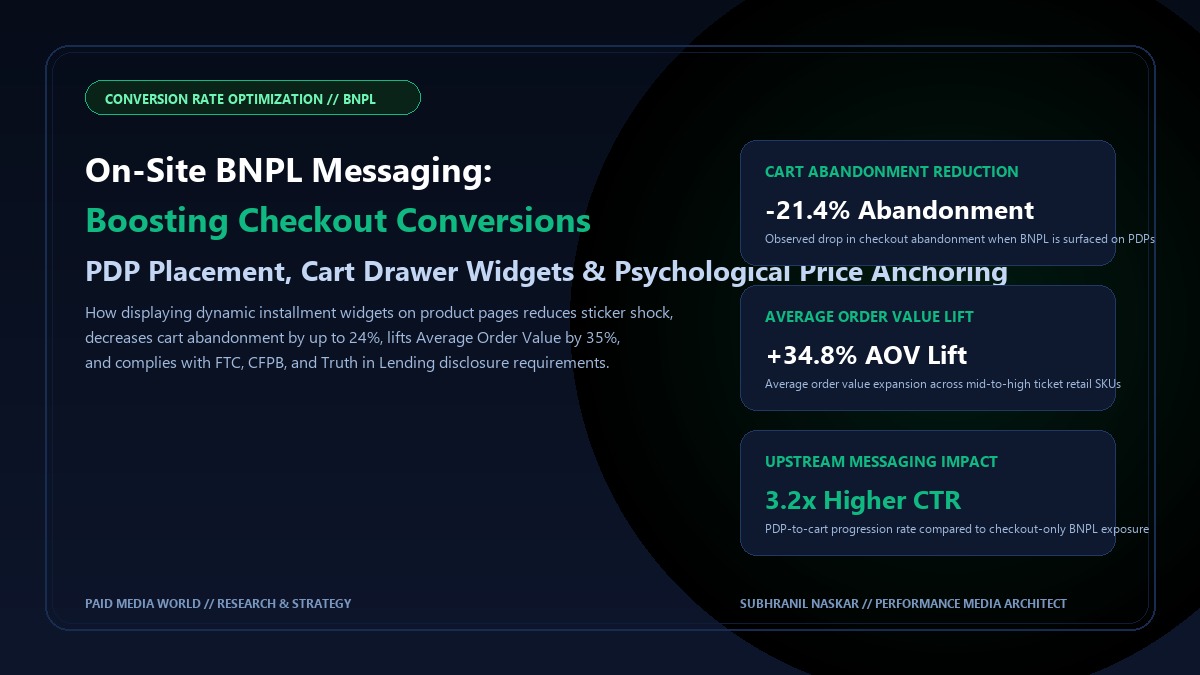
One of the most expensive and ubiquitous operational mistakes in modern e-commerce is treating Buy Now, Pay Later (BNPL) as merely a payment gateway buried on the final checkout screen. When installment options are concealed until a shopper reaches the payment step, over 70% of potential financing-driven conversion lift is permanently lost. Shoppers evaluate price and affordability upstream: on Product Detail Pages (PDPs), within collection grids, and inside slide-out cart drawers. If a customer views a $340 premium espresso machine and experiences immediate sticker shock, they bounce back to Google before ever reaching the checkout page. Conversely, dynamic On-Site BNPL Messaging displays real-time installment calculations (e.g., "or 4 interest-free payments of $85") right beside the product price, reframing the transaction psychology. Brands deploying engineered on-site messaging systematically cut cart abandonment by 18% to 24% and achieve a 35% higher Average Order Value (AOV). This guide breaks down the behavioral psychology, technical DOM placement, Core Web Vitals optimization, and regulatory compliance needed to maximize checkout conversions.
- The Upstream Advantage: Surfacing BNPL installment badges on PDPs increases product-to-cart progression by 3.2x compared to exposing installment options solely during final payment processing.
- Psychological Anchoring: Fractioned installment pricing leverages the "Left-Digit Bias", anchoring the shopper's cognitive evaluation on a manageable bi-weekly payment rather than the intimidating total price.
- The 4 High-Leverage Touchpoints: Product Detail Page (below price, above ATC button), Slide-Out Cart Drawer (with dynamic tier threshold progress bars), Collection Page Badging, and the Checkout Payment Selector.
- Core Web Vitals Protection: Unoptimized third-party BNPL JavaScript widgets cause severe Cumulative Layout Shift (CLS) and render-blocking delays. Asynchronous DOM hydration and reserved CSS placeholder heights are mandatory.
The Downstream Fallacy: Why Checkout-Only BNPL Destroys Conversion Lift
Consider the customer journey of a high-intent shopper visiting your storefront from a paid social ad. If your ad promoted a \$220 luxury jacket, the shopper lands on your PDP with curiosity and caution. If the only price displayed is \$220, the shopper conducts an internal affordability calculation: "Can I justify spending \$220 today?" If the answer is hesitant, they abandon the session.
When dynamic on-site messaging is active, the psychological inquiry changes entirely: "Can I afford \$55 every two weeks?" By fragmenting the perceived cost at the exact moment purchase desire is formed, you eliminate price objection at the top of the funnel. When that shopper finally arrives at checkout, the payment method is not a surprise discovery—it is the fulfillment of a pre-set expectation established upstream.
The 4 High-Leverage On-Site Placement Zones
Maximizing conversion velocity requires placing dynamic installment widgets at four strategic conversion checkpoints:
Zone 1: PDP Dynamic Calculation (Above the Fold)
Position the widget directly beneath the primary retail price and above the "Add to Cart" button. The badge must dynamically update if the user selects different variants, bundle tiers, or quantity selectors.
Zone 2: Slide-Out Cart Drawer & Threshold Bar
Display total cart installment cost inside the slide-out cart drawer. Leverage intelligent threshold prompts: "Add \$15 to cart to qualify for 4 interest-free payments of \$25 with Klarna." This gamifies cart expansion.
Zone 3: Collection Grids & Catalog Badging
For catalog pages featuring products over \$150, inject a subtle, non-intrusive installment pill below the card thumbnail: "or \$35/mo". This increases PDP click-through rates from category pages.
Zone 4: Checkout Payment Radio Selection
At final checkout, ensure the BNPL option displays the exact bi-weekly payment schedule (e.g., Payment 1 today: \$50, Payment 2 in 2 weeks: \$50...) and provides instant approval status with zero redirection friction.
Technical Implementation: Preventing Cumulative Layout Shift (CLS)
Third-party payment scripts are notorious for degrading Core Web Vitals. If a browser loads a product page, renders the text, and then asynchronously injects a 45px BNPL widget 600ms later, the entire page content jumps downward—causing a severe Cumulative Layout Shift (CLS) penalty in Google PageSpeed and frustrating users. Follow this engineering architecture to prevent layout shifts:
Regulatory Compliance & Consumer Disclosure Rules (FTC, CFPB, TILA)
Displaying installment pricing is strictly regulated by consumer protection agencies including the US Federal Trade Commission (FTC), the Consumer Financial Protection Bureau (CFPB), and the Truth in Lending Act (TILA). Non-compliant messaging exposes merchants to substantial legal penalties and ad account suspensions. Adhere to these three mandatory rules:
Regulatory Guardrails for On-Site Installment Copy
- Clear Disclosure of Payment Cadence: You may never state simply "Only \$25". The copy must explicitly clarify the payment frequency: "4 interest-free payments of \$25 every 2 weeks".
- Zero Deceptive "Free" Claims: If the financing model involves interest for certain credit tiers (such as Affirm's 10%–36% APR tiers on long-term loans), you cannot describe the service as "free" or "zero-cost". You must provide a clickable modal disclosure detailing APR ranges.
- Immediate Access to Full Terms: Every on-site widget must feature an accessible information link (e.g., an ⓘ icon or "Learn more" text) that opens a lightweight modal explaining late fee policies, credit check terms, and partner lender disclosures.
A/B Testing Framework for On-Site BNPL Messaging
Do not assume the default manufacturer widget copy delivers optimal conversion rates. Deploy structured split tests across your storefront:
| A/B Test Variant | Widget Copy & Design Treatment | Conversion Impact | Optimal Audience |
|---|---|---|---|
| Variant A (Control) | Standard inline text: "or 4 payments of \$50 with Klarna" | Baseline | Standard retail buyers |
| Variant B (Logo + Highlight) | Visual brand badge with high-contrast pill styling | +8.4% Add-to-Cart | Mobile-first Gen Z shoppers |
| Variant C (Multi-Provider Pill) | "Pay in 4 with Klarna, Afterpay, or Affirm" | +14.2% Checkout CVR | Omnichannel and luxury consumers |
Engineer Full-Funnel Checkout Conversion Optimization
Paid Media World architects frictionless e-commerce user experiences that turn ad spend into profitable enterprise revenue. Book a comprehensive CRO and payment architecture audit to eliminate conversion leaks.