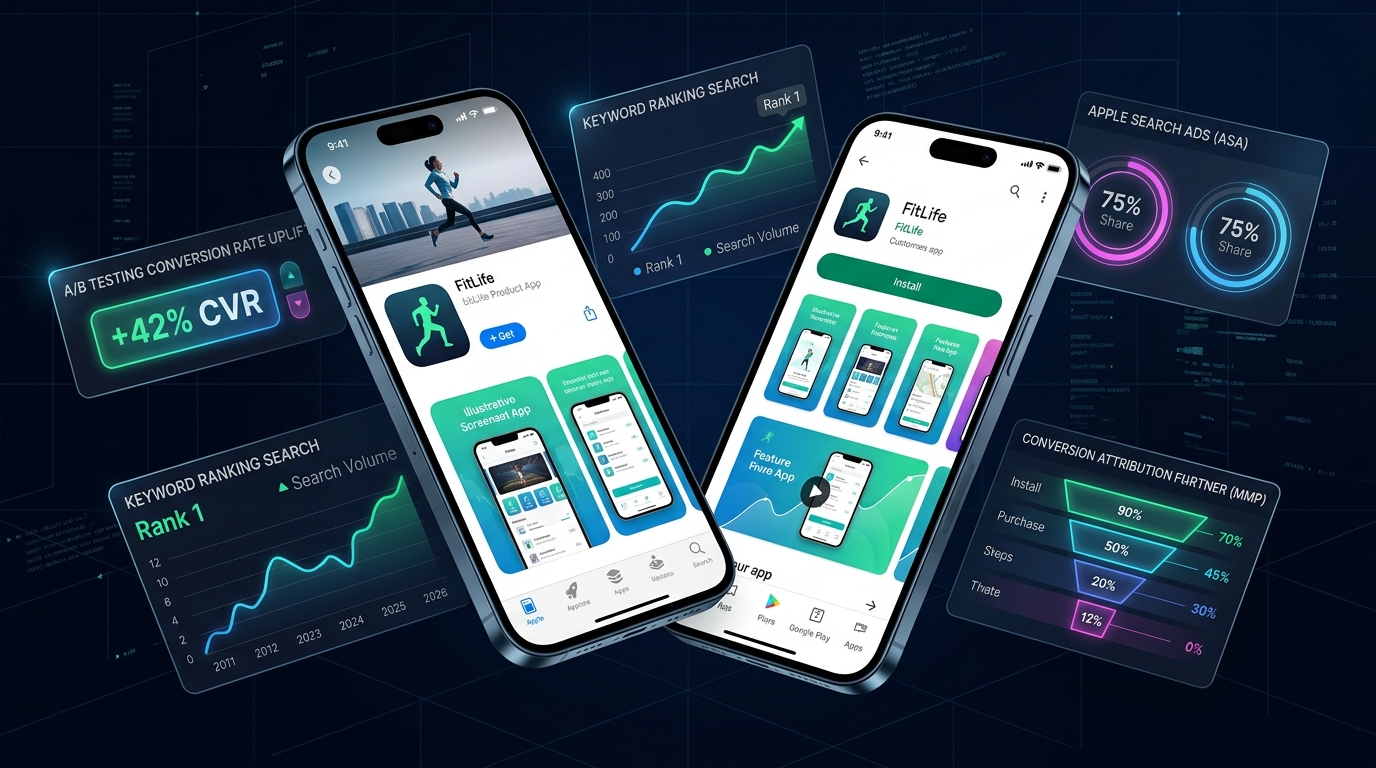
In the post-ATT mobile app ecosystem, user acquisition on mobile has bifurcated: while broad social ad networks struggle with signal degradation, App Store search intent remains the highest-converting channel on mobile devices. Over 70% of App Store visitors use search to discover new applications, and 65% of all downloads occur immediately following a search query. To scale mobile applications sustainably in 2026, mobile growth leaders must engineer a unified, symbiotic growth engine combining organic App Store Optimization (ASO) with paid Apple Search Ads (ASA). This guide breaks down App Store metadata ranking factors, Custom Product Pages (CPPs), and advanced Apple Search Ads campaign architecture.
- The Intent Monopoly: Apple Search Ads boast an average conversion rate of 55% to 65% from tap to download because ads appear at the exact moment a high-intent user searches for a solution.
- The Organic Metadata Hierarchy: iOS App Store keyword weighting prioritizes fields strictly in order: App Title (30 chars, highest weight) > Subtitle (30 chars, strong weight) > Keyword Field (100 chars comma-separated without spaces) > In-App Purchase Titles.
- Custom Product Pages (CPPs): Aligning specific ASA ad groups with tailored App Store screenshot and video variations lifts on-page tap-to-install conversion rates by 25% to 40%.
- SKAdNetwork & AdAttributionKit: Mapping fine vs coarse conversion values, handling privacy thresholds, and measuring downstream D7/D30 subscriber LTV under Apple's privacy-centric attribution frameworks.
The Anatomy of iOS App Store Organic Ranking Factors
Unlike Google Play Store—which crawls and indexes your entire long-form app description like a standard web page—the Apple App Store algorithm ignores your description for keyword ranking. Apple relies strictly on four metadata elements:
App Title (30 Characters Max)
Carries the highest organic ranking weight in Apple's algorithm. Structure: Brand Name: Primary Commercial Keyword. Example: "Moovalot: Daily Step Counter" (29 chars). Every character in this field must be ruthlessly optimized.
App Subtitle (30 Characters Max)
Carries the second-highest ranking weight. Displays directly below your title in search results. Structure: secondary high-intent keywords paired with a strong hook: "Pedometer, Walking & Calorie" (30 chars).
Keyword Field (100 Characters Max)
Invisible to consumers in App Store Connect. Follow these strict formatting rules: separate keywords with commas only; never include spaces after commas; never repeat words already used in your Title or Subtitle; use singular forms (Apple automatically matches plurals). Example: fitness,tracker,mileage,health,jogging,runner,distance,activity,weightloss.
Apple Search Ads (ASA) Campaign Architecture: The 4-Bucket Framework
To prevent keyword overlap and maintain predictable Cost Per Install (CPI), organize Apple Search Ads Advanced accounts into four distinct campaign buckets:
| Campaign Bucket | Match Type | Targeting Objective | Target CPT / CPI Profile |
|---|---|---|---|
| 1. Brand Defense | Exact Match | Own your brand name & prevent competitor conquesting | Lowest CPI ($0.40 - $1.20) |
| 2. Category Generic | Exact Match | Core solution keywords (e.g., [step counter], [pedometer]) | Moderate CPI ($2.50 - $6.00) |
| 3. Competitor Conquesting | Exact Match | Direct competitor brand names & alternative terms | Higher CPI ($4.00 - $10.00) |
| 4. Discovery Engine | Broad Match + Search Match | Uncover emerging queries (Negative-match Brand & Exacts) | Variable CPI ($2.00 - $5.50) |
Custom Product Pages (CPPs): The Conversion Rate Supercharger
Historically, all Apple Search Ads traffic landed on your default App Store product page. If you bid on "walking tracker for seniors", the user saw identical screenshots as someone searching for "marathon race training".
With Custom Product Pages (CPPs), you can deploy up to 35 tailored App Store variations with custom screenshots, promotional videos, and app previews. By linking your Category Generic ad groups to dedicated CPPs, you maintain perfect message match from query to visual screenshot, frequently boosting install conversion rates by 28% to 45%.
7-Point Technical ASO & ASA Audit Checklist
SKStoreReviewController prompts triggered immediately following a high-satisfaction user milestone (e.g., completing 5 consecutive workouts).
Scale iOS App Downloads with Lower Cost Per Install
Paid Media World engineers high-converting App Store Optimization (ASO) and Apple Search Ads architectures for high-growth iOS applications. Book an audit with Subhranil Naskar.