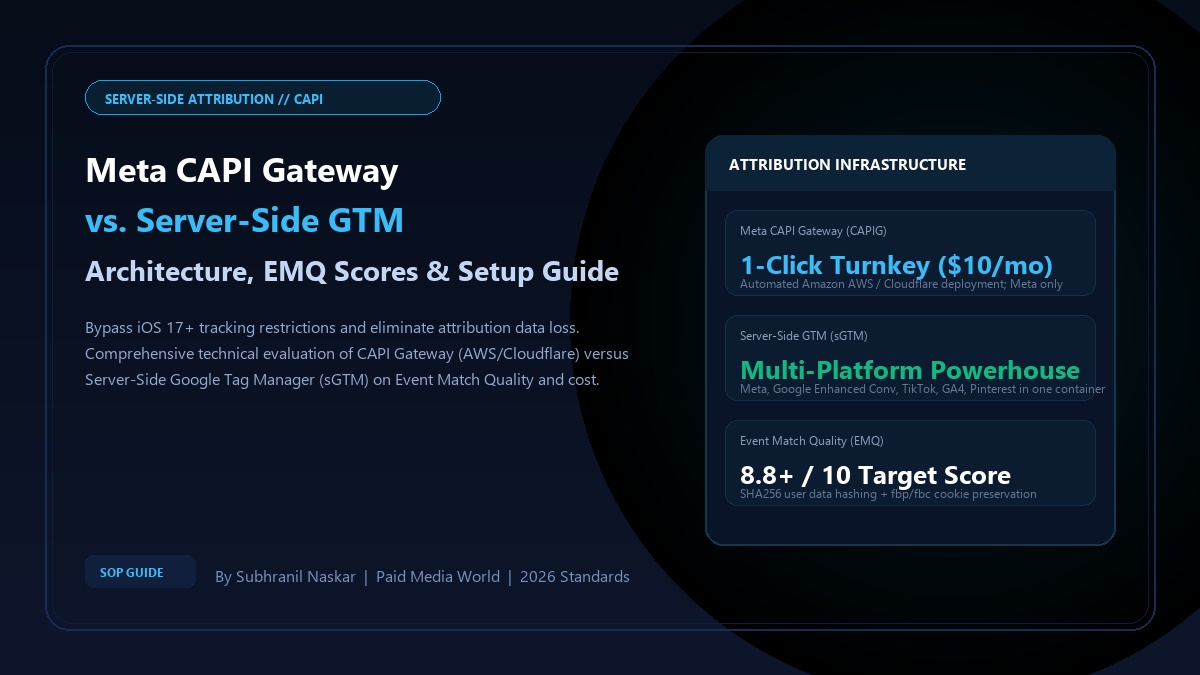
In the post-iOS 17 and Privacy Sandbox landscape, client-side Meta pixel tracking is fundamentally compromised. With Safari ITP restricting client-side cookie lifecycles to 24 hours and ad blockers severing up to 35% of frontend browser requests, server-side data dispatch via the Meta Conversions API (CAPI) is no longer optional—it is the baseline requirement for conversion attribution and algorithmic ad delivery. However, growth leaders face a major architectural fork: should you deploy the turnkey Meta Conversions API Gateway (CAPIG) or invest in a flexible Server-Side Google Tag Manager (sGTM) infrastructure? This guide provides the definitive technical teardown.
- The Core Dilemma: CAPI Gateway offers 1-click turnkey deployment on AWS/Cloudflare with zero maintenance, but it is locked exclusively to Meta. Server-Side GTM requires more setup but powers Meta, Google Enhanced Conversions, TikTok, GA4, and Klaviyo from a single container.
- Event Match Quality (EMQ): Both architectures can achieve EMQ scores of 8.5+ to 9.5 out of 10 if first-party parameters (hashed email, phone, IP address, user agent,
_fbp,_fbc) are properly collected and dispatched. - Cookie Lifespan Restoration: Serving your server container under a custom first-party subdomain (e.g.,
data.paidmediaworld.com) bypasses Safari ITP restrictions, extending tracking cookie lifespan from 24 hours back to 90–180 days. - Cost & TCO Analysis: CAPI Gateway on Cloudflare costs ~$5/month; sGTM on Stape or GCP Cloud Run scales between $20 and $120/month depending on monthly hit volume.
What is the Meta Conversions API (CAPI)?
Definition (AEO Direct Answer):
The Meta Conversions API (CAPI) is a direct server-to-server data pipeline that transmits web and offline customer actions (such as PageViews, AddToCart, and Purchases) directly from a brand's web server or cloud container to Meta's ad delivery servers. CAPI operates independently of browser cookies and client-side ad blockers, ensuring complete conversion attribution and accurate smart bidding optimization.
When you run both the browser Meta Pixel and the Conversions API simultaneously, you achieve Redundant Dual-Tracking. Meta uses the unique event_id and event_name parameters to deduplicate events, processing whichever payload arrives first while utilizing the secondary payload to enrich customer match parameters.
The 7-Point Architectural Comparison: CAPIG vs. Server-Side GTM
Choosing between Conversions API Gateway and Server-Side GTM requires evaluating your marketing tech stack, internal engineering resources, and multi-channel attribution requirements:
| Evaluation Criteria | Meta CAPI Gateway (CAPIG) | Server-Side Google Tag Manager (sGTM) |
|---|---|---|
| Deployment Complexity | Extremely Low (15 mins): Turnkey 1-click cloud deployment via Meta Events Manager. | Moderate (2–4 hours): Requires configuring Web GTM tags, Server GTM clients, and transformation variables. |
| Multi-Platform Scalability | Single Platform Only: Routes data exclusively to Meta Ads. Cannot send to Google, TikTok, or GA4. | Omnichannel Hub: One incoming web event can dispatch to Meta, Google Ads, TikTok, Pinterest, LinkedIn, and BigQuery. |
| Data Transformation Control | None: Black-box automated event capture based on frontend pixel hits. | Complete: Custom JavaScript transformations, PII redaction, profit margin derivation, and hashing rules. |
| First-Party Cookie Restoration | Yes (via custom routing subdomain). | Yes (via custom custom domain routing on Stape or GCP with Cookie Keeper). |
| Maintenance Overhead | Zero: Automated software updates and security patches managed directly by Meta. | Low to Moderate: Requires occasional template updates and container monitoring. |
| Infrastructure Cost | $5 – $15 / month (Cloudflare Workers or AWS t3.micro) | $20 – $100+ / month (Stape.io tier or Google Cloud Run server cluster) |
| Optimal Business Profile | DTC brands spending 80%+ of budget on Meta with limited developer resources. | Omnichannel brands running heavy spend across Meta, Google Ads, TikTok, and warehouse analytics. |
The Anatomy of Event Match Quality (EMQ) Optimization
Meta grades every CAPI event connection on a scale of 0 to 10 called Event Match Quality (EMQ). An EMQ score below 6.0 indicates that Meta cannot connect server conversion events back to user profiles on Facebook and Instagram, impairing ad delivery and reported ROAS.
em(Hashed Email): Normalized (lowercase, stripped whitespace) and SHA-256 encrypted. (Impact: +3.5 to EMQ)ph(Hashed Phone): Normalized to E.164 international format (e.g.,+14155552671) and SHA-256 encrypted. (Impact: +2.0 to EMQ)fbp(Browser Cookie): The first-party_fbpcookie created by Meta Pixel. (Impact: +1.5 to EMQ)fbc(Click Identifier Cookie): Formatted from URLfbclidparameter. (Impact: +1.5 to EMQ)client_ip_address&client_user_agent: Extracted directly from server headers. (Impact: +1.0 to EMQ)- External ID (
external_id): Unique CRM customer ID or Shopify customer ID. (Impact: +0.5 to EMQ)
Step-by-Step CAPI Deduplication Protocol
When running browser pixel and server CAPI simultaneously, failing to deduplicate events will double-count purchases in Ads Manager, artificially inflating reported ROAS and throwing smart bidding models into chaos. Deduplication requires two identical variables on every event:
- Matching
event_name: The exact event name must match word-for-word (e.g.,Purchase,AddToCart,InitiateCheckout). - Unique
event_id: A unique transaction or session identifier generated at the moment of interaction. For purchases, this should be the Order ID (e.g.,order_10924). For micro-conversions (AddToCart, PageView), generate a timestamped hash (e.g.,atc_user123_1730419200) and pass the identical string to both the browser pixel and the server payload.
Master omnichannel tracking and ad scaling with our dedicated technical guides:
- Shopify First-Party Data & Meta CAPI Server GTM Setup — Step-by-step sGTM implementation.
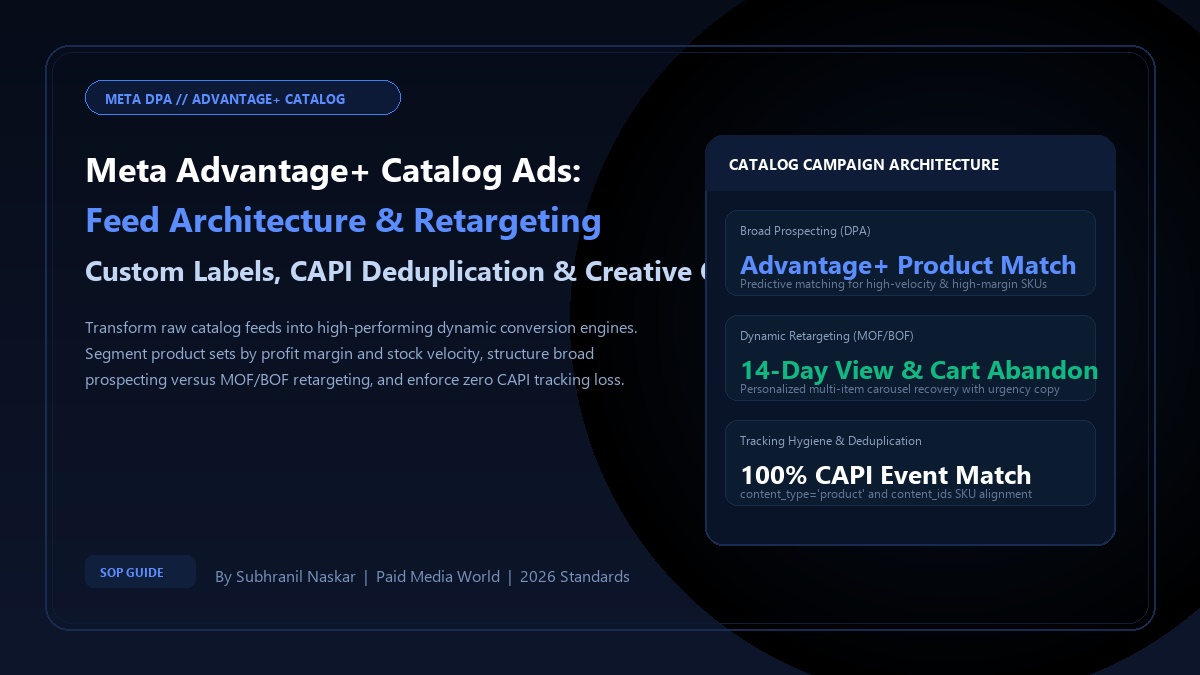
- Meta Advantage+ Catalog Ads: Setup & Retargeting Guide — Dynamic product feed synchronization.
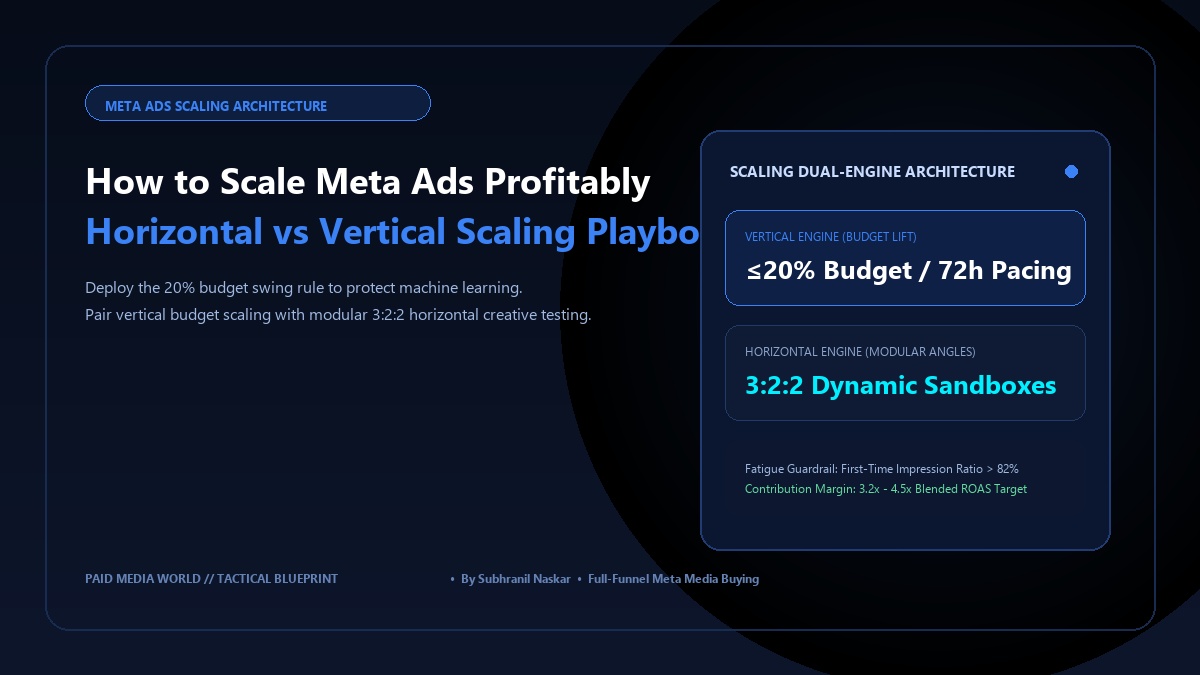
- How to Scale Meta Ads: Horizontal vs Vertical Playbook — Managing budget lifts without learning resets.
- Google Ads Value-Based Bidding: Profit Margins & tROAS — Offline conversion tracking for Google.
Frequently Asked Questions (FAQ)
What is the difference between CAPI Gateway and standard CAPI?
Standard CAPI refers to the underlying REST API endpoint provided by Meta. CAPI Gateway is a pre-packaged, containerized software appliance hosted on AWS or Cloudflare that automatically converts frontend Meta Pixel hits into CAPI payloads with zero custom coding.
Does CAPI Gateway bypass ad blockers?
Yes, when configured with a custom routing subdomain (e.g., capig.yourdomain.com). Because the tracking requests are dispatched to your own domain rather than connect.facebook.net, standard browser ad blockers and Safari ITP cannot intercept the tracking payload.
Can I run both CAPI Gateway and Server-Side GTM at the same time?
No, you should never run both on the same Meta Pixel ID. Running both simultaneously creates triple-event collisions and complicates deduplication. Choose CAPI Gateway if you only care about Meta, or Server-Side GTM if you manage multi-channel tracking across Google, Meta, and TikTok.
What is a good Event Match Quality (EMQ) score on Meta?
An EMQ score of 8.0 or above is considered good, and 8.8+ is considered elite. Scores below 6.0 indicate that critical matching parameters (email, phone, fbp, fbc) are missing or improperly hashed.
How much does hosting Server-Side GTM cost?
Hosting Server-Side GTM via managed platforms like Stape.io starts at $20/month for up to 500,000 requests. Hosting directly on Google Cloud Platform (GCP) Cloud Run with minimum 3 server instances typically costs between $45 and $120/month depending on traffic volume.