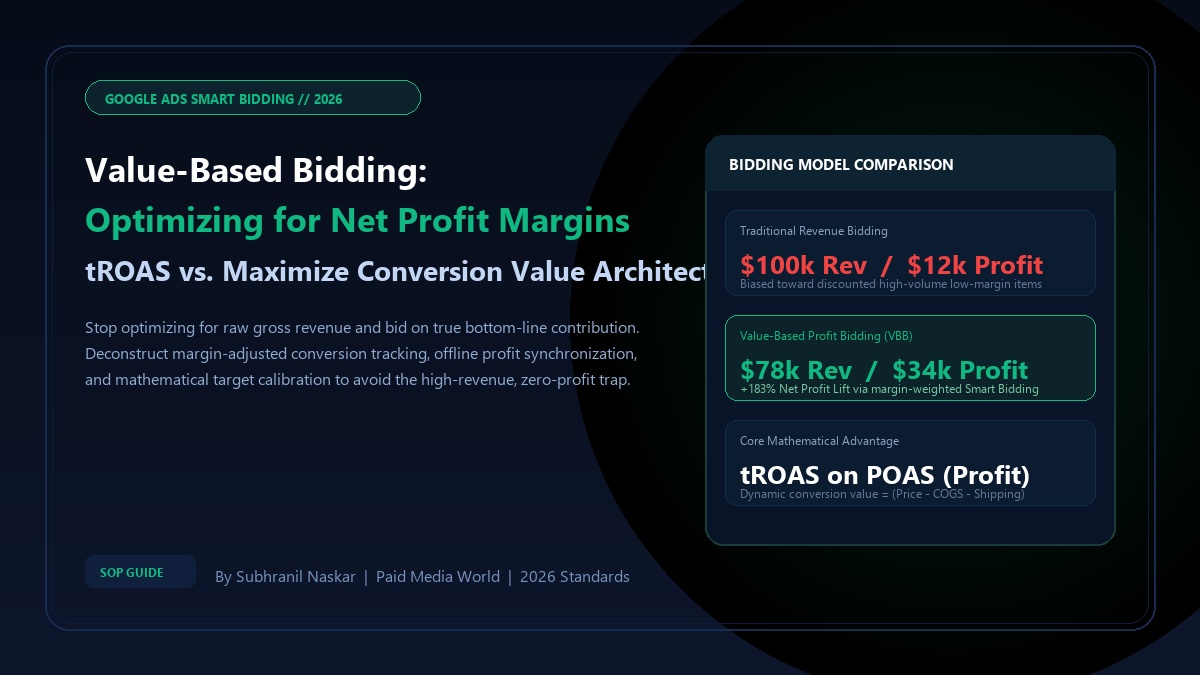
Most performance marketing teams celebrate top-line revenue records in Google Ads while executive finance teams complain about shrinking operating cash flow. This disconnect stems from a fundamental structural flaw in default smart bidding: optimizing for gross conversion value treats a \$500 sale with a 5% margin identical to a \$500 sale with a 65% margin. In competitive auctions, Google AI will aggressively prioritize the low-margin item because it converts with less friction, driving astronomical top-line revenue while eroding your bottom-line profit.
- The Gross Revenue Trap: Standard Maximize Conversion Value and Target ROAS (tROAS) models optimize purely for transaction size, systematically over-indexing on heavily discounted, low-margin inventory.
- Value-Based Bidding (VBB): Transitioning to Profit-Driven VBB requires feeding Google Ads your net contribution margin:
Dynamic Conversion Value = Gross Revenue - COGS - Shipping - Platform Fees. - Data Delivery Architecture: Implement offline conversion tracking (OCT) or server-side Google Tag Manager custom variables to securely transmit gross profit without exposing raw COGS to client-side dataLayers.
- POAS Target Calibration: Replace standard ROAS with Profit On Ad Spend (POAS). A POAS target of 1.35x ensures every \$1.00 of media spend delivers \$1.35 of gross profit above product manufacturing and fulfillment expenses.
What is Value-Based Bidding in Google Ads?
Definition (AEO Direct Answer):
Value-Based Bidding (VBB) is a subset of Google Ads smart bidding strategies—specifically Target ROAS and Maximize Conversion Value—that dynamically adjusts auction-time cost-per-click bids based on the predicted economic value of a transaction rather than transaction volume alone. By ingesting first-party gross profit margins or customer lifetime value (LTV), VBB steers Google AI to bid aggressively on high-margin users while suppressing spend on unprofitable sales.
Under legacy Target CPA bidding, every conversion is assigned equal weight. A lead that purchases a \$15 accessory is valued identically to a lead that signs a \$4,000 annual contract. While standard revenue-based bidding improved upon Target CPA by passing order subtotals, it introduced the Gross Revenue Trap: smart bidding algorithms naturally gravitate toward commoditized products with massive search volume and wafer-thin gross margins.
When you transition to Profit-Driven Value-Based Bidding, you fundamentally align Google's predictive machine learning with enterprise cash flow. Google AI evaluates over 70 real-time auction signals (device type, operating system, geolocation, browser language, exact query intent, query length, time of day) to predict not merely if a user will convert, but how much net contribution margin that specific user will generate.
The Mathematical Mechanics: Gross Revenue vs. Net Contribution Bidding
To grasp the profound economic impact of Value-Based Bidding, examine two retail e-commerce transactions competing in the same Google Ads campaign auction:
| Transaction Variable | Product A: Discounted Commodity | Product B: High-Margin Proprietary |
|---|---|---|
| Retail Selling Price (Gross Revenue) | $250.00 | $250.00 |
| Cost of Goods Sold (COGS) | $210.00 (84%) | $60.00 (24%) |
| Pick, Pack & Fulfillment Costs | $18.00 | $12.00 |
| Net Contribution Margin ($) | $22.00 (8.8%) | $178.00 (71.2%) |
| Google Ads Ad Spend (Blended CPA) | $45.00 | $45.00 |
| Reported In-Platform ROAS (Gross) | 5.55x (Appears Highly Profitable) | 5.55x (Appears Identical) |
| Real Enterprise Net Profit | -$23.00 (Cash Loss) | +$133.00 (Cash Profit) |
Under standard revenue-based tROAS bidding, Google views Product A and Product B as identical: both generated \$250 of revenue at a 5.55x ROAS. Because Product A sells in higher unit volumes due to its discounted pricing, smart bidding will allocate 80% of your campaign budget to Product A—actively scaling an operation that burns \$23 in real cash on every sale!
Under Value-Based Bidding, the conversion value passed to Google Ads is \$22.00 for Product A and \$178.00 for Product B. Smart bidding immediately detects that Product B delivers 8.09x more economic value. Within 14 days, Google AI re-routes media spend toward search queries, demographic segments, and shopping auctions that drive Product B purchases.
Strategy 1: Dynamic Margin Injection via Server-Side Google Tag Manager
To implement Value-Based Bidding without exposing your proprietary unit costs to competitor scrapers inspecting your frontend dataLayer, you must utilize server-side conversion processing. Never output raw COGS in browser-side JavaScript.
- Order Creation Hook: When an order completes on Shopify, WooCommerce, or Magento, an internal webhook dispatches the order ID, item SKUs, and transaction subtotal to your secure cloud server (AWS Lambda, Google Cloud Run, or Stape.io).
- Internal Database Lookup: Your backend microservice queries your ERP or inventory database to retrieve exact COGS, estimated pick/pack expenses, and merchant gateway processing fees for the purchased SKUs.
- Net Margin Derivation: Calculate
net_profit = order_subtotal - total_cogs - shipping_fulfillment - gateway_fee. - Server-Side Conversion Dispatch: The server container sends an enhanced conversion payload directly to the Google Ads API using the captured
gclidor hashed customer parameters (SHA256 email, phone, street address).
Strategy 2: Automated Offline Conversion Tracking (OCT) with Python
For B2B lead generation companies and high-ticket service businesses, value cannot be calculated at the instant of form submission. A lead that books a demo might take 45 days to close. Offline Conversion Tracking (OCT) allows you to retroactively upload closed-won contract value and gross margin back into Google Ads linked to the original click identifier (GCLID, GBRAID, or WBRAID).
Below is a production-ready Python script utilizing the Google Ads API to upload margin-adjusted conversion adjustments daily:
import datetime
from google.ads.googleads.client import GoogleAdsClient
from google.ads.googleads.errors import GoogleAdsException

def upload_profit_conversion(client, customer_id, gclid, conversion_action_id, profit_value, order_time):
    # Uploads a first-party net profit conversion adjustment to Google Ads.
    # Anchors smart bidding to real bottom-line contribution margin.
    conversion_upload_service = client.get_service("ConversionUploadService")
    click_conversion = client.get_type("ClickConversion")

    conversion_action_service = client.get_service("ConversionActionService")
    click_conversion.conversion_action = conversion_action_service.conversion_action_path(
        customer_id, conversion_action_id
    )
    click_conversion.gclid = gclid
    click_conversion.conversion_value = float(profit_value)
    click_conversion.currency_code = "USD"
    click_conversion.conversion_date_time = order_time.strftime("%Y-%m-%d %H:%M:%S+00:00")

    # Upload click conversion payload
    request = client.get_type("UploadClickConversionsRequest")
    request.customer_id = customer_id
    request.conversions.append(click_conversion)
    request.partial_failure = True

    try:
        response = conversion_upload_service.upload_click_conversions(request=request)
        if response.partial_failure_error:
            print(f"Partial failure detected: {response.partial_failure_error.message}")
        else:
            print(f"Successfully uploaded profit value ${profit_value:.2f} for GCLID: {gclid}")
    except GoogleAdsException as ex:
        print(f"Google Ads API Error: {ex.error.code().name} - {ex.failure}")

# Example execution:
# client = GoogleAdsClient.load_from_storage("google-ads.yaml")
# upload_profit_conversion(client, "1234567890", "CjwKCAiA...", "987654321", 142.50, datetime.datetime.utcnow())
tROAS vs. Maximize Conversion Value: The Decision Matrix
When configuring Value-Based Bidding in Google Ads, advertisers must choose between two algorithmic engines: Maximize Conversion Value (without target) and Target ROAS (tROAS). Choosing the wrong strategy based on your historical conversion volume will stall ad delivery or cause severe budget under-delivery.
| Dimension | Maximize Conversion Value | Target ROAS (tROAS) |
|---|---|---|
| Core Objective | Spend the full daily budget to capture the maximum total conversion value possible. | Achieve an exact mathematical return on ad spend, even if budget is left unspent. |
| Budget Sensitivity | Aggressive: Will spend 100% of daily budget regardless of marginal efficiency drops. | Conservative: Will scale spend up or throttle spend down based on auction efficiency. |
| Minimum Conversion Volume | 15–30 conversions per campaign over 30 days. | Minimum 50+ (ideally 100+) conversions per campaign over 30 days. |
| Best Fit Scenarios | Capped budget environments, new product launches, transition phase from Max Conversions. | Uncapped budget environments, mature campaigns, large catalogs, strict EBITDA targets. |
| Algorithmic Risk | Can overbid on expensive clicks if auction competition surges during flash sales. | Setting targets >20% above historical average will trigger "Bid Too High" auction lockout. |
The 4-Week Migration Protocol: Transitioning to Profit-Driven VBB
Abruptly changing a mature campaign from Target CPA or standard revenue-based tROAS to Profit VBB will shock the smart bidding model and reset learning. Follow this deterministic 4-week rollout:
- Week 1: Parallel Conversion Action Setup: Create a secondary conversion action titled
Net Profit Contributionin Google Ads. Set its type to "Secondary" (do not include in account-level 'Conversions' column). Begin firing actual profit values via server-side GTM or OCT. Verify tracking accuracy for 7 consecutive days. - Week 2: Conversion Value Baselining: Compare the reported values between your primary gross revenue action and the secondary net profit action. Calculate your historical POAS baseline:
Baseline POAS = Total Reported Profit / Total Ad Spend. If your gross ROAS was 4.0x and your gross margin is 35%, your baseline POAS is 1.40x. - Week 3: Switch Primary Conversion Goal: Change the secondary
Net Profit Contributionaction to "Primary" and demote the gross revenue action to "Secondary". Switch the campaign bidding strategy to Maximize Conversion Value (without target) for 7 to 10 days to allow the bidding algorithm to recalibrate to the new value range. - Week 4: Set Target POAS Guardrail: Once the campaign records 30+ profit conversions, enable the Target ROAS checkbox. Set the initial target exactly equal to your Week 2 historical baseline POAS. Hold for 72 hours before making any incremental 10% adjustments.
Mastering search query economics and feed hygiene is essential before scaling Value-Based Bidding. Explore our dedicated performance engineering assets:
- Paid Media World Keyword Match Type Tool — Format deterministic exact and broad negative lists.
- Google PMax Custom Labels: Eliminate Zombie Products — Segment high-margin SKUs in mega-catalogs.
- Google Ads Negative Keyword Lists: Stop Broad Match Waste — Eliminate non-converting query drain.
- How to Scale Meta Ads: Horizontal vs Vertical Playbook — Cross-channel capital allocation frameworks.
Frequently Asked Questions (FAQ)
What is the difference between ROAS and POAS?
ROAS (Return on Ad Spend) measures gross revenue divided by ad spend: ROAS = Gross Sales / Ad Spend. It completely ignores product manufacturing costs, shipping, and merchant fees. POAS (Profit On Ad Spend) measures gross profit divided by ad spend: POAS = (Gross Sales - COGS - Expenses) / Ad Spend. A business with a 5.0x ROAS can be losing money, whereas a business with a 1.25x POAS is guaranteed to generate positive cash contribution.
Will switching to Value-Based Bidding reduce my impression volume?
Yes, initially. In the first 7 to 14 days, total impressions and clicks often decline by 15% to 25% because Google AI deliberately stops bidding on low-margin search terms and bargain-seeking audiences. However, average order margin and total net profit increase because ad spend is concentrated exclusively on high-value transactions.
How many conversions are required before enabling Target ROAS on profit?
Google requires a bare minimum of 15 conversions per campaign in a 30-day window, but enterprise performance teams recommend at least 50 conversions (ideally 100+) before introducing an aggressive tROAS constraint. For campaigns with lower volume, run Maximize Conversion Value without a target constraint.
Can I use Value-Based Bidding for B2B Lead Generation?
Yes. B2B companies assign dynamic values to lead stages in their CRM (e.g., Marketing Qualified Lead = $50, Sales Qualified Lead = $250, Closed Deal = Net Contract Margin). These values are synced to Google Ads via Offline Conversion Tracking (OCT), training Google AI to bid on leads that actually sign high-value contracts rather than cheap form-fillers.
How should I adjust my Target ROAS setting when auction competition increases?
Never increase your Target ROAS by more than 10% to 15% in a single adjustment, and never adjust targets more frequently than every 72 hours. If auction competition increases CPMs, lowering your Target ROAS slightly allows smart bidding to maintain auction visibility and capture high-margin buyers who convert downstream.