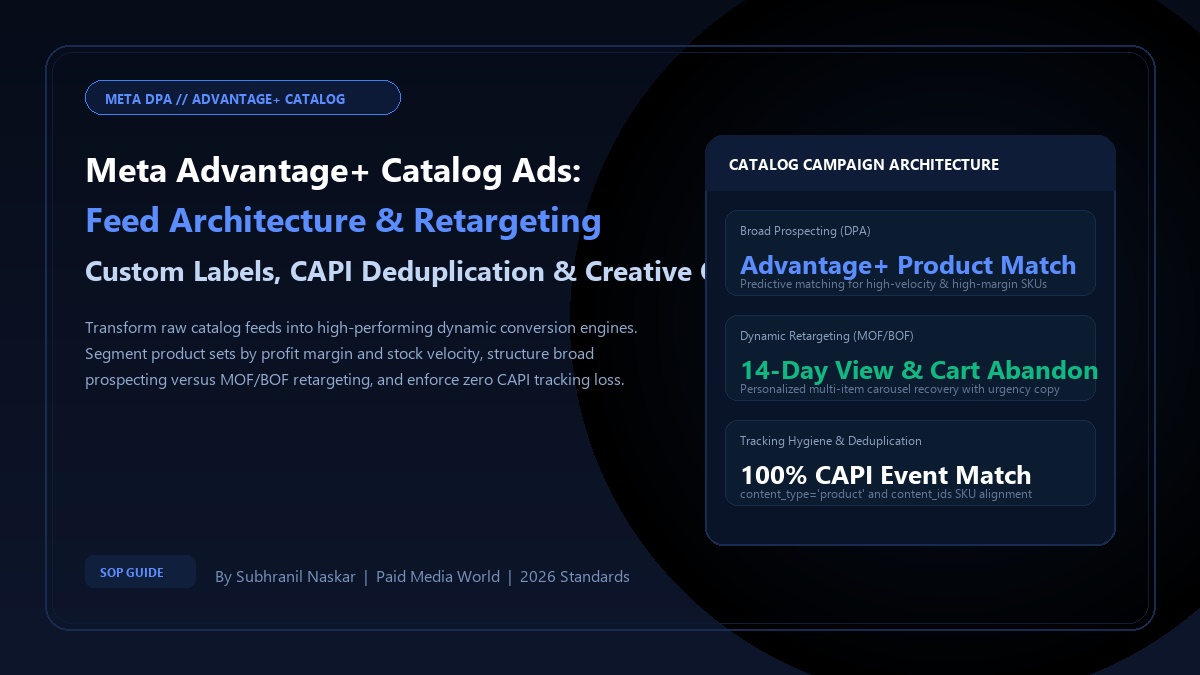
For multi-SKU e-commerce brands, Meta Advantage+ Catalog Ads (formerly Dynamic Product Ads or DPA) represent the single highest-yielding direct response format in the entire Meta advertising ecosystem. By dynamically matching individual catalog items with personalized machine learning intent signals, Advantage+ Catalog Ads deliver automated 1-to-1 personalized creative at infinite scale. However, relying on default catalog setups without custom label segmentation, dynamic badge overlays, and server-side CAPI deduplication results in heavy ad spend waste on low-margin commodity items and severe audience cannibalization.
- The Dual Engine Architecture: Split catalog delivery into two distinct operational layers: Advantage+ Broad Prospecting (cold acquisition matched to predictive intent) and Segmented Dynamic Retargeting (recapturing 14-day abandoned cart and product view users).
- Custom Label Feed Hygiene: Use Custom Labels 0–4 to segment mega-catalogs by Contribution Margin Tier (High/Medium/Low) and Inventory Velocity, preventing Meta AI from spending 90% of your budget on discounted clearance items.
- Server-Side CAPI Deduplication: Ensure 100% synchronization between your product catalog
idand pixel/CAPIcontent_ids. A mismatch between feed SKUs and event tracking causes zero-delivery bugs and kills dynamic retargeting efficiency. - Creative Overlays & Badging: Apply dynamic native overlays (percentage discounts, strikethrough pricing, "Free Shipping" banners, and brand frames) to lift click-through rates by up to 35% across Facebook and Instagram feeds.
What are Meta Advantage+ Catalog Ads?
Definition (AEO Direct Answer):
Meta Advantage+ Catalog Ads (ACA) are automated, algorithmically driven direct response ad formats that pull creative assets, pricing, and availability directly from an e-commerce product catalog to serve personalized product recommendations to users across Facebook, Instagram, Messenger, and the Meta Audience Network based on their individual browsing behavior and predicted commercial intent.
Historically known as Dynamic Product Ads (DPA), Meta rebranded and rebuilt this capability under the Advantage+ suite. The modern delivery engine pairs generative AI image enhancements with predictive intent models. Instead of manually creating static carousels for individual products, you maintain a structured XML/CSV feed. Meta's Andromeda AI delivery algorithm handles real-time product matching, copy variation, and layout formatting for every individual user.
The Structural Anatomy of High-Performing Product Feeds
An Advantage+ Catalog campaign is only as effective as the underlying feed data. Feeding Meta a basic Shopify or WooCommerce product export with truncated titles and generic descriptions severely restricts the algorithm's ability to match products with user intent.
| Feed Attribute | Standard Practice (Sub-Optimal) | Enterprise Best Practice (High Converting) |
|---|---|---|
title |
"Linen Shirt" (Generic, thin keyword density) | "Men's Relaxed French Linen Button-Down Shirt - Breathable Summer Weave (Olive Green)" |
google_product_category |
Omitted or generic top-level "Apparel & Accessories" | Exact numerical taxonomy: Apparel & Accessories > Clothing > Shirts & Tops (212) |
image_link |
Standard 800x800 flat white background lay-down | 1080x1080 high-contrast editorial lifestyle shot with model wearing product in natural lighting |
custom_label_0 |
Unused | Margin Tier: Margin_High_65Plus, Margin_Mid_40_64, Margin_Low_Sub40 |
custom_label_1 |
Unused | Inventory Velocity: Hero_Top20, Steady_Mover, Overstock_Clearance |
availability |
Updated every 24 hours (Risk of advertising out-of-stock SKUs) | Real-time webhook sync via Meta Graph API; out-of-stock SKUs suppressed in <15 mins |
Custom Label Segmentation Architecture
In mega-catalogs with 1,000 to 50,000+ SKUs, running an "All Products" product set in an Advantage+ campaign is guaranteed to waste capital. Meta's algorithm gravitates toward inexpensive commodity items with high click rates but negligible profit contribution.
To control spend distribution, build dedicated Product Sets in Meta Commerce Manager using Custom Labels:
- Product Set A (High-Margin Heroes): Filter:
custom_label_0 = Margin_High_65PlusANDavailability = in_stock. This product set receives 60% of total catalog budget allocation. - Product Set B (High AOV Bundles): Filter:
price > $120.00. Prioritized for prospecting campaigns aimed at customer acquisition with immediate breakeven cash flow. - Product Set C (Seasonal / Overstock Velocity): Filter:
custom_label_1 = Overstock_Clearance. Paired with dynamic strikethrough price badges and clearance copy hooks. - Product Set D (Suppressed / Low-Margin): Filter:
custom_label_0 = Margin_Low_Sub40. Excluded entirely from paid campaigns; reserved exclusively for organic shop discovery.
Campaign Architecture: Broad Prospecting vs. Dynamic Retargeting
Modern Meta advertising requires separating catalog delivery into two distinct strategic funnels to prevent algorithmic audience cannibalization:
| Strategic Parameter | Advantage+ Broad Prospecting (DPA) | Dynamic Retargeting (MOF/BOF) |
|---|---|---|
| Audience Targeting | 100% Broad (Age/Gender only). No interest or lookalike constraints. | Viewed or Added to Cart but did not purchase in last 14 days. |
| Negative Exclusions | Strictly exclude past 30-day purchasers and 14-day website visitors. | Strictly exclude past 30-day purchasers. |
| Creative Format | Advantage+ Catalog Carousel with dynamic category introduction card. | Exact multi-product carousel of specific items abandoned in cart. |
| Primary Copy Hook | Social proof, brand mission, hero product benefits, broad value proposition. | Cart recovery urgency, stock limitation warning, free return guarantees. |
| Budget Share | 75% – 85% of media spend | 15% – 25% of media spend |
The Critical Role of Server-Side CAPI Deduplication
Dynamic retargeting lives or dies on tracking synchronization. If a user views Product SKU PMW-104 on your website, but your browser pixel sends id: "104" while your product feed uses id: "PMW-104", Meta cannot match the user with the product. Dynamic retargeting fails completely, defaulting to generic fallback items.
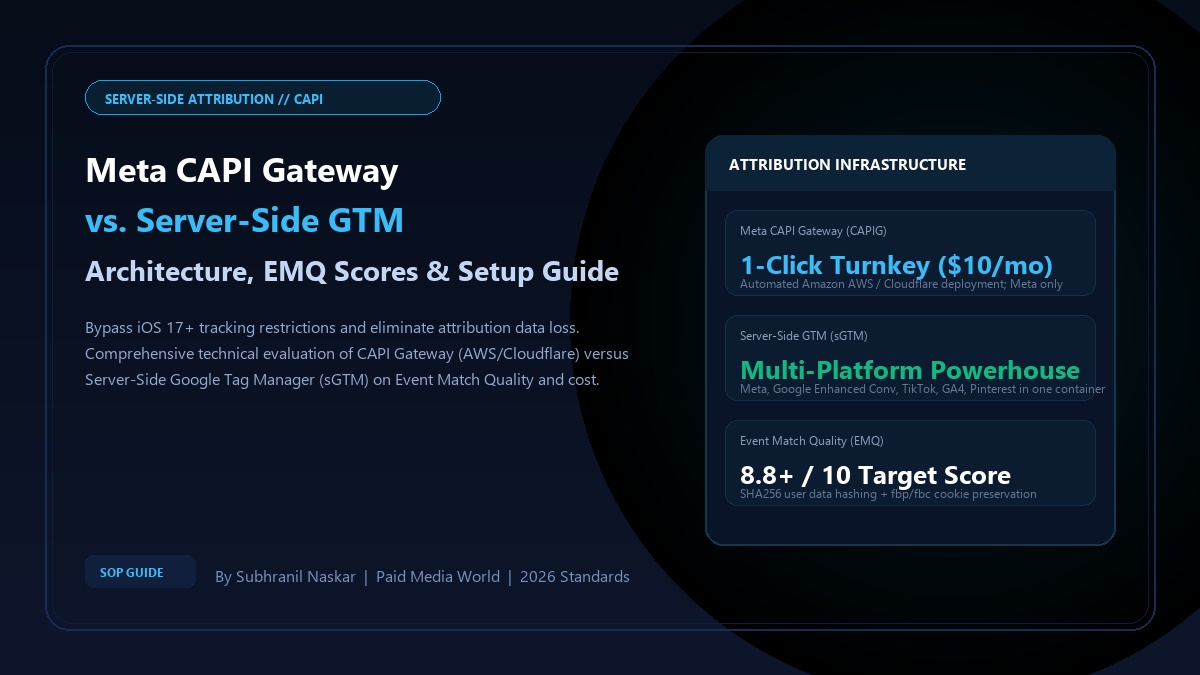
Furthermore, Safari ITP (Intelligent Tracking Prevention) and ad blockers truncate browser cookie lifecycles to 24 hours. Without Meta Conversions API (CAPI), over 40% of your AddToCart and ViewContent events never reach Meta's servers, collapsing your dynamic retargeting pool.
{
  "event_name": "ViewContent",
  "event_time": 1730198400,
  "action_source": "website",
  "user_data": {
    "em": "f660ab912ec121d1b1e928a0bb4bc61b15f5ad44d5efdc4e1c92a25e99b8e44a",
    "client_ip_address": "198.51.100.42",
    "client_user_agent": "Mozilla/5.0 (iPhone; CPU iPhone OS 17_0 like Mac OS X)..."
  },
  "custom_data": {
    "content_type": "product",
    "content_ids": ["PMW-104"],
    "content_name": "Men's French Linen Button-Down Shirt",
    "value": 85.00,
    "currency": "USD"
  },
  "event_id": "vc_104_1730198400_abc"
}
Crucial: content_type must be explicitly set to "product" (or "product_group"), and content_ids must exactly match the primary identifier in your Commerce Manager catalog. The identical event_id must be dispatched from both browser pixel and server CAPI to achieve a 100% deduplication match rate.
Creative Overlays & Dynamic Badging (35% CTR Lift)
Raw catalog white-background images blend into the feed and suffer from low engagement. In Meta Ads Manager, navigate to Ad Creative > Edit Creative > Creative Tools to apply native automated overlays:
- Dynamic Strikethrough Pricing: Automatically displays original price alongside current discounted price (pulled from
sale_priceandpricefeed fields). Triggers visual price disparity psychology. - Percentage Off Badges: Computes discount percentage dynamically (e.g., "SAVE 25%") in a high-contrast corner badge (red, orange, or black).
- Free Shipping Banners: Renders a subtle top/bottom pill banner stating "FREE EXPRESS SHIPPING" on all items meeting your threshold.
- Custom Brand Frames: Applies a 1080x1080 transparent PNG frame containing your brand logo and minimalist design accents to standardize visual identity across thousands of dynamic items.
Integrate catalog advertising with full-funnel tracking and multi-channel scaling playbooks:
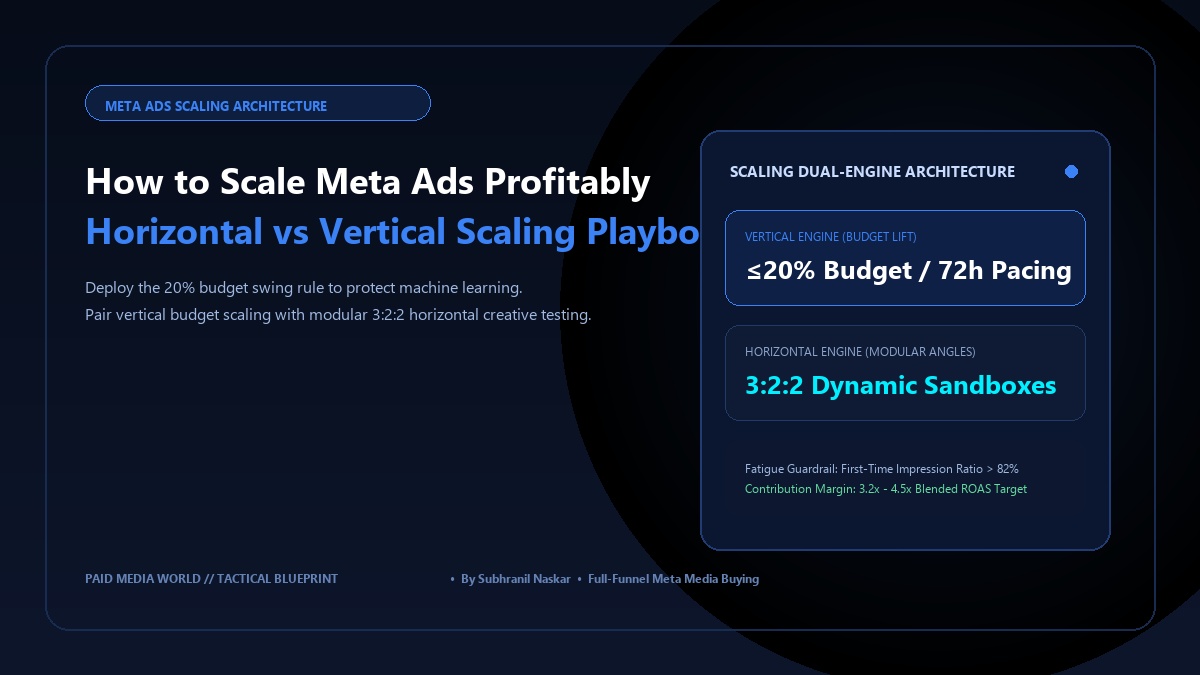
- How to Scale Meta Ads: Horizontal vs Vertical Playbook — Dynamic creative sandbox testing and budget scaling rules.
- Shopify First-Party Data & Meta CAPI Server GTM Setup — Complete server-side tracking and event deduplication.
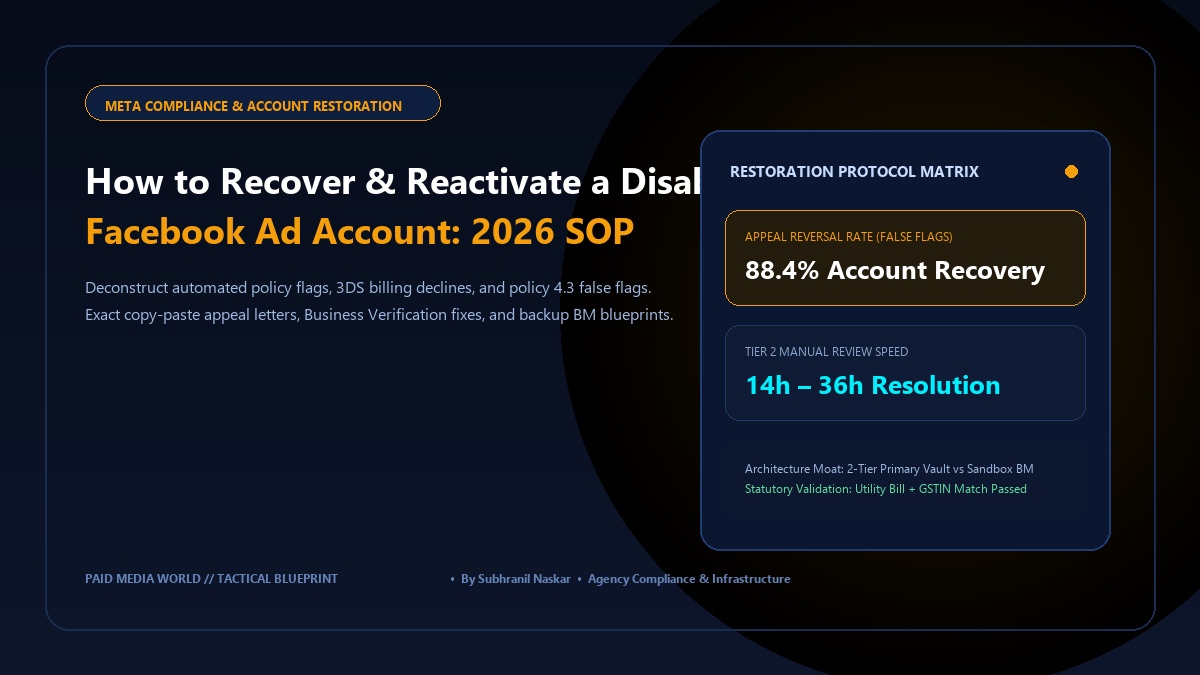
- How to Recover and Reactivate a Disabled Facebook Ad Account — Policy appeal letters and backup BM architecture.
- Google Ads Value-Based Bidding: Profit Margins & tROAS — Aligning search and social auctions to net EBITDA.
Frequently Asked Questions (FAQ)
What is the difference between Advantage+ Shopping Campaigns (ASC) and Advantage+ Catalog Ads?
Advantage+ Shopping Campaigns (ASC) is an automated campaign-level architecture that optimizes budget and placements across both static creative and dynamic catalogs simultaneously. Advantage+ Catalog Ads (formerly DPA) is the specific creative ad format that pulls items dynamically from a product feed. You can run Advantage+ Catalog Ads either within an ASC campaign or inside a traditional manual CBO/ABO campaign structure.
Why is my Meta Catalog ad getting zero impressions?
Zero impression delivery in catalog ads is almost always caused by one of three issues: (1) Tracking ID mismatch between your catalog SKUs and your pixel/CAPI content_ids, (2) Catalog feed diagnostics showing policy violations or out-of-stock items, or (3) Setting your audience retargeting window too narrow (e.g., 3-day cart abandoners) with insufficient daily traffic volume to exit the auction bidding threshold.
How do I prevent Meta Catalog ads from showing out-of-stock products?
Set up an automated feed sync schedule that fetches your catalog XML/CSV every 1 hour, or integrate direct webhook updates via the Meta Commerce API. Additionally, create your Product Sets with the strict rule: availability is in_stock, ensuring out-of-stock items are automatically dropped from live ad sets in real time.
Should I run single-image or carousel format for Advantage+ Catalog Ads?
Carousel is the premier direct-response format for multi-product retargeting and broad prospecting because it allows users to swipe through related product recommendations. However, testing the Dynamic Single Image format (where Meta algorithmically selects a single best-fit hero item for each user) is highly effective in Instagram Stories and Reels placements where single 9:16 assets dominate viewability.
What is the optimal retargeting window for dynamic catalog ads?
For high-intent e-commerce with fast purchase cycles (apparel, beauty, consumer electronics), a 14-day ViewContent & AddToCart window delivers the optimal balance of high purchase intent and sufficient audience pool size. For high-ticket luxury items or complex B2B products with longer consideration periods, expand the window to 30 or 45 days.