Scaling Meta Ads without destroying your return on ad spend (ROAS) is the ultimate test of media buying discipline. Most advertisers double their daily budget, trigger the algorithmic learning phase, induce creative fatigue, and watch their blended cost per acquisition (CPA) skyrocket within 72 hours. This tactical playbook deconstructs how elite performance teams scale profitably using vertical budget lifts, horizontal creative diversification, and automated algorithmic guardrails.
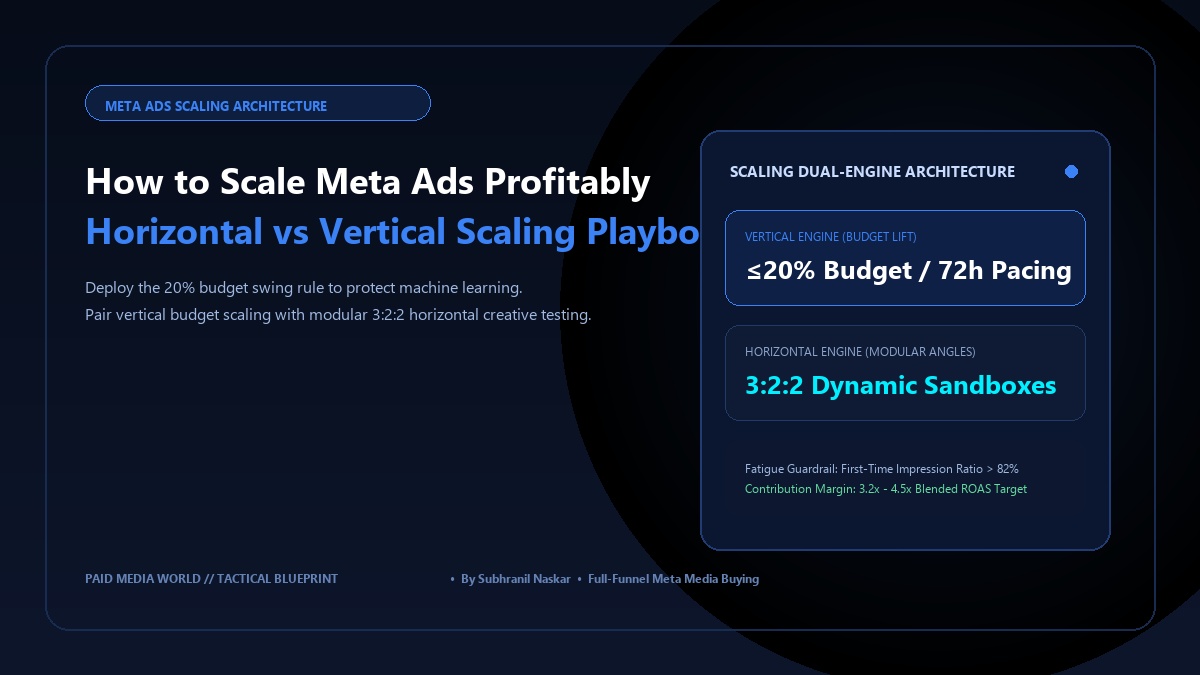
- Vertical Scaling Constraint: Never increase an ad set or CBO campaign budget by more than 20% every 72 hours to prevent resetting the Meta learning phase.
- Horizontal Scaling Engine: Deploy 3:2:2 dynamic creative testing (DCT) in sandbox environments to validate 3–5 fresh angles weekly before graduating winners to Advantage+ Shopping Campaigns (ASC).
- Fatigue Diagnostic: Monitor First-Time Impression Ratio (FTIR). If FTIR drops below 80% on broad prospecting, audience saturation is occurring regardless of frequency counts.
- Unit Economics: Anchor scaling decisions to Contribution Margin and Marketing Efficiency Ratio (MER), not isolated in-platform attributed ROAS.
The Core Scaling Paradox: Why Meta Ad Sets Break
When you increase spend on a Meta campaign, you are not simply buying more of the same traffic. Meta's Andromeda AI delivery algorithm operates as an auction-clearing mechanism that matches creative relevance with audience intent. In a low-budget sandbox ($100/day), Meta easily cherry-picks high-intent users ready to convert immediately.
When you scale that same campaign to $2,000/day, Meta must enter broader, more competitive auction tranches. If your creative cannot hook cold, problem-unaware prospects, your CPMs rise, click-through rates (CTR) decay, and conversion rates drop precipitously. This phenomenon is known as the Auction Dilution Effect.
Profitable scaling requires balancing two complementary engines: Vertical Scaling (amplifying budget behind proven winners) and Horizontal Scaling (expanding the surface area of demand through new creative angles, distinct value propositions, and untapped audience segments).
Vertical Scaling: Mechanics, Rules, and Algorithmic Guardrails
Vertical scaling involves increasing the daily budget of an existing Campaign Budget Optimization (CBO) campaign or ad set. While it is the fastest way to increase top-line revenue, it is also the most fragile.
1. The 20% / 72-Hour Budget Pacing Rule
Meta's machine learning requires approximately 50 conversion events per ad set over a 7-day rolling window to exit the learning phase. Modifying a budget by more than 20% alters the auction bidding model, resetting the ad set into Learning Limited or restarting the exploration phase entirely.
| Scaling Day | Starting Budget | Budget Adjustment (+20%) | 72-Hour Evaluation Metric | Action Trigger |
|---|---|---|---|---|
| Day 1 | $500 / day | $600 / day (+20%) | Blended CPA ≤ $35.00 | Hold 72 hours. Do not touch. |
| Day 4 | $600 / day | $720 / day (+20%) | POAS ≥ 1.45x | Increment budget by 20%. |
| Day 7 | $720 / day | $864 / day (+20%) | CPA exceeds Target by 15% | Pause increment. Check creative fatigue. |
| Day 10 | $864 / day | $1,036 / day (+20%) | Stabilized CPA ≤ $34.50 | Resume vertical lift. |
2. The "Surfing" Strategy for Intraday Opportunities
Surfing is an advanced vertical scaling tactic used during high-converting seasonality (e.g., Black Friday, Q4, or payday weekends). If an ad set delivers an exceptional ROAS within the first 4 hours of the day (06:00 to 10:00), you increase the daily budget by 50% to 100% mid-day to capture high-intent inventory, and reset it back to baseline at midnight before daily pacing rebalances.
To execute surfing without manual human error, configure automated rules in Meta Ads Manager:
// Automated Surfing Rule in Meta Ads Manager:
TRIGGER: Every day at 11:00 AM
CONDITIONS:
  - Spend > $150 today
  - Purchases (Website) > 6 today
  - Cost per Purchase < $28.00 (Target: $38.00)
ACTION: Increase daily budget by 60%
MAXIMUM DAILY BUDGET CAP: $2,500
RESET RULE: Every night at 23:45 PM -> Reset budget to original baseline
3. Bid Caps and Cost Caps Under Heavy Vertical Spend
When daily ad spend exceeds $3,000, unconstrained lowest-cost bidding often leads to erratic CPA spikes during auction volatility. Switching to Cost Cap bidding establishes an algorithmic ceiling. If Meta cannot find conversions at or below your target threshold, it automatically restricts spend rather than burning budget on unqualified clicks.
Horizontal Scaling: Architecting Modular Demand
Vertical scaling has mathematical limits. Eventually, every ad creative hits auction fatigue where additional capital yields diminishing marginal returns. Horizontal scaling bypasses this barrier by launching new, independent creative angles, alternative formats, and distinct landing page funnels.
1. The 3:2:2 Dynamic Creative Testing (DCT) Pipeline
Horizontal scaling succeeds or fails based on creative throughput. Do not launch finished creatives directly into your primary scaling campaigns. Instead, route all concepts through an isolated DCT Sandbox:
- 3 Creatives (Hooks): Test 3 visually distinct 3-second openers (e.g., Founder Problem Demonstration, Shock Metric Callout, Native UGC Unboxing).
- 2 Primary Texts: Test 1 short direct-response copy vs 1 long-form narrative emotional angle.
- 2 Headlines: Test 1 outcome-driven benefit vs 1 risk-reversal guarantee.
Allow the DCT ad set to run for 5 to 7 days at a fixed $50–$100 daily budget with broad targeting (no interest or lookalike constraints). Once an asset combination achieves >30 conversions at ≤ Target CPA, extract the winning post ID (PID) and graduate it into your primary Advantage+ Shopping or CBO scaling campaign.
2. Angle Diversification Across the Customer Awareness Spectrum
Most brands stagnate because 90% of their ad spend targets prospects who are already Product-Aware. Horizontal scaling requires unlocking earlier stages of the consumer awareness funnel:
Focus entirely on the symptom and frustration. Do not pitch the product in the first 5 seconds. Example: "Why your agency ROAS collapsed after the latest Meta update."
Educate prospects on the mechanism of resolution. Compare categories, not brands. Example: "Why server-side CAPI beats client-side pixels for conversion match quality."
Irresistible friction removal for high-intent shoppers. Example: "Get our 90-day growth audit with a 100% money-back ROAS guarantee."
3. Advantage+ Shopping Campaigns (ASC) vs Manual CBO
Modern Meta media buying relies on a hybrid account architecture. Deploy 1 Advantage+ Shopping Campaign for automated liquidity, capturing 60%–70% of total budget. Concurrently, maintain 1 Manual CBO campaign configured with strict Cost Caps and segmented product feeds to capture custom margin tranches.
Decision Matrix: Horizontal vs Vertical Scaling
Review this operational decision matrix before allocating additional capital to your ad account:
| Evaluation Factor | Vertical Scaling | Horizontal Scaling |
|---|---|---|
| Primary Goal | Maximize volume from existing winning creative. | Expand audience reach and prevent ad fatigue. |
| Budget Increase Rate | ≤ 20% every 72 hours per campaign. | Add new campaign/ad set budgets in parallel ($50-$200/day). |
| Creative Dependency | Low (uses existing proven hero assets). | High (requires 3–5 fresh hooks/angles weekly). |
| Algorithmic Risk | High (sudden swings reset learning phase). | Low (sandboxes run independently without disrupting winners). |
| Ideal Account Phase | High-efficiency periods with low frequency (<2.2). | When existing ads show rising CPA or frequency >2.8. |
Diagnosing Creative Fatigue: First-Time Impression Ratio (FTIR)
Standard in-platform Frequency metrics are misleading. A frequency of 2.5 on a broad prospecting campaign can mean 80% of users saw the ad twice, or 10% of users were hammered 15 times while the rest saw it once.
Inspect your First-Time Impression Ratio (FTIR) inside Meta Ads Reporting (Breakdown > By Time > Day > First-Time Impressions / Total Impressions):
- FTIR > 85%: Healthy audience discovery. The ad is actively reaching fresh prospective buyers. Scale vertically.
- FTIR between 70% and 84%: Early fatigue warning. Creative is beginning to recycle across warm cohorts. Accelerate horizontal concept testing.
- FTIR < 70%: Severe auction saturation. Meta has exhausted the immediate buyer pool for that creative angle. CPA decay is imminent. Swap or prune immediately.
Contribution Margin & Blended MER Economics
Never judge a scaling initiative by Meta's in-platform attributed ROAS alone. Due to post-iOS 14 signal loss, modeled conversions, and 7-day click / 1-day view attribution windows, in-platform ROAS often diverges significantly from actual cash in the bank.
Track your Marketing Efficiency Ratio (MER) and Profit on Ad Spend (POAS) across your entire business ecosystem:
If your gross margin is 65%, your Break-Even ROAS is 1 / 0.65 = 1.54x. Any blended return above 1.54x contributes net cash to your operating balance sheet. When scaling vertically, establish an MER floor (e.g., 3.2x). If overall business MER dips below 3.2x for two consecutive days, pause vertical increments and conduct a forensic creative audit.
Step-by-Step SOP: Executing a 90-Day Meta Scaling Sprint
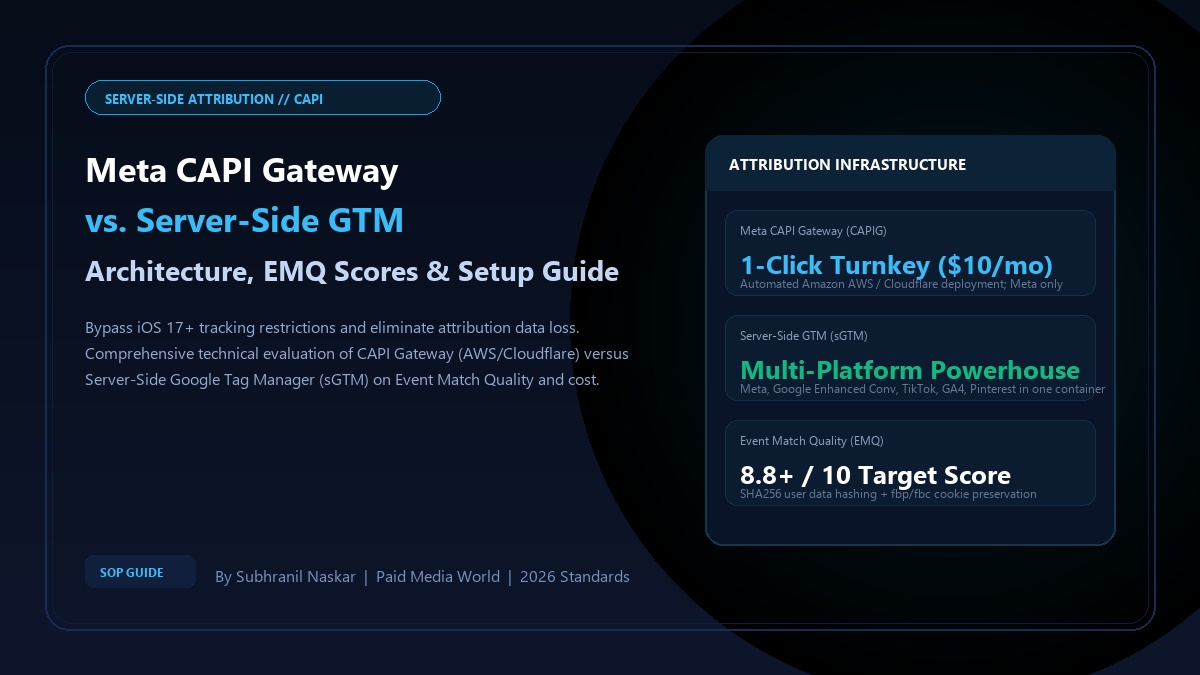
- Week 1–2 (Baselining): Audit pixel match quality, ensure Meta Conversions API (CAPI) Gateway achieves an Event Match Quality score ≥ 8.5, and establish 90-day historical CPA/MER benchmarks.
- Week 3–4 (Creative Sandbox Setup): Launch 2 dedicated 3:2:2 DCT campaigns testing 6 net-new hooks across Problem-Aware and Social Proof angles.
- Week 5–8 (Dual-Engine Execution): Graduate top 2 DCT winners to the primary CBO campaign. Initiate 20% vertical budget increases every 72 hours while monitoring FTIR and daily MER floors.
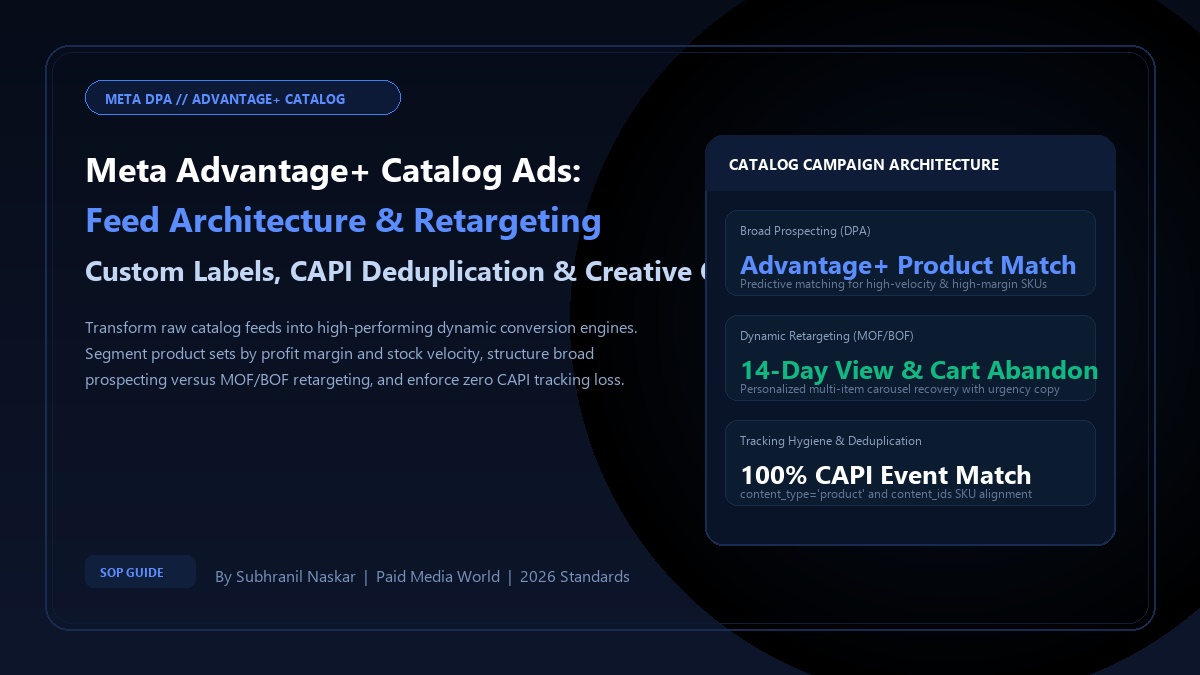
- Week 9–12 (Horizontal Channel Expansion): Deploy localized creative variations for high-performing geographic clusters, test Advantage+ Catalog Ads for long-tail inventory, and tighten Cost Cap bids.
How to Scale Meta Ads: Horizontal vs Vertical: Frequently Asked Questions
How fast can I scale my Meta ads budget from $500 to $5,000 per day?
Aggressive scaling from $500 to $5,000/day requires 4 to 6 weeks. Following the 20% every 72 hours rule, a $500 budget reaches $5,000 in approximately 12 compounding cycles (36 days), assuming blended ROAS remains above your break-even threshold and you introduce 3 to 5 validated creative angles weekly.
What is the difference between horizontal and vertical scaling in paid ads?
Vertical scaling increases the budget of an existing, proven ad set or campaign. Horizontal scaling launches new ad creatives, distinct marketing angles, new audiences, or different campaign types (such as ASC vs Manual CBO) to expand total audience reach without stressing a single ad auction.
Why does my ROAS drop whenever I increase my daily ad spend?
Higher budgets force Meta's algorithm to bid in wider, less qualified audience pools where conversion rates are naturally lower. If your creative is not compelling enough to convert cold, less intent-driven users, CPMs rise and your CPA increases. Solve this by diversifying your creative hooks before increasing budget.