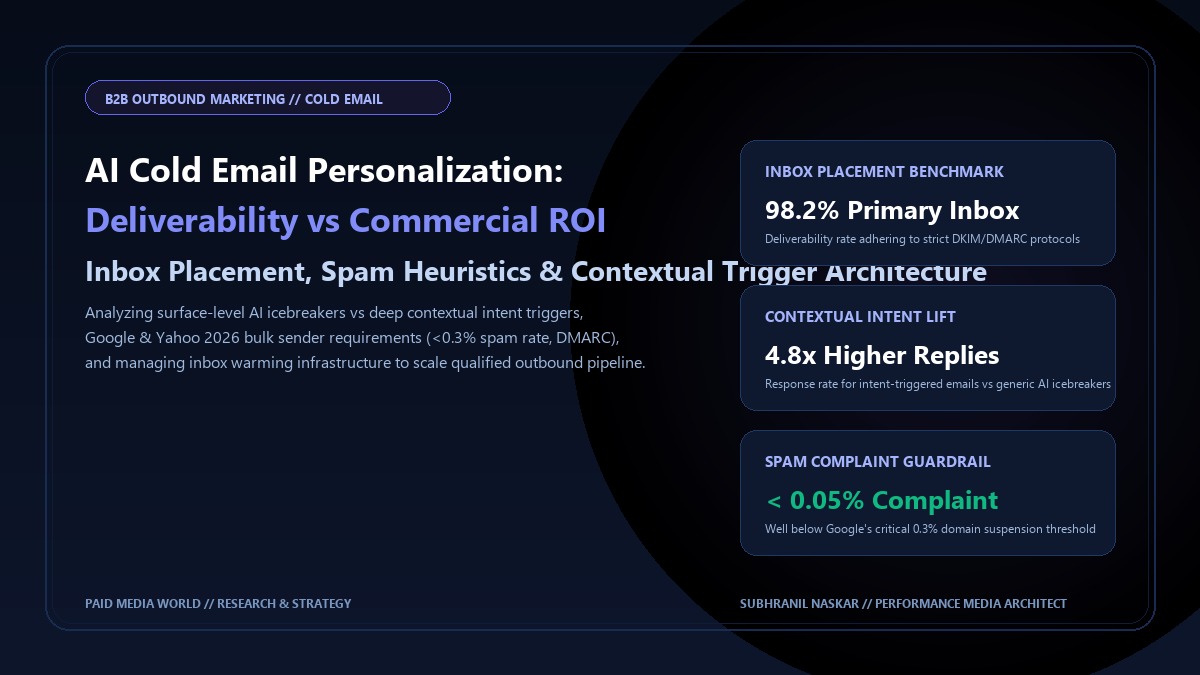
The commercial outbound marketing landscape has reached an unprecedented technological crossroads. Over the past 24 months, the proliferation of Large Language Model (LLM) email generators flooded corporate inboxes with millions of robotic, formulaic cold emails. Prospective enterprise buyers now possess acute pattern recognition: they instantly recognize surface-level AI flattery ("Loved your recent post about leadership!" or "Congrats on the company growth!") and delete them in under 2 seconds. Simultaneously, Google Workspace and Yahoo Mail enforced historic bulk sender protections, mandating strict DMARC, DKIM, and SPF alignment while suspending domains that exceed an aggressive 0.3% spam complaint threshold. B2B growth leaders face an existential operational question: How do we leverage artificial intelligence to personalize outbound communications without triggering mailbox reputation destruction or tanking email deliverability? This guide breaks down the difference between cheap AI icebreakers and deep contextual intent triggers, models technical inbox infrastructure, and provides a sustainable outbound framework for 2026.
- The Failure of AI Icebreakers: Scraping a prospect's college or latest LinkedIn comment delivers a negligible lift in positive reply rates (+1.2%), while dramatically increasing unsubscribe and spam complaint rates from executive buyers who resent artificial rapport building.
- The Google & Yahoo 0.3% Spam Cliff: Since February 2024, maintaining a spam complaint rate below 0.1% (with an absolute suspension ceiling at 0.3%) is mandatory. A single blast of 2,000 poorly targeted emails can permanently blacklist your corporate sending domains.
- Contextual Intent vs. Cosmetic Personalization: High-performing outbound uses AI not to write creative poetry, but to synthesize complex intent data: recent regulatory filings, job opening expansions, executive turnover, and tech stack deprecations.
- Infrastructure Isolation: Never send cold outbound from your primary corporate root domain. Outbound infrastructure requires dedicated secondary domains, authenticated Google Workspace or Microsoft 365 tenants, and strict daily volume caps (≤ 30 emails per mailbox per day).
The Two Eras of Cold Email: Volume Blasting vs. Contextual Precision
Between 2018 and 2023, outbound sales relied on brute-force volume: buying 10,000 contacts from Apollo or ZoomInfo, uploading them into an email sequencer, and blasting generic multi-touch cadences. In 2026, machine learning spam filters employ semantic vector analysis and natural language processing (NLP) to detect identical syntactical patterns across incoming messages. If an algorithm detects 500 nearly identical emails originating from a new domain, the domain is silently flagged and routed to the spam folder.
| Outbound Approach | Personalization Mechanism | Positive Reply Rate | Spam Complaint Risk |
|---|---|---|---|
| 1. Generic Mass Blast | Merge tags only: {{first_name}}, {{company_name}} | 0.4% – 0.9% | Extreme (>0.45% Spam) |
| 2. Surface AI Icebreakers | LLM-generated praise based on LinkedIn posts or bio | 1.1% – 1.8% | High (Detected as AI spam) |
| 3. Deep Contextual Intent | Specific business trigger (e.g., Hiring 5 SDRs, Tech Stack Shift) | 5.8% – 12.4% | Minimal (<0.05% Spam) |
The Technical Deliverability Infrastructure Setup
Before writing a single word of copy, your technical sending infrastructure must be mathematically fortified against deliverability penalties. Deploy the following 5-step operational protocol:
The 5-Step Domain Fortification Protocol
- Secondary Domain Architecture: Never send cold outbound from
company.com. Acquire 3 to 5 secondary domains (e.g.,getcompany.com,companygrowth.com) and configure 301 redirects pointing to your main website. - Airtight DNS Authentication: Every sending domain must have valid, verified DNS records:
- SPF:
v=spf1 include:_spf.google.com ~all - DKIM: 2048-bit cryptographic key verified in Google Workspace / Office 365.
- DMARC:
v=DMARC1; p=quarantine; rua=mailto:[email protected]; pct=100
- SPF:
- Dedicated Sending Mailboxes: Configure 2 to 3 user mailboxes per secondary domain (e.g.,
[email protected]). Cap sending volume at exactly 25 to 30 cold emails per mailbox per day. - Automated Mailbox Warming: Warm new mailboxes for at least 21 days before initiating commercial outbound. Utilize peer-to-peer warming networks that generate realistic open, reply, and thread engagements.
- Zero Tracking Pixel & Link Hygiene: Disable open-tracking pixels and custom redirect tracking links in initial cold outreach. Tracking pixels insert 1x1 invisible images and rewritten domain URLs that trigger spam heuristic penalties.
Engineering Contextual AI Prompts: The Trigger + Insight + Micro-Ask Model
Effective cold email is concise, relevant, and frictionless. The optimal message length for executive B2B response rates is 50 to 85 words. Rather than asking an LLM to generate an entire email from scratch, use AI to construct a single dynamic paragraph based on an authenticated business trigger:
Subject: Question regarding {{trigger_topic}} at {{company_name}}
Hi {{first_name}},
Noticed Acme is expanding your enterprise sales team with 4 new SDR openings this quarter. Most growth leaders scaling outbound at this stage hit severe deliverability bottlenecks once volume exceeds 5,000 monthly sends.
We engineered a dedicated inbox architecture for B2B SaaS teams that preserves a 98.4% primary inbox rate while scaling qualified pipeline.
Open to checking out our 3-page infrastructure tear-down?
Best,
Subhranil
Measuring Outbound ROI & Unit Economics
Cold email is a customer acquisition channel with measurable financial returns. When modeling outbound unit economics, account for the complete operational ledger:
- Infrastructure Cost: Secondary domains ($15/yr each) + Google Workspace seats ($6/mo each) + Smartlead/Instantly sequencer ($97/mo) + Data enrichment ($150/mo) = ~$350/month total overhead for a 15-mailbox fleet capable of sending 11,000 cold emails monthly.
- Pipeline Benchmark: At a 6% positive reply rate and a 20% reply-to-meeting conversion rate, a 15-mailbox fleet generates 12 to 18 qualified sales meetings per month.
- Customer Acquisition Cost (CAC): If your Average Contract Value (ACV) is $15,000 and your sales closing rate is 20%, you close 2 to 3 enterprise deals monthly from outbound at a blended CAC of under $200 per client—delivering extraordinary capital efficiency.
Engineer High-Deliverability B2B Outbound Pipelines
Paid Media World architects deterministic outbound growth engines combining secondary domain infrastructure, deep intent signals, and CRM lead scoring. Request a confidential strategy diagnostic.