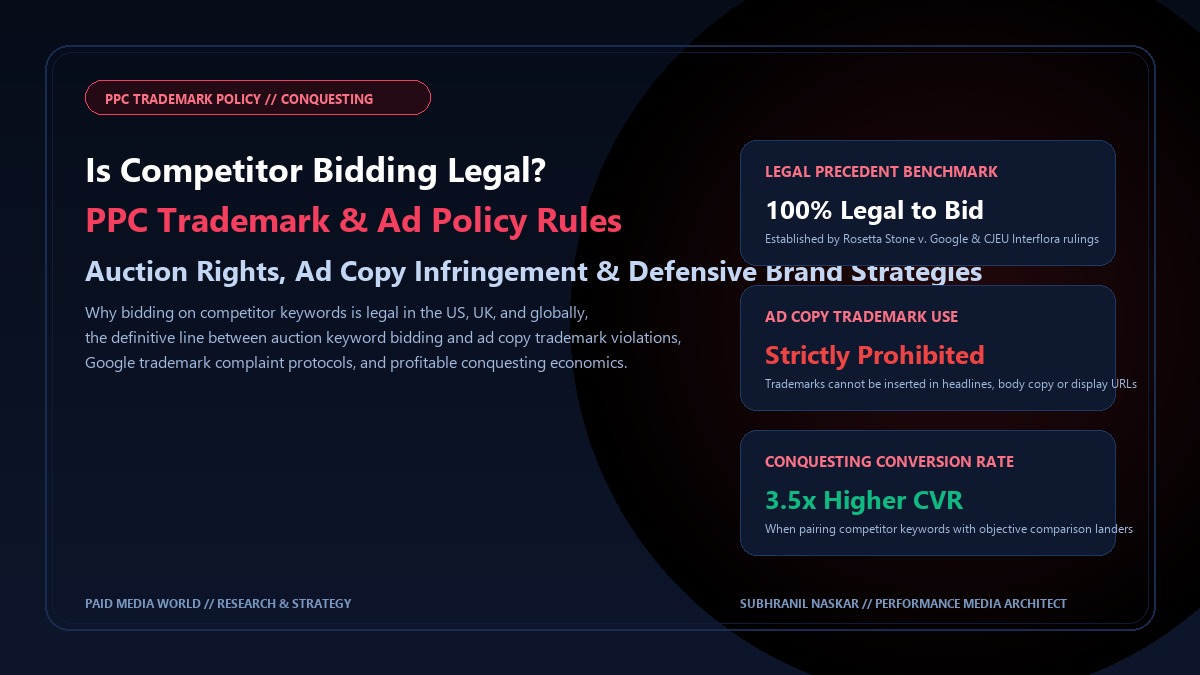
One of the most fiercely contested battlegrounds in paid search marketing is competitor conquesting: bidding on the registered trademarks, brand names, and flagship product titles of your direct commercial rivals. When a prospective buyer types a competitor's brand name into Google, capturing the #1 position above their organic listing can divert high-intent consideration directly to your platform. However, marketing directors and corporate counsel frequently ask: Is it legal to bid on competitor keywords in Google Ads? Does bidding on a trademarked brand name violate trademark infringement laws? What are Google's actual policies, and how can advertisers conquest competitor market share without risking legal disputes or ad account suspensions? This comprehensive legal and tactical guide unpacks landmark judicial rulings (including Rosetta Stone v. Google and Interflora v. Marks & Spencer), defines the critical boundary between keyword bidding and ad copy infringement, outlines Google's official Trademark Complaint procedures, and reveals when competitor bidding delivers profitable enterprise ROI.
- The Legal Reality: Bidding is 100% Legal: Federal courts in the United States, High Courts in the United Kingdom, and the Court of Justice of the European Union (CJEU) have established that buying a competitor's trademark as an internal search keyword does not constitute trademark infringement.
- The Red Line: Ad Copy Infringement: While bidding on the keyword is protected competition, you cannot use the competitor's trademark in your ad headline, description, or display URL in a manner that creates consumer confusion or implies commercial affiliation.
- Google's Trademark Policy: Google will not investigate or restrict the selection of trademarks as keywords. However, Google strictly enforces trademark restrictions inside ad text upon receiving a formal complaint from a verified trademark owner.
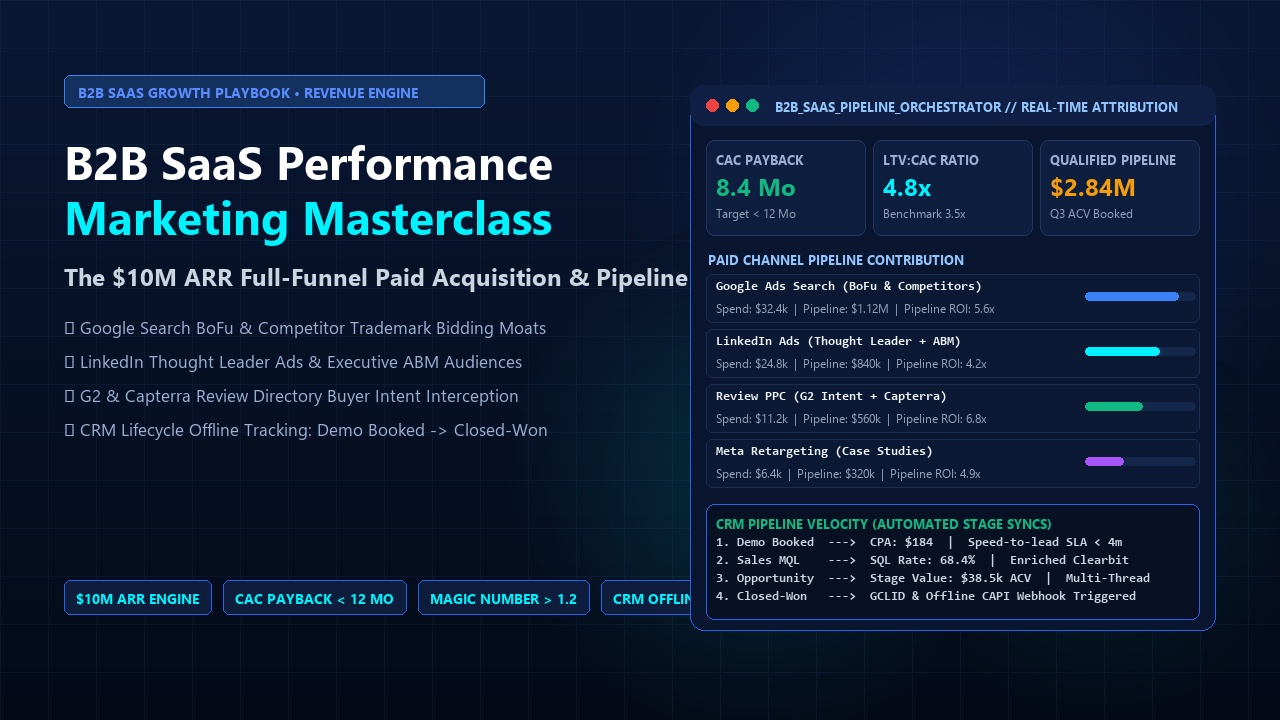
- The Conquesting Economic Threshold: Competitor keywords carry low Quality Scores (typically 1/10 to 3/10) and high CPCs. Conquesting is commercially viable only for high-LTV products ($10k+ ACV) or when targeting dissatisfied users actively seeking alternatives.
The Fundamental Legal Distinction: Keyword Bidding vs. Ad Text Infringement
To understand the legality of PPC conquesting, you must understand how trademark law intersects with search engine architecture. Under the US Lanham Act and international trademark treaties, trademark infringement requires proving a "Likelihood of Confusion"—that an ordinary consumer would reasonably believe your product was manufactured by, affiliated with, or endorsed by the trademark owner.
100% Legal: Bidding on the Keyword
Entering a competitor's trademark (e.g., [Salesforce] or "HubSpot alternative") into your Google Ads keyword list is completely lawful. The consumer searches for a brand; Google presents your advertisement as an alternative choice. The keyword is an internal auction trigger invisible to the consumer.
Strictly Prohibited: Trademark in Ad Copy
Writing an ad headline that reads "Official Salesforce Portal" or "HubSpot CRM Login" is unlawful trademark infringement. Inserting a rival's trademark in headlines or display URLs deceives users into believing they are clicking on the competitor's website.
Landmark Legal Precedents: How the Courts Ruled
The legal framework governing PPC competitor bidding was forged through major precedent-setting cases across multiple continents:
- Rosetta Stone Ltd. v. Google, Inc. (US 4th Circuit Court of Appeals): Rosetta Stone sued Google, claiming that allowing competitors to bid on "Rosetta Stone" infringed their trademark rights. The courts affirmed that utilizing trademarks as internal indexing keywords does not per se violate the Lanham Act, provided the resulting advertisements do not create consumer confusion regarding origin.
- Interflora Inc. v. Marks & Spencer plc (Court of Justice of the European Union): British retailer Marks & Spencer bid on the keyword "Interflora" to promote their flower delivery service. The European Court of Justice ruled that competitor keyword bidding is a legitimate form of fair competition that offers consumers alternatives, provided the ad allows an average internet user to discern that the goods originate from a separate company.
- BharatMatrimony v. Google India & Consim Info (Madras High Court / Supreme Court of India): Indian courts similarly established that bidding on competitor brand names as search keywords does not constitute infringement under the Indian Trade Marks Act 1999, upholding the right of businesses to advertise comparative alternatives.
Google's Official Trademark Policy Explained
Google maintains an explicit distinction between keywords and creative copy in its advertising guidelines:
| Ad Component | Google Policy Stance | Investigation & Action Trigger |
|---|---|---|
| Keywords | Allowed Without Restriction | Google will NOT investigate or disable competitor keywords, even upon trademark complaint. |
| Ad Text (Headlines & Body) | Restricted Upon Valid Complaint | If trademark owner files a formal complaint, Google will disapprove ads containing the trademark. |
| Display URL Subdomain/Path | Allowed in Path Only | Allowed in descriptive path (yoursite.com/competitor-alternative); disallowed in main domain. |
| Dynamic Keyword Insertion (DKI) | HIGH RISK TRAP | Using {KeyWord:Default} dynamically injects the trademark into your ad headline, violating policy. |
The 3 Legitimate Exceptions: Resellers, Parts & Comparative Sites
Under Google's Reseller and Informational Site Policy, you can use a trademark in ad text under three strict conditions:
- Authorized Resellers: The ad's landing page is dedicated primarily to selling the trademarked goods, products, or replacement parts.
- Informational & Review Sites: The landing page provides objective commercial reviews, benchmarks, or informational directories comparing the trademarked entity.
- Nominative Fair Use: The ad uses the trademark purely to describe compatibility (e.g., "Cases engineered for iPhone 16" or "Replacement filters compatible with Airdog X5").
The Economics of Competitor Conquesting: When Does It Make Financial Sense?
Bidding on competitor keywords carries inherent algorithmic friction. Because your domain does not match the search term, Google assigns a low Expected Click-Through Rate and Low Ad Relevance, penalizing the keyword with a Quality Score of 1/10 to 3/10. Consequently, your Cost Per Click (CPC) will be 2x to 4x higher than normal non-brand search.
Competitor conquesting delivers profitable net return under three specific commercial scenarios:
In enterprise B2B SaaS where winning a single customer generates $30,000 in gross margin, paying $25 per click on a competitor's exact match name is highly profitable even at a modest 2% lead conversion rate.
When a competitor doubles their subscription prices or experiences a major public server outage, search volume for "[Competitor] alternative" surges. Conquesting during this window yields extraordinary conversion rates.
Never route competitor clicks to your generic homepage. Direct them to an objective, side-by-side feature comparison lander (/compare/us-vs-them/) that addresses the competitor's known product weaknesses.
Conquer Competitor Market Share Legally & Profitably
Paid Media World engineers high-converting competitor conquesting architectures, ensuring complete trademark policy compliance while capturing high-intent enterprise pipeline. Request a strategy audit.