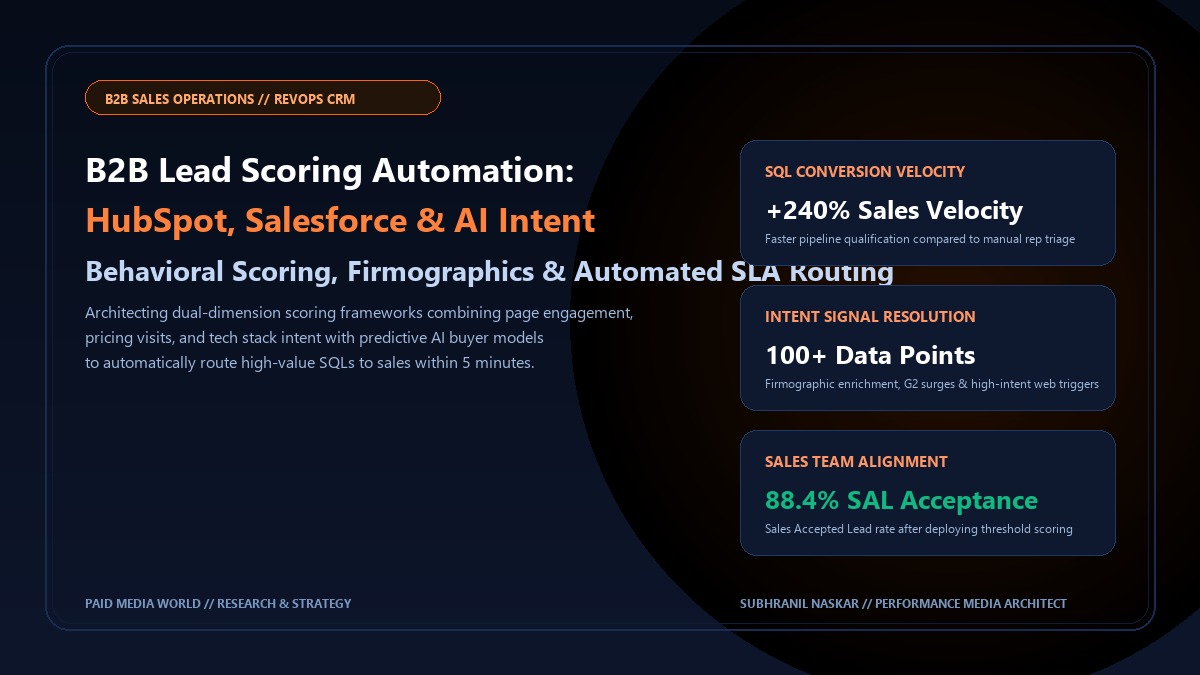
In high-velocity B2B software and enterprise service sales, the single largest driver of stalled pipeline and customer acquisition cost (CAC) inflation is not lead volume—it is the catastrophic mismatch between marketing lead generation and sales development representative (SDR) follow-up velocity. Research across 100,000+ enterprise inbound inquiries reveals that contacting a prospective buyer within 5 minutes of high-intent qualification yields a 391% higher conversion-to-opportunity rate compared to waiting 30 minutes. Yet, most B2B sales organizations force reps to manually sift through hundreds of low-intent webinar attendees, student researchers, and personal Gmail downloads. Automated B2B Lead Scoring bridges this gap by unifying explicit firmographic data, real-time behavioral signals, and third-party AI intent into an automated qualification engine. This technical playbook outlines the exact 100-point scoring matrix, HubSpot and Salesforce workflow schemas, automated SLA routing rules, and closed-loop feedback frameworks required to build an autonomous pipeline engine.
- The Decay of Speed-to-Lead: Inbound conversion rates decay by over 80% after the first 10 minutes. Without automated scoring, sales reps waste 65% of their working hours calling unqualified leads who will never convert into paying customers.
- The Dual-Axis Scoring Engine: High-performing RevOps architectures never rely on a single score. They separate scoring into Fit (Firmographic/Demographic) and Interest (Behavioral/Intent), creating a 4-quadrant routing matrix (Fast-Track SQL vs Marketing Nurture vs Disqualification).
- AI Intent Enrichment: Incorporating external surge signals (G2 category comparisons, Bombora topic spikes, job board hiring velocity) identifies accounts in an active buying cycle weeks before they fill out a website contact form.
- The Closed-Loop Feedback Mandate: Marketing must measure the Sales Accepted Lead (SAL) rate. When reps reject leads scored as "SQL", machine learning models and threshold rules must automatically adjust point weights to eliminate sales friction.
The Dual-Axis Lead Scoring Model: Fit vs. Interest
A common failure mode in HubSpot or Marketo implementations is combining all criteria into a single cumulative integer. For example, a student from an academic institution who downloads 10 whitepapers might amass 80 points, triggering an urgent SDR task for an account with zero revenue potential. Conversely, a Fortune 500 VP of Infrastructure who visits your pricing page once might only score 25 points and be ignored.
To solve this, implement a dual-axis matrix that evaluates prospective buyers across two independent vectors:
Dimension A: Firmographic Fit (0 to 100 Points)
Measures whether the company and contact match your Ideal Customer Profile (ICP). Attributes include company headcount, annual revenue, industry vertical, tech stack integrations, and decision-maker job seniority.
Dimension B: Behavioral Intent (0 to 100 Points + Decay)
Measures real-time commercial purchase intent. Attributes include pricing page frequency, product documentation engagement, security whitepaper downloads, webinar attendance, and third-party G2 review activity.
The 100-Point Scoring Framework Matrix
The following master rubric provides calibrated point weights across positive intent signals and negative disqualifiers:
| Signal Category | Trigger / Condition | Point Weight | Operational Context |
|---|---|---|---|
| Job Seniority (Fit) | C-Level, VP, or Head of Department | +25 Points | Primary budget holder and executive decision-maker |
| Company Headcount (Fit) | 50 to 1,000 Employees (Core Mid-Market/Enterprise) | +20 Points | Highest contract retention and expansion LTV |
| High-Intent URL (Intent) | Visited /pricing/ or /enterprise-quote/ >= 2x in 7 days | +30 Points | Direct commercial evaluation signal |
| Technical Validation (Intent) | Viewed API Documentation or Security Architecture | +15 Points | Indicates active implementation scoping |
| Third-Party Intent (AI) | G2 Comparison View or 6sense High-Surge Spike | +20 Points | Competitor evaluation outside your owned web properties |
| Disqualification (Negative) | Free Webmail Domain (gmail.com, yahoo.com, hotmail.com) | -35 Points | Low commercial validity; route to self-serve nurture |
| Disqualification (Negative) | Visited /careers/ or Job Application Pages | -50 Points | Job seeker, not a commercial enterprise software buyer |
| Inactivity Decay (Negative) | Zero web sessions or email opens for 30 consecutive days | -20 Points | Automated monthly depreciation to prevent stale triggers |
Automated Routing & The 5-Minute SDR SLA Architecture
A lead scoring system is commercially useless if it merely populates an analytical report. Its primary function is to trigger automated operational workflows. When a prospect's combined score crosses your qualification threshold (typically Fit >= 50 AND Intent >= 45), execute the following automated routing sequence:
The Sales-Marketing Feedback Loop: Tracking SAL & Model Optimization
The fatal error in lead scoring is treating weights as static rules. To ensure continuous accuracy, establish weekly reconciliation between Marketing and Sales operations based on three metrics:
- Sales Accepted Lead (SAL) Rate: The percentage of marketing-generated SQLs that sales reps accept and begin actively working within 24 hours. The benchmark for a healthy scoring engine is 85% or higher. If SAL falls below 75%, sales reps believe marketing is passing low-quality leads, indicating that firmographic thresholds are set too loosely.
- Disqualification Reason Tagging: Require sales reps to select a structured disqualification reason in the CRM whenever they reject a lead (e.g., Budget Too Low, Wrong Persona, No Buying Intent, Competitor/Student). Use these tags to programmatically adjust negative scoring rules.
- Opportunity Velocity: Compare how fast leads with scores > 80 progress through the sales pipeline compared to leads scored between 50 and 79. Calibrate point weights until high scores directly correlate with shortened sales cycles and higher average contract values.
Engineer Automated Lead Scoring & Sales Acceleration
Paid Media World builds high-intent lead generation architectures that integrate paid media acquisitions directly into automated HubSpot and Salesforce RevOps scoring engines. Request a pipeline audit to eliminate sales friction.