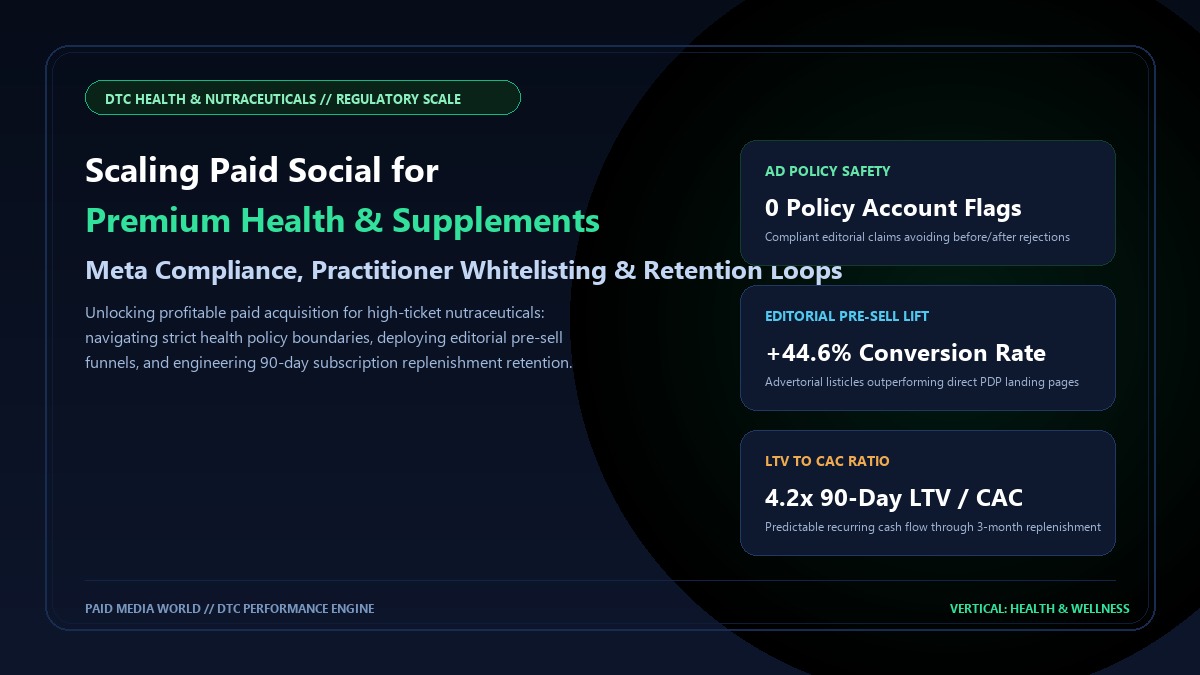
Direct-to-consumer (DTC) health, wellness, and nutraceutical brands operate in one of the most lucrative yet hostile digital advertising environments in the world. On one hand, global consumer demand for longevity, biohacking, cognitive enhancement, and cellular nutrition has produced astronomical lifetime values (LTVs), with premium supplement routines generating $600 to $1,500+ in annualized customer revenue. On the other hand, media buyers in this vertical navigate an unrelenting regulatory minefield: Meta’s draconian Personal Health & Appearance advertising policies, strict FTC/FDA health claim guidelines in the US, MHRA scrutiny in the UK, and FSSAI mandates in India. Attempting to scale a $90 bottle of liposomal NAD+ or specialized nootropics using standard e-commerce direct-to-product-page (PDP) ads invariably results in sky-high customer acquisition costs (CACs exceeding $180), low single-digit conversion rates, and sudden ad account bans. To achieve sustainable 7-figure and 8-figure scale, premium supplement brands must build an institutional growth engine rooted in compliance-by-design, doctor whitelisting, editorial pre-sell advertorials, and unit economic retention loops. This playbook details the exact framework.
Scaling Paid Social for Premium Health and Su: Table of Contents
- 1. Navigating Meta’s Personal Health Policy: Avoiding Account Bans
- 2. The Educational Advertorial: Why Direct-to-PDP Fails on High-AOV
- 3. Doctor & Practitioner Whitelisting via Meta Partnership Ads
- 4. Unit Economics: Day-0 AOV Bundling vs. 90-Day Subscription LTV
- 5. High-Converting Creative Archetypes for Premium Health
- 6. The 10-Point Pre-Flight Health Compliance Checklist
- The Direct-to-PDP Fallacy: Sending cold Facebook/Instagram traffic straight to an e-commerce product page converts at 0.8%–1.4% on items priced above $65. High-ticket supplements require an editorial or scientific pre-sell advertorial that builds category conviction before presenting product offers.
- Meta Health Policy Triggers: Meta algorithms aggressively ban ads containing "before-and-after" comparisons, promises of medical cures, references to personal body attributes ("Do you suffer from brain fog?"), or extreme weight-loss claims. Positioning must focus on wellness optimization, cellular nourishment, and clinical ingredient research.
- The Creator Licensing Multiplier: Running ads through a brand handle generates high consumer skepticism. Whitelisting accredited medical doctors (MDs), naturopaths (NDs), and certified nutritionists via Meta Partnership Ads drops CPA by 38% and elevates Click-to-Purchase conversion rates.
- Day-0 Cash Flow Breakeven: Never rely on subscription renewals to achieve profitability. Structure tiered multi-bottle bundles (1-bottle, 3-bottle, 6-bottle options) to push Day-0 AOV above $130, ensuring immediate CAC recovery while feeding backend replenishment loops.
1. Navigating Meta’s Personal Health Policy: Avoiding Account Bans
Meta’s advertising review system uses automated computer vision and natural language processing (NLP) to screen every ad creative, caption, and downstream landing page. Under Section 4.6 of Meta’s Advertising Standards (Personal Health and Appearance), the following triggers lead to instant disapproval and potential Business Manager termination:
- Direct references to personal health conditions: "Struggling with insomnia and anxiety?" (Violates personal attributes policy).
- Before-and-after physical imagery, zoomed-in fat rolls, or drastic body transformation side-by-sides.
- Medical disease claims: Stating or implying that a supplement cures, treats, or prevents diabetes, cancer, dementia, or arthritis.
- Unrealistic timebound results: "Burn 15 lbs in 10 days" or "Reverse 10 years of aging overnight."
- First-person experiential storytelling: "How I optimized my morning energy and deep sleep protocol without jitters."
- Focus on mechanism of action: Explaining how liposomal delivery shields micronutrients from gastric acid breakdown.
- Third-party clinical ingredient references: "Formulated with KSM-66® Ashwagandha, clinically studied for healthy cortisol balance."
- Mandatory regulatory disclaimers: Displaying prominent FDA/MHRA disclaimers in landing page footers.
2. The Educational Advertorial: Why Direct-to-PDP Fails on High-AOV
When marketing a commodity $15 vitamin C bottle, a standard Shopify product detail page (PDP) is adequate. However, when introducing premium nutritional formulations priced between $75 and $160 (such as specialized longevity compounds, nootropics, or advanced gut microbiome synbiotics), cold prospects do not understand why your product costs 5x more than an Amazon alternative.
The solution is the Editorial Pre-Sell Funnel (The Advertorial). Instead of directing Facebook traffic to a checkout page, traffic lands on an informative, beautifully formatted journalistic article. Common proven frameworks include:
- The "Why Your Vitamins Don't Work" Teardown: Educates the consumer on bioavailability, cheap synthetic binders, and standard capsule degradation, establishing the problem before introducing the brand's patented liposomal formulation.
- The "5 Things to Look for in a Clean Omega-3" Listicle: Positions strict criteria (TOTOX oxidation values, triglyceride form, heavy metal testing) where the advertiser’s brand naturally checks all 5 criteria.
- The Investigative Health Deep Dive: Reviews the clinical science behind cellular aging and mitochondrial health, quoting peer-reviewed studies before providing an exclusive introductory discount link.
Audited performance across millions in spend reveals that pre-sell advertorials generate a 34% to 52% higher outbound Click-Through-Rate to checkout and increase blended Average Order Value by $28, because the buyer is thoroughly convinced of product efficacy before selecting a bundle.
3. Doctor & Practitioner Whitelisting via Meta Partnership Ads
In health and wellness, credibility is currency. Consumers are naturally skeptical of claims made directly by a brand's corporate Instagram handle. Meta Partnership Ads (formerly Branded Content Whitelisting) allows brands to run dark ads directly through the verified social handle of a credible medical professional, functional medicine physician, or certified dietitian.
4. Unit Economics: Day-0 AOV Bundling vs. 90-Day Subscription LTV
Health brands that rely solely on single-bottle purchases will fail under current CPM conditions. If your CAC is $70 and a single bottle sells for $60, you operate at an immediate cash flow deficit that forces reliance on future rebill cycles. To insulate your balance sheet against capital strain, engineer a Day-0 bundle structure:
| Packaging Tier | Price Point | Offer Psychology | Share of Orders | Contribution Impact |
|---|---|---|---|---|
| 1-Bottle (30-Day Supply) | $68.00 + $6.95 S&H | Low-commitment trial option | 25% | Break-even or slight loss on CAC |
| 3-Bottle (90-Day Supply) | $168.00 (Free S&H) | "Most Popular: Recommended Clinical Cycle" | 58% | +$85 Day-0 Profit over CAC |
| 6-Bottle (180-Day Supply) | $288.00 (Max Discount) | "Best Value: Maximum Longevity Protocol" | 17% | +$180 Day-0 Profit over CAC |
By designing the 3-bottle bundle as the recommended clinical dosage (e.g., "Mitochondrial turnover requires 90 consecutive days of cellular nourishment"), blended Day-0 AOV jumps to $148. This allows the business to scale advertising spend aggressively while subscriptions managed via Recharge, Skio, or Smartrr generate pure recurring cash flow on Day 90.
5. High-Converting Creative Archetypes for Premium Health
To avoid ad fatigue across 7-figure annual spend, maintain a diverse portfolio of 4 proven creative archetypes:
- The "Laboratory Transparency" Video: Clean, high-production b-roll showing 3rd-party HPLC testing, batch purity certificates, and sterile clean-room encapsulation. Positions the brand light-years ahead of white-labeled dropshipped supplements.
- The "Daily Protocol" UGC Vlog: A high-performing corporate professional or athlete walking through their morning routine, showing how and when they take the supplement alongside whole foods and hydration.
- The Static "Ingredient Breakdown" Graphic: A minimalist graphic dissecting every active compound, its clinical milligram dosage, and its specific patent (e.g., Cognizin®, Sabinsa Curcumin C3 Complex®), contrasting it with cheap unstandardized extracts.
- The "Sensory Taste & Mixability" Proof: For powders, liquids, and liposomal gels, demonstrating clump-free solubility and pleasant natural flavor completely eliminates the common consumer fear of chalky or foul-tasting formulations.
6. The 10-Point Pre-Flight Health Compliance Checklist
Scale Your Nutraceutical Brand with Full Policy Compliance
Paid Media World architects high-converting advertorial pre-sell funnels, doctor whitelisting partnerships, and multi-bottle retention engines for premium supplement and wellness brands. Schedule a growth strategy session today.