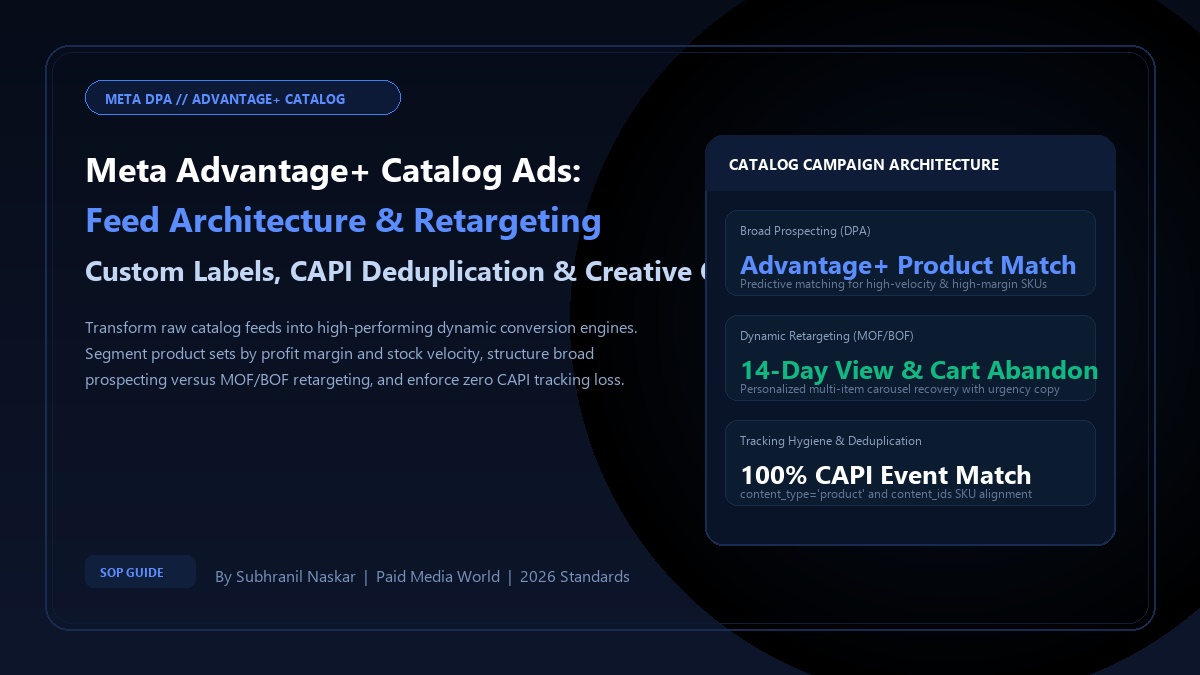
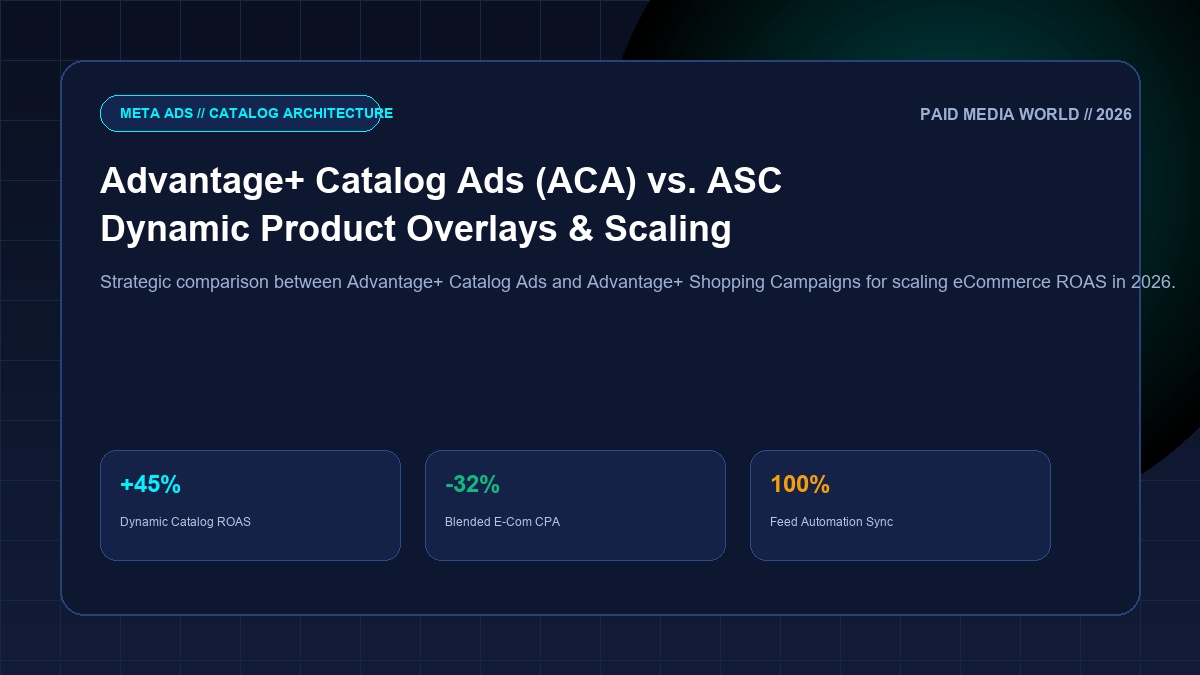
When a DTC brand scales a catalog past 2,000 to 50,000+ SKUs on Meta Advantage+ Catalog Ads (formerly Dynamic Product Ads or DPA), performance teams routinely run into a silent profit-draining wall: the 80/20 algorithmic catalog trap. Meta's delivery algorithms naturally reward click velocity and low-friction conversion rates. As a consequence, the machine learning auction gravitates toward your cheapest 15 to 25 bestseller products—items that sell effortlessly with low price points but frequently carry paper-thin 15% to 25% gross margins. Meanwhile, your high-margin flagship collections (65%+ gross margin) sit dormant with zero impressions. This technical guide outlines the exact custom label architecture, catalog filtering logic, and multi-feed bid strategies required to force Meta to hunt for high gross-profit conversions across massive e-commerce inventories.
- The Zombie SKU Trap: In an unsegmented catalog of 2,000+ items, Meta routinely allocates 80% to 90% of total ad spend to fewer than 1.5% of products, starving your long-tail high-margin inventory of auction data.
- Custom Label Taxonomy: Implementing Custom Labels 0 through 4 allows you to pass real-time contribution margin percentages, stock depth, seasonality velocity, and RTO (Return to Origin) probability directly into Commerce Manager.
- Bifurcated Campaign Architecture: Never run a generic "All Products" product set in an uncapped Advantage+ Shopping Campaign. Separate your catalog into Margin-Tiered Product Sets with distinct CPA and tROAS bid constraints.
- Dynamic Creative Overlays: Ingest automated price badges, crossed-out MSRPs, and margin-protected promotional tags using dynamic catalog image templates to increase high-margin item CTR by 28% to 45%.
The Anatomy of the 80/20 Catalog Trap in Meta Ads
Meta's algorithmic auction operates under an expected value maximization equation: eCPM = Bid × Estimated Action Rate (EAR) + User Value. When an ad account launches an Advantage+ Catalog campaign containing an entire product catalog, the system conducts initial exploratory testing. Low-ticket items (e.g., $18 phone cases, $22 cotton tees, or $15 beauty balms) convert at significantly higher raw rates (EAR) than $140 cashmere knitwear or $350 solid-oak coffee tables.
Because Meta's primary auction goal is to secure the conversion event designated at the ad set level (typically standard Purchase), the machine learning engine quickly determines that serving the $18 item yields the lowest cost-per-acquisition (CPA). The algorithm enters a positive feedback loop: more budget is channeled to the bestseller, generating more signals, which cements its dominance. Within 14 days, the remaining 1,980 SKUs become "Zombie Products"—products that are active in the feed but receive less than 10 impressions per week.
| Catalog Metric | Default Unsegmented Catalog | Margin-Engineered Catalog |
|---|---|---|
| Active SKU Share Receiving Spend | < 2% (20 - 40 SKUs) | 25% - 40% (500 - 800 SKUs) |
| Blended Gross Margin % | 22% - 32% (Low-Margin Dominated) | 54% - 68% (Profit Protected) |
| Average Order Value (AOV) | $34 - $48 | $88 - $145 |
| Net Contribution Margin (NCM) | 8% - 14% of Revenue | 26% - 38% of Revenue |
| Stockout Vulnerability | Severe (Over-sells top 20 items) | Resilient (Balanced warehouse draw) |
The 5-Tier Custom Label Architecture for Large Catalogs
To overcome this algorithmic bias, performance media buyers must inject first-party unit economics into the product feed. Meta Commerce Manager supports five custom attributes: custom_label_0 through custom_label_4. In large catalogs of 2,000+ items, these fields must be rigorously mapped to financial and operational realities:
Gross Contribution Margin Tiers
Calculated as (Retail Price - COGS - Estimated Shipping - Packaging) / Retail Price. Tagged as:
• High_Margin_65Plus: Gross margin ≥ 65%. Receives the primary prospecting budget.
• Mid_Margin_40_64: Gross margin between 40% and 64%. Secondary scaling tier.
• Low_Margin_Sub40: Gross margin < 40%. Restricted strictly to retargeting and excluded from cold prospecting.
Historical Sales Velocity & Zombie Identification
Calculated from 30-day ERP or Shopify sales data:
• Bestseller_Top50: Top 50 revenue drivers. Capped in ad sets to prevent budget cannibalization.
• Steady_Mover: Consistent sales without auction dominance.
• Cold_Zombie: Fewer than 3 sales in 30 days. Routed to a dedicated high-creative "Catalog Revival" test set.
Inventory Depth & Size Integrity
Monitors variant health:
• Full_Inventory: All core sizes/variants have ≥ 5 units in warehouse stock.
• Broken_Sizes: More than 50% of core variants sold out. Auto-excluded from high-CPA prospecting campaigns.
• Clearance_Deep_Stock: Discontinued lines with massive overstock; pushed via cost-cap clearing sets.
Return Rate & Return-to-Origin (RTO) Risk
Critical for fashion, footwear, and cash-on-delivery (COD) markets:
• Low_Return_Sub12: Return rate < 12%. Safe for aggressive top-of-funnel scaling.
• High_Return_Over28: Return rate > 28% (e.g., delicate apparel, structured shoes). Target ROAS must be adjusted upwards by +0.8x to preserve profitability.
Automated Stop-Loss Governance
Dynamic programmatic flag:
• Active_Eligible: Meets all margin, inventory, and efficiency thresholds.
• Suppressed_StopLoss: Product spent > 2.5x Target CPA in the last 7 days with 0 purchases. Automated rules suppress this SKU across all ad sets.
How to Configure Margin-Engineered Product Sets in Commerce Manager
Once your automated feed tool (such as Socioh, AdYogi, Feedonomics, or a custom Shopify GraphQL sync) populates the custom labels, create structured Product Sets within Meta Commerce Manager:
- Primary Prospecting Engine (High-Margin & Full Stock): Filter where
custom_label_0 = High_Margin_65PlusANDcustom_label_2 = Full_InventoryANDcustom_label_4 != Suppressed_StopLoss. This set receives 60% of your total Advantage+ Catalog budget. - Bestseller Volume Driver (With Spend Guardrails): Filter where
custom_label_1 = Bestseller_Top50ANDcustom_label_2 = Full_Inventory. Run this set in a separate ad set or campaign with a strictly defined budget cap or a conservative Target ROAS rule to ensure it does not siphon the rest of the catalog's airtime. - DPA Retargeting & Upsell (Full Catalog with Exclusions): Filter where
custom_label_2 != Broken_Sizes. Only products with full variant availability are eligible to be retargeted to users who viewed products or added to cart in the past 14 days. - Clearance & Inventory Liquidation: Filter where
custom_label_2 = Clearance_Deep_Stock. Paired with Bid Caps or Cost Caps set at break-even ROAS to monetize stagnant warehouse capital without eating high-intent conversion budget.
Expert Media Buying Tip
Never add newly launched SKUs directly into a high-spend Advantage+ Shopping Campaign alongside established bestsellers. Meta's learning models evaluate historical click-through rates; brand-new products with zero data will be starved of impressions. Instead, create an "Incubation Product Set" (products launched within the last 21 days) and run them in a dedicated Dynamic Creative testing ad set with manual bids until each SKU logs 30+ conversion signals.
Dynamic Creative Overlays: Elevating Catalog Conversion Rates
Standard dynamic catalog ads typically display raw white-background e-commerce product photos. On mobile feeds (Instagram and Facebook), these look sterile and fail to communicate value propositions. By integrating dynamic template software (such as Marpipe, Socioh, or Smartly.io), you can programmatically inject high-contrast design overlays directly onto feed images without editing 2,000 individual graphics:
- Profit-Protected Promotional Badges: Dynamically render badges like "Buy 2, Get Free Priority Shipping" or "Exclusive 25% Margin Member Bundle" solely on items where
custom_label_0 = High_Margin_65Plus. - Social Proof & Review Stars: Map your customer review platform (Yotpo, Okendo, or Judge.me) to your feed so that products with a 4.7+ star rating dynamically display golden star icons and review counts on the image card.
- Low-Stock Urgency Banners: For items with between 3 and 8 remaining units, dynamically display a subtle urgency pill: "Only 4 Units Left in Warehouse", driving immediate checkout velocity.
Real-World Case Study: DTC Home & Living Brand (3,200 SKUs)
A leading home furnishings brand managing 3,200 active SKUs spent $95,000 monthly on Meta Advantage+ Catalog campaigns. Their historical performance was characterized by extreme catalog concentration:
- Just 14 tabletop decor products (priced at $16 to $24 with 22% gross margins) soaked up 82% ($77,900) of the monthly ad spend.
- Top-line ad account ROAS hovered at 2.85x, but after accounting for packaging, free shipping thresholds, and product COGS, the company's Net Contribution Margin on Meta spend was a meager 11.2% ($30,300 net cash profit).
- The brand's signature solid-wood dining tables and upholstered bed frames ($450 to $1,200 with 68% gross margin) logged fewer than 120 impressions combined.
The Restructuring Protocol:
- Automated Feed Enrichment: Integrated real-time ERP gross margins into
custom_label_0and inventory depth intocustom_label_2. - Catalog Division: Built three distinct product sets: High-Margin Furniture (65%+ Margin), Core Decor (45%-64% Margin), and Impulse Bestsellers (Sub-40% Margin).
- Campaign Allocation: 65% of the prospecting budget was directed into the High-Margin set with dynamic lifestyle room overlays. The low-margin impulse set was moved to a restricted CBO campaign with a strict $12,000 spend ceiling.
- Variant Integrity Filter: Any item missing more than one standard finish or fabric option was immediately pushed into
custom_label_2 = Broken_Sizesand suppressed from prospecting.
60-Day Audited Results: While overall ad account ROAS remained virtually identical (2.92x vs 2.85x), the underlying financial outcome transformed entirely. Average Order Value escalated from $38.50 to $114.20. The number of active purchasing SKUs expanded from 14 to 286. Most crucially, Net Contribution Profit surged from $30,300 to $74,800 per month—a 146.8% increase in cold cash generated on identical media spend.
7-Point Technical Checklist for Large-Catalog Meta Delivery
content_ids parameter passed in your ViewContent, AddToCart, and Purchase CAPI payloads exactly matches the feed's id field (SKU vs Variant ID).
Is Your Meta Catalog Burning Ad Spend on Low-Margin Bestsellers?
Book an omnichannel media buying audit with Subhranil Naskar. We analyze your product catalog distribution, audit pixel and CAPI match quality, and build a deterministic custom label architecture to maximize net contribution profit.