
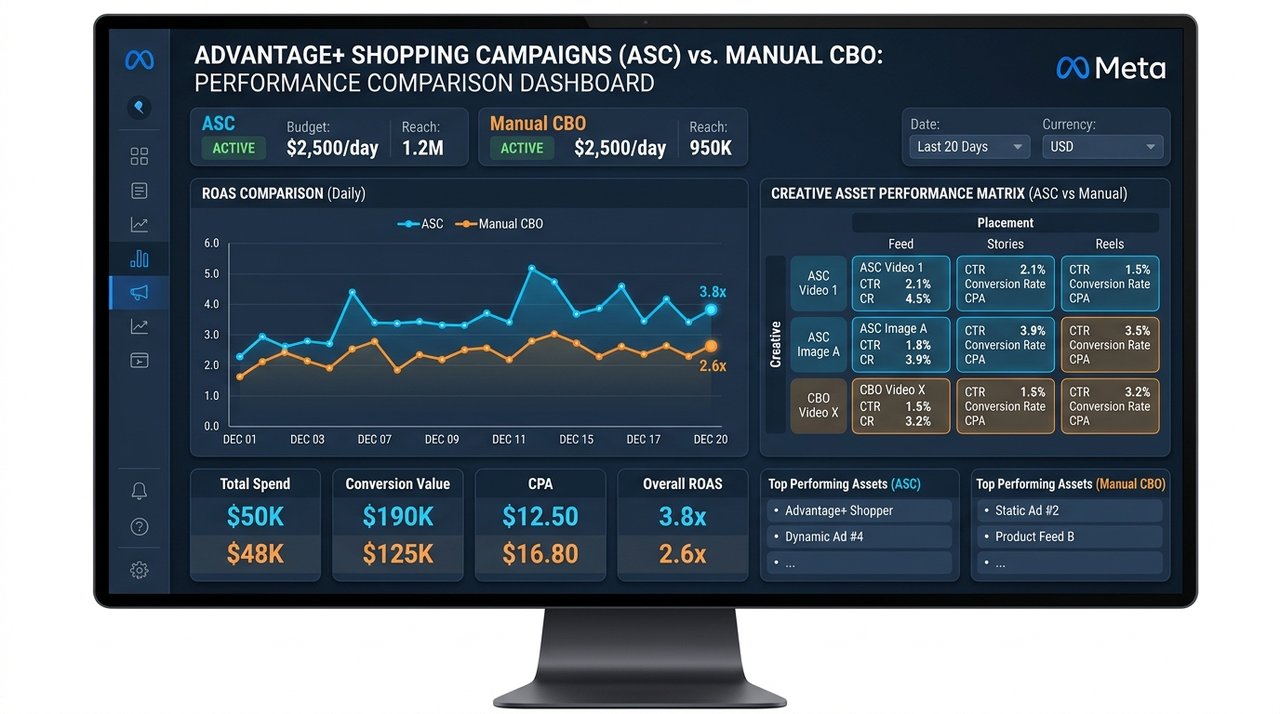
Meta’s Advantage+ Shopping Campaigns (ASC) have redefined e-commerce media buying by automating audience segmentation, creative assembly, and budget allocation under machine learning models. However, hands-off automation frequently cannibalizes warm traffic by aggressively retargeting existing buyers unless hard existing customer budget caps are applied. Analyzing meta advantage plus shopping campaigns vs manual cbo architectures reveals when to leverage automated machine learning and when to retain manual campaign budget controls. In this tactical comparison guide, examine performance benchmarks, creative diversification rules, and scaling frameworks for DTC brands.
Table of Contents
- 1. Meta’s Andromeda AI Retrieval Engine: How ASC Works
- 2. Configuring Existing Customer Budget Caps in ASC
- 3. Managing Creative Asset Limits (Up to 150 Ads per ASC Campaign)
- 4. When Manual CBO Outperforms ASC (Bid Caps & Strict Retargeting)
- 5. ASC vs. Manual CBO Benchmark Comparison Matrix
- 6. The Ideal Hybrid Account Architecture (80/20 Rule)
- 7. Budget Scaling Rules: 15–20% Increments Every 48 Hours
- 8. Frequently Asked Questions
1. Meta’s Andromeda AI Retrieval Engine: How ASC Works
Advantage+ Shopping Campaigns (ASC) leverage Meta’s high-performance Andromeda AI retrieval architecture. Unlike manual CBO campaigns where advertisers manually construct lookalike audiences, interest groups, and retargeting exclusions, ASC operates on a completely broad targeting framework across Meta’s 3.8+ billion global users.
When you upload ad creative into ASC, Andromeda evaluates real-time user intent signals (watch time, post interactions, saved posts, external browser pixel conversions) to dynamically match ad assets to users with the highest immediate purchase intent.
2. Configuring Existing Customer Budget Caps in ASC
A major flaw in default ASC setups is budget skew. Left unconstrained, Meta’s algorithm will allocate a large percentage of your ASC budget to warm custom audiences (existing customers and past website visitors) because warm users convert at a cheaper CPA, inflating reported campaign ROAS.
Setting Up Account-Level Existing Customer Lists
- Go to Meta Ads Manager ➔ Account Settings ➔ Existing Customer Definition.
- Import your primary Customer Match email CSV list and link your Meta Pixel / Conversions API (CAPI)
Purchaseevent. - Inside your ASC Campaign Settings, toggle Existing Customer Budget Cap and enter a cap percentage (e.g., 0% to 15% Max Existing Customer Budget).
Restricting existing customer spend to 10% or less forces ASC to operate as a true new customer acquisition (NCA) engine.
3. Managing Creative Asset Limits (Up to 150 Ads per ASC Campaign)
While manual CBO campaigns suffer from ad fatigue when containing more than 5 to 6 active creative variations per ad group, ASC campaigns are designed to host up to 150 active ad variations simultaneously.
Optimal ASC Asset Mix Guidelines
- Static UGC & Image Ads (50%): High-converting user-generated content, press quotes, side-by-side product comparisons, and benefit callout graphics.
- Video & Reels Format (35%): 9:16 vertical video assets with hook variations in the first 3 seconds.
- Dynamic Catalog Ads / DPA (15%): Carousel product catalog ads populated directly from your Shopify or WooCommerce product feed.
4. When Manual CBO Outperforms ASC (Bid Caps & Strict Retargeting)
Despite ASC’s automated power, manual CBO campaigns remain superior under specific strategic scenarios:
- Strict Bid Cap / Cost Cap Control: ASC operates strictly on Highest Volume bidding. If you need to enforce a maximum allowable Customer Acquisition Cost (e.g., $35 Cost Cap) to preserve unit economics, manual CBO allows precise cost control.
- Isolated Mid-Funnel & Bottom-Funnel Retargeting: If you want to serve a specific 20% discount offer exclusively to users who added to cart in the last 7 days, manual CBO allows strict audience exclusions.
- Testing Single Creative Variables: Manual CBO lets media buyers isolate headlines, primary text hooks, or thumbnail variations without algorithm budget bias.
5. ASC vs. Manual CBO Benchmark Comparison Matrix
| Strategic Dimension | Advantage+ Shopping (ASC) | Manual CBO / ABO |
|---|---|---|
| Audience Targeting | Broad (Algorithmic Intent Retrieval) | Manual Lookalikes, Interests, & Retargeting |
| Bidding Controls | Highest Volume Only | Highest Volume, Cost Cap, Bid Cap, Minimum ROAS |
| Max Active Ads per Campaign | Up to 150 Ad Assets | 3 – 6 Ads per Ad Set recommended |
| Average Incremental CAC | 12% to 22% Lower CAC | Baseline CAC (Higher manual management overhead) |
6. The Ideal Hybrid Account Architecture (80/20 Rule)
Top-performing DTC brands achieve maximum ROAS by deploying an 80/20 Hybrid Account Architecture combining the strengths of both campaign types:
├── Campaign 1: Advantage+ Shopping Campaign (ASC) – [80% Budget]
│ ├── Existing Customer Cap: Set to 5% Max
│ └── 20–30 Active High-Performing Proven Creatives (Images, Reels, Dynamic Catalog)
│
└── Campaign 2: Manual CBO / ABO Creative Sandbox – [20% Budget]
├── Audience: Broad Targeting (Age / Gender / Location only)
└── Testing 3 to 5 new ad concepts weekly (Graduating winner creatives into ASC)
7. Budget Scaling Rules: 15–20% Increments Every 48 Hours
When an ASC campaign achieves profitable ROAS above your target break-even threshold, avoid doubling campaign budgets abruptly. Sudden 100%+ budget increases reset campaign learning phases, causing CPM spikes.
To scale budget without triggering performance volatility:
$$ ext{Next Day Budget} = ext{Current Budget} imes 1.20 \quad ext{(Scale by +20\% every 48 Hours)}$$
If your ASC campaign is operating profitably at $1,000/day, increase budget to $1,200/day, evaluate 48-hour CPA metrics, and repeat the 20% budget increment step as performance holds steady.
8. Frequently Asked Questions
What is the difference between meta advantage plus shopping campaigns vs manual cbo?
Advantage+ Shopping Campaigns (ASC) rely on automated AI broad targeting and support up to 150 ad assets per campaign. Manual CBO allows advertisers to manually construct lookalike audiences, retargeting ad sets, and cost cap bid controls.
Can I run ASC campaigns alongside manual CBO campaigns?
Yes. The recommended hybrid Meta ad account framework allocates 70–80% of budget to ASC for broad scaling and 20–30% to manual CBO for creative sandbox testing and cost cap controls.
How do I stop ASC from spending all budget on existing customers?
Define an existing customer list inside Meta Account Settings using customer email CSV uploads and set an Existing Customer Budget Cap (e.g., 0% to 10%) in your ASC settings.
What is the minimum budget required to test Meta ASC?
A recommended minimum starting budget for ASC is 3x to 5x your target Customer Acquisition Cost (CAC) per day (e.g., $150/day if target CAC is $30).
How many ad assets should I upload into an ASC campaign?
Upload at least 10 to 20 diverse ad assets (mix of static images, UGC videos, Reels 9:16 assets, and dynamic product catalogs) to give Meta’s algorithm sufficient creative variation.
Does ASC support retargeting exclusions?
ASC does not allow traditional ad set custom audience exclusions. Instead, use the Existing Customer Budget Cap setting to control retargeting exposure.
Why did my ASC campaign performance drop after scaling budget?
ASC performance drops if budget was scaled too aggressively (over +20% at once) or if creative assets suffered from audience ad fatigue. Rotate in 3 to 5 new winning creative concepts.
What is the learning phase length for ASC?
ASC requires 50 conversion events per week to exit the initial machine learning calibration phase.
Can B2B lead generation accounts use Advantage+ Shopping Campaigns?
Meta ASC is engineered primarily for e-commerce catalog sales. For B2B lead gen, use Advantage+ Lead Campaigns or manual CBO with native lead forms.
How often should I refresh creative inside ASC?
Audit ASC asset performance weekly. Replace assets rated as “Low” performance with fresh winning concepts graduated from your manual CBO creative sandbox.
Advanced Meta Conversions API (CAPI) Data Enrichment for ASC
To maximize ASC algorithmic retrieval accuracy, transmit enriched customer data signals via Meta CAPI (Server-Side). Include user_data parameters such as hashed email (em), phone number (ph), zip code (zp), and external client ID (external_id) with every purchase event payload.
Auditing Dynamic Product Ad (DPA) Feed Errors in ASC
When incorporating Commerce Manager product catalogs into ASC, ensure your feed contains zero missing price, availability, or GTIN errors. Catalog feed errors suppress product carousel impressions across Meta Shops and Instagram Shopping placements.
Auditing Creative Fatigue & Frequency Saturation Metrics
When scaling ASC campaigns beyond $5,000/day, ad accounts inevitably encounter Creative Fatigue. As frequency metrics rise above 3.5x over a 7-day window, ad CTR drops while Customer Acquisition Costs surge:
$$ ext{Creative Fatigue Index} = rac{ ext{Frequency (7 Days)}}{ ext{Click-Through Rate (CTR \%)}}$$
A spiking Creative Fatigue Index signals that your primary winning creative assets have saturated your target broad audience. Inject 3 to 5 new video hook variations into your ASC asset pool to refresh delivery.
Advantage+ Creative Automation Controls: When to Toggle Off Auto-Enhancements
Meta’s Advantage+ Creative suite automatically applies visual enhancements (such as image brightness adjustments, automatic music overlays, 3D motion effects, and text field swaps). While auto-enhancements can boost CTR on broad placements, unmonitored visual adjustments can distort brand aesthetic guidelines:
- Auto-Cropping to 9:16: Enable auto-cropping to expand 1:1 image assets into vertical Stories and Reels placements.
- Music Overlays: Toggle off automated music overlays for premium luxury brands to maintain consistent audio identity.
- Text Field Swaps: Disable automated headline/description swaps if your ad copy relies on strict compliance disclosures.
Troubleshooting Creative Cannibalization inside ASC Asset Pools
If 1 or 2 dominant video assets consume 90% of your total ASC campaign budget while 18 other uploaded assets receive zero impressions, execute the following diagnostic workflow:
- Test New Assets in Manual CBO First: Never upload unproven creative concepts directly into a high-budget ASC campaign. Test new ad variations inside your Manual CBO Creative Sandbox first.
- Graduate Only Proven Winners: Only graduate creative assets that achieve Above-Average CTR and CPA metrics inside your sandbox into your core ASC campaign pool.
How does Meta ASC handle international multi-currency catalogs?
ASC automatically matches user currency preferences if your connected Meta Commerce Manager catalog contains localized country pricing feeds.
Can I use Cost Caps inside an Advantage+ Shopping Campaign?
No. Advantage+ Shopping Campaigns currently enforce Highest Volume bidding. Use Manual CBO or ABO if you require strict Cost Cap or Bid Cap bid controls.
Automating Meta ASC Budget Scaling via Python Graph API
For growth engineering teams managing large-scale DTC accounts, automate daily 15% budget scaling increments using Python scripts interacting with Meta’s Marketing Graph API:
import requests

ACCESS_TOKEN = "EAAB..."
CAMPAIGN_ID = "238491029384"
URL = f"https://graph.facebook.com/v19.0/{CAMPAIGN_ID}"

# Fetch current daily budget in cents
r = requests.get(URL, params={"access_token": ACCESS_TOKEN, "fields": "daily_budget"})
current_budget = int(r.json().get('daily_budget', 0))

# Calculate +15% budget increment
new_budget = int(current_budget * 1.15)

# Update campaign budget
r_up = requests.post(URL, data={
    "access_token": ACCESS_TOKEN,
    "daily_budget": new_budget
})

print("Updated ASC Daily Budget Response:", r_up.json())
Optimizing Conversions API (CAPI) Event Match Quality Scores
To maximize ASC algorithmic retrieval accuracy, elevate your Meta CAPI Event Match Quality (EMQ) score from 6.0/10 to 9.0/10+. Higher EMQ scores enable Meta algorithms to match website purchasers to active user profiles with 95%+ precision:
- Hashed Customer Email (em): Normalize customer emails to lowercase and apply SHA-256 hashing before transmitting payloads.
- Hashed Phone Number (ph): Format phone numbers in E.164 international format (e.g.,
+14155552671) prior to SHA-256 hashing. - Client IP Address (client_ip_address) & User Agent (client_user_agent): Include raw client browser headers with every server-side CAPI event.
Mastering these advanced Meta scaling and tracking configurations equips your performance media team to dominate paid social auctions efficiently.
Conclusion
Evaluating meta advantage plus shopping campaigns vs manual cbo proves that the ultimate paid social strategy relies on combining both approaches. Harnessing ASC for automated broad scaling while maintaining manual CBO for creative testing ensures continuous customer acquisition growth.
Need expert assistance designing your Meta ad account architecture or optimizing ASC campaigns? Schedule a Meta Ads audit with our media team today.