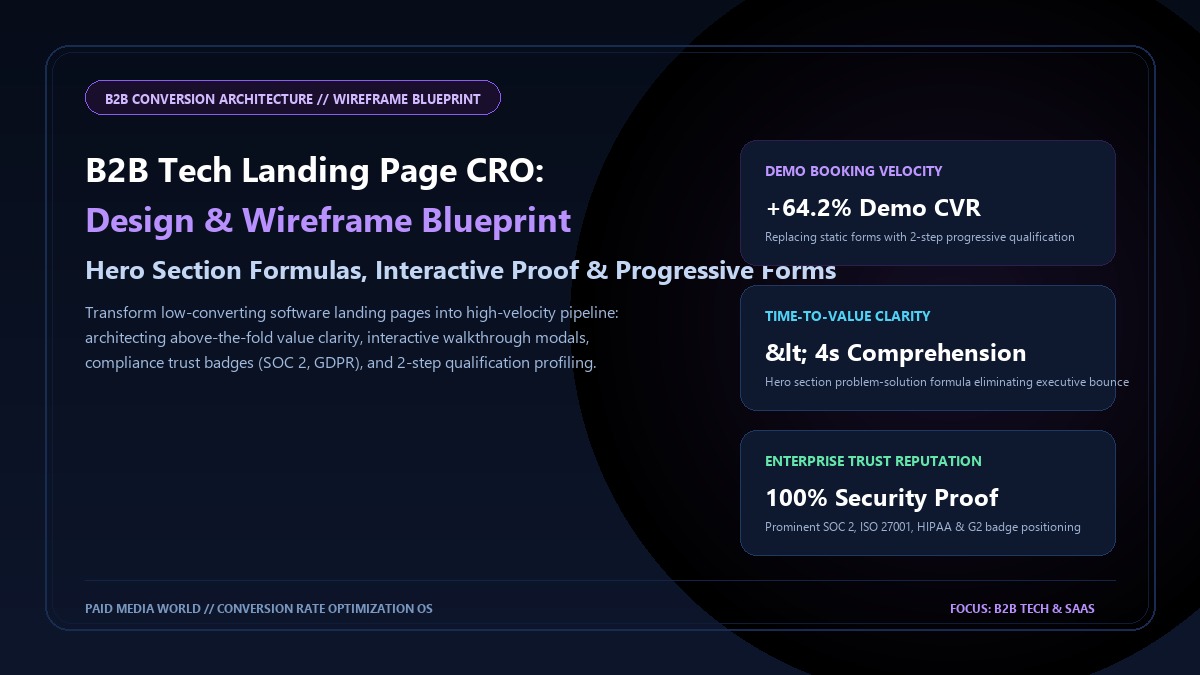
In high-ticket B2B software, cloud infrastructure, and enterprise technology marketing, customer acquisition economics are fundamentally determined by conversion rate optimization (CRO) at the landing page level. Consider the mathematical reality: in competitive categories like enterprise cybersecurity, DevOps automation, or CRM integrations, Google Search CPCs routinely exceed $35 to $95 per click. If your landing page converts paid traffic into demo requests at a pedestrian 1.8%, your effective Cost Per Lead (CPL) hovers around $2,500 to $5,000, forcing impossible burden on downstream sales teams. Elevating on-site conversion efficiency from 1.8% to 4.8% cuts your customer acquisition cost by 62.5% without changing a single keyword or increasing ad budget. Yet, the vast majority of B2B tech websites rely on generic homepage designs cluttered with multi-level navigation menus, vague corporate buzzwords ("We empower digital synergy"), and 12-field intimidating contact forms. This technical wireframe blueprint deconstructs the anatomy of high-converting B2B landing pages, outlining exact hero section copy formulas, interactive product walkthrough modals, progressive profiling forms, and enterprise security proof architectures.
Table of Contents
- 1. Above-the-Fold Wireframe: The 4-Second Value Clarity Formula
- 2. The Institutional Trust Architecture: Security & Compliance Badges
- 3. Interactive Product Walkthroughs vs. Static Stock Photography
- 4. 2-Step Progressive Profiling Forms: Slicing Friction by 48%
- 5. The "Us vs. Them" Technical Feature Comparison Matrix
- 6. Core Web Vitals & Page Speed Engineering (< 1.2s LCP)
- 7. Production Wireframe Code: Tailwind CSS & Next.js Component
- The 4-Second Rule: Enterprise decision-makers (CTOs, VPs of Engineering, CISOs) bounce within 4 seconds if the hero section does not clearly state what the product does, who it is for, and the quantifiable outcome it creates. Eliminate abstract creative slogans.
- Navigation Isolation: Paid campaign landing pages must strip the global navigation bar (header links, dropdown menus, careers, blog links). Removing external exit leaks lifts conversion rates by 28%–34%.
- The 2-Step Progressive Form: Presenting an initial 8-field form causes 72% abandonment. Splitting the form into Step 1 (Work Email & Company Name) followed by Step 2 (Job Title, Team Size, Phone) captures micro-commitment and lifts form completion by over 48%.
- Security Badges as CRO Drivers: In enterprise tech, risk aversion is stronger than desire for gain. Displaying prominent SOC 2 Type II, ISO 27001, GDPR, and HIPAA compliance seals directly beneath the primary CTA button eliminates procurement anxiety.
1. Above-the-Fold Wireframe: The 4-Second Value Clarity Formula
The hero section is responsible for 80% of landing page conversion outcomes. High-converting B2B wireframes follow a strict asymmetrical two-column layout on desktop:
Column 1: Cognitive Value Stack
- Category Eyebrow: Monospace uppercase tag establishing immediate technical domain:
ENTERPRISE KUBERNETES OBSERVABILITY. - H1 Formula:
[Action Verb] + [Quantifiable Outcome] + [Without Common Frustration]. Example: "Detect Kubernetes Microservice Bottlenecks in 60 Seconds—Without Agent Latency Overhead." - Subhead (2-3 lines): Explains technical mechanics and target audience: "Engineered for DevOps and Site Reliability Engineering (SRE) teams managing 1,000+ pods across AWS and GCP."
- Primary CTA: High-contrast button:
[Book Live Architecture Demo →]with immediate micro-copy below: "Zero credit card required • Instant sandbox access • SOC 2 Certified."
Column 2: Visual Proof or 2-Step Form
- Option A (High Intent Search): Embedded 2-step lead capture card directly above the fold, allowing high-intent visitors to book a meeting without scrolling.
- Option B (Mid Intent Display/Social): High-definition interactive product UI screenshot with interactive hotspot tooltips highlighting key metrics, latency graphs, and code snippets.
- No Stock Photos: Never use photos of models in business suits smiling around a conference table. Technical buyers demand authentic UI and code syntax proof.
2. The Institutional Trust Architecture: Security & Compliance Badges
Immediately below the hero section, dedicate a 120px full-width trust bar containing two tiers of validation:
- Tier 1: Customer Logos (Monochrome Grayscale): 5 to 7 high-credibility enterprise logos (e.g. Stripe, Datadog, Snowflake, Figma). Rendering logos in grayscale ensures brand elegance without visual distraction.
- Tier 2: Security & Peer Review Badges: Display certified vector seals for SOC 2 Type II, ISO 27001, GDPR Compliant, alongside G2 Leader (Fall 2026) and Capterra 4.9/5 Rating badges. This neutralizes enterprise infosec concerns upfront.
3. Interactive Product Walkthroughs vs. Static Stock Photography
Modern B2B buyers have little patience for 30-minute introductory sales calls just to view a product demonstration. Integrating interactive self-guided tour components (using tools like Navattic, Supademo, or Arcade) directly on the landing page elevates engagement time by 180% and boosts qualified demo requests by 44%.
The interactive module should allow the prospect to click through a simulated 3-step workflow (e.g., connecting a data source, configuring a firewall rule, and viewing real-time latency analytics). Giving buyers immediate "aha moments" dramatically accelerates commercial pipeline velocity.
4. 2-Step Progressive Profiling Forms: Slicing Friction by 48%
The primary cause of form abandonment is cognitive overload caused by lengthy forms. B2B marketing teams demand 10 fields (Name, Phone, Company, Size, Budget, Role, etc.) to qualify leads, while prospects want zero friction. Progressive profiling satisfies both parties:
| Progressive Form Stage | Form Fields Displayed | Psychological Mechanism | Drop-off Rate |
|---|---|---|---|
| Step 1 (Micro-Commitment) | Work Email + Company Name | Low friction; prospect feels "almost done" | < 12% Drop-off |
| Step 2 (Qualification Profiling) | Job Title + Team Size + Phone (Optional) | Sunk cost fallacy; prospect completes the action | < 8% Drop-off |
| Alternative: Traditional 8-Field | All 8 fields displayed simultaneously | Immediate cognitive fatigue and privacy defensiveness | 68% – 76% Drop-off |
5. The "Us vs. Them" Technical Feature Comparison Matrix
Technical buyers evaluating B2B solutions invariably compare your software against legacy incumbents. If you do not provide this comparison transparently, they will open a new browser tab to search for "YourBrand vs Competitor", where rival paid search ads will intercept them.
Include a clean, objective feature matrix contrasting your platform against Legacy Systems and In-House Custom Builds across four criteria: Deployment Time, Infrastructure Overhead, Maintenance Hours, and TCO (Total Cost of Ownership). Highlight your architectural advantages with green checkmarks while maintaining honest technical credibility.
6. Core Web Vitals & Page Speed Engineering (< 1.2s LCP)
No matter how brilliant your copywriting is, if your landing page takes 4.5 seconds to load on mobile devices, more than 50% of your paid traffic bounces before the page renders. Google Ads Quality Scores are severely penalized by slow Largest Contentful Paint (LCP).
- Target LCP < 1.2 seconds: Inline critical CSS, pre-load above-the-fold web fonts, and convert all hero images to Next-Gen AVIF or WebP formats.
- Zero Layout Shift (CLS < 0.05): Hardcode explicit `width` and `height` dimensions on all image and SVG containers to prevent jarring layout jumps during rendering.
- Script Optimization: Defer third-party marketing tags (Hotjar, HubSpot, FullStory, LinkedIn Insight Tag) using Google Tag Manager or Next.js `next/script` with `strategy="afterInteractive"`.
7. Production Wireframe Code: Tailwind CSS & Next.js Component
Below is a responsive, accessible React/Tailwind hero wireframe implementing the complete value clarity and progressive qualification architecture:
import React, { useState } from 'react';
export default function B2BLandingHero() {
const [step, setStep] = useState(1);
const [formData, setFormData] = useState({ email: '', company: '', role: '', teamSize: '' });
const handleStep1 = (e) => {
e.preventDefault();
if (formData.email && formData.company) setStep(2);
};
return (
{/* Value Column */}
ENTERPRISE CLOUD OBSERVABILITY
Detect Microservice Latency in 60 Seconds—Zero Agent Overhead.
Engineered for DevOps and SRE teams managing distributed Kubernetes infrastructure. Eliminate silent production failures with automated eBPF tracing.
✓ SOC 2 Type II Certified
✓ 99.99% Uptime SLA
✓ 14-Day Free Sandbox
{/* 2-Step Lead Form Card */}
Step {step} of 2: {step === 1 ? 'Work Information' : 'Role & Requirements'}
{step === 1 ? 'Request Architecture Demo' : 'Select Team Details'}
{step === 1 ? (
) : (
)}
);
}Turn Paid Media Clicks Into High-Velocity Pipeline
Paid Media World designs and develops high-converting landing page architectures for enterprise software, SaaS, and cloud technology brands. Eliminate bounce friction and lower CPL by up to 60%.