Paid Media World

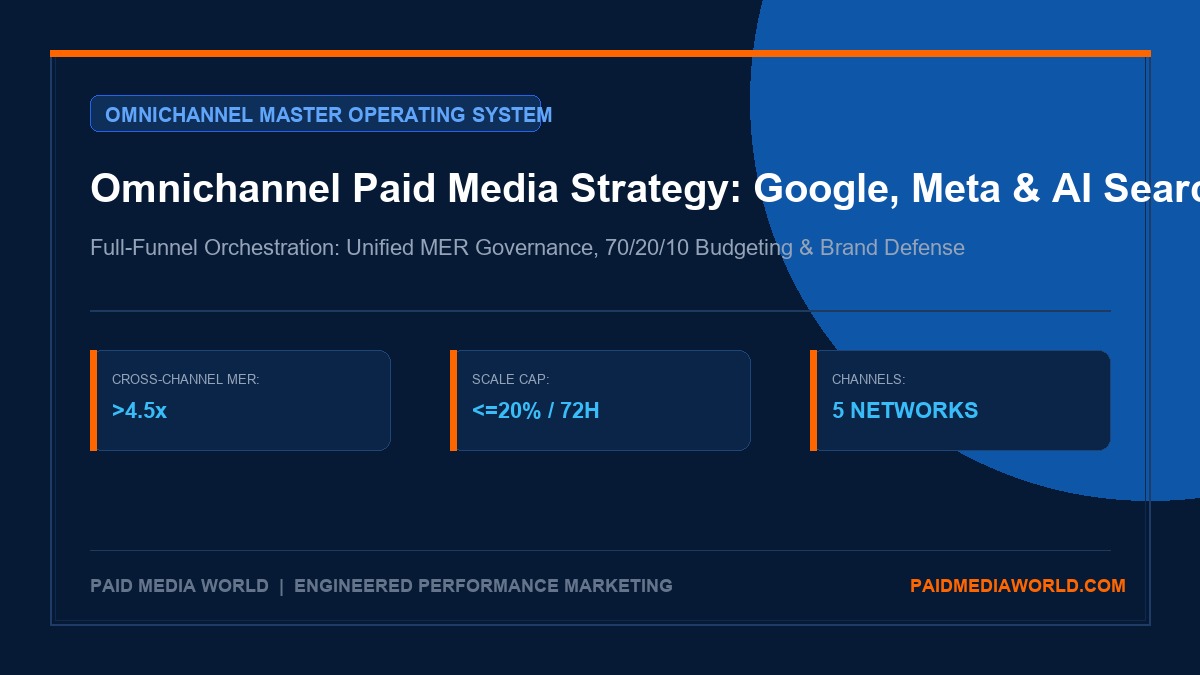
The Omnichannel Paid Media Master Strategy: Full-Funnel Google, Meta, Amazon & AI Search Orchestration

The master operating system for omnichannel performance marketing in 2026. Orchestrate Google Ads, Meta Advantage+, Amazon Ads, and AI search visibility under a

SN
By Subhranil Naskar
|November 6, 2026|11 min read|Fact-Checked & Audited
Sponsored Technical Insights
omnichannel paid media master strategy
# The Omnichannel Paid Media Master Strategy: Full-Funnel Google, Meta, Amazon & AI Search Orchestration In the contemporary advertising landscape, the era of single-channel media buying is officially extinct. Brands that attempt to scale exclusively on Meta Ads invariably run into steep creative fatigue, rising CPMs, and attribution decay. Simultaneously, brands relying solely on Google Ads encounter search inventory ceilings and hyper-inflated cost-per-click bids driven by auction competition. True enterprise growth requires an **Omnichannel Performance Marketing Operating System**. Instead of managing isolated media channels with competing agency silos, sophisticated marketing leaders orchestrate **Google Ads (Search, Shopping, PMax)**, **Meta Ads (ASC, Dynamic Catalog)**, **Amazon Ads (Sponsored Products, DSP)**, and **AI Search Engines (Google AI Overviews, Perplexity)** into a synchronized acquisition flywheel. When structured correctly, channel synergy compounds: top-of-funnel Meta and YouTube creative stimulates unbranded Google Search volume; high-intent Google Search captures immediate purchase demand; Amazon advertising captures retail market share; and AI search optimization ensures your brand is cited as the definitive authority across zero-click LLM answer engines. This master playbook delivers the complete architectural framework for building, governing, and scaling a multi-million-dollar omnichannel media operation in 2026. ---

1. The Collapse of Channel Silos: Why Multi-Platform Synergy Wins in 2026

Historically, brands operated with fractured digital marketing teams: an agency managing Facebook Ads, an in-house specialist managing Google Search, a contractor handling SEO, and an outsourced broker managing Amazon Seller Central. This siloed model collapses under modern auction conditions: - **Attribution Double-Counting**: Each platform claims credit for the same customer. Meta reports a 3.5x ROAS, Google claims a 4.2x ROAS, and Amazon reports a 5.0x ROAS—yet Shopify net cash flow is stagnant. - **Audience Bleed**: Without centralized audience exclusions, existing customers are bombarded with cold prospecting ads across multiple platforms, wasting 20% to 35% of total budget. - **Asymmetric Scaling**: When Meta Ads spending surges, Google brand search volume doubles, yet the Google Ads specialist claims credit for "optimizing search" without recognizing that Meta generated the demand. Omnichannel orchestration eliminates these dysfunctions by treating paid media as a **single, unified capital deployment engine**. ---

2. The 12-Part Omnichannel Performance Marketing Operating System

Our proprietary 12-part framework unifies commercial strategy with mathematical execution: ```mermaid graph TD A["1. Unit Economics & Contribution Margins"] --> B["2. First-Party Data & CAPI Infrastructure"] B --> C["3. Market Positioning & Core Narrative"] C --> D["4. High-Intent Google Search Alpha/Beta"] D --> E["5. Google Performance Max Margin Sculpting"] E --> F["6. Meta Ads Dual-Engine (ASC + ACA)"] F --> G["7. Dynamic Creative Testing Sandboxes (3:2:2)"] G --> H["8. Amazon Co-Op & Retail Media Networks"] H --> I["9. Generative Engine Optimization (GEO/AEO)"] I --> J["10. Retention & Lifecycle Automation (Klaviyo)"] J --> K["11. Unified Attribution & Incrementality (MMM)"] K --> L["12. Budget Pacing & Capital Allocation (70/20/10)"] ``` Every stage informs the next. If Stage 1 (Unit Economics) is ungrounded, Stage 6 (Meta Scaling) will simply accelerate cash burn. If Stage 2 (Tracking) is unverified, Stage 11 (Attribution) will optimize for phantom conversions. ---

3. Capital Allocation: The 70/20/10 Budget Framework & Budget Pacing Guardrails

Enterprise capital allocation balances proven stability against aggressive experimentation: | Allocation Tier | Share of Budget | Operational Function | Primary Channels & Formats | | :--- | :--- | :--- | :--- | | **Core Scaled Engine (70%)** | 70% | High-conviction, proven customer acquisition and revenue capture | Google Search (Exact Match), Google PMax (High-Margin Feed), Meta ASC (Winning Creatives) | | **Growth Expansion (20%)** | 20% | High-potential channels with established product-market fit | YouTube Video View Campaigns (VVC), Meta Catalog Ads (ACA), Amazon Sponsored Products | | **Exploratory Innovation (10%)** | 10% | Rapid experimentation, new formats, and frontier platforms | Reddit Ads, TikTok Shop, AI Search Placement Testing, 3:2:2 Creative Testing Sandboxes | ### Budget Pacing Scaling Laws: - **The ≤ 20% / 72-Hour Rule**: Never increase campaign budgets by more than 20% within a 72-hour window. This protects algorithm stability and prevents sudden CPM inflation across Meta and Google. - **Safety Creation Gate**: All new campaigns, ad sets, and ads must be generated in **`PAUSED`** status, verified through a rigorous 5-point QA checklist before activation. ---

4. Channel Synergy Triad: Google Search, Meta Demand Gen & Amazon Conversion Co-Op

To capture customer intent across their journey, deploy the **Cross-Platform Synergy Triad**: ```mermaid flowchart LR subgraph Demand Generation [Top of Funnel: Meta & YouTube] A["Meta Advantage+ Video UGC"] B["YouTube Video View Campaigns (VVC)"] end subgraph Intent Capture [Middle of Funnel: Google Ads] C["High-Intent Exact Match Search"] D["Performance Max Margin Sculpting"] end subgraph Conversion Co-Op [Bottom of Funnel: Multi-Channel Checkout] E["Direct DTC Checkout (Shopify CAPI)"] F["Amazon Prime 1-Click Buy (FBA)"] end Demand Generation --> Intent Capture Intent Capture --> Conversion Co-Op ``` 1. **Meta & YouTube Create Awareness**: Cold prospects discover your brand via high-hook lifestyle video ads and founder storytelling. 2. **Google Search Captures Residual Intent**: 45% of users who see a Meta ad will not click immediately; they open Google Search hours later and search for your product category or brand name. 3. **Amazon Defends Brand Equity**: Shoppers with Amazon Prime will search for your brand directly on Amazon. Running Sponsored Brand and Sponsored Product defense prevents competitors from stealing your hard-earned demand. ---

5. Diminishing Marginal Returns & Saturation Curve Modeling

In paid media, capital efficiency decays as spend increases. Every ad platform follows a non-linear Hill saturation function: $$ ext{Revenue}(S) = rac{V_{\max} \cdot S^n}{K^n + S^n}$$ Where: - $S$ is the channel media spend. - $V_{\max}$ is the theoretical revenue ceiling for the target audience. - $K$ is the half-saturation spend threshold (the point of maximum marginal efficiency). - $n$ is the shape parameter reflecting audience elasticity. ```text Marginal Return vs Media Spend Decay Curve: Return ($) ^ | /------------- (Plateau: Marginal ROAS < Break-Even) | / | / (Optimal Efficiency Zone: 70/20 Split) | / |/ +-----------------------------------------> Daily Spend ($) ``` ### The Capital Reallocation Rule: When marginal ROAS on Meta falls below Break-Even ROAS ($d ext{Revenue}/d ext{Spend} < ext{BE ROAS}$), allocating another $1,000/day to Meta destroys cash. Rather than forcing spend into a saturated auction, reroute that incremental capital into unspent high-intent Google Search, YouTube VVC audience seeding, or Amazon Sponsored Products. ---

6. The Cross-Platform Attribution War Room: Reconciling Meta, Google & Amazon

Every ad platform calculates conversions using distinct, self-serving attribution windows. Navigating this landscape requires understanding the reporting variance across platforms: | Platform | Default Attribution Window | Primary Bias / Over-Reporting Mechanism | Reconciliation Method | | :--- | :--- | :--- | :--- | | **Meta Ads** | 7-day click, 1-day view | View-through conversions claim credit for users who scrolled past an ad without reading | Inspect 1-day click only; compare with BigQuery first-click telemetry | | **Google Ads** | 30-day click, Data-Driven Attribution | Claims 100% credit for brand search terms originated by Meta campaigns | Isolate Brand Search into a separate campaign; evaluate Non-Brand CPA | | **Amazon Ads** | 14-day click (DTC + Wholesale) | Overlaps with off-Amazon Google and Meta traffic directed to product listings | Use Amazon Attribution tags; measure total Amazon Brand Search lift | | **GA4 (Web)** | 30-day Data-Driven / Last Non-Direct | Ignores cross-device mobile-to-desktop conversions; drops 15% due to ad blockers | Reconcile with Shopify/Stripe ERP order IDs in BigQuery warehouse | Never add platform-reported revenues together. Always evaluate performance through **Blended MER** and **Shopify Net Cash Flow**. ---

7. Generative Engine Optimization (GEO) & AEO: Winning Real Estate in AI Overviews

By 2026, search behavior has fragmented. Millions of consumers query **Google AI Overviews**, **Perplexity.ai**, **ChatGPT Search**, and **Claude** before making purchase decisions. ### Princeton KDD 2024 Framework for AI Search Visibility: Based on peer-reviewed research on Generative Engine Optimization (GEO), AI models prioritize content that adheres to four technical citation signals: 1. **Statistical Density & Exact Quotation**: LLMs favor content containing verified benchmarks, data points, and mathematical models over generic prose. 2. **Authoritative Entity Schema**: Deploy comprehensive `Organization`, `Person` (E-E-A-T), `Service`, and `FAQPage` JSON-LD schemas linking to established Wikidata and Crunchbase nodes. 3. **Technical Teardown Depth**: Structure content with clear H2/H3 semantic hierarchies, bulleted technical takeaways, and direct answer definitions within the first 120 words of every section. 4. **llms.txt Governance**: Maintain an updated `/llms.txt` file in your root server directory, providing AI web scrapers with structured markdown indexes of your core authority guides. Audit your brand's AI search visibility with our [AI Search Visibility Tool](/ai-search-visibility/). ---

8. Universal Audience Hygiene: Strict Cross-Platform 30-Day Customer Exclusions

Audience hygiene is the foundation of high-margin performance marketing. Without centralized exclusions, ad platforms default to spending money on users who already know and love your brand. ### Universal Exclusion Rules: - **30-Day Purchasers**: Exclude across Meta ASC, Meta ACA, Google PMax, and YouTube VVC. - **Active Subscription Customers**: Exclude active recurring subscribers (Klaviyo / Recharge lists) from all cold prospecting campaigns. - **Past 14-Day High-Intent Visitors**: Isolate into dedicated remarketing ad sets with capped frequency ($\le 2.0$ impressions/week) to prevent ad fatigue. Verify your event match quality and tracking deduplication with our [Meta CAPI Calculator](/meta-capi-calculator/). ---

9. Unified Measurement & Governance: Blended MER, Incrementality Testing, and MMM

Enterprise media buying is governed by **Blended Economics**, not isolated platform dashboards: $$ ext{Blended MER (Marketing Efficiency Ratio)} = rac{ ext{Total Net Store Revenue}}{ ext{Total Ad Spend Across All Channels}}$$ $$ ext{POAS (Profit On Ad Spend)} = rac{ ext{Net Revenue} - ext{COGS} - ext{Fulfillment}}{ ext{Total Ad Spend}}$$ ### The 3 Tiers of Measurement Governance: 1. **Daily Operational Guidance (MER & POAS)**: Tracked daily in an automated executive dashboard (Looker Studio or BigQuery) to guide budget scaling decisions. 2. **Monthly Lift Testing (Incrementality)**: Execute randomized holdout geo-lift tests or Meta Conversion Lift Studies to calculate true incremental revenue. 3. **Quarterly Marketing Mix Modeling (MMM)**: Deploy open-source Bayesian models (e.g., Meta Robyn or Google Meridian) to establish channel saturation curves and determine cross-channel budget equilibrium. Read our authoritative guide on [How to Reallocate Media Spend Based on Performance Metrics](/reallocate-media-spend-performance-metrics/). ---

10. The Creative Velocity Flywheel: 3:2:2 Sandboxes Feeding Cross-Network Execution

High-performing omnichannel campaigns require constant creative fuel. Rather than producing single ads haphazardly, deploy the **Dynamic Creative Testing Flywheel**: ```text Creative Velocity Flywheel ├── 1. Weekly Concept Ideation: 3 new hooks (visual/script), 2 visual bodies, 2 CTAs ├── 2. Isolated 3:2:2 Sandbox: Tested with broad targeting and $100/day CBO budget ├── 3. Statistical Validation: Winner identified based on lowest Cost-Per-Unique-Add-To-Cart └── 4. Omnichannel Distribution: ├── Primary ASC Scaling Campaign on Meta ├── YouTube Shorts & In-Feed Video Ad Adaptations └── High-Converting Video Assets attached to Google Performance Max ``` Review our full [3:2:2 Dynamic Creative Testing Guide](/3-2-2-dynamic-creative-testing-meta-flexible-ads/) for complete configuration steps. ---

11. The 52-Point Pre-Launch Omnichannel QA & Safety Checklist

Before setting any scaled campaign live, enforce this strict pre-flight audit: ```text Pre-Flight Omnichannel QA Protocol: [ ] 1. Creation State: All campaigns, ad sets, and ads created in PAUSED status [ ] 2. Tracking: Server-Side Meta CAPI and Google Enhanced Conversions verified [ ] 3. Match Quality: Meta Event Match Quality (EMQ) score verified >= 8.5 / 10 [ ] 4. Deduplication: event_id parity verified between browser pixel and server event [ ] 5. Exclusions: Past 30-day purchasers excluded across all prospecting sets [ ] 6. Brand Negatives: Account-level negative keyword list applied to PMax campaigns [ ] 7. Scaling Cap: Daily budget increases programmed to <= 20% per 72 hours [ ] 8. UTM Governance: Standardized lowercase UTM syntax across all landing page URLs [ ] 9. Compliance: EU AI Act Article 50 disclosures and C2PA metadata attached to AI visuals [ ] 10. Financial Guardrail: Target CPA and Break-Even ROAS confirmed by finance leadership ``` ---

12. The 90-Day Execution Roadmap: From Fragmented Media to Unified Machine

### Days 1 to 30: Forensic Audit & Tracking Hardening - Complete a 52-point forensic audit of existing Google and Meta accounts. - Implement server-side Meta CAPI and Google Enhanced Conversions with $\ge 8.5/10$ Event Match Quality. - Establish baseline Unit Economics: derive true Break-Even ROAS and Target CPA. ### Days 31 to 60: Account Restructure & Dual-Engine Deployment - Consolidate Meta into the Dual-Engine Architecture (ASC + Margin-Tiered ACA). - Transition Google Search to high-intent Search Alpha/Beta with strict negative keyword pruning. - Launch YouTube Video View Campaigns (VVC) for low-cost audience seeding. ### Days 61 to 90: Omnichannel Scaling & MMM Governance - Integrate Amazon Sponsored Product defense and Co-Op funnels. - Deploy automated BigQuery GA4 raw data warehouse pipelines. - Scale total ad spend by up to 20% every 72 hours governed strictly by POAS $\ge 1.4x$. ---

13. Frequently Asked Questions (FAQ)
### What is the minimum monthly budget required to run an omnichannel media strategy? An effective omnichannel strategy across Meta, Google, and YouTube requires a minimum blended ad spend of **$15,000 to $25,000 per month**. At lower spend levels (e.g., $3,000/month), spreading budget across multiple platforms dilutes auction liquidity and prevents smart bidding algorithms from exiting the learning phase. Focus on one primary channel until reaching $15k/month. ### How do I prevent Google and Meta from claiming credit for the same conversion? Do not rely on the sum of platform-reported conversions. Instead, establish **Blended MER (Total Revenue / Total Spend)** as your primary North Star metric, and implement a **First-Party Data Warehouse in BigQuery** to perform deterministic first-click and last-click user journey deduplication. ### What is the role of Amazon Ads in a direct-to-consumer strategy? Amazon represents over 40% of US e-commerce market share. When your Meta and Google ads drive brand awareness, a significant portion of consumers will search for your brand on Amazon. If you do not run Sponsored Brand and Sponsored Product ads, your competitors will bid on your brand name and capture your sales. ### How does Generative Engine Optimization (GEO) differ from traditional SEO? Traditional SEO optimizes for keyword rankings and blue-link clicks in Search Engine Results Pages (SERPs). **GEO optimizes for citation inclusion inside AI-generated answers** (Google AI Overviews, Perplexity, ChatGPT). It requires high statistical density, structured JSON-LD entity schema, clear factual answers, and direct topic authority rather than keyword stuffing. --- *Ready to architect a high-growth omnichannel performance marketing engine? Explore our specialized [Paid Media Services](/services/) or review our verified [Case Studies](/case-studies/) to see how we deliver engineered profitability.*
SN

Subhranil Naskar

Founder & Lead Performance Strategist
Kolkata, West Bengal, India

Subhranil is the Founder and Lead Performance Strategist at Paid Media World. With over 10 years of practitioner experience managing high-budget performance marketing infrastructure across Google Ads, Meta Ads (CAPI), and GA4 event attribution, he personally architects and audits deterministic paid media infrastructure, algorithmic portfolio bidding, and enterprise conversion architecture.

Recommended Deep Dives

Related Playbooks & Further Reading

Explore All Playbooks
Sponsored Recommendations