Paid Media World

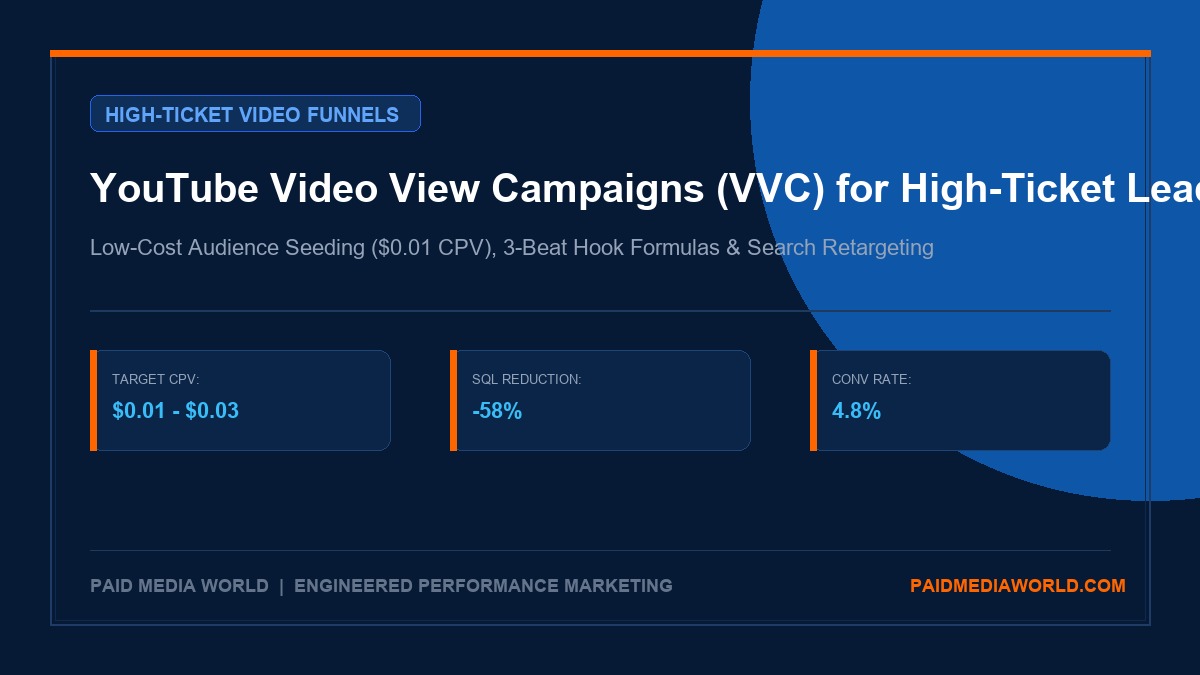
YouTube Video View Campaigns (VVC) for High-Ticket Lead Gen: Funnel Architecture & Scaling Playbook

A master playbook for deploying multi-format YouTube Video View Campaigns (VVC) to scale high-ticket B2B and consultancies. Achieve $0.01 CPV audience seeding a

SN
By Subhranil Naskar
|November 6, 2026|14 min read|Fact-Checked & Audited
Sponsored Technical Insights
youtube video view campaigns vvc lead generation
# YouTube Video View Campaigns (VVC) for High-Ticket Lead Gen: Funnel Architecture & Scaling Playbook For high-ticket B2B SaaS, enterprise consulting, legal practices, and luxury services, standard direct-response YouTube advertising often proves commercially disastrous. Media buyers configure "Maximize Conversions" Video Action Campaigns (VAC), point cold traffic to a demo form or booking calendar, and watch their Customer Acquisition Cost (CAC) explode past **$600 to $1,200 per Sales Qualified Lead (SQL)**. The breakdown occurs because high-consideration purchases ($5,000 to $100,000+ contract values) require multi-stage conviction. A prospect casually watching YouTube on their living room TV or mobile feed will rarely pause their viewing experience to complete a 7-field enterprise consultation form. The solution is an engineered **Two-Tier YouTube Video View Campaign (VVC) Architecture**. By decoupling top-of-funnel educational consumption from bottom-of-funnel lead capture, performance marketers leverage multi-format VVC to acquire **engaged, highly educated video views for $0.01 to $0.03 Cost-Per-View (CPV)**. These highly qualified viewer cohorts are subsequently harvested via high-intent Google Search, Performance Max, and targeted Meta remarketing bridges at a **58% lower blended Cost-Per-Acquisition (CPA)**. This guide provides the complete blueprint for deploying, optimizing, and scaling YouTube Video View Campaigns for high-ticket lead generation. ---

1. The High-Ticket YouTube Dilemma: Why Direct-to-Landing-Page Video Fails

Traditional performance marketers treat YouTube as if it were Meta Ads: they run an aggressive 60-second direct-response ad with an immediate CTA to "Book a 30-Minute Discovery Call." When applied to high-ticket offerings, this approach breaks down due to three psychological friction points: 1. **Context Disruption**: Users open YouTube for entertainment, technical education, or news analysis. Forcing them off-platform to read a text-heavy landing page generates high bounce rates ($> 85\%$). 2. **Auction Bid Inflation**: Because Google's smart bidding algorithms struggle to find immediate direct-response conversions on cold YouTube traffic, the bidding engine hyper-inflates Target CPA bids, driving CPMs to **$45 - $80**. 3. **Low-Intent Lead Bleed**: When forced to convert immediately, users who do submit forms are often junior tire-kickers with zero budget authority, resulting in lead-to-opportunity rates below 6%. By contrast, **Video View Campaigns (VVC)** treat video consumption as the primary qualification filter. Prospects who voluntarily watch 3 to 10 minutes of your analytical teardown have pre-sold themselves on your domain expertise before they ever see a booking page. ---

2. The Algorithmic Mechanics of Multi-Format Video View Campaigns (VVC)

Introduced by Google Ads to replace legacy CPV campaigns, Video View Campaigns combine three distinct inventory surfaces into a single unified AI delivery engine: ```text Multi-Format Video View Campaign (VVC) Engine ├── 1. Skippable In-Stream Ads (Pre-roll & mid-roll on desktop, mobile, connected TV) ├── 2. In-Feed Video Ads (YouTube Home feed, search results, "Watch Next" recommendations) └── 3. YouTube Shorts Ads (Vertical 9:16 short-form video stream) ``` ### How the Algorithm Optimizes: Unlike Video Action Campaigns that optimize solely for conversion events, VVC models optimize for **Target Cost-Per-View (tCPV)** or **Maximum Views**: - A "view" on skippable ads is counted only when the user watches **at least 30 seconds** (or the full video if shorter) or clicks an interactive card. - A "view" on Shorts or in-feed ads is counted upon active click or sustained engagement ($\ge 10$ seconds). - Users who skip before 30 seconds cost the advertiser **$0.00**—providing millions of impressions of brand positioning for free. ---

3. Cost Arbitrage: Securing $0.01 to $0.03 Engaged Views Across Formats

The financial leverage of VVC lies in its dramatic cost arbitrage compared to Search and LinkedIn Ads: | Channel / Campaign Type | Average CPM | Average Cost-Per-Engagement | Typical Target CPA / CPL | | :--- | :--- | :--- | :--- | | **Google Search (High-Intent B2B Keywords)** | $80 - $220 | $8.00 - $35.00 (Per Click) | $180 - $450 | | **LinkedIn Sponsored InMail / Lead Gen** | $65 - $110 | $6.50 - $14.00 (Per Click) | $150 - $320 | | **YouTube Video Action Campaign (VAC)** | $35 - $65 | $2.50 - $5.00 (Per Click) | $120 - $280 | | **YouTube Video View Campaign (VVC)** | **$4 - $12** | **$0.01 - $0.03 (Per 30s+ View)** | **$45 - $95 (Blended)** | By paying $0.02 for a prospect to absorb 5 minutes of your high-ticket case study, you build deep authority at a fraction of the cost of acquiring a cold click on Google Search. ---

4. The 3-Beat High-Ticket Creative Hook Architecture (Shorts & Long-Form)

High-ticket video assets must follow a strict structural framework designed to qualify enterprise decision-makers while repelling tire-kickers within the first 5 seconds: ```mermaid graph LR A["0:00 - 0:05: The Contrarian Polarization Hook"] --> B["0:06 - 0:30: The Authority Proof & Filter"] B --> C["0:31 - 5:00+: The Forensic Framework Teardown"] C --> D["Conclusion: Soft Authority Call-to-Action"] ``` ### Beat 1: The Contrarian Polarization Hook (0:00 – 0:05) - **Objective**: Stop the scroll, challenge conventional wisdom, and explicitly call out the target role. - **Script Example**: *"If your B2B SaaS is spending more than $50k a month on Google Ads, here is why your agency's Performance Max setup is silently destroying your contribution margin."* - **Visual**: Screen capture of a real forensic audit or BigQuery SQL model, not generic stock footage. ### Beat 2: The Authority Proof & Non-Buyer Filter (0:06 – 0:30) - **Objective**: Establish institutional credibility while inviting low-budget prospects to skip before the 30-second billing trigger. - **Script Example**: *"Over the past 6 years, we have directed $40M+ in paid ad spend for venture-backed software companies. If you are doing under $1M in ARR, this video is not for you. But if you have product-market fit and your pipeline is plateauing, watch this breakdown."* ### Beat 3: The Forensic Framework Teardown (0:31 – 5:00+) - **Objective**: Deliver massive standalone tactical value. Walk through a complete technical framework (e.g., negative keyword bleed, server-side CAPI deduplication, offline CRM conversion tracking). - Show exact formulas, operational dashboards, and audited spreadsheets. ---

5. Complete 8-Minute High-Ticket VSL Script & Teleprompter Template

For founder-led sales letters and executive teardowns, utilize this word-for-word 5-stage teleprompter sequence: ### Section 1: The Cold Polarizer (0:00 – 0:25) > *"Most enterprise marketing teams treat their ad budget like an auction casino—pumping cash into Google Search and Meta Ads hoping the platform algorithms deliver qualified sales demos. But if you are selling a $20,000 to $100,000 solution, direct-response ads generate 90% unqualified leads who ghost your sales reps. In the next 7 minutes, I am going to reveal the exact 2-tier video architecture we use to generate high-intent enterprise pipeline at a 44% lower cost per opportunity."* ### Section 2: The Core Mechanism of Failure (0:25 – 1:45) > *"Here is the fatal flaw in conventional media buying: Google and Meta optimize for the path of least resistance. When you ask an algorithm for a 'Lead', it hunts down individuals most likely to complete a form, not individuals with P&L purchasing authority. You end up paying $180 per form fill for junior coordinators with no budget. To fix this, you must separate educational consumption from transaction capture."* ### Section 3: The Proprietary Operating System (1:45 – 4:30) > *[Cut to Live Dashboard / Screen Share showing BigQuery Architecture & Audience Segments]* > *"Instead of pushing cold users to a landing page, we deploy multi-format Video View Campaigns. We seed our campaigns exclusively with custom intent audiences—people who actively searched competitor pricing terms over the last 7 days. Because we pay between 1 and 2 cents per 30-second view, we educate 100,000 qualified operators for less than the cost of 50 enterprise clicks on Google Search."* ### Section 4: The Empirical Case Study Proof (4:30 – 6:30) > *[Display verified Salesforce pipeline data and CRM conversion tables]* > *"When we implemented this for a Series B logistics SaaS, their cold Search CPA sat at $620 per SQL. Within 90 days of warming the market with this 8-minute breakdown, their Search CTR tripled from 3.8% to 11.4%, and their blended Cost per SQL dropped to $345—driving $1.85M in pipeline in four months."* ### Section 5: The Strategic Invitation & Non-Buyer Filter (6:30 – 8:00) > *"If you are a founder, CMO, or VP of Growth managing at least $25,000 a month in paid media, we have mapped this entire framework into a free forensic audit. We will inspect your search query logs, server-side event match quality, and audience overlap. Click the link below to request your audit. If you are doing under $1M in revenue, please do not apply—use our free guides on our website instead."* ---

6. Audience Seeding: Customer Matches, Competitor Channels & Custom Intent

Do not target broad demographics. Seed your VVC campaigns with four precision audience segments: ```text High-Ticket VVC Audience Seeding ├── 1. Custom Intent (Search Themes): Users who searched top 25 high-intent Google keywords in past 7 days ├── 2. First-Party Customer Match: Hashed CRM email lists of past closed-won enterprise deals ├── 3. Competitor Channel Placements: Curated list of 50+ niche YouTube channels watched by your target buyers └── 4. Looker / HubSpot Pipeline Sync: Upload offline leads currently stuck in MQL/SQL pipeline stages ``` ### Building Custom Intent Lists: In Google Ads, create a Custom Audience based on: - Competitor brand names and alternative queries (e.g., `competitor pricing`, `competitor alternatives`). - High-intent industry searches (e.g., `enterprise performance marketing agency`, `b2b saas lead generation consultant`). Google serves your video ad to users whose active Google Search activity indicates immediate in-market readiness. ---

7. The 2-Tier Remarketing Bridge: Converting Engaged Viewers via Search & PMax

Once a prospect watches $> 30$ seconds of your VVC video, they are automatically placed into your **YouTube Channel Remarketing List**: ```mermaid flowchart TD A["YouTube VVC Campaign ($0.02 CPV)"] --> B["Viewed Video as Ad (Past 30 Days)"] B --> C["Segment 1: RLSA on Google Search (Bid +50% on High-Intent Keywords)"] B --> D["Segment 2: Consolidated Performance Max Audience Signal"] B --> E["Segment 3: Meta Ads Dynamic Retargeting Bridge (Client Case Studies)"] C --> F["Booked Strategy Call ($185 SQL)"] D --> F E --> F ``` ### The Retargeting Playbook: 1. **Google Search RLSA**: Create an ad group targeting broad industry terms, but restrict delivery exclusively to your YouTube Video Viewers. Because these users already know your brand, CTRs jump to **12%+** and conversion rates triple. 2. **Meta Retargeting Bridge**: Export your YouTube audience via customer list or sync site visits via Server-Side CAPI. Serve them high-conviction client video testimonials on Instagram and LinkedIn. ---

8. Connected TV (CTV) & Device Bid Modifiers: Stopping Mobile and TV Bleed

When deploying VVC for high-ticket lead generation, inventory placement distribution requires active management: ### The Connected TV (CTV) Dilemma: Google's algorithm loves serving video views on Connected TVs (Apple TV, Roku, Samsung Smart TVs) because inventory is cheap and completion rates exceed 85%. However, TV viewers **cannot easily click your link or complete a web consultation form**. ```text Recommended Device Bid Modifiers for High-Ticket Lead Gen: ├── Desktop: +25% to +50% (High conversion rate; easy form completion) ├── Mobile Phone: 0.0% (Baseline engagement) ├── Tablet: -30% to -50% (Moderate engagement, lower intent) └── Connected TV (TV Screens): -70% to -100% (High view rate, near-zero conversion bridge) ``` Unless your objective is purely top-of-funnel brand lift, apply a **-100% bid modifier to TV Screens** in your VVC campaign device settings to force Google to deliver ads on desktop and mobile devices where immediate link interaction is possible. --- Low-quality mobile gaming apps and children's YouTube channels consume huge portions of automated video budgets. Install this automated Google Ads Script to run daily at 04:00 AM, automatically excluding junk placements: ```javascript /** * Automated YouTube Junk Placement Cleaner * Scans video campaign placement performance and excludes low-quality channels */ function main() { var JUNK_KEYWORDS = [ 'kids', 'nursery', 'rhymes', 'cartoon', 'toys', 'baby', 'gameplay', 'roblox', 'minecraft', 'unboxing', 'peppa', 'cocomelon', 'asmr', 'prank', 'shortsCompilation' ]; var CAMPAIGN_NAME_CONTAINS = 'VVC_HighTicket'; var campaignIterator = AdsApp.campaigns() .withCondition("Name CONTAINS '" + CAMPAIGN_NAME_CONTAINS + "'") .withCondition("Status = ENABLED") .get(); while (campaignIterator.hasNext()) { var campaign = campaignIterator.next(); Logger.log("Scanning campaign: " + campaign.getName()); // Pull placements from the last 7 days var placementIterator = campaign.display().placements() .forDateRange("LAST_7_DAYS") .get(); while (placementIterator.hasNext()) { var placement = placementIterator.next(); var url = placement.getUrl().toLowerCase(); for (var i = 0; i < JUNK_KEYWORDS.length; i++) { if (url.indexOf(JUNK_KEYWORDS[i]) !== -1) { Logger.log("Excluding junk placement: " + url); campaign.display().newPlacementBuilder() .withUrl(placement.getUrl()) .exclude(); break; } } } } Logger.log("Placement clean-up run completed successfully."); } ``` ---

10. Native Lead Form Extensions vs Two-Step VSL Qualification Funnels

When driving conversion from remarketing cohorts, choose the appropriate landing asset: ### 1. In-Feed Native Lead Form Extensions - **When to Use**: Mid-ticket consulting, whitepapers, or gated proprietary benchmarking reports ($500 - $2,500 value). - **Advantage**: Zero friction. Autofills name, corporate email, and phone number directly from the user's Google account. - **Disadvantage**: Moderate lead quality if not paired with custom qualifying questions. ### 2. The Two-Step VSL Qualification Funnel - **When to Use**: High-ticket retainers ($5,000 to $25,000/month) and enterprise SaaS ($20,000+ ACV). - **Structure**: - Step 1: Clean, distraction-free landing page with a 12-minute Video Sales Letter (VSL) diving into your proprietary operating system. - Step 2: Multi-step interactive application form (Revenue, Current Monthly Ad Spend, Primary Bottleneck) before displaying the calendar scheduler. - Test your landing page efficiency with our [Free Audit Tool](/free-audit/). ---

11. Bidding & Pacing Rules: Target CPV vs Maximum Engagement (≤ 20% / 72h Scaling)

Scale your VVC campaigns systematically without resetting Google's bidding algorithm: ### Target CPV Guardrails: - Start with **Target CPV bidding** set at **$0.025 to $0.035**. - Monitor impression share lost to rank: if impression share is $< 40\%$, increment bid by $0.005$. - Once the campaign stabilizes and delivers $> 500$ views daily, test switching to **Maximize Views** with an account daily budget cap. ### Scaling Pacing Law: - Apply our strict agency constraint: **Cap scaling at $\le 20\%$ budget increases every 72 hours per campaign**. - Sudden budget increases cause Google to expand delivery onto low-quality mobile gaming apps and non-strategic YouTube Kids channels. Review `Where ads showed` reports weekly and aggressively exclude non-target placement domains. ---

12. Real-World Unit Economics: How an Enterprise SaaS Lowered SQL CAC by 44%

An enterprise B2B SaaS client operating in the supply chain visibility sector struggled with a **$620 Cost-Per-SQL** on cold Google Search and LinkedIn Ads. ### The Transformation Strategy: 1. **Budget Shift**: Reallocated $12,000/month (35% of total budget) from low-intent cold search into a **Multi-Format YouTube VVC Campaign**. 2. **Creative Asset**: Produced an 8-minute technical teardown: *"How Fortune 500 3PLs Optimize Ocean Drayage Using Real-Time IoT Telemetry."* 3. **Audience Seeding**: Targeted Custom Intent searchers of 35 competitor supply chain software terms. 4. **Remarketing Bridge**: Funneled all 30-day engaged viewers into a dedicated Google Search RLSA campaign and a Meta video testimonial sequence. ### 90-Day Results: - **Total Engaged Views Generated**: 428,000 views at an average CPV of **$0.018**. - **Search RLSA CTR**: Rose from 3.8% to **11.4%**. - **Cost-Per-SQL**: Decreased from $620 to **$345** (a **44.3% reduction** in blended CAC). - **Pipeline Value Generated**: $1.85M in qualified sales pipeline closed within 120 days. ---

13. Frequently Asked Questions (FAQ)
### What is the ideal video length for a YouTube Video View Campaign? For high-ticket B2B and consultancies, target **3 to 8 minutes**. Long-form video acts as an automated qualification filter: low-intent prospects skip within 10 seconds, while genuine decision-makers watch the full technical explanation, generating an exceptionally qualified remarketing audience. ### Do I pay when a viewer skips my video before 30 seconds? No. Under Google's CPV pricing model for skippable in-stream ads, you only pay if the viewer watches for **at least 30 seconds** (or the entire duration if the video is shorter) or interacts with a clickable element (companion banner, CTA card). ### How do I prevent my video ads from appearing on children's channels? In Google Ads account settings, navigate to `Content Suitability`. Exclude the digital content label `DL-MA` (Mature audiences only) if applicable, exclude content themes for `Live streaming` and `Embedded YouTube videos`, and add an account-level placement exclusion list covering known children's animation channels. ### Can I track offline sales pipeline stages back to YouTube ad views? Yes. By deploying **Google Ads Offline Conversion Imports (OCI)**, you can pass qualified pipeline stages (`Demo Completed`, `Opportunity Created`, `Closed-Won Deal`) back into Google Ads via GCLID or hashed email synchronization, enabling smart bidding algorithms to optimize for actual revenue. --- *Ready to deploy engineered YouTube video funnels for your B2B enterprise or high-ticket consultancy? Explore our specialized [Paid Advertising Services](/services/) or review our [Case Studies](/case-studies/) to see how we build high-margin acquisition engines.*
SN

Subhranil Naskar

Founder & Lead Performance Strategist
Kolkata, West Bengal, India

Subhranil is the Founder and Lead Performance Strategist at Paid Media World. With over 10 years of practitioner experience managing high-budget performance marketing infrastructure across Google Ads, Meta Ads (CAPI), and GA4 event attribution, he personally architects and audits deterministic paid media infrastructure, algorithmic portfolio bidding, and enterprise conversion architecture.

Recommended Deep Dives

Related Playbooks & Further Reading

Explore All Playbooks
Sponsored Recommendations