Paid Media World

Google Demand Gen Campaigns vs Performance Max: When and How to Scale YouTube Shorts & Discover

A definitive architectural comparison between Google Demand Gen and Performance Max. Master YouTube Shorts creative pacing, Lookalike audience seeding, and incr

SN
By Subhranil Naskar
|November 9, 2026|14 min read|Fact-Checked & Audited
Sponsored Technical Insights
google demand gen vs performance max scaling guide
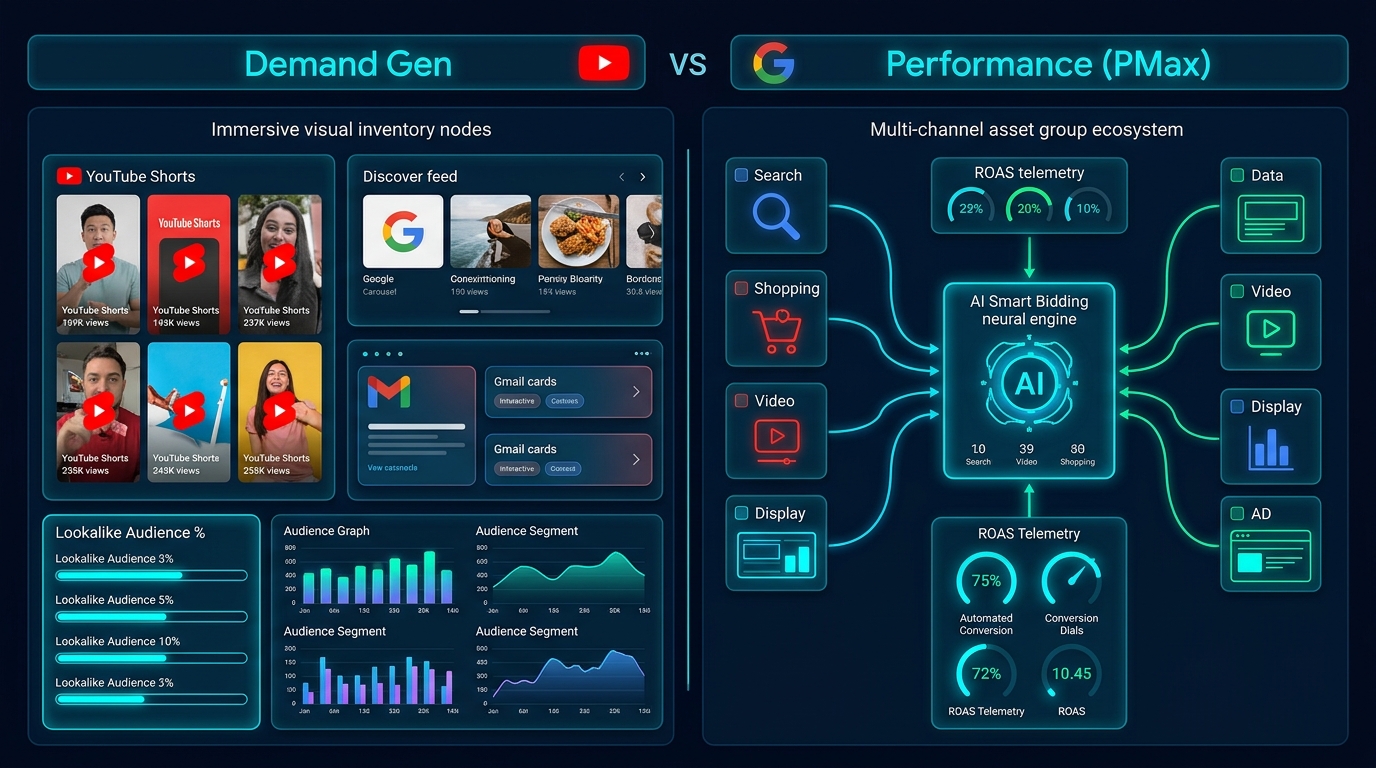
# Google Demand Gen Campaigns vs Performance Max: When and How to Scale YouTube Shorts & Discover In modern paid media architecture, Google Ads is no longer just a high-intent search engine—it is an autonomous multi-surface media ecosystem. However, performance marketers scaling mid-market DTC e-commerce brands and B2B SaaS pipelines frequently confront an architectural fork in the road: **Should cold prospecting budget be allocated to Google Performance Max (PMax) or Google Demand Gen?** At first glance, both campaign types appear to share overlapping machine-learning DNA. Both utilize automated Smart Bidding, both synthesize multi-format creative assets, and both serve across Google's visual inventory. However, beneath the interface lies a fundamental operational divide: - **Performance Max (PMax)** is an **Omnichannel Demand Harvester**. It sweeps across all seven Google properties (Search, Shopping, Maps, Display, YouTube, Gmail, Discover), gravitating algorithmically toward users who have already displayed commercial intent, frequently cannibalizing branded search terms to inflate reported ROAS. - **Demand Gen** is an **Immersive Demand Creator**. It isolates Google's premier visual and social surfaces—**YouTube Shorts, YouTube In-Stream, Google Discover Feed, and Gmail**—and equips media buyers with deterministic **Lookalike Audiences**, device exclusions, and creative-level reporting, functioning as Google's native direct competitor to Meta Ads and TikTok. Deploying both campaigns without an engineered allocation framework leads to attribution double-counting, creative cannibalization, and inflated Customer Acquisition Costs (CAC). This guide provides the complete comparative teardown, algorithmic mechanics, Lookalike seeding workflows, and budget allocation models required to master Demand Gen and Performance Max in 2026. ---

1. The Algorithmic Divide: Demand Creation vs Demand Harvesting

To deploy ad capital profitably, performance marketers must understand the mathematical objective function governing each campaign type: ```mermaid flowchart TD subgraph PMax [Performance Max: Bottom-Funnel Demand Harvester] A1["High Existing Intent (Searchers, Site Visitors)"] --> A2["Google Search & Shopping Auctions"] A2 --> A3["Maps & App Store Placements"] A3 --> A4["Low-CPM Display Remnants & YouTube Mid-Roll"] A4 --> A5["Goal: Maximize Total In-Platform Conversion Volume"] end subgraph DemandGen [Demand Gen: Mid/Top-Funnel Demand Creator] B1["Cold & Unaware Audiences (Lookalike 1%-5%, Custom Intent)"] --> B2["YouTube Shorts (Vertical 9:16 UGC)"] B2 --> B3["Google Discover Feed (High-Res Native Cards)"] B3 --> B4["Gmail Social & Promo Tabs"] B4 --> B5["Goal: Generate Brand Consideration & Unbranded Search Velocity"] end ``` ### The Performance Max Vulnerability: PMax is engineered to achieve the highest possible return on ad spend within its target constraints. If left ungoverned, the algorithm takes the path of least resistance: it bids heavily on **existing brand search queries**, **dynamic search retargeting**, and **bottom-of-funnel Google Shopping**. It claims credit for conversions that would have occurred organically, creating an illusion of high efficiency while failing to generate incremental net-new customers. ### The Demand Gen Advantage: Demand Gen deliberately excludes Search and Shopping inventory. It forces Google's machine learning models to act as a **pure visual discovery engine**. By serving engaging vertical video and swipeable carousels in user feeds before they ever enter a search query, Demand Gen seeds awareness and stimulates brand search lift. ---

2. Inventory & Placement Collision Matrix: Where Your Ad Dollars Actually Go

Understanding placement distribution reveals why treating these campaign types interchangeably causes media waste: | Inventory Surface | Google Demand Gen Campaigns | Google Performance Max (PMax) | Strategic Implications | | :--- | :---: | :---: | :--- | | **Google Search (Text Ads)** | **NO** | **YES** (Dominates spend) | PMax prioritizes Search; Demand Gen never competes on keyword auctions | | **Google Shopping Feed** | **NO** (Catalog feeds optional in-feed) | **YES** (Core e-commerce engine) | PMax Shopping captures active product searchers; Demand Gen pushes visual products | | **YouTube Shorts (9:16 Vertical)** | **YES** (Primary allocation) | **YES** (Secondary allocation) | Demand Gen gives 100% control over vertical video assets without desktop dilution | | **YouTube In-Stream (Long-Form)** | **YES** (Skippable video ads) | **YES** (Often dumps unspent budget) | Demand Gen lets you preview and select video formats; PMax auto-generates robotic clips | | **Google Discover Feed** | **YES** (Native multi-card carousels) | **YES** (Mixed with search) | Discover reaches 800M+ monthly active mobile users browsing news on Android/iOS | | **Gmail (Promotions & Social)** | **YES** (Expandable native cards) | **YES** | Demand Gen allows dedicated Gmail headline testing | | **Google Display Network (GDN)** | **NO** (Zero third-party websites) | **YES** (Massive remnant inventory) | Demand Gen eliminates low-quality mobile gaming apps and MFA (Made-For-Ad) site bleed | | **Google Maps** | **NO** | **YES** (Local store campaigns) | PMax drives physical foot traffic; Demand Gen drives digital engagement | > [!IMPORTANT] > The single biggest operational benefit of Demand Gen over PMax is the **complete exclusion of the Google Display Network (GDN)**. PMax frequently dumps 15% to 25% of ad spend onto low-quality mobile gaming apps and click-farm websites. Demand Gen delivers ads exclusively on **Google-owned and operated properties** (YouTube, Discover, Gmail), guaranteeing brand-safe environments. ---

3. Audience Targeting Showdown: First-Party Lookalikes vs Passive Audience Signals

The targeting architecture represents the most decisive technical difference between the two campaign models: ```text Targeting Governance Comparison: ├── Demand Gen Targeting: DETERMINISTIC ENFORCEMENT │ ├── 1. First-Party Lookalike Segments: Seeded with CRM high-LTV purchasers (1% to 10% reach) │ ├── 2. Custom Intent Audiences: Users who searched specific competitor keywords on Google Search │ ├── 3. Exclusion Controls: Hard exclusions for existing customers and 30-day purchasers │ └── 4. Demographics & Device Rules: Exclude Connected TV, exclude Tablets, isolate Mobile │ └── Performance Max Targeting: PASSIVE SUGGESTIONS (Soft Signals) ├── 1. "Audience Signals": Algorithm uses inputs as soft suggestions, then expands broadly ├── 2. Search Themes: Ingests up to 25 search themes, but cannot guarantee query matching └── 3. Limited Exclusions: Account-level negative lists required to prevent brand poaching ``` ### Building High-Converting Demand Gen Lookalike Segments: Unlike Meta Ads where lookalikes have become less effective under Advantage+ broad targeting, Google's Demand Gen Lookalikes leverage **Google's deterministic cross-device search and video consumption graph**: 1. **Seed List Curation**: Export your top 20% highest Lifetime Value (LTV) customers from Shopify or your CRM (minimum 1,000 matched hashed emails). 2. **Lookalike Segmentation**: - **Narrow (Top 2.5% Reach)**: Delivers highest conversion rate; ideal for high-ticket lead generation and luxury e-commerce. - **Balanced (Top 5.0% Reach)**: The optimal balance of scale and acquisition cost; recommended for scaling $100+ AOV products. - **Broad (Top 10.0% Reach)**: Maximum top-of-funnel reach; ideal for impulse purchases and viral consumer products. ---

4. Creative Asset Architecture: 9:16 Shorts, Discovery Carousels & Video Pacing

Demand Gen is a creative-first auction engine. If your creative assets are static desktop banners or horizontal corporate explainer videos, CPMs will surge and CTR will collapse. ```text Recommended Demand Gen Creative Matrix per Ad Group: ├── Vertical Video (9:16 - 1080x1920): 3 to 5 variations (YouTube Shorts, mobile Discover) ├── Horizontal Video (16:9 - 1920x1080): 2 variations (YouTube In-Stream living room & desktop) ├── Square Video (1:1 - 1080x1080): 2 variations (YouTube feed & Gmail) ├── Single-Image Native Cards (1.91:1 & 1:1): 5 variations (High-res photography for Discover) └── Multi-Card Discovery Carousels: 1 carousel with 4 to 10 product/story cards ``` ### The 3-Beat Hook Architecture for YouTube Shorts Ads: - **Beat 1: The Contrarian Pattern Interrupt (0:00 – 0:03)**: - Visual: High-motion physical demonstration or split-screen contrast test. - Audio: A bold, contrarian statement that disproves conventional wisdom. - **Beat 2: The Mechanism Teardown (0:03 – 0:15)**: - Show the internal engineering, ingredient breakdown, or software workflow. - Avoid generic hype; emphasize unique product differentiation. - **Beat 3: The Frictionless Call-to-Action (0:15 – 0:25)**: - Clear visual arrow pointing toward the sticky CTA button: *"Tap below to claim your 20% introductory trial."* Review our complete guide to [AI Video Creative Pipelines](/ai-video-creative-pipelines-comfyui-runway-gen3-elevenlabs-meta-ads/) for automated asset generation SOPs. ---

5. Feed-Driven Demand Gen for E-Commerce: Dynamic Catalogs Without Search

One of the most powerful and underutilized features of Demand Gen is **Google Merchant Center (GMC) Product Feed Integration**: ```mermaid flowchart LR A["Google Merchant Center Product Feed"] --> B["Demand Gen Campaign (Feed-Enabled)"] B --> C["Dynamic Product Cards Overlaying YouTube Shorts"] B --> D["Swipeable Product Strip in Discover Feed"] B --> E["Interactive Catalog Showcases in Gmail Promotions"] C --> F["Direct Checkout on PDP / Cart"] D --> F E --> F ``` ### Why Feed-Driven Demand Gen Outperforms Meta DPA: When a user watches a YouTube Short ad, Demand Gen renders a **dynamic horizontal product carousel beneath the video player**. As the creator demonstrates an outfit or skincare routine, the viewer can browse individual SKUs with real-time pricing and stock availability without pausing the video. ### Feed Hygiene Rules for Demand Gen: 1. **Custom Label 0 (Margin Tiers)**: Segment products into `high_margin` (> 60% gross margin) and `low_margin`. Run Demand Gen exclusively on high-margin SKUs to support higher allowable customer acquisition costs. 2. **High-Resolution Lifestyle Imagery**: Unlike Google Shopping which requires plain white backgrounds, Demand Gen pulls images from your feed's `lifestyle_image_link` attribute. Ensure high-resolution lifestyle images (1200x1200 minimum) are populated in GMC. ---

6. B2B & High-Ticket Lead Gen: Why Demand Gen Defeats PMax for Complex Funnels

For B2B software, executive consulting, and high-consideration lead generation ($5,000+ contract values), Performance Max is notorious for generating **spam form fills** and unqualified tire-kickers. ### Why PMax Fails B2B Lead Gen: PMax seeks the cheapest possible conversion. Because Google's machine learning models cannot differentiate between a legitimate enterprise VP and a bot submitting fake contact information, PMax will flood your CRM with fraudulent form fills originating from automated bots on the Display Network and spam sites. ### Why Demand Gen Succeeds: 1. **Clean Inventory**: Zero Display Network remnant sites; 100% of impressions occur within authenticated Google user sessions (signed-in YouTube and Gmail accounts). 2. **In-Feed Native Lead Forms**: Deploy Google's native lead form extensions inside YouTube and Discover. Fields pre-populate deterministically from the user's Google corporate account, eliminating fake phone numbers and invalid email addresses. 3. **Custom Intent Search Seeding**: Target users who recently searched for your top 20 direct enterprise competitors on Google, intercepting high-intent buyers before they finalize software contracts. ---

7. The 70/30 Budget Allocation Framework & Pacing Guardrails (≤ 20% / 72h)

To prevent auction cannibalization and maximize capital efficiency, orchestrate Demand Gen alongside Search using our **70/30 Hybrid Media Architecture**: | Campaign Tier | Budget Share | Strategic Mandate | Target Bidding Strategy | | :--- | :---: | :--- | :--- | | **Tier 1: Intent Harvesting (Search Alpha/Beta)** | **70%** | Capture existing search demand on exact brand and high-intent commercial keywords | Target CPA or Target ROAS (Value-Based) | | **Tier 2: Visual Demand Creation (Demand Gen)** | **30%** | Seed brand consideration, expand reach via Lookalikes, and generate unbranded search lift | Maximize Conversions with strict Target CPA Cap | ```text Scaling Pacing Protocol: [Safety Rule 1]: Create all new Demand Gen campaigns and ad groups in PAUSED status. [Safety Rule 2]: Cap budget scaling at <= 20% increases every 72 hours per campaign. [Safety Rule 3]: Ensure account-level brand exclusions are active to prevent search poaching. ``` Sudden budget spikes (> 30%) trigger Google's bidding algorithm to expand into low-affinity inventory, causing immediate CPM inflation. Scale methodically following our strict 72-hour stabilization window. ---

8. Bidding Strategies & Conversion Lag: Max Clicks, Target CPA & Value Rules

Selecting the correct bid strategy depends on campaign maturity and pixel conversion volume: ```mermaid graph TD A["Phase 1: Cold Account Launch (< 30 Conversions/mo)"] --> B["Bidding: Maximize Clicks (Drive Cheap Qualified Traffic, Benchmark CPC: $0.40 - $0.85)"] B --> C["Phase 2: Learning Stabilization (30 - 100 Conversions/mo)"] C --> D["Bidding: Maximize Conversions with Target CPA Guardrail"] D --> E["Phase 3: Mature E-Commerce Scale (> 100 Conversions/mo)"] E --> F["Bidding: Target ROAS (Value-Based Bidding using High-Margin Product Feed)"] ``` ### Managing Conversion Lag in Demand Gen: Visual discovery campaigns exhibit significantly higher **conversion lag** than Google Search. A consumer who watches a YouTube Short ad on Monday morning will rarely purchase immediately on their mobile device. In e-commerce, **45% to 65% of conversions happen 3 to 14 days later**, often through direct URL entry, organic search, or brand search. Do not pause a Demand Gen ad after 48 hours; allow a **14-day attribution maturation window** before evaluating True Contribution Margin. ---

9. Incrementality & Attribution: Measuring Demand Gen Lift via BigQuery SQL

Evaluating Demand Gen purely on Last-Click attribution will lead to premature campaign termination. To calculate true incremental value, join raw GA4 BigQuery events to measure **Search Lift and Assisted Conversion Paths**: ```sql -- Measure Unbranded Search Query Volume Lift Correlated with Demand Gen Spend WITH DemandGenDailySpend AS ( SELECT date, SUM(cost_micros) / 1000000.0 AS demand_gen_spend FROM `marketing-data-warehouse-prod.google_ads.campaign_performance_*` WHERE campaign_name LIKE '%DemandGen%' AND _TABLE_SUFFIX >= '20260901' GROUP BY 1 ), UnbrandedOrganicSearchSessions AS ( SELECT PARSE_DATE('%Y%m%d', event_date) AS date, COUNT(DISTINCT CONCAT(user_pseudo_id, CAST((SELECT value.int_value FROM UNNEST(event_params) WHERE key = 'ga_session_id') AS STRING))) AS unbranded_sessions FROM `marketing-data-warehouse-prod.analytics_123456789.events_*` WHERE event_name = 'session_start' AND traffic_source.medium = 'organic' AND traffic_source.source = 'google' AND _TABLE_SUFFIX >= '20260901' GROUP BY 1 ) SELECT s.date, COALESCE(d.demand_gen_spend, 0) AS daily_demand_gen_spend, s.unbranded_sessions, ROUND(s.unbranded_sessions / NULLIF(d.demand_gen_spend, 0), 2) AS organic_sessions_per_ad_dollar FROM UnbrandedOrganicSearchSessions s LEFT JOIN DemandGenDailySpend d ON s.date = d.date ORDER BY s.date DESC; ``` When Demand Gen ad spend scales, unbranded organic sessions and direct traffic volume index upward in direct statistical correlation, proving incrementality. ---

10. Real-World Case Study: DTC Apparel Brand Scales to $180k/mo at 3.4x Blended ROAS

An activewear DTC brand had exhausted their Google Search and Standard Shopping reach, plateauing at $65k/month ad spend with rising CPCs ($2.80+ on high-intent terms). ### The Demand Gen Restructure: 1. **Budget Reallocation**: Allocated 35% of total paid media budget ($25,000/month) into a dedicated **Feed-Driven Demand Gen Campaign**. 2. **Creative Differentiation**: Produced 12 native 9:16 YouTube Shorts videos featuring authentic athlete workout routines and fabric stretch demonstrations. 3. **Audience Architecture**: Seeded a 2.5% Narrow Lookalike from 8,500 past purchasers; excluded past 30-day purchasers. 4. **Feed Layer**: Attached Google Merchant Center product catalog tagged with `high_margin` custom labels. ### 90-Day Empirical Results: - **YouTube Shorts Average CPV**: **$0.014** across 1.8M engaged video views. - **Brand Search Volume Lift**: Google Search Console recorded a **74% surge in branded search queries**. - **Blended Account ROAS**: Maintained a **3.42x Blended ROAS** as monthly revenue scaled from $65k to **$182,000**. - **Customer Acquisition Cost (CAC)**: Dropped by **38.4%** compared to fatigued PMax cold prospecting. ---

11. The 28-Point Demand Gen Pre-Flight Setup & QA Checklist

Before setting any scaled Demand Gen campaign live, verify compliance across this pre-flight checklist: ```text Demand Gen Pre-Flight QA Protocol: [ ] 1. Creation State: Campaign and ad groups created in PAUSED status [ ] 2. Inventory Hygiene: Ensure Display Network expansion is not selected [ ] 3. Aspect Ratio Diversity: At least one 9:16, one 16:9, and one 1:1 video uploaded [ ] 4. High-Res Image Assets: At least 3 landscape (1.91:1) and 3 square (1:1) images attached [ ] 5. Audience Seeding: First-Party Lookalike segment (2.5% or 5%) verified and active [ ] 6. Negative Audience Exclusions: Excluded 30-day purchasers and active email subscribers [ ] 7. Feed Connection: Verified Google Merchant Center catalog attached with approved products [ ] 8. Brand Exclusions: Account-level negative keyword list confirmed to prevent brand overlap [ ] 9. Pacing Guardrail: Daily budget programmed to <= 20% scaling cap per 72 hours [ ] 10. Landing Page Speed: Mobile landing page Core Web Vitals LCP verified < 2.2 seconds [ ] 11. Conversion Tracking: Google Enhanced Conversions verified with green active status [ ] 12. Attribution Window: Account reporting set to Data-Driven Attribution model ``` ---

12. Frequently Asked Questions (FAQ)
### Can Demand Gen campaigns run alongside Performance Max without cannibalization? Yes, but only if you manage audience and inventory boundaries. Performance Max must be constrained with account-level brand exclusions to prevent it from poaching brand search, while Demand Gen should be dedicated to cold Lookalikes and YouTube Shorts visual prospecting. Do not target the exact same customer remarketing list in both campaigns simultaneously. ### What is the minimum monthly budget required to test Google Demand Gen? We recommend a minimum starting budget of **$3,000 to $5,000 per month** ($100 to $170/day) dedicated exclusively to Demand Gen. Because Smart Bidding requires approximately 30 to 50 conversion events per month to optimize its bidding algorithms, running Demand Gen on less than $50/day will trap the campaign in an indefinite learning phase. ### How does Google Demand Gen compare to Meta Advantage+ Shopping Campaigns (ASC)? Demand Gen is Google's architectural equivalent to Meta ASC. Both focus on feed-driven visual discovery and automated audience expansion. However, Demand Gen provides superior control over **exact video aspect ratios (9:16 Shorts vs 16:9 In-Stream)** and deterministic **First-Party Lookalike audience tiers**, whereas Meta ASC operates as a unified black-box campaign. ### Do Demand Gen campaigns show ads on Google Search? No. Demand Gen campaigns **never serve text or shopping ads on Google Search results pages**. They deliver ads exclusively across YouTube (Shorts, In-Feed, In-Stream), Google Discover feed, and Gmail. --- *Ready to scale high-converting Google Demand Gen funnels or optimize your Performance Max architecture? Explore our specialized [Paid Advertising Services](/services/) or review our verified [Client Case Studies](/case-studies/) to see how we build high-margin acquisition engines.*
SN

Subhranil Naskar

Founder & Lead Performance Strategist
Kolkata, West Bengal, India

Subhranil is the Founder and Lead Performance Strategist at Paid Media World. With over 10 years of practitioner experience managing high-budget performance marketing infrastructure across Google Ads, Meta Ads (CAPI), and GA4 event attribution, he personally architects and audits deterministic paid media infrastructure, algorithmic portfolio bidding, and enterprise conversion architecture.

Recommended Deep Dives

Related Playbooks & Further Reading

Explore All Playbooks
Sponsored Recommendations