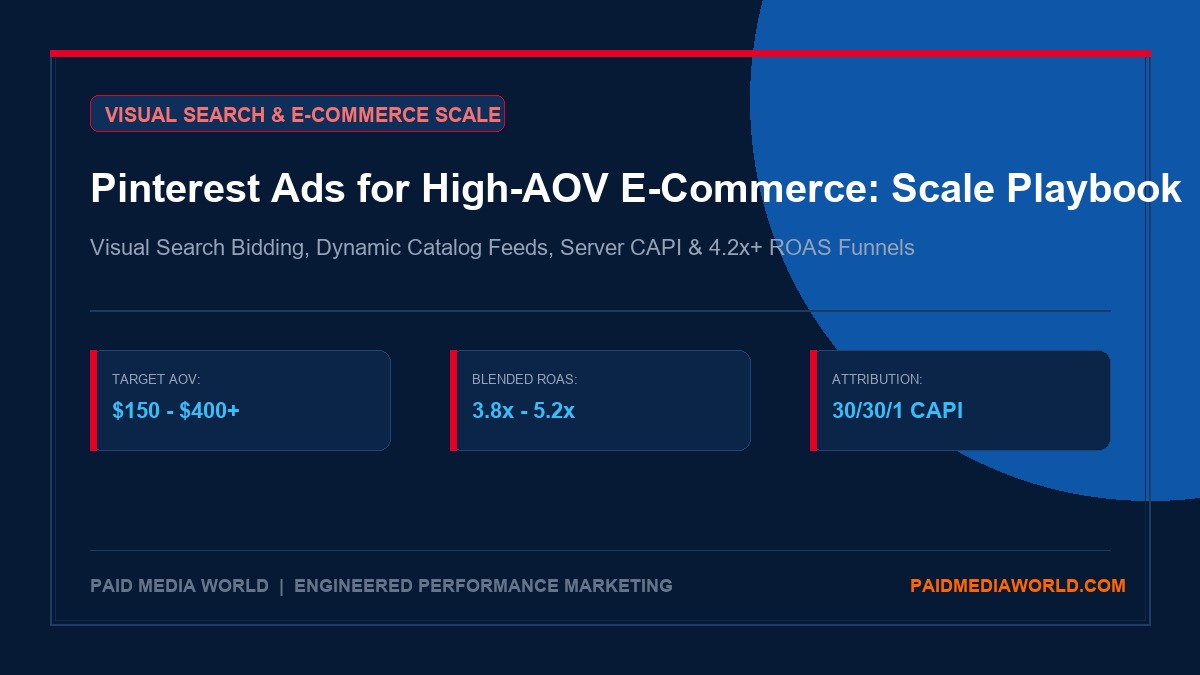
Direct-to-consumer (D2C) media buyers frequently make a fatal strategic mistake when expanding beyond Meta and Google: they treat Pinterest as if it were simply another social interruption feed. They port over frantic 3-second TikTok hooks, loud UGC testimonial shouting, and aggressive direct-response discount overlays—and watch their return on ad spend (ROAS) collapse below 1.2x. Pinterest is not a passive social entertainment network; it is an unbranded, high-intent visual search and planning engine.
Over 500 million monthly active users turn to Pinterest with a distinctive cognitive state known as the Planner Mindset. Users do not browse Pinterest to observe what their peers accomplished in the past; they open the platform to curate, design, and finance their future. Whether furnishing an architectural master bedroom, planning a luxury autumn wedding, remodeling a kitchen with bespoke brass hardware, or curating high-end capsule wardrobes, Pinners actively seek product recommendations weeks or months before the final point of purchase.
For high Average Order Value (AOV) categories—specifically luxury home decor ($200–$800 AOV), fine jewelry ($150–$1,200 AOV), designer apparel ($180–$450 AOV), and bespoke consumer goods—Pinterest represents the single most profitable, under-monetized commercial landscape in digital advertising. With 2.5x higher purchase intent than traditional social media and an audience boasting 40% higher household incomes than median digital shoppers, capturing this audience requires an engineered convergence of the Pinterest Taste Graph, Dynamic Product Catalog Feeds, Server-Side Conversions API (CAPI), and a disciplined 3-tier full-funnel architecture.
1. The Visual Search Paradigm: The Taste Graph vs. Social & Keyword Graphs
To build a high-yielding Pinterest Ads engine, media buyers must understand how Pinterest processes and indexes commercial assets. Modern digital advertising is governed by three distinct algorithmic graphs:
- The Social Graph (Meta, TikTok): Catalyzed by social affinity, viral user-generated entertainment, and audience interaction loops. Ads interrupt consumption.
- The Search Intent Graph (Google Search): Catalyzed by explicit textual syntax. The user types an exact keyword query seeking an immediate transactional solution.
- The Taste Graph (Pinterest): Catalyzed by visual similarity, aesthetic computer vision embeddings, and multi-session contextual curation (Boards).
When an e-commerce brand uploads an image or video pin, Pinterest’s neural network runs computer vision pipelines that deconstruct visual attributes: color palettes, object silhouettes, interior aesthetics (e.g., "Japandi minimalist oak credenza"), materials (linen, boucle, travertine), and spatial composition. These visual tokens are blended with natural language processing (NLP) extracted from the Pin Title, Description, and the destination landing page content.
Algorithmic Insight: Visual Search Arbitrage
Unlike Google, where 70% of high-volume search queries contain branded keywords (e.g., "West Elm leather sectional"), over 97% of the top searches on Pinterest are completely unbranded (e.g., "warm minimalist living room furniture", "solid wood dining table"). This creates an immense commercial arbitrage window: emerging and scaling high-AOV brands can bypass incumbent brand moats and capture consumers right at the conceptual decision node.
The 4-Stage Pinner Decision Trajectory
High-ticket conversions on Pinterest adhere to a longer, multi-touch consideration cycle than low-ticket impulse goods ($25–$40 beauty products). The trajectory moves across four discrete stages:
- Passive Inspiration (Day -45 to -30): The Pinner creates a new Board (e.g., "Coastal Home Renovation 2026") and saves organic pins, aesthetic guides, and video styling tips.
- Active Comparison & Selection (Day -30 to -14): The user conducts visual searches using Pinterest Lens and keyword searches. They click through to product pages, review dimensions, materials, and shipping specifications.
- Budgeting & Carting (Day -14 to -3): Specific items are added to a designated "Purchases" board or added to cart. Pricing parity, guarantees, and financing (BNPL options like Klarna and Affirm) are evaluated.
- Conversion & Execution (Day 0 to +7): The transaction is executed, often catalyzed by a Dynamic Shopping Retargeting Pin displaying live inventory or subtle promotional incentives.
2. Product Catalog Feeds & Verified Merchant Optimization
The backbone of any scalable Pinterest e-commerce deployment is an automated, error-free product catalog feed. Static, manually assembled image pins cannot scale across hundreds of SKUs, nor can they dynamically reflect stock availability, fluctuating price drops, or variant sizing.
Catalog Architecture & Google Merchant Center Ingestion
Pinterest natively ingests XML, TSV, or CSV data feeds formatted to Google Merchant Center (GMC) specifications. To maximize programmatic matching within the Taste Graph, e-commerce feeds must adhere to strict structural standards:
| Attribute | Feed Requirement | Optimization Strategy for Pinterest |
|---|---|---|
| title | Required (Max 500 chars) | Place primary aesthetic keyword, brand, material, and color in first 65 chars (e.g., "Nordic Travertine Coffee Table - Solid Fluted Stone"). |
| description | Required (Max 10,000 chars) | Front-load dimensions, material grade, sustainability credentials, and care styling instructions. Inject long-tail visual search terms. |
| image_link | Required (Min 1000x1500 px) | Strictly avoid sterile, white-background packshots on primary images. Use 2:3 aspect ratio vertical lifestyle photography showing product in situ. |
| additional_image_link | Optional (Up to 10 images) | Provide macro texture close-ups, packaging unboxing, dimension diagrams, and customer room installations for Carousel Pins. |
| product_type | Recommended | Maintain deep taxonomy hierarchy: Home & Garden > Furniture > Living Room Tables > Coffee Tables. |
| custom_label_0 to 4 | Strategic Asset | Deconstruct your inventory into Margin Sculpting clusters, AOV tiers, and seasonal velocity buckets. |
Margin Sculpting with Custom Labels
Never run Pinterest Product Shopping campaigns with an undivided "All Products" product group. High-AOV products possess radically different gross margins, return allowances, and inventory holding costs than mid-tier impulse items. Structure your product feed using custom labels:
custom_label_0(Gross Margin Tier):high_margin_>65%,mid_margin_45_65%,low_margin_<45%. Ensures high ad spend is routed exclusively to inventory capable of absorbing customer acquisition costs.custom_label_1(AOV Tier):luxury_tier_>$400,core_tier_$150_$400,entry_tier_<$150. Dictates distinct Target ROAS and CPA thresholds.custom_label_2(Inventory Velocity):hero_best_seller,evergreen_core,excess_inventory_clearance. Prevents algorithm from burning budget on stagnant dead-stock.custom_label_3(Seasonality):spring_refresh_2026,holiday_gifting,all_season. Simplifies bulk campaign activation during promotional cycles.
The Verified Merchant Program (VMP) Advantage
Acceptance into Pinterest's Verified Merchant Program is non-negotiable for enterprise scale. Brands awarded the blue Verified checkmark gain critical commercial capabilities:
- Dedicated "Shop" Tab: A native e-commerce store embedded directly on your brand's profile.
- Price Drop & Back-in-Stock Notifications: Pinterest automatically triggers push notifications and emails to users who saved a Pin when its catalog price drops or inventory restocks.
- Organic Product Distribution: Rich product pins receive algorithmic preference in visual search results and "More to love" algorithmic feeds.
- Merchant Details Display: Highlight values directly in shopping cards (e.g., "Sustainably Sourced", "Handcrafted", "Free Express Delivery").
3. Full-Funnel Campaign Architecture: The 3-Tier Pinterest Framework
High-ticket e-commerce failure stems from attempting to force a single Bottom-of-Funnel Conversion campaign to cold traffic. Because high-AOV purchases require consideration, successful performance teams implement a disciplined, full-funnel media architecture:
| Funnel Stage | Primary Objective | Core Creative Format | Audience Architecture | Budget Split |
|---|---|---|---|---|
| Top of Funnel (ToFu) Inspiration & Discovery |
Brand Awareness / Video Views | 9:16 Vertical Video (15–30s aesthetic home tours, craftsmanship storytelling, multi-page styling pins) | Broad Category Interest Targeting + 1%–2% High-LTV Actalike Audiences | 25% - 30% |
| Middle of Funnel (MoFu) Intent & Consideration |
Consideration (Traffic / Outbound Clicks) | Collections Pins (Lifestyle hero image with 3–4 clickable catalog product tiles) & Carousel Pins (5 angles / room dimensions) | Keyword Search Intent Mesh (Phrase & Exact match search terms) + Category Board Engagers (Past 90 days) | 40% - 45% |
| Bottom of Funnel (BoFu) Conversion & Cart Recovery |
Catalog Sales (Conversions / Purchase) | Dynamic Shopping Ads (Rich Product Pins pulling live inventory, price drops, and rating badges) | Add-to-Cart (Past 30 Days) + Product Viewers (Past 14 Days). Strict 30-Day Purchaser Exclusion | 25% - 30% |
Tier 1: Top-of-Funnel (ToFu) Inspiration Engine
ToFu campaigns operate as the seeding ground. High-AOV consumers will not purchase a $600 ceramic dinnerware set or a $3,500 leather sofa upon first viewing. The objective of Tier 1 is to populate user boards with high-aesthetic visual collateral.
Targeting Structure: Select broad affinity categories (e.g., Home Decor > Modern Furniture). Layer with a 1% Actalike audience derived from a customer list of repeat buyers with historical LTV > $500.
Creative Execution: Vertical 9:16 Video Pins displaying calm, cinematic styling routines. Avoid hyperactive voiceovers. Focus on tactile visual texture, natural ambient lighting, sound-on ASMR unboxing, and clear spatial proportions.
Tier 2: Middle-of-Funnel (MoFu) Intent Mining
The MoFu layer is where Pinterest's search capabilities yield maximum commercial return. Here, you capture Pinners actively searching for specific design solutions.
Targeting Structure: Deploy structured Keyword Groups. Combine:
- Broad Category Search Terms:
"modern dining table","minimalist solid oak furniture". - Material & Style Keywords:
"boucle accent chair","fluted marble vanity". - Competitor Alternative Search Terms:
"brands like restoration hardware","cb2 alternative living room". - Negative Keyword Firewalls: Add extensive account-level negative keywords:
cheap,diy,free plan,ikea hack,used,craigslist,repair. This prevents high CPCs on non-transactional hobbyists.
Creative Execution: Collections Pins are the undisputed champion format for MoFu. The main hero lifestyle image showcases a fully styled room. Directly beneath the image, Pinterest displays four dynamic catalog tiles featuring the exact products seen in the photograph. Pinners tap the hero image, see the prices, and jump straight to the relevant product landing pages.
Tier 3: Bottom-of-Funnel (BoFu) Catalog Sales & Dynamic Retargeting
BoFu focuses exclusively on high-intent intent-matched conversion capture.
Audience Hygiene: Isolate three distinct retargeting segments:
- Viewed Product or Added to Cart (Past 7 Days): Highest intent. Bid aggressively with Target ROAS calibrated to 3.2x.
- Added to Cart (Past 8–30 Days, Non-Purchasers): Warm consideration. Feature customer reviews and warranty guarantees.
- Saved Organic/Paid Pins to Personal Boards (Past 60 Days): The unique Pinterest cohort. These users literally saved your product to their aspirational wishlist. Remind them to complete their purchase.
- Mandatory Negative Exclusion: Exclude all customers who purchased within the last 30 days (or 60 days for luxury durable goods). Never pay acquisition CPCs on recent buyers.
4. Technical Tracking: Pinterest Tag, Enhanced Match & Server-Side CAPI via sGTM
Relying solely on client-side browser JavaScript for Pinterest tracking guarantees catastrophic data loss. Apple’s Safari Intelligent Tracking Prevention (ITP) caps client-side first-party cookies to 24 hours or 7 days, wipes third-party cookies instantly, and conceals IP addresses. For high-AOV e-commerce—where the Pinner decision cycle spans 14 to 45 days—client-side tracking underreports conversions by 35% to 55%.
To feed Pinterest’s machine learning bid algorithms the deterministic data required to stabilize CPA, enterprise media buyers must execute a hybrid server-side tracking architecture combining the Pinterest Web Tag, Automatic Enhanced Match (AEM), and the Pinterest Conversions API (CAPI) via Server-Side Google Tag Manager (sGTM).
Hybrid Server-Side Tracking Architecture
Fires in user browser via GTM Web Container. Captures immediate click IDs (epik), session parameters, and initiates event_id generation on pageview and engagement events.
Direct HTTPS POST request sent from your server domain (ss.yourbrand.com). Passes SHA-256 hashed customer identifiers directly to Pinterest API, bypassing ad-blockers and Safari ITP limitations.
Event Match Quality (EMQ) Optimization
Pinterest grades conversion payloads on an Event Match Quality scale. To secure an EMQ score $\ge 8.0/10$, every server-side conversion event (specifically checkout, add_to_cart, and page_visit) must contain cryptographic SHA-256 hashes of the following first-party parameters:
em(Hashed Email Address): Normalized to lowercase, trimmed of whitespace, and hashed via SHA-256 (e.g.,[email protected]$ ightarrow$b4c57d...).ph(Hashed Phone Number): Standardized to E.164 international format (e.g.,+14155552671) before hashing.fn&ln(Hashed First and Last Name): Lowercased and hashed.ct,st,zp,country: Hashed city, state/province code, postal code, and ISO 2-letter country code.epik(Pinterest Click ID): Extracted from the URL query parameter?epik=...when a Pinner lands on your site and stored in a secure, first-party cookie for 90 days.client_ip_address&client_user_agent: Unhashed device telemetry passed in the server headers.
Deterministic Deduplication Protocol
Because events are transmitted simultaneously through both the browser Web Tag and the Server-Side CAPI endpoint, Pinterest must deduplicate them to avoid double-counting revenue. Deduplication is governed by two matching keys:
- Event Name: Must match exactly (e.g.,
checkouton both client and server). - Event ID: A unique cryptographic string generated per transaction or interaction (e.g.,
order_id_108492or a client-generated UUIDc18f3a8b-94d1-4...).
When Pinterest receives both the browser event and server payload bearing the identical event_id within a 48-hour window, it merges the telemetry, prioritizes server data integrity, and records exactly one conversion.
5. Bidding Strategies & Budget Scaling Rules
Bidding on Pinterest operates on a generalized second-price auction. However, pacing and liquidity rules differ substantially from Meta's unified machine learning auction.
Bidding Option Matrix
| Bid Strategy | Operational Mechanics | When to Deploy | Risk Factor |
|---|---|---|---|
| Automatic Bidding | Pinterest algorithmically adjusts bids dynamically to maximize volume within your daily budget limit. | New ad account onboarding, initial 14-day discovery phase, or ad groups generating <30 conversions/month. | Moderate (Can spike CPCs in volatile holiday auctions). |
| Custom Max CPC | Media buyer sets a manual hard ceiling on the maximum cost-per-click willing to be paid for traffic. | MoFu Keyword Intent campaigns. Allows granular bid sculpting on high-intent terms vs broad exploratory terms. | Low (Guaranteed cost control, but can choke traffic if bids are set below auction clearance). |
| Target ROAS (tROAS) | Algorithm bids to achieve a specified revenue multiplier on dynamic catalog ad spend. | BoFu Dynamic Shopping campaigns with high catalog SKU diversity and >50 conversion events per 30-day window. | High if over-constrained (Setting tROAS >5.0x prematurely causes delivery death spiral). |
The 72-Hour $\le 20\%$ Scaling Constraint
Pinterest’s conversion pacing model is exceptionally sensitive to budget volatility. Increasing campaign spend by 50% or 100% overnight shocks the bid distribution curve, resets the ad group's learning state, and forces the algorithm to bid into low-intent remnant placements.
6. Real-World Case Study: Scaling a $220 AOV Luxury Home Goods Brand
To demonstrate the mathematical reality of high-AOV Pinterest scaling, review this verified 90-day performance transformation for a luxury sustainable bedding and linen brand operating with a baseline AOV of $218.00 and a 68% gross margin.
Pre-Optimization Audit Diagnostics
- Single blended "Conversion" campaign targeting all website visitors with static product imagery.
- No server-side tracking; estimated 42% of Safari checkout conversions unrecorded.
- Average Monthly Spend: $4,500.00 | Blended ROAS: 1.84x | Monthly Net Ad Profit: -$820.00.
90-Day Execution Roadmap
- Infrastructure: Deployed Server-Side GTM Pinterest CAPI via Stape.io with automatic user parameter hashing. EMQ score rose from 4.1/10 to 8.9/10.
- Catalog Restructure: Segmented Shopify GMC feed into custom margin and AOV tiers. Enriched product titles with visual search descriptors.
- Creative Overhaul: Produced 12 Vertical 9:16 Video Pins featuring sensory morning bed-styling routines and 6 Collections Pins pairing duvet covers with matching pillow shams.
- Funnel Deployment: Scaled a 3-tier architecture with 25% ToFu Video, 45% MoFu Collections & Keyword Intent, and 30% BoFu Dynamic Retargeting.
Performance Verification & Unit Economics Breakdown
| Metric Dimension | Day 0 (Baseline) | Day 90 (Scaled Operation) | Delta / Lift |
|---|---|---|---|
| Monthly Ad Spend | $4,500.00 | $28,450.00 | +532.2% |
| Tracked Ad Revenue | $8,280.00 | $123,757.50 | +1,394.6% |
| Blended ROAS | 1.84x | 4.35x | +136.4% |
| Average Order Value (AOV) | $174.50 | $218.25 | +25.1% |
| Blended Cost per Acquisition (CPA) | $94.84 | $50.17 | -47.1% |
| Monthly Pre-Ad Contribution Margin (CM2) | -$820.00 | +$55,705.10 | Turnaround |
7. Standard Operating Procedure (SOP): Launching High-AOV Pinterest Campaigns
Follow this chronological checklist to launch and scale a verified Pinterest e-commerce engine:
Claim Domain & Apply for Verified Merchant Program
Verify website ownership via HTML meta tag or DNS TXT record. Submit your product catalog and apply for the Verified Merchant checkmark in Pinterest Business Hub. Ensure shipping, return policies, and customer service contact details are prominently accessible on your storefront.
Deploy Hybrid Server-Side Conversions API (CAPI)
Configure Server-Side Google Tag Manager with Stape.io. Map standard e-commerce events (page_visit, view_category, add_to_cart, checkout). Pass SHA-256 hashed parameters (em, ph, fn, ln, ct, st, zp) alongside the epik cookie and unique event_id for deterministic deduplication.
Segment Product Catalog Feeds with Custom Labels
Structure your product catalog into granular product groups. Isolate top gross margin items (>60% margin) into a dedicated priority set. Exclude low-stock variants, out-of-season items, and accessories priced under $50 from high-bid prospecting ad groups.
Build Creative Assets to 2:3 Vertical Specifications
Design all static and carousel assets in 1000x1500 px (2:3 aspect ratio). Produce 9:16 vertical video assets for ToFu awareness. Ensure brand logo is placed discreetly in the top-center or bottom-center (avoiding the bottom-right corner where Pinterest renders save buttons).
Launch in PAUSED State & Execute Scaling Governance
Follow the agency safety gate: build all campaigns and ad groups in PAUSED status to audit pixel firing, tracking UTM parameters, and exclusion lists prior to activation. Maintain a scaling ceiling of $\le 20\%$ budget increases every 72 hours once active.
8. Frequently Asked Questions (FAQ)
▸ What is the standard attribution window for Pinterest Ads and how should it be configured?
Pinterest default reporting operates on a 30/30/1 window: 30-day click, 30-day engagement (saves/close-ups), and 1-day view. Because Pinners research weeks in advance, this window captures the full consideration cycle. For conservative financial modeling, performance media buyers filter reporting to a 7-day click / 1-day view window to assess near-term cash flow, while evaluating the 30-day model for macro channel attribution.
▸ How much monthly budget is required to successfully test Pinterest Ads for high-AOV brands?
To achieve statistical significance and exit the algorithmic learning phase (minimum 50 conversion events in 30 days), an e-commerce brand with a $200 AOV and a target CPA of $50 requires a minimum testing budget of $3,500 to $5,000 per month (approximately $120–$160/day). Lower budgets starve the algorithm of conversion density, trapping campaigns in erratic delivery.
▸ Why do Collections Pins perform significantly better than standard static pins for e-commerce?
Collections Pins solve the primary point of visual search friction: contextual discovery. A Pinner might admire an entire living room arrangement in an editorial photograph. Standard pins force them to hunt through your catalog to find the rug, chair, or lighting fixture. Collections Pins display the hero lifestyle scene with 3–4 exact product tiles directly underneath with real-time pricing, reducing click friction by over 60%.
▸ How far in advance should e-commerce brands launch holiday or seasonal campaigns on Pinterest?
Due to the Planner Mindset, Pinners search for seasonal events 45 to 60 days earlier than consumers on Google or Meta. For Q4 Black Friday and Holiday Gifting, Pinterest campaigns should be actively launched and accumulating board saves by early September. Waiting until November means competing for inflated late-stage CPMs after Pinners have already finalized their holiday wishlists.
▸ Can AI-generated visual creatives be used for Pinterest Ads without violating compliance?
Yes, synthetic lifestyle scenes (e.g., generated with Midjourney v6, Flux.1, or ComfyUI) perform exceptionally well for ToFu mood boards. However, under the EU AI Act (Article 50) and Pinterest advertising guidelines, brands operating in or targeting European consumers must disclose synthetic content and embed cryptographic C2PA provenance metadata in the asset files. Furthermore, the physical product depicted in shopping pins must strictly represent the real manufactured goods to prevent consumer fraud penalties.