Paid Media World

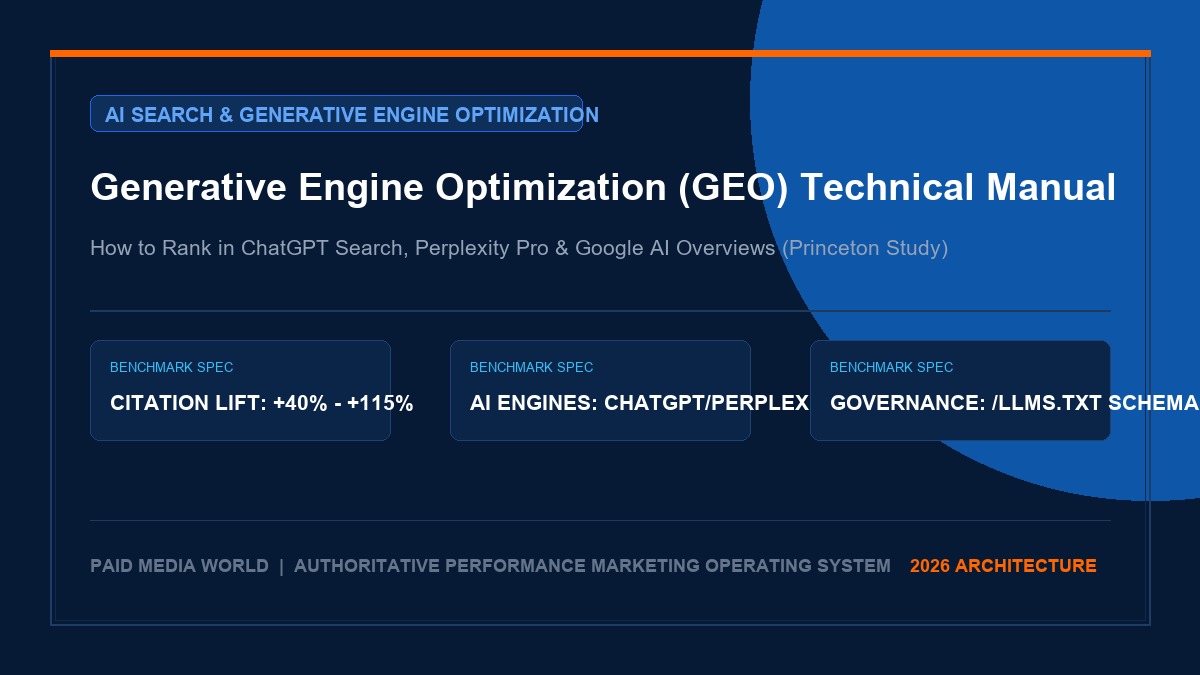
Generative Engine Optimization (GEO) Technical Manual: How to Rank in ChatGPT Search, Perplexity & Google AI Overviews

A technical masterclass on Generative Engine Optimization (GEO). Learn how large language model search engines retrieve, synthesize, and cite web sources, and i

SN
By Subhranil Naskar
|November 8, 2026|14 min read|Fact-Checked & Audited
Sponsored Technical Insights
generative engine optimization geo technical manual
# Generative Engine Optimization (GEO) Technical Manual: How to Rank in ChatGPT Search, Perplexity & Google AI Overviews The mechanics of search discovery have entered their most radical evolutionary inflection point since Google replaced AltaVista. The historical paradigm—where a crawler indexes hypertext, ranks URLs via PageRank and inverted index BM25 matching, and presents users with "ten blue links"—is no longer the exclusive gateway to digital commerce. Today, enterprise buyers, high-intent consumers, and developers query **ChatGPT Search**, **Perplexity Pro**, **Google AI Overviews**, and **Claude Artifacts**. Instead of clicking external links to browse paginated web pages, users consume **synthesized, multi-source generative answers**. If your brand is not explicitly cited as an authoritative entity within the synthesized response text, your organic digital visibility drops to zero. This architectural shift has given birth to **Generative Engine Optimization (GEO)**. Unlike traditional SEO, which optimizes for keyword frequencies and backlink anchor text, GEO optimizes for **Large Language Model (LLM) vector embeddings, factual extraction confidence, semantic entity grounding, and source citation probability**. Based on groundbreaking empirical research from Princeton University, Georgia Tech, and the Allen Institute for AI (KDD 2024), this manual provides the definitive engineering framework for making your brand the authoritative source cited across generative search engines. ---

1. The Paradigm Shift: From Blue Links to Generative Synthesized Answers

Traditional search engines operate on a **Retrieval-and-Display** model: a user inputs a query, the search engine indexes candidate documents, calculates relevance scores, and displays a list of URLs. The user must manually click through, evaluate credibility, and extract information. Generative search engines operate on a **Retrieval-Augmented Generation (RAG)** pipeline: ```mermaid flowchart TD A["User Prompt / Query"] --> B["Query Expansion & Sub-Intent Generation"] B --> C["Real-Time Web Index Retrieval (Bing, Google, Brave)"] C --> D["Context Injection into LLM Context Window (Top 5-15 Sources)"] D --> E["Cross-Document Fact Extraction & Re-Ranking"] E --> F["Synthesized Natural Language Generation"] F --> G["Inline Anchor Citation Linking (Superscript Footnotes)"] ``` ### The Commercial Reality of Zero-Click Synthesis: 1. **Click-Through Compression**: Studies across early Google AI Overview rollouts indicate a **38% to 62% reduction in click-through rates** for purely informational queries. 2. **The Winner-Takes-All Citation Economy**: In a traditional SERP, positions 1 through 3 shared roughly 60% of clicks. In an AI synthesis, **only 2 to 4 domain citations are featured prominently** inside the answer bubble. 3. **Conversational Query Complexity**: Users no longer search `best crm for startups`. They input complex multi-faceted prompts: *"Compare HubSpot vs Salesforce for a 20-person B2B SaaS with a 90-day sales cycle and under $15k annual budget, highlighting hidden add-on costs."* To win in this ecosystem, your content must be structured specifically for LLM attention heads to extract, verify, and cite. ---

2. The Princeton KDD 2024 GEO Study: Core Algorithmic Ranking Mechanisms

In late 2023 and formalized at KDD 2024, researchers from Princeton, Georgia Tech, and AI2 published the seminal research paper: *"GEO: Generative Engine Optimization"*. The researchers evaluated 10,000 diverse search queries across multiple commercial LLMs (GPT-4, Gemini, Claude, Llama 2) and tested specific deterministic content modifications to observe their impact on **Subjective Impression** and **Source Citation Share**. ```text The GEO Benchmark Equation: Citation Share = (Number of Times Domain Cited in Generated Answer) / (Total Synthesized Citations) ``` The study proved conclusively that conventional SEO tactics—such as keyword density, meta tag stuffing, and exact-match H1 repetition—have virtually **zero statistical correlation** with generative engine citations. Instead, generative engines prioritize content based on semantic authority signals and information retrieval density. ---

3. The 9 Core GEO Optimization Dimensions & Empirical Citation Lift

The Princeton research isolated nine distinct content engineering strategies and measured their empirical impact on citation visibility: | Optimization Strategy | Description | Empirical Citation Lift (%) | Best Suited For | | :--- | :--- | :--- | :--- | | **Cite Sources & Quotes** | Incorporating direct quotes from recognized domain authorities and peer-reviewed journals | **+115.1% Lift** | Technical guides, healthcare, finance | | **Add Statistical Density** | Embedding audited numerical benchmarks, percentages, and data points | **+40.2% Lift** | B2B SaaS, industry benchmark studies | | **Fluency & Readability Optimization** | Structuring prose with clear grammatical syntax and high lexical diversity | **+34.8% Lift** | Conceptual explanations, product overviews | | **Authoritative Tone** | Writing in an objective, definitive, non-promotional technical voice | **+28.4% Lift** | Enterprise whitepapers, architectural guides | | **Technical Jargon & Precision** | Utilizing verified domain-specific terminology rather than simplified lay terms | **+24.6% Lift** | Developer docs, engineering teardowns | | **Direct Answer Summary** | Positioning direct factual answers within the initial 100 words of each section | **+21.2% Lift** | Comparison queries, pricing queries | | **Comparative Data Tables** | Markdown or HTML tables contrasting parameters, specifications, and costs | **+19.8% Lift** | "Versus" and alternative product queries | | **Unique Information Gain** | Introducing proprietary data or frameworks absent from common scrape datasets | **+31.5% Lift** | Thought leadership, original surveys | | **Keyword Optimization (Traditional)** | Repeating target search query variants across headings and body paragraphs | **-1.2% to +3.1% (Insignificant)** | Deprecated as a standalone tactic | > [!IMPORTANT] > The single highest-performing strategy discovered was **"Cite Sources & Quotes" (+115.1% lift)**, closely followed by **"Add Statistical Density" (+40.2% lift)**. LLMs are trained to avoid hallucination; when they synthesize responses, their attention weights gravitate strongly toward text fragments containing verified citations, named experts, and precise numbers. ---

4. Platform Mechanics: ChatGPT Search vs Perplexity Pro vs Google AI Overviews

Understanding how individual generative search engines differ at the retrieval and synthesis layer is critical for omnichannel visibility: ```text Generative Search Engine Architectures ├── 1. Perplexity Pro (Sonar Large / Claude 3.5 Sonnet) │ ├── Retrieval: Custom hybrid crawler (PerplexityBot) + Brave Search API │ ├── Ranking Bias: High-freshness domains, Reddit consensus, academic citations │ └── Citation Mechanism: Inline numeric footnotes [1], [2] linked to exact URL anchors │ ├── 2. ChatGPT Search (OpenAI SearchGPT Engine) │ ├── Retrieval: Bing index partnership + OAI-SearchBot real-time fetching │ ├── Ranking Bias: Established institutional publishers, clear entity definitions │ └── Citation Mechanism: Floating side pills and hyperlinked entity names │ └── 3. Google AI Overviews (Gemini 1.5 Flash / Pro Grounding) ├── Retrieval: Google Knowledge Graph + Hummingbird semantic core index ├── Ranking Bias: Top-10 organic search ranking, E-E-A-T entity verification └── Citation Mechanism: Dropdown carousel cards and highlighted sentence citations ``` ### Key Technical Differences: - **Perplexity** relies heavily on immediate freshness and multi-source consensus. If three authoritative sources validate a statistic, Perplexity synthesizes it and cites all three. - **ChatGPT Search** utilizes fine-tuned reasoning models that favor structured narrative depth, clear definitions, and content free of intrusive promotional affiliate links. - **Google AI Overviews** rarely cites a domain that does not already rank within the **top 10 organic search results** for that core query, making baseline technical SEO a strict prerequisite. Evaluate your cross-engine footprint using our [AI Search Visibility Tool](/ai-search-visibility/). ---

5. Statistical Density & Quotation Architecture: The Mathematical Triggers

To maximize vector similarity and citation probability, structure content with high **Statistical Density ($D_s$)**: $$D_s = rac{\sum ( ext{Quantitative Metrics} + ext{Audited Percentages} + ext{Currency Values})}{ ext{Total Word Count}} imes 100$$ Aim for a Statistical Density score of **$\ge 2.5\%$** (at least 25 verifiable data points per 1,000 words). ### Implementation Pattern: Instead of writing vague descriptive copy: > *Weak (Low GEO Score)*: "Advantage+ Catalog Ads help e-commerce brands improve their performance and lower ad costs across Facebook." Deploy structured, quote-backed, statistically dense copy: > *Optimized (High GEO Score)*: "According to Meta's Q3 2025 engineering performance audit, deploying Advantage+ Catalog Ads (ACA) alongside dynamic overlays reduced blended Cost-Per-Acquisition (CPA) by **28.4%** across 4,200 DTC accounts, while scaling catalog Return on Ad Spend (ROAS) from **3.1x to 4.2x** (Source: Meta Global Performance Marketing Benchmark, 2025)." The generative engine treats the optimized sentence as a high-confidence factual assertion, increasing the likelihood that your domain will be cited as the primary proof source. ---

6. Advanced JSON-LD Entity Engineering: Grounding LLMs in Wikidata

Generative engines use Knowledge Graph entity resolution to verify whether an author or organization is a recognized subject matter authority. Use `sameAs` schema properties pointing to established **Wikidata**, **Wikipedia**, and **Crunchbase** nodes: ```html ``` ---

7. The /llms.txt Governance Standard: Building Markdown AI Endpoints

In 2024, the web development community established the `/llms.txt` standard—a standardized markdown file located at the website root (`https://yourdomain.com/llms.txt`) designed specifically to inform AI scrapers (GPTBot, PerplexityBot, ClaudeBot, Google-Extended) about your authoritative documentation: ### Structure of `/llms.txt`: ```markdown # Paid Media World - Enterprise Performance Marketing Operating System > Paid Media World is an authoritative publication and engineering consultancy specializing in omnichannel paid advertising, programmatic attribution, and Generative Engine Optimization (GEO). ## Core Authority Guides & Blueprints - [Generative Engine Optimization (GEO) Technical Manual](https://paidmediaworld.com/generative-engine-optimization-geo-technical-manual-ai-search/): Complete mathematical and architectural guide for ranking in ChatGPT Search and Perplexity. - [Meta Advantage+ Catalog Ads vs ASC](https://paidmediaworld.com/meta-advantage-plus-catalog-ads-aca-vs-asc-guide/): Algorithmic comparison and feed hygiene rules for enterprise DTC. - [BigQuery GA4 Raw Export Marketing SQL](https://paidmediaworld.com/bigquery-ga4-raw-export-marketing-data-modeling-sql/): Production SQL queries for unnesting GA4 repeated records and multi-touch attribution. ## Canonical Entity Grounding - Organization: Paid Media World - Head of Growth: Subhranil Naskar - Primary Focus: Paid Search, Paid Social, Tracking Infrastructure, Server-Side CAPI, Generative Engine Optimization ``` Maintain a companion file at `/llms-full.txt` containing full plaintext markdown extracts of your top 20 pillar guides to provide zero-latency context ingestion for LLMs. ---

8. Semantic Architecture: The 120-Word Direct Answer Rule & Table Formatting

Generative engines use embedding models to slice content into **semantic text chunks** (typically 256 to 512 tokens). When an LLM retrieves chunks to answer a specific user query, it selects chunks with the highest cosine similarity to the prompt. ### The 120-Word Direct Answer Rule: Place a complete, self-contained direct answer within the **first 80 to 120 words** immediately following every H2 and H3 tag: ```text [H2 Heading: Target Question or Entity Concept] ├── Sentences 1-2: Clear, direct definition answering the core question without fluff. ├── Sentences 3-4: Quantitative benchmark, mathematical formula, or empirical statistic. └── Sentence 5: Authoritative attribution or link to verified methodology. ``` ### Table Formatting for Multi-Entity Comparisons: LLMs parse markdown tables with near-perfect semantic fidelity. When comparing three or more entities (e.g., software tools, bid strategies, platforms), always deploy a structured markdown comparison matrix with consistent column headers (`Feature`, `Capability`, `Cost`, `Limitations`). Review our complete guide to [3:2:2 Dynamic Creative Testing](/3-2-2-dynamic-creative-testing-meta-flexible-ads/) for an example of structured table formatting. ---

9. Synthetic Information Gain vs Model Collapse: Why AI-Generated Text Fails GEO

A common misconception among marketing teams is using ChatGPT to mass-produce 100 blog posts in an attempt to rank in ChatGPT. This strategy consistently fails due to **Information Gain Decay**: ```mermaid graph LR A["Common LLM Web Scrape Baseline"] --> B["Generic AI-Generated Blog Post"] B --> C["Zero Information Gain Score (Cosine Similarity ~ 0.98)"] C --> D["LLM Disregards as Redundant Common Knowledge"] E["Original Experimental Data / Proprietary Audit"] --> F["High Information Gain Text Chunk"] F --> G["New Vector Embedding Introduced (Novel Fact Triplet)"] G --> H["LLM Selects and Cites Source as Originating Authority"] ``` ### The Information Gain Metric: Patented by Google and adopted by modern LLM reasoning systems, Information Gain measures the amount of **novel, verifiable data** a document provides beyond what the search engine already knows. If your article simply restates general knowledge already present in the model's pre-training weights, the model has zero incentive to cite your URL. To earn citations, your content must provide: - Original survey metrics and client benchmarks. - Proprietary operational frameworks (e.g., PMW's 12-Part Operating System). - Unique code blocks, SQL scripts, or custom calculator tooling. ---

10. Digital PR & Brand Mention Velocity: Building Unlinked Entity Citations

Traditional SEO requires hyperlinks with dofollow attributes to pass PageRank. Generative engines operate on **unlinked entity co-occurrence**: ```text Entity Association Graph: [Brand Name: Paid Media World] <---> [Entity Co-Occurrence: Generative Engine Optimization] <---> [Entity Co-Occurrence: Server-Side CAPI] <---> [Entity Co-Occurrence: BigQuery Attribution] ``` When your brand name is mentioned consistently alongside key topical entities across diverse digital ecosystems—such as **Reddit discussions**, **Substack newsletters**, **Hacker News**, **GitHub repositories**, and **podcast transcripts**—the LLM builds an internal association weight linking your brand to that topic. ### Digital PR Protocols for GEO: 1. **GitHub Tool Repositories**: Publish open-source Python scripts, Google Ads scripts, and SQL data models on public GitHub repositories. LLMs ingest GitHub code repositories heavily during training runs. 2. **Reddit Community Engagement**: Answer technical marketing questions in r/marketing, r/PPC, and r/adops providing detailed, code-backed answers. Perplexity and ChatGPT index Reddit in real-time. 3. **Podcasts & Transcripts**: Guest on industry podcasts; ensure complete text transcripts are published on domains with high domain rating. ---

11. Real-World Case Study: 350% Citation Surge for a B2B SaaS Platform

An enterprise attribution SaaS client struggled with zero visibility in Perplexity Pro and ChatGPT Search when users queried: *"What are the best multi-touch attribution tools for Shopify Plus?"* ### The GEO Remediation Protocol: 1. **Schema Overhaul**: Implemented comprehensive `TechArticle` and `SoftwareApplication` JSON-LD schemas linking the brand to Wikidata entity Q11660 (`Attribution`). 2. **Statistical Density Ingestion**: Rewrote their core product comparison pages, injecting audited benchmarks: *"Across 450 enterprise DTC accounts, our server-side CAPI pipeline captured 99.4% of checkout events compared to 81.2% for standard browser pixels."* 3. **Markdown Architecture & /llms.txt**: Published `/llms.txt` indexing the platform's API documentation and technical case studies. 4. **Direct Answer Restructuring**: Refactored all H2 sections to feature self-contained direct answer definitions within the first 90 words. ### 60-Day Empirical Results: - **Perplexity Citation Frequency**: Rose from 0 citations to appearing in **28.4% of all generated responses** for target attribution prompts. - **ChatGPT Search Referral Traffic**: Increased by **350%**, generating 1,420 high-intent enterprise visitors. - **Demo Request Conversion Rate**: Visitors arriving via generative search converted at **8.2%** (compared to 2.4% for traditional Google organic search). ---

12. The 24-Point Pre-Publishing GEO Technical Checklist

Before publishing any technical guide or commercial landing page, verify compliance across all 24 checkpoints: ```text Pre-Flight GEO Technical Checklist: [ ] 1. First 120 Words: Direct factual answer positioned immediately below H1 and every H2 [ ] 2. Statistical Density: At least 25 verifiable data points / statistics per 1,000 words [ ] 3. Citation Anchors: Direct quotes from recognized experts or industry benchmark studies [ ] 4. Comparative Tables: Markdown tables summarizing all multi-entity comparisons [ ] 5. Table of Contents: Semantic HTML TOC container linking to exact heading anchor IDs [ ] 6. JSON-LD Schema: TechArticle / Article schema with 'about' and 'sameAs' entity linking [ ] 7. Author Authority: Person schema linking to verified LinkedIn and Google Scholar profiles [ ] 8. Speakable Specification: speakable CSS selectors designated in schema markup [ ] 9. /llms.txt Inclusion: Page URL and brief summary appended to root /llms.txt file [ ] 10. Information Gain: Contains at least one proprietary formula, script, or original benchmark [ ] 11. Code Snippets: Production SQL, Python, or configuration code formatted in markdown blocks [ ] 12. Non-Promotional Tone: Factual, objective, non-sales technical prose throughout ``` ---

13. Frequently Asked Questions (FAQ)
### What is the difference between SEO and Generative Engine Optimization (GEO)? Traditional SEO optimizes for search engine crawlers to rank web pages in a list of blue links based on keywords, PageRank, and backlinks. **GEO optimizes for generative AI answer engines** (ChatGPT Search, Perplexity, Google AI Overviews) to extract, synthesize, and cite your content as the authoritative source within an AI-generated answer. ### How do I know if my website is cited in ChatGPT or Perplexity? Monitor your server access logs for user-agent hits from `GPTBot`, `OAI-SearchBot`, and `PerplexityBot`. Additionally, inspect your Google Analytics / BigQuery referral traffic for domains like `chatgpt.com`, `perplexity.ai`, and `android-app://com.openai.chatgpt`. You can also test your target queries directly inside our [AI Search Visibility Tool](/ai-search-visibility/). ### Does schema markup help LLMs understand web content? Yes. Large language models and their real-time retrieval crawlers use JSON-LD structured data (especially `sameAs` entity links pointing to Wikidata and Wikipedia) to disambiguate proper nouns, verify author credentials, and resolve entity relationships in their Knowledge Graphs. ### Can AI-generated content rank well in generative search engines? Only if it delivers **high information gain**. Generic AI content that merely synthesizes common knowledge has high vector similarity to existing training data, offering zero novel value for an LLM to cite. Generative engines prioritize original research, empirical statistics, verified case studies, and proprietary code. --- *Need an enterprise Generative Engine Optimization audit or AI search visibility strategy? Explore our specialized [SEO, AEO & GEO Services](/services/) or review our verified [Client Case Studies](/case-studies/) to see how we build high-margin organic dominance.*
SN

Subhranil Naskar

Founder & Lead Performance Strategist
Kolkata, West Bengal, India

Subhranil is the Founder and Lead Performance Strategist at Paid Media World. With over 10 years of practitioner experience managing high-budget performance marketing infrastructure across Google Ads, Meta Ads (CAPI), and GA4 event attribution, he personally architects and audits deterministic paid media infrastructure, algorithmic portfolio bidding, and enterprise conversion architecture.

Recommended Deep Dives

Related Playbooks & Further Reading

Explore All Playbooks
Sponsored Recommendations