Paid Media World

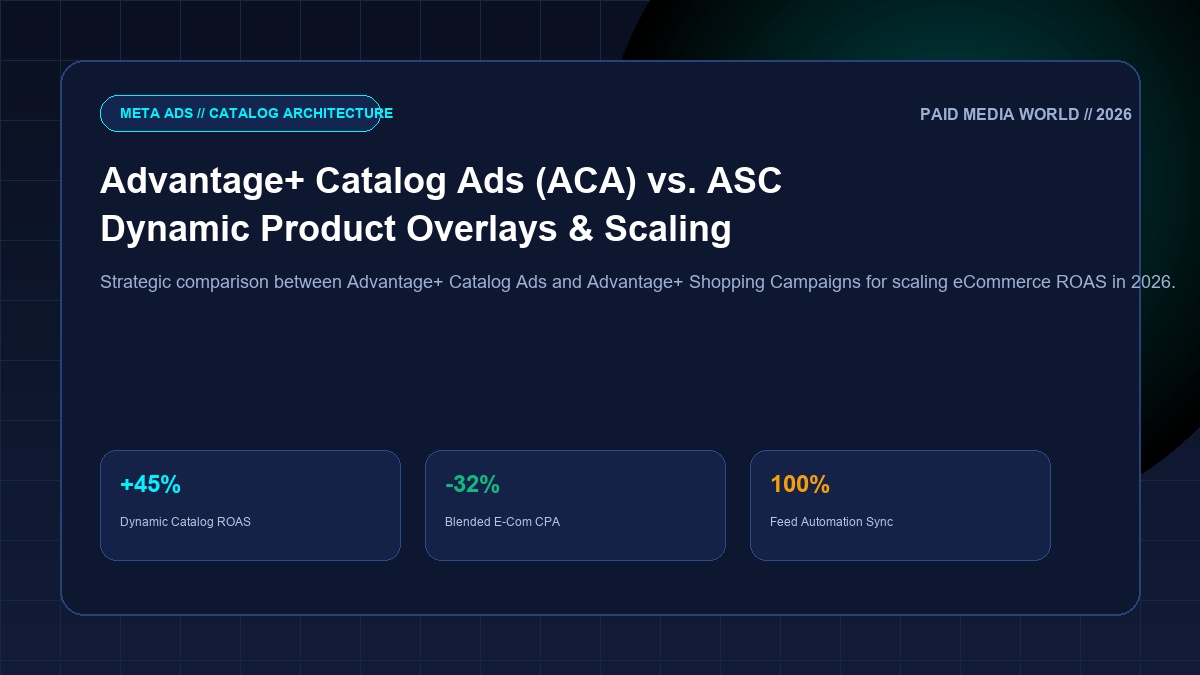
Meta Advantage+ Catalog Ads (ACA) vs ASC: E-Commerce Architecture Guide

A deep architectural comparison of Meta Advantage+ Catalog Ads (ACA) versus Advantage+ Shopping Campaigns (ASC). Master product feed enrichment, Custom Label ti

SN
By Subhranil Naskar
|November 6, 2026|12 min read|Fact-Checked & Audited
Sponsored Technical Insights
meta advantage plus catalog ads aca vs asc
# Meta Advantage+ Catalog Ads (ACA) vs ASC: E-Commerce Architecture Guide In modern e-commerce advertising on Meta, media buyers face a persistent architectural dilemma: should budget flow predominantly into **Advantage+ Shopping Campaigns (ASC)** powered by dynamic creative sandbox winners, or should it be allocated to **Advantage+ Catalog Ads (ACA)** driven by product feed intelligence? While industry consensus often frames ACA and ASC as mutually exclusive alternatives, enterprise media buyers manage them as complementary engines. ASC excels at broad narrative angles, value proposition hooks, and video UGC that educate cold prospects. Conversely, ACA leverages real-time product feed telemetry—matching browsing history, category affinities, price thresholds, and margin availability directly to Meta's deep retrieval ranking models. This guide provides an exhaustive, engineering-grade comparison of Advantage+ Catalog Ads versus Advantage+ Shopping Campaigns. We analyze feed enrichment strategies, Custom Label architectures, dynamic overlay execution, 30-day purchaser exclusion hygiene, and the hybrid dual-engine operating model designed to scale past $100k/month in net profitable ad spend. ---

1. Executive Architecture Summary: ACA vs ASC in 2026

Meta's Andromeda machine learning infrastructure treats catalog ads and traditional dynamic ads with fundamentally different scoring functions: | Feature / Dimension | Advantage+ Catalog Ads (ACA) | Advantage+ Shopping Campaigns (ASC) | | :--- | :--- | :--- | | **Primary Driver** | Product Catalog Feed (SKU attributes, pricing, stock) | Creative Assets (Static images, UGC videos, carousels) | | **Auction Delivery Model** | High-cardinality 1:1 personalization matching | Broad multi-format creative testing and broad clustering | | **Best SKU Catalog Size** | 50 to 100,000+ SKUs (Apparel, Home, Beauty, B2B Supplies) | 1 to 50 Hero SKUs (Single-product, bundle focuses) | | **Creative Iteration Speed** | Dynamic (Auto-updates via feed changes and overlays) | Manual (Requires net-new video hooks, scripts, and editing) | | **Feed Dependency** | Critical (Incomplete feeds directly degrade delivery) | Optional (Can attach catalog, but primarily creative-led) | | **Cold Prospecting Power** | High for broad multi-category intent | Extremely High for category-defining brand narratives | | **Retargeting Native Capture** | Automatic dynamic product matching based on pixel events | Blended within customer cap threshold (typically 0%–5%) | | **Target ROAS Benchmark** | 3.5x to 5.2x (High repeat intent & SKU breadth) | 3.2x to 4.5x (Net new customer acquisition) | When brands exceed 500 SKUs, relying exclusively on ASC forces the algorithm into a severe volume bottleneck: Meta will arbitrarily select 2 to 3 creative concepts and allocate 85% of total budget to them, leaving 99% of your product catalog completely starved of auction impressions. ACA eliminates this bottleneck by feeding Meta's retrieval models thousands of granular vectors simultaneously. ---

2. Algorithmic Mechanics: Feed-Driven ACA vs Creative-Driven ASC

To understand how Meta delivers these formats, consider the two distinct auction pipelines: ### The ASC Retrieval Pipeline 1. **User Interaction Vector**: Meta identifies that User $X$ frequently engages with problem-solution UGC videos featuring organic skincare. 2. **Creative Cluster Matching**: Meta evaluates your ad account's top-performing static and video creatives in the ASC ad set. 3. **Auction Bidding**: Meta bids aggressively to serve your highest-probability video asset into User $X$'s Instagram Reels feed. 4. **Landing Destination**: The user lands on a dedicated landing page or product detail page (PDP) pre-selected in the creative configuration. ### The ACA Retrieval Pipeline 1. **Multi-Touch Behavioral Signal**: User $Y$ viewed 3 ceramic dinnerware items on a competitor's site, read an interior design blog, and triggered an `AddToCart` event on your website 45 days ago. 2. **Catalog Vector Lookup**: Meta's retrieval engine queries your product catalog for items matching category `Home & Garden > Kitchen & Dining`, filtered by in-stock status and price tier. 3. **Dynamic Rendering**: Meta automatically generates a carousel or collection ad containing the exact 5 dinnerware SKUs most likely to yield an immediate purchase, complete with local currency formatting and dynamic discount badges. 4. **Direct SKU Routing**: Clicking any product image routes the user directly to that specific product's checkout-optimized PDP. By bypassing manual creative assembly, ACA operates at the speed of inventory turnover. If a product sells out, the feed marks it out of stock, and Meta ceases spending ad dollars on it within minutes. ---

3. Catalog Feed Enrichment: Custom Labels 0–4 for Margin & Velocity Sculpting

The fatal mistake made by novice media buyers is running an Advantage+ Catalog Campaign on an unsegmented "All Products" product set. When Meta is given an unconstrained catalog, its conversion optimization algorithm seeks the lowest friction conversion—which invariably leads to promoting discounted $15 accessories that produce zero net contribution margin. Enterprise performance marketing requires **Custom Label Architecture** within Google Merchant Center, Shopify feeds, or Feedonomics to control algorithmic delivery: ```text Product Catalog Feed ├── Custom Label 0: Margin Tier (Ultra-High >65%, High 45-64%, Medium 25-44%, Low <25%) ├── Custom Label 1: Inventory Velocity (Fast Movers, Core Continuity, Slow Movers, Clearance) ├── Custom Label 2: Stock Availability (Deep Stock >50 units, Thin Stock <5 units, Broken Sizes) ├── Custom Label 3: Seasonality / Focus (Summer 2026, Evergreen Hero, Black Friday Prep) └── Custom Label 4: Price Bracket (Under $50, $50-$100, $100-$250, Luxury $250+) ``` ### Implementing Margin-Weighted Product Sets Instead of one unified catalog campaign, segment your product catalog into 3 strategic product sets: 1. **Set A — High-Margin Scaling (Custom Label 0 = Ultra-High & High)**: - Contains SKUs with gross margins $> 55\%$. - Receives 60% of total catalog ad spend. - Allows lower target ROAS thresholds (e.g., 2.8x) because gross profit per order is high ($45+ net margin). 2. **Set B — Volume Velocity Best-Sellers (Custom Label 1 = Fast Movers & Deep Stock)**: - Core revenue drivers with moderate margin ($35\% - 50\%$). - Strict `Thin Stock` exclusions to prevent spending on inventory that sells out mid-flight. - Enforces a higher target ROAS (3.8x) to protect bottom-line contribution. 3. **Set C — Seasonal & Clearance Liquidation (Custom Label 1 = Clearance)**: - Dedicated budget bucket capped at $\le 15\%$ of total media spend. - Leverages high-urgency promotional copy and heavy dynamic discounts. Calculate your exact contribution margins and allowable acquisition costs with our [Free Marketing Calculators](/marketing-calculators/). ---

4. Dynamic Creative Overlays: Frame Templates, Strikethrough Pricing & Rating Badges

White-background product packshots generated by standard e-commerce feeds suffer from banner blindness on visual feeds like Instagram and Facebook. Dynamic Creative Overlays transform boring white-box photos into high-converting branded assets programmatically. ### The 4 High-Converting Dynamic Overlay Types: 1. **Strikethrough Price Badges**: - Displays current sale price alongside original MSRP (e.g., `~$120~ $89`). - Automatically pulls `price` and `sale_price` from the catalog feed. - Triggers psychological urgency and perceived value directly within the carousel card. 2. **Review Star Rating Badges**: - Overlays social proof: `★ 4.9 (2,400+ Reviews)`. - Increases cold prospecting CTR by 18% to 32% compared to plain catalog images. 3. **Category Benefit Frames**: - Subtle top/bottom framing communicating brand trust markers: `Free 2-Day US Shipping`, `Dermatologist Approved`, `Plastic Neutral Certified`. 4. **Dynamic Stock Scarcity Tags**: - Automatically triggered when inventory drops below 10 units: `Only 4 Left in Stock`. Ensure overlays occupy no more than 15% of the total image area to comply with Meta's visual quality guidelines and prevent algorithmic penalty in auction bid delivery. ---

5. 30-Day Purchaser Exclusion Integrity & Prospecting Purity

A critical point of failure in Meta Catalog campaigns is **retargeting cannibalization**. Because catalog ads possess extraordinary retargeting affinity, unconstrained algorithms will secretly allocate 60% to 80% of ACA spend to people who visited your checkout or purchased within the past 14 days. This inflates reported in-platform ROAS while starving the top of the funnel of genuine new-to-brand customers. ### Enforcing Strict Prospecting Integrity: ```mermaid graph TD A["Meta Advantage+ Catalog Ad (Cold Prospecting)"] --> B{"Audience Gate"} B -->|"EXCLUDE"| C["30-Day Past Purchasers (Pixel + CAPI)"] B -->|"EXCLUDE"| D["Active Customer Email List (Klaviyo / Shopify)"] B -->|"EXCLUDE"| E["14-Day AddToCart / InitiateCheckout Warm Retargeting"] B -->|"INCLUDE"| F["Pure Cold Prospects (100% Incremental Reach)"] ``` 1. **Pixel & Server-Side CAPI Custom Audiences**: Exclude all `Purchase` events fired across the last 30 to 180 days. Ensure Event Match Quality (EMQ) on your CAPI stream is $> 8.5/10$ to prevent audience leakage. Check your implementation with our [Meta CAPI Calculator](/meta-capi-calculator/). 2. **First-Party Customer Hash Lists**: Upload hashed customer databases via Meta Business Manager or automated Klaviyo sync, refreshed daily. 3. **Separate Dynamic Retargeting Campaign (DPA)**: If you wish to retarget past 14-day cart abandoners, isolate them into a dedicated manually capped retargeting campaign with a distinct budget and strict frequency cap ($\le 2.5$ impressions per week). ---

6. Machine Learning Auction Behavior: Delivery Bias & Budget Cannibalization

When running both ACA and ASC simultaneously within the same ad account, media buyers frequently observe auction interference or creative fatigue. Understanding how Meta's machine learning models allocate budget is vital to prevent self-competition: ### Why ASC Cannibalizes ACA if Not Structured Correctly - ASC operates on an account-wide optimization model. If Meta detects that ASC can generate quick, low-hanging view-through conversions, it will bid up the CPMs on your catalog ads. - **Audience Overlap**: While Meta claims its auction deduplication eliminates internal self-bidding within a single ad account, serving both an ASC and an ACA ad to the same target demographic causes **creative fatigue acceleration**. ### The Solution: Strategic Role Differentiation - **ASC Role = Brand Anchor & Narrative Storyteller**: ASC runs high-production video ads, founder stories, influencer unboxing UGC, and comparative comparison charts. Its primary job is **creating desire** and establishing category authority. - **ACA Role = Product Discovery & Broad Intent Matching**: ACA runs margin-tiered catalog carousels and collection ads. Its primary job is **satisfying immediate purchase intent** across long-tail SKUs that would never receive dedicated video production budgets. ---

7. The Hybrid Dual-Engine Operating Framework (Sandbox + Scale)

To maximize contribution margin, enterprise accounts deploy the **Dual-Engine Architecture**: ```mermaid flowchart LR subgraph Creative Engine [Engine 1: ASC Brand Sandbox] A["3:2:2 Dynamic Creative Sandbox"] --> B["Identify Winning Angles & Hooks"] B --> C["Scale Winners in Main ASC Campaign"] end subgraph Catalog Engine [Engine 2: ACA Margin Machine] D["Product Feed Telemetry"] --> E["Custom Label Margin Bucketing"] E --> F["Scale High-Margin Sets in ACA"] end Creative Engine --> G["Blended Storewide Scale (Target MER > 4.5x)"] Catalog Engine --> G ``` ### Budget Allocation Matrix (Monthly Ad Spend $50k - $250k) - **50% — Advantage+ Shopping Campaign (ASC)**: Powered by 4 to 8 validated winning creative concepts (lifestyle video, problem-solution UGC, PR press quotes). - **35% — Advantage+ Catalog Ads (ACA)**: Segmented into High-Margin (Custom Label 0) and Deep Stock Best-Sellers (Custom Label 1), running dynamic review overlays. - **15% — Creative Testing Sandbox**: Isolated CBO sandbox testing 3:2:2 dynamic creative iterations (3 hooks, 2 bodies, 2 CTAs) to continually supply new assets to ASC. Explore our [3:2:2 Dynamic Creative Testing Guide](/3-2-2-dynamic-creative-testing-meta-flexible-ads/) for deep setup instructions. ---

8. Bidding & Budget Allocation: ROAS Targets, Bid Caps, and Scaling Caps (≤ 20% / 72h)

Scaling e-commerce ad accounts requires strict adherence to budget pacing guardrails to avoid resetting Meta's machine learning exploration phase: ### The 20% / 72-Hour Scaling Law - Never increase the daily budget of an ACA or ASC campaign by more than **20% within any 72-hour window**. - Aggressive budget spikes (e.g., doubling budget from $1,000/day to $2,000/day) reset the campaign into the **"Learning Phase"**, causing CPMs to surge by 30% to 50% as Meta enters hyper-exploration across low-intent audience pockets. ### Bid Strategy Selection: Highest Volume vs. Cost Cap ```text Campaign Goal: Aggressive Volume Scaling (Profitable Cash Flow) └── Bid Strategy: Highest Volume (Lowest Cost) └── Governance: Strict daily budget caps + manual pacing Campaign Goal: Margin Preservation During Volatile Auction Periods (Q4 Holidays) └── Bid Strategy: Cost Cap or Minimum ROAS Target └── Rule: Set Cost Cap at 1.15x of your Target CPA to prevent bid starvation ``` If your target CPA is $35, set your Cost Cap at $40. Setting the cap exactly at or below $35 will cause Meta to lose auctions, dropping delivery to zero. ---

9. Measuring True Incremental Return: Mitigating View-Through Attribution Cannibalization

Both ACA and ASC benefit heavily from Meta's default **7-day click and 1-day view attribution window**. For catalog campaigns in particular, 1-day view attribution can account for up to **40% of reported purchases**—many of whom were existing customers who saw a dynamic carousel in their feed and purchased organically an hour later. ### How to Calculate True Incremental ROAS: $$ ext{Incremental ROAS} = rac{ ext{Net Revenue from Lift Test Holdout Group}}{ ext{Ad Spend in Test Window}}$$ 1. **Deploy Meta Conversion Lift Studies**: Run a randomized control trial (RCT) holdout test isolating 10% of your audience from receiving ads. Compare the organic conversion rate of the holdout group against the exposed group. 2. **Evaluate In-Platform 1-Day Click vs 1-Day View**: - Review your reporting breakdown in Meta Ads Manager: `Columns > Compare Attribution Settings`. - If 1-day view accounts for $> 30\%$ of total ACA conversions, discount your reported ROAS by 20% to prevent over-crediting paid media. 3. **Cross-Check with Blended MER & POAS**: - Benchmark total Shopify/ERP revenue against total ad spend across Meta and Google. If in-platform ROAS climbs from 3.0x to 4.5x but total store net profit remains flat, view-through cannibalization is occurring. Read our authoritative guide on [Measuring True Incremental Lift in Paid Media Advertising](/measuring-incremental-lift-paid-media-advertising/) for full testing blueprints. ---

10. Frequently Asked Questions (FAQ)
### Should I run Advantage+ Catalog Ads (ACA) or Advantage+ Shopping Campaigns (ASC) first? If you have fewer than 20 SKUs and strong lifestyle video creative, begin with **Advantage+ Shopping Campaigns (ASC)**. If you operate a multi-brand catalog, fashion boutique, or B2B distributor with $> 200$ SKUs, deploy **Advantage+ Catalog Ads (ACA)** first to immediately unlock catalog-wide purchase intent while developing video creative in parallel. ### Can I include catalog feeds inside an Advantage+ Shopping Campaign? Yes. Meta allows you to attach a product catalog directly to an ASC campaign, creating a hybrid ad format where Meta serves either static/video creative or a catalog carousel based on individual user propensity. However, separating them into distinct campaigns gives you granular control over margin-weighted budget allocation. ### How often should my product catalog feed update? For dynamic inventory management, your feed should sync **at least every 60 minutes via Shopify API or Google Merchant Center Content API**. Real-time stock syncing prevents advertising out-of-stock items, which directly harms conversion rates and customer satisfaction. ### Why are my catalog ads spending on low-margin products? By default, Meta's algorithm optimizes for conversion volume, not contribution margin. A $12 pair of socks converts faster than a $180 jacket. You must create filtered **Product Sets using Custom Labels** (e.g., `Custom Label 0 = High Margin`) to force the algorithm to spend exclusively on profitable inventory. --- *Need senior performance marketing architecture to scale your e-commerce catalog profitably? Explore our engineered [Paid Media Services](/services/) or book an audit consultation with our team.*
SN

Subhranil Naskar

Founder & Lead Performance Strategist
Kolkata, West Bengal, India

Subhranil is the Founder and Lead Performance Strategist at Paid Media World. With over 10 years of practitioner experience managing high-budget performance marketing infrastructure across Google Ads, Meta Ads (CAPI), and GA4 event attribution, he personally architects and audits deterministic paid media infrastructure, algorithmic portfolio bidding, and enterprise conversion architecture.

Recommended Deep Dives

Related Playbooks & Further Reading

Explore All Playbooks
Sponsored Recommendations