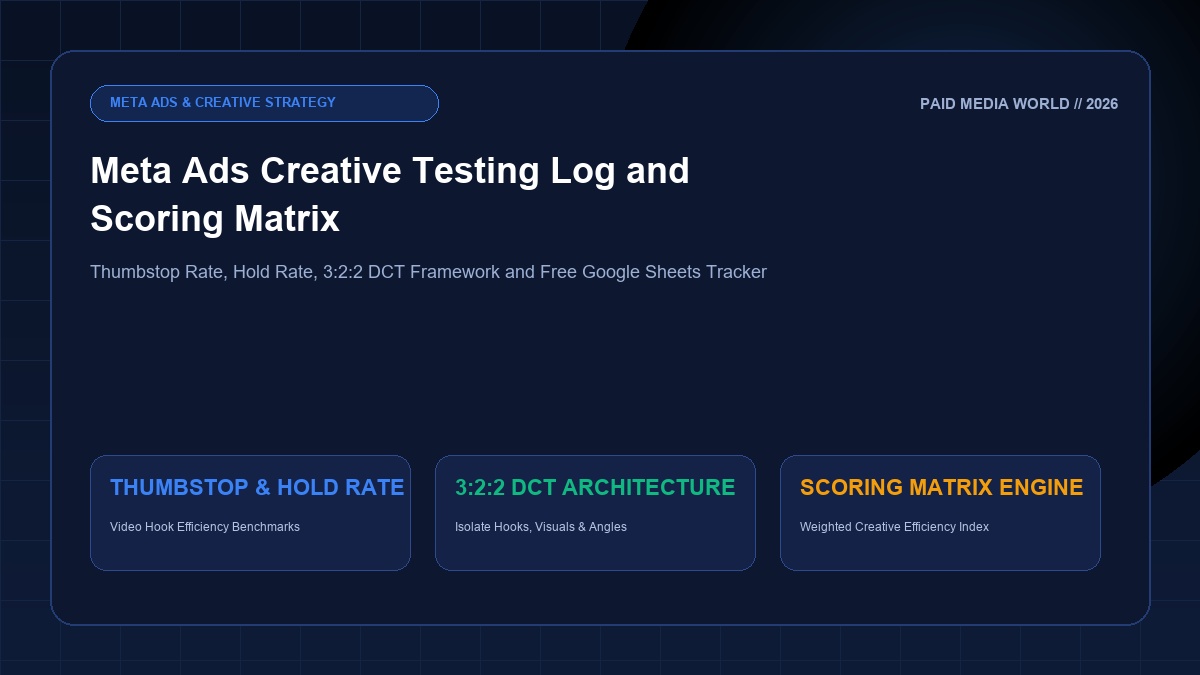
In modern Meta advertising, creative is your targeting. Ever since Meta's AI ad delivery architecture (Lattice and Andromeda) deprecated granular interest targeting and lookalike reliance in favor of broad algorithmic matching, the creative asset itself determines which audience cohort views your ad, what CPM you are charged, and your eventual customer acquisition cost (CAC). Yet, most media buyers still test ads haphazardly—dumping dozens of random creative assets into ad sets, judging winners by vanity ROAS over a 48-hour window, and wondering why performance collapses two weeks later. This guide delivers a free, battle-tested Meta Ads Creative Testing Log and Scoring Matrix for Google Sheets, the exact 3:2:2 Dynamic Creative Testing (DCT) framework, and the mathematical formulas used by eight-figure DTC brands and B2B scale-ups.
The 2026 Creative Testing Protocol
- The 3:2:2 DCT Standard: Test 3 creatives (or video hooks), 2 primary texts, and 2 headlines within a single Dynamic Creative ad set to isolate variables without fragmenting ad spend.
- Thumbstop Rate Benchmark:
3-Second Video Plays / Impressions. Elite hooks achieve > 35%; below 20% indicates immediate creative death. - Hold Rate Benchmark:
ThruPlays (15s) / 3-Second Video Plays. Elite video retention achieves > 25%; below 15% means the body script fails to maintain interest. - Creative Efficiency Index (CEI): A weighted algorithm scoring Thumbstop, Hold Rate, Outbound CTR, and ROAS out of 100 to make objective kill/scale decisions.
- Graduation Protocol: Extract the winning Post ID from DCT ad sets to preserve accrued social proof (comments, likes, shares) before scaling into evergreen CBO or Advantage+ Shopping campaigns.
1. Why Traditional Creative Testing Fails on Meta
Legacy performance media buying relied on manual A/B split testing: creating 10 ad sets with identical budgets, dropping one video into each, and declaring a winner after 72 hours. In 2026, this approach is mathematically flawed for three reasons:
Running multiple ad sets targeting the same broad demographic causes your own ad sets to compete against each other in Meta's auction, inflating CPMs by 20% to 40%.
Splitting a $500 daily testing budget across 10 ad sets gives each ad set only $50/day. At a $100 CPA, not a single ad set can generate the 50 conversions required to exit Meta's learning phase.
Meta often allocates spend to ads that appeal to existing brand engagers rather than driving incremental net-new customers, producing artificially high ROAS on ads that cannot scale.
2. The 3:2:2 Dynamic Creative Testing (DCT) Architecture
The 3:2:2 method is the gold standard testing setup used by top media buyers. It leverages Meta's native Dynamic Creative feature (or flexible ad format) to test 12 possible permutations simultaneously without dividing your ad set budget:
3 distinct videos (or static images) featuring different 3-second hooks while keeping the remaining 80% of the body script consistent.
1 long-form narrative copy targeting emotional pain points vs. 1 short punchy bulleted copy highlighting product features and direct offer.
1 benefit/offer headline (e.g., "Get 20% Off Your First Order") vs. 1 social proof headline (e.g., "Over 10,000 5-Star Reviews").
3. The Creative Funnel Hierarchy: Metrics That Actually Matter
When analyzing dynamic creative performance in Meta Ads Manager, standard metrics like CTR (all) and CPC (all) are meaningless because they include clicks on the post text, comments, and profile picture. You must build a custom metrics dashboard focused on the 4-stage Creative Funnel:
| Funnel Stage | Metric Name | Mathematical Formula | Elite Target (>) | Average Target | Kill Threshold (<) |
|---|---|---|---|---|---|
| 1. Stop Scroll | Thumbstop Rate (Hook Rate) | =3-Sec Plays / Impressions | > 35% | 22% – 30% | < 20% |
| 2. Retain Attention | Hold Rate (Video Retention) | =ThruPlays / 3-Sec Plays | > 25% | 16% – 24% | < 15% |
| 3. Generate Click | Outbound CTR (Link Click) | =Outbound Clicks / Impressions | > 1.8% | 1.0% – 1.6% | < 0.8% |
| 4. Convert Traffic | Cost Per Acquisition (CPA) | =Spend / Conversions | < Target CPA | Target ± 10% | > 1.25x Target |
4. The Google Sheets Creative Scoring Matrix Engine
To eliminate subjective opinions during creative reviews, our free spreadsheet uses an automated Creative Efficiency Index (CEI). The CEI calculates an index score from 0 to 150 based on weighted metrics across the creative funnel.
Automated Creative Decision Rules
High Thumbstop, high Hold Rate, and target CPA achieved. Extract the specific winning Post ID and graduate immediately to the Scaling CBO / Advantage+ Shopping Campaign.
The video body and offer convert well, but the first 3 seconds fail to stop the scroll. Do not discard the video. Cut 3 brand-new 3-second visual hooks and re-test with the same body script.
The hook stops users, but viewers drop off immediately in seconds 4 through 10. The core message is boring or clickbaity. Retain the hook concept, but rewrite the body value proposition.
Low Thumbstop, low Hold Rate, and unprofitable CPA. The creative concept does not resonate with the market. Turn off the ad set and redirect budget to other concept angles.
5. The Post ID Graduation Protocol: How to Scale Without Resetting Social Proof
One of the most catastrophic mistakes in Meta media buying is recreating a winning DCT ad as a new ad in your scaling campaign. When you do this, you lose all the comments, shares, and social validation accrued during the testing phase.
Follow this exact 5-step graduation protocol:
- Identify the Winning Combination in Ads Manager: Navigate to your DCT ad set, click the Breakdown button in the top right, and select By Dynamic Creative Asset → Text, Headline, and Media. Identify the exact asset trio driving the lowest CPA.
- Preview Post with Comments: Select the winning ad, click Preview, choose Facebook Post with Comments from the dropdown, and open it in a new browser tab.
-
Extract the Post ID: Look at the URL in your browser address bar. The numeric string following
/posts/orfbid=is your unique Post ID (e.g.,10158493829102834). - Create Ad in Scaling Campaign Using Existing Post: In your main scaling campaign (CBO or Advantage+ Shopping), create a new ad. Under Ad Setup, select Use Existing Post, paste the extracted Post ID, and publish.
- Scale Spend Safely: Maintain budget pacing rules. Never scale daily spend by more than 20% every 72 hours to prevent triggering Meta's auction reset. Track your budget pacing with our free Budget Pacing Tracker.
6. Integrating Your Creative Matrix with the PMW Growth Stack
A high-velocity creative testing engine requires clean tracking parameters, accurate unit economics, and reliable billing infrastructure. Connect your creative log with our free tools:
Free UTM Builder Sheet
Deploy native Meta macros ({{campaign.name}}, {{ad.name}}) to track every creative test in GA4.
50 Marketing Calculators
Model break-even ROAS, MER, blended CAC, and customer lifetime value across your scaling campaigns.
Open Calculators Hub →Meta Billing Recovery Guide
Protect your accounts from payment holds with our guide on fixing Meta Payment Verification Declines.
Read Verification Guide →Build a Predictable Creative Growth Engine
Stop guessing which ad creatives will perform. Implement the 3:2:2 Dynamic Creative Testing framework, track your Thumbstop and Hold Rates scientifically, and scale high-margin winners with complete confidence.