
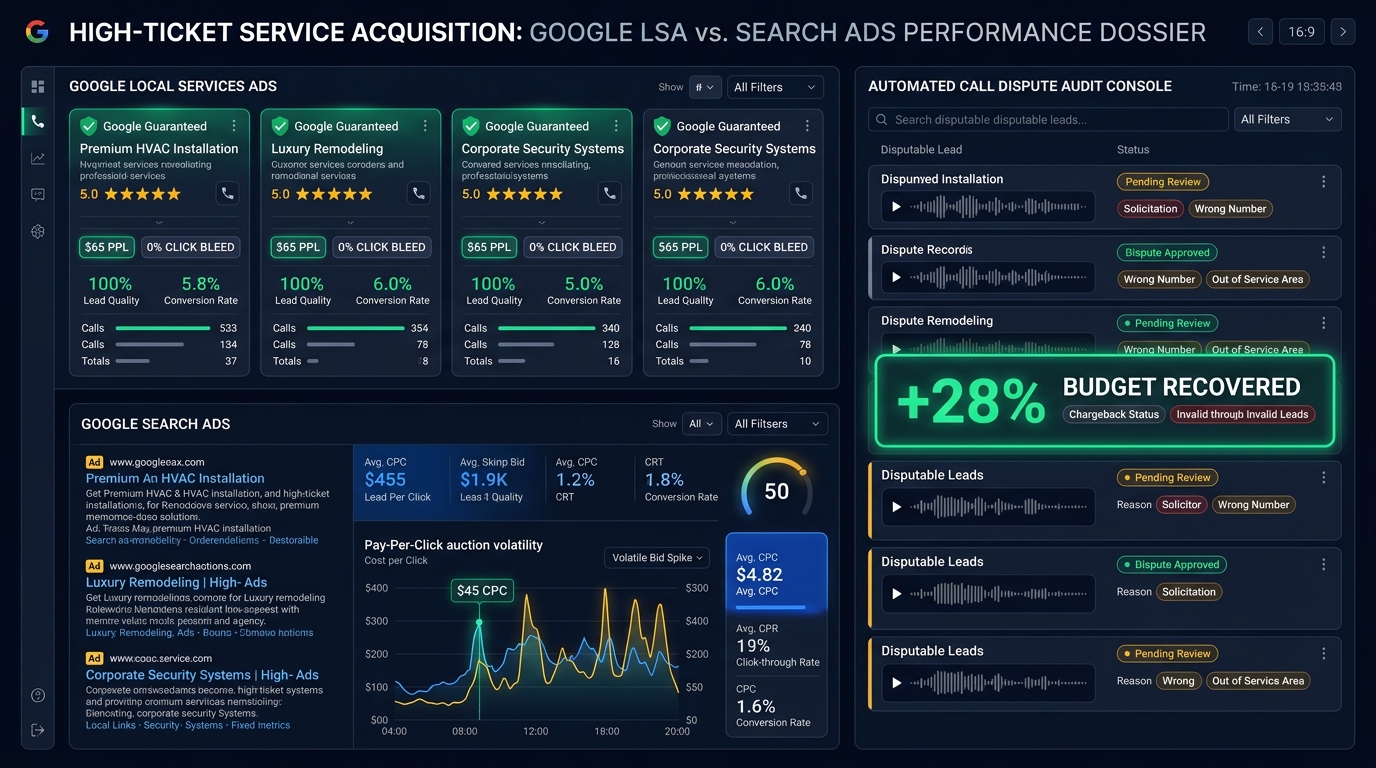
In competitive local service categories—including personal injury law, HVAC, commercial roofing, cosmetic surgery, and high-end home remodeling—traditional Google Search Ads have become intensely inflationary. With Cost Per Click (CPC) bids routinely surpassing $45 to $150 per click on transactional keywords, even a modest 8% landing page conversion rate translates to a blistering $550–$1,800 Cost Per Lead (CPL). Savvy performance marketers and local agency operators in 2026 deploy Google Local Services Ads (LSA) alongside traditional Google Ads to exploit a lucrative Pay-Per-Lead (PPL) arbitrage, securing verified phone inquiries for a fraction of search auction costs while capturing over 65% of above-the-fold SERP real estate.
Executive Comparison: Google LSA vs. Traditional Search Ads
While traditional Google Search Ads charge for every click regardless of inquiry intent, Google Local Services Ads operate on a strict Pay-Per-Qualified-Lead basis. Advertisers pay only when a customer places a direct phone call lasting over 30 seconds or submits a verified booking message.
1. The Pay-Per-Lead (PPL) Economic Arbitrage Model
Consider the unit economics of an emergency plumbing or commercial roofing contractor in an urban market:
Traditional Search Ads Funnel:
• 100 Clicks at $52.00 Average CPC = $5,200 Total Ad Spend
• Landing Page Conversion Rate = 9.0% (9 Inquiries Generated)
• Effective Cost Per Lead = $577.78
Risk: Unqualified clicks, bounce traffic, and accidental clicks bleed budget without recourse.
Google Local Services Ads (LSA) Arbitrage:
• 25 Phone Calls Received at $85.00 Fixed Cost Per Lead = $2,125 Ad Spend
• 4 Calls Disputed & Refunded (Robocall, wrong geographic county, solicitation)
• 21 Qualified High-Intent Phone Calls = $1,785 Net Spend ($85.00 Qualified CPL)
Outcome: 85% lower acquisition cost with zero landing page bounce risk.
2. The "Hybrid Monopoly" Setup: Dominating 65%+ of the SERP
The most effective strategy is not choosing between LSA and Search Ads—it is orchestrating both simultaneously. In 2026, when a high-intent local query is executed (e.g., "emergency dental clinic near me"), the top of the search engine results page displays three distinct tiers:
- Top 1–3 Cards: Google Local Services Ads displaying your green Google Guaranteed shield, phone button, and 4.9-star review count.
- Directly Below LSA: Google Search Ad (Position 1) featuring your customized callouts, structured snippets, and site links.
- Middle of Page: Google Business Profile (GBP) 3-Pack featuring your organic local listing.
By executing this Hybrid Monopoly architecture, your business captures 3 separate clickable entities across the primary viewport. Prospects who disregard standard text ads often trust the Google Guaranteed shield, while commercial buyers wanting extensive portfolio details click through the search ad landing page.
3. The Lead Dispute & Chargeback Protocol (Saving 15%–30% of Spend)
The single greatest financial advantage of LSA is the legal right to dispute invalid leads and obtain 100% account credits. Google automatically records all inbound calls in your LSA Lead Center. Follow our verified weekly dispute audit SOP:
Valid Dispute Categories Approved by Google:
- Wrong Service Line: Customer called requesting a service you explicitly do not provide in your active category settings (e.g., residential vs. commercial).
- Out-of-Service-Area: Customer job address or location is outside your verified zip code or county service boundaries.
- Robocall / Automated Spam / Telemarketing: Recorded call is a vendor soliciting your business or an automated robotic voice.
- Duplicate Lead: The same customer called twice within a 30-day window regarding the same job.
- No Call Audio / Immediate Hang-up: Inbound call disconnected within the first 15 seconds without two-way communication.
4. Key Ranking Factors in the 2026 LSA Algorithm
Unlike traditional Google Ads where maximum CPC bid dominates ad rank, the LSA ranking algorithm prioritizes consumer fulfillment metrics:
- Responsiveness Rate: Google tracks the percentage of inbound calls answered live. Missing calls or sending callers to voicemail immediately demotes your card down the carousel. Target an answer rate > 90%.
- Review Velocity and Sentiment: Maintaining a minimum of 4.5+ stars with regular fresh reviews on your linked Google Business Profile directly dictates impression share.
- Proximity & Service Radius: Bidding tighter geographic boundaries (e.g., 15-mile radius vs. 50 miles) drastically boosts your ranking velocity for nearby searchers.
- Business Verification Status: Background checks (via Evident/Pinkerton), state contractor license validation, and proof of general liability insurance ($250k–$1M coverage).
Frequently Asked Questions: Google LSA vs. Search Ads
What is the difference between Google Guaranteed and Google Screened?
Google Guaranteed (green shield with checkmark) applies to home service providers (plumbers, electricians, HVAC, locksmiths) and carries a Google-backed money-back reimbursement guarantee (up to $2,000 lifetime in US/Canada). Google Screened applies to professional service firms (lawyers, accountants, financial planners, real estate brokers) and verifies professional credentials without the cash-back guarantee.
Can I run Google Local Services Ads without a physical office?
Yes. Service Area Businesses (SABs) that operate on-site at customer locations can register by defining their serviced zip codes and completing remote background checks, without displaying a physical storefront address on the SERP.
How do negative keywords work in Google Local Services Ads?
LSA does not use keyword bidding or negative keywords. Instead, you control targeting strictly by toggling individual Job Types on or off inside your Profile settings (e.g., enabling "Drain Cleaning" while disabling "Septic Tank Installation"). For surgical keyword control, run companion campaigns via our Keyword Match Type Tool on Google Search.