
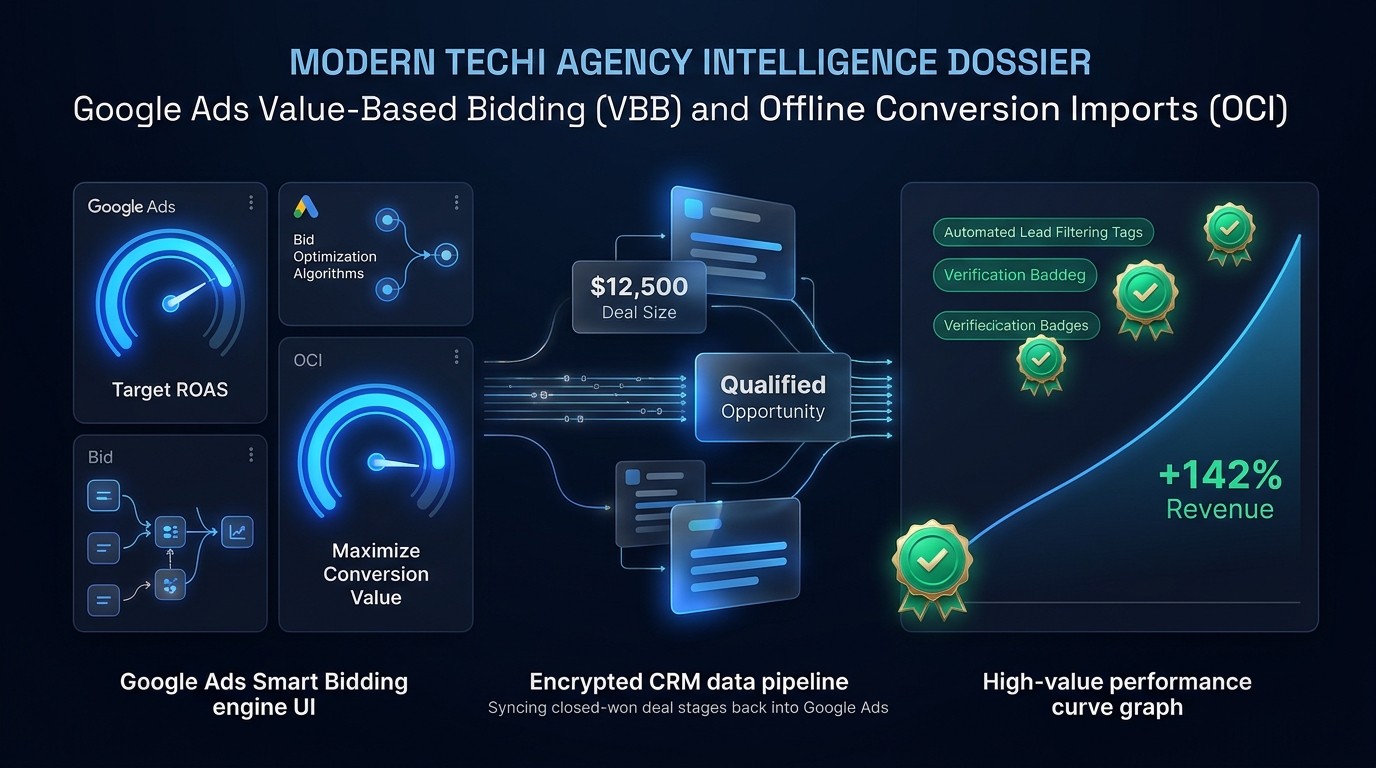
In high-ticket lead generation and B2B SaaS, optimizing Google Ads for simple form submits (Target CPA) is a dangerous trap. When Google's Smart Bidding algorithm is rewarded equally for a $50k enterprise contract and a student submitting a fake email, it systematically gravitates toward the cheapest, lowest-quality conversions. In 2026, sophisticated media buyers deploy Value-Based Bidding (VBB) powered by Offline Conversion Imports (OCI). By feeding qualified pipeline stages and closed-won revenue from your CRM (Salesforce, HubSpot, Zoho) back into Google Ads, you force Smart Bidding to hunt exclusively for revenue-generating buyers.
Executive Summary: Value-Based Bidding vs. Target CPA
Target CPA treats every lead as having equal economic value ($1.00 = $1.00). Value-Based Bidding assigns dynamic dollar weights to conversion milestones (e.g., Lead = $10, SQL = $150, Opportunity = $800, Closed-Won = Actual Contract Value), allowing the Smart Bidding auction to bid aggressively on high-ACV prospects while suppressing bids on tire-kickers.
1. What is Offline Conversion Import (OCI) and How Does It Work?
When a user clicks your Google Search ad, Google generates a unique parameter called the Google Click Identifier (GCLID) or captures Enhanced Conversion data (hashed first-party email and phone number). When the user submits your form, your website must capture this identifier in a hidden form field and store it alongside the contact record in your CRM.
As the prospect progresses through your sales pipeline over the next 15 to 90 days (e.g., Discovery Call Completed > Proposal Sent > Closed Won), your CRM triggers an automated webhook or API payload sending the original GCLID, conversion name, timestamp, and transaction value back into Google Ads via the Google Ads Offline Conversion API.
2. Step-by-Step Technical Setup: From GTM to HubSpot & Salesforce
-
Capture GCLID & Enhanced Conversion Data in GTM: Configure a First-Party Cookie or URL Parameter variable in Google Tag Manager to capture
gclidand write it to local storage or a 90-day cookie. -
Pass Hidden CRM Form Fields: In your multi-step lead form or landing page builder, add a hidden input field named
gclid. Use JavaScript to populate the value dynamically before form submission. -
Configure Conversion Actions in Google Ads: In Google Ads > Goals > Conversions > Summary > New Conversion Action, select Import > Other data sources or CRMs > Track conversions from clicks. Create distinct milestones:
MQL (Value: $25),SQL (Value: $150),Closed_Won (Dynamic Value). -
Automate the Sync Engine: Use direct integrations (HubSpot Google Ads App, Salesforce Google Ads integration) or an automated Zapier/Make pipeline triggered whenever a deal stage updates. Ensure the timestamp format conforms to
yyyy-mm-dd hh:mm:ss+timezone.
3. Mathematical Calibration: Calculating Proxy Conversion Values
If your sales cycle exceeds 60 days, waiting for closed-won revenue creates a latency lag that starves Smart Bidding of daily signals. To overcome this, calculate Proxy Expected Values (EV) based on historical stage-to-close conversion probabilities:
Proxy Value = Average Closed-Won Deal Size × Downfunnel Win Probability (%)
Example: If your average deal is $20,000 and 15% of Sales Qualified Leads (SQLs) convert into closed customers, every SQL holds a mathematical proxy value of $3,000 ($20,000 × 0.15). Uploading $3,000 when an SQL status triggers gives Google Ads immediate bidding guidance without waiting 3 months for final payment.
4. Transitioning Bidding Strategies: ABO to tROAS
Never switch cold campaigns directly to Target ROAS. Follow our verified 30-day graduation protocol:
- Phase 1 (Days 1–14): Secondary Conversion Calibration: Set your new offline conversion actions to Secondary (Observe Only). Validate that GCLID uploads match with > 90% accuracy in Google Ads upload diagnostic logs.
- Phase 2 (Days 15–21): Primary Switch & Max Conversion Value: Promote offline actions to Primary and change bid strategy to Maximize Conversion Value (without a target). Let the algorithm discover the auction ceiling for 7 days.
- Phase 3 (Days 22+): Target ROAS Guardrail: Set a conservative Target ROAS based on actual performance from the prior 3 weeks. Scale budgets up by ≤ 20% every 72 hours using our strict budget pacing guidelines.
Frequently Asked Questions: Value-Based Bidding
What happens if iOS 17 Link Tracking Protection strips the GCLID?
Google Ads Enhanced Conversions for Leads resolves this by matching hashed first-party customer data (SHA-256 email and phone number) directly with Google's signed-in user database, providing a robust fallback when query parameters are scrubbed.
How many conversion values does Google Ads need for VBB?
Google recommends a minimum of 15 conversion value events within a rolling 30-day window per campaign. Using proxy values at the SQL or Demo Completed stage ensures steady volume for Smart Bidding machine learning.