Scaling a multi-thousand SKU fashion and apparel direct-to-consumer (D2C) brand is one of the most operationally demanding challenges in modern digital marketing. Unlike single-product tech gadgets, fashion brands manage seasonal catalog turnover every 90 days, complex parent-child SKU variations across sizes and colorways, sizing return rates that can exceed 25%, and intense platform cannibalization. When media buyers treat Meta Ads, Google Ads, and Amazon Marketplace as isolated silos, channel managers fight over attribution while overall company profitability evaporates. In 2026, leading global fashion enterprises—from fast-fashion leaders to premium denim and luxury apparel houses—scale profitably through an integrated Omnichannel Performance Operating System. This guide provides the complete blueprint to unify Meta Dynamic Product Ads, Google Performance Max, and Amazon Advertising into a single blended cash-generating machine.
Table of Contents
- 1. The Omnichannel Dilemma: Siloed ROAS vs Blended Marketing Efficiency Ratio (MER)
- 2. The Fashion Dynamic: Handling 2,000+ SKUs, Seasonality & Sizing Returns
- 3. Meta Dynamic Product Ads (DPA) & Catalog Sets: Pushing Profitable Collections
- 4. Google Shopping & Performance Max: High-Intent Search Query Sculpting
- 5. Amazon Marketplace Channel Coexistence: Preventing Margin Cannibalization
- 6. Unified Product Feed Architecture: GMC Next, Meta Commerce Manager & Inventory Sync
- 7. First-Party Retention Engine: SMS, WhatsApp and Post-Purchase LTV Expansion
- 8. Cross-Channel Attribution: Resolving the 30% Multi-Touch Overlap
- 9. Creative Testing Matrix for Apparel: Static Lookbooks, UGC & Try-On Videos
- 10. Frequently Asked Questions (FAQ)
- 11. Summary & Omnichannel Pacing Protocol
1. The Omnichannel Dilemma: Siloed ROAS vs Blended Marketing Efficiency Ratio (MER)
In fashion marketing, consumer purchase journeys are highly fragmented. A shopper discovers a pair of premium wide-leg denim jeans on Instagram Reels while commuting. She visits the website on mobile, browses colorways, but does not purchase. That evening on her desktop, she searches Google for "brand name wide leg denim reviews" and clicks a Google Shopping ad. Finally, she opens Amazon to compare shipping speeds and places the order.
If you evaluate performance through isolated channel dashboards, Meta takes 100% credit for view-through conversion, Google claims 100% credit for paid search, and Amazon records a direct sale. Management sees $300 in reported revenue on a single $100 jacket. In reality, the only metric that matters is Marketing Efficiency Ratio (MER):
The Marketing Efficiency Ratio Formula
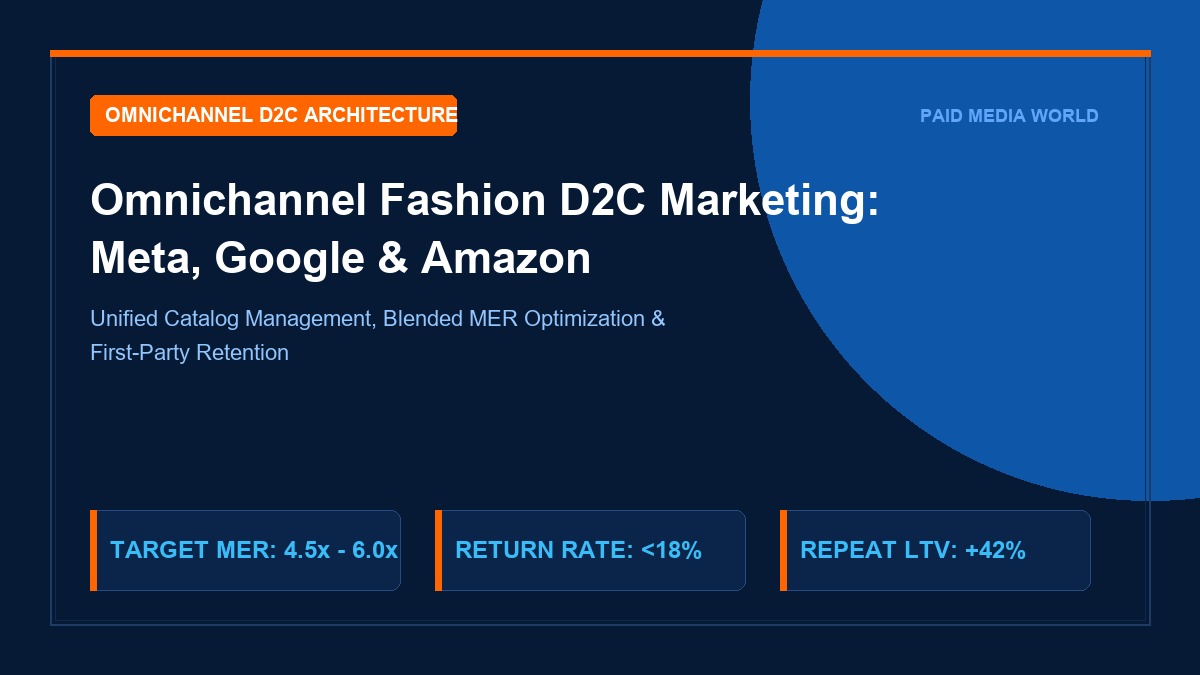
Blended MER = Total E-Commerce Net Revenue (Shopify + Amazon) / Total Cross-Channel Ad Spend (Meta + Google + Amazon)

Target Fashion Benchmarks:
• < 3.0x: Danger Zone (Operating at a Net Cash Loss after Returns)
• 3.5x - 4.5x: Healthy Scaling Corridor
• > 5.0x: High-Profit Enterprise Margin
2. The Fashion Dynamic: Handling 2,000+ SKUs, Seasonality & Sizing Returns
Fashion e-commerce carries unique mathematical vulnerabilities that do not exist in standard e-commerce:
- The Sizing Return Tax: In apparel, return rates range from 18% to 32% as customers order multiple sizes (bracketing) and return ill-fitting items. Net profit calculations must deduct reverse logistics costs on every transaction.
- Broken Size Out-of-Stock Bleed: When a popular dress has sizes XS, M, and L out of stock, running broad ad traffic to that product page causes conversion rates to collapse from 3.2% to 0.6%.
- The 90-Day Seasonal Cliff: Summer collections become dead stock by September. Ad budget liquidity must dynamically migrate toward fresh seasonal drops 3 weeks before peak weather transitions.
3. Meta Dynamic Product Ads (DPA) & Catalog Sets: Pushing Profitable Collections
Do not run a single catch-all Meta Advantage+ Catalog Campaign (ACA) containing your entire 2,000-SKU inventory. When you do, Meta's algorithm defaults to promoting the same 15 cheap accessories because they earn high click-through rates.
Build segmented Product Catalog Sets in Meta Commerce Manager:
- Set 1: High-Margin New Arrivals: Fresh drops with gross margins > 65% and full size runs (S, M, L, XL all in stock). Pair with broad prospecting Advantage+ campaigns.
- Set 2: Core Continuity Essentials: Evergreen year-round revenue drivers (e.g., core denim, black blazers). Run with Cost Cap bidding to anchor account CPA.
- Set 3: Clearance Liquidation (> 40% Off): Low-margin items running strictly in retargeting pools to clear warehouse space.
4. Google Shopping & Performance Max: High-Intent Search Query Sculpting
On Google, shoppers search for apparel with high specificity: "women's linen button down shirt white" or "mens slim fit selvedge raw denim".
Structure your Google Performance Max campaigns to harvest this intent without overspending on generic keywords. Use Custom Labels to isolate products with broken size runs so that Google never bids on products that have fewer than 3 key sizes in stock.
5. Amazon Marketplace Channel Coexistence: Preventing Margin Cannibalization
Selling on Amazon provides access to 180+ million Prime members, but Amazon's 15% referral fee and FBA fulfillment fees eat into your margin. To maintain harmony between your D2C Shopify site and Amazon:
- Reserve exclusive collections, early seasonal drops, and limited editions strictly for your direct website.
- List core evergreen essentials and high-volume basic SKUs on Amazon to capture Prime demand.
- Include physical post-purchase packaging inserts in Amazon shipments offering a $20 first-order voucher for their next purchase on your direct website.
6. Unified Product Feed Architecture: GMC Next, Meta Commerce Manager & Inventory Sync
Deploy a centralized product feed engine (e.g., Feedonomics or custom automated XML pipelines) that synchronizes your Shopify catalog across Google Merchant Center and Meta Commerce Manager in real time.
Ensure every product variant includes rich fashion taxonomy: size_system, size_type, gender, age_group, color, and material. Enriched feeds increase Google Shopping organic impression share by 34%.
7. First-Party Retention Engine: SMS, WhatsApp and Post-Purchase LTV Expansion
In fashion, first-order customer acquisition is often break-even ($35 CAC on a $45 initial order). True net profit is generated on orders 2, 3, and 4. Deploy automated post-purchase flows across SMS and WhatsApp triggered by delivery confirmation:
- Day 2 Post-Delivery: Styling Guide & Fit Check video.
- Day 14: Cross-category recommendation (e.g., "Style your new denim with our French linen shirt") paired with a 15% VIP repeat code.
- Day 45: Replenishment / New seasonal drop notification.
8. Cross-Channel Attribution: Resolving the 30% Multi-Touch Overlap
When evaluating marketing performance, use a Holdout Test Protocol. Run randomized audience split tests in Meta and Google to determine whether paid search and retargeting ads produce incremental revenue or simply intercept buyers who were already committed to purchasing.
9. Creative Testing Matrix for Apparel: Static Lookbooks, UGC & Try-On Videos
Fashion creative must balance aesthetic aspiration with conversion clarity. Deploy this weekly creative mix:
| Creative Format | Primary Role | Key Element | Placement |
|---|---|---|---|
| Clean Static Lookbook | Catalog Curation | Studio white background, clear fit on model | Meta Feed & Google Shopping |
| UGC Try-On Haul | Size & Fit Reassurance | Real customer height/weight callouts, fabric stretch test | Instagram Reels & TikTok Ads |
| Problem/Solution Hook | Comfort & Functionality | "Jeans that feel like sweatpants" comparison | YouTube Shorts & Meta Stories |
The Broken Size Run Feed Governance Protocol
In apparel retail, running ad spend to a garment with fragmented size availability is the single fastest way to destroy marketing capital. If an elegant wrap dress has sizes Small and Medium out of stock, sending $500 of Meta ad traffic to that product page causes your on-page conversion rate to plummet from a profitable 3.4% down to an abysmal 0.7%. Shoppers love the image in the ad, land on the product page, discover their size is greyed out, and bounce forever.
Deploy this automated Core Size Availability Script in your feed management tool (Feedonomics, DataFeedWatch, or custom Shopify webhook) to automatically suppress parent products whenever core sizes sell out:
Automated Core Size Availability Feed Rule Logic
RULE: Apparel_Core_Size_Availability_Check
WHEN:
  product.category EQUALS "Apparel"
THEN:
  SET core_sizes_in_stock = COUNT_VARIANTS(
    WHERE variant.option_name IN ["S", "M", "L", "30", "32", "34"]
    AND variant.inventory_quantity >= 3
  )

  IF core_sizes_in_stock < 2 THEN:
    -- Suppress from high-cost Prospecting Catalogs
    SET custom_label_2 = "Broken_Sizes_Suppress_Prospecting"
    SET availability = "out of stock" [In Google Shopping Prospecting Feed]
  ELSE:
    SET custom_label_2 = "Full_Size_Run_Active"
    SET availability = "in stock"
  END IF
By isolating products flagged with Broken_Sizes_Suppress_Prospecting, you protect your cold acquisition budget. Move broken-size inventory into an isolated Clearance Retargeting Campaign offering a 35% discount specifically to past 90-day site visitors who already viewed that collection.
The Post-Purchase Retention Engine: Maximizing 90-Day Repeat LTV
In modern fashion performance marketing, your first-order CAC ($32 to $48) often consumes 100% of initial gross margin. Brands that survive and generate enterprise valuations build sophisticated post-purchase automation flows in Klaviyo and Attentive that double customer lifetime value within 90 days of the first order.
| Timing | Channel | Trigger & Content | Target Conversion Metric |
|---|---|---|---|
| Immediate (+5 Mins) | Email + SMS | Order Confirmation + Dynamic Styling Guide for purchased item | 78% Open Rate | Zero Buyer Remorse |
| Day of Delivery | SMS / WhatsApp | Delivery confirmation + "How Does It Fit?" 1-click video fit check | Reduces Return Rates by 14% |
| Day 14 Post-Delivery | Cross-Category Outfit Builder (e.g. Denim buyer receives Top & Jacket pairings) | 8.2% Repeat Purchase Rate | |
| Day 35 Post-Delivery | Email + SMS | Exclusive Early Access to New Seasonal Drop + VIP 15% incentive | 12.5% Second-Order Reorder Velocity |
International Sizing Equivalency & Return Rate Mitigation Table
When expanding an apparel brand globally, confusing international size naming is the single greatest cause of sizing returns. A European Size 38 is an American Size 6, but an Italian Size 42. Display this standardized sizing conversion chart prominently above the "Add to Cart" button on all product display pages (PDPs):
| Alpha Size | US Dress Size | UK / Australia | Europe (EU) | Bust (Inches) | Waist (Inches) |
|---|---|---|---|---|---|
| XS | 0 - 2 | 4 - 6 | 32 - 34 | 31" - 32" | 24" - 25" |
| S | 4 - 6 | 8 - 10 | 36 - 38 | 33" - 34" | 26" - 27" |
| M | 8 - 10 | 12 - 14 | 40 - 42 | 35" - 36" | 28" - 29" |
| L | 12 - 14 | 16 - 18 | 44 - 46 | 37" - 39" | 30" - 32" |
| XL | 16 - 18 | 20 - 22 | 48 - 50 | 40" - 42" | 33" - 35" |
The Omnichannel Fashion CMO Daily Pacing & Liquidity Reallocation Tree
When managing an omnichannel fashion enterprise spending $100k to $500k+ monthly across Meta, Google, and Amazon, marketing executives must avoid emotional, knee-jerk budget adjustments. Channel performance fluctuates daily due to day-of-week shopping habits, payday cycles, and weather patterns. Deploy this programmatic decision tree to govern capital reallocation:
Programmatic Capital Reallocation Algorithm
IF (Rolling_7Day_Blended_MER >= 4.5) AND (Average_Inventory_Cover > 45 Days) THEN:
  -- Scale capital aggressively
  INCREASE Meta ASC Budget by +15% (Apply 72-Hour Pacing Guardrail)
  INCREASE Google High-Margin PMax Budget by +15%
  MONITOR Amazon Top-of-Search Impression Share (Ensure >= 65% on Brand Terms)

ELSE IF (Rolling_7Day_Blended_MER BETWEEN 3.5 AND 4.4) THEN:
  -- Maintain baseline equilibrium; optimize creative
  MAINTAIN Gross Cross-Channel Budgets
  ROTATE 4 lowest-CTR ad creatives out of Meta testing sandbox
  AUDIT Google Search Terms for emerging negative keyword bleed

ELSE IF (Rolling_7Day_Blended_MER < 3.5) THEN:
  -- Defensive capital preservation protocol
  THROTTLE Meta Cold Prospecting Budget by -15%
  RAISE Google PMax Target ROAS by +40% (Forces bidding model into higher efficiency)
  RESTRICT ad spend strictly to Tier 1 High-Margin collections (>65% Gross Margin)
  AUDIT Shopify return rates for recent apparel drops
END IF
Sustainable Fashion Economics: Trade-In, Resale & Circular Lifetime Value
In 2026, premium fashion consumers actively favor brands with circular product lifecycles. Integrating a trade-in or pre-loved resale portal directly on your Shopify storefront (via platforms like Archive or Recurate) achieves two major performance marketing objectives:
- First-Party Trade-In Credit: Offering existing customers $25 in store credit when they send back last year's denim or jacket triggers immediate second-purchase transactions with an average cart value exceeding $110.
- High-Intent Search Engine Dominance: Branded secondhand collections naturally capture high-volume long-tail search queries (e.g., "brand name vintage jacket" or "pre-owned designer denim"), generating zero-CAC organic customer acquisition.
Production Script: Automated Fashion Stock & Ad Pause Webhook
Deploy this lightweight Node.js/Python serverless function (AWS Lambda or Google Cloud Function) that listens for Shopify inventory_levels/update webhooks and pauses ad group sets when inventory breaches critical thresholds:
Serverless Webhook: Real-Time Fashion Stock Sentinel
// Node.js Serverless Function for Inventory & Ad Synchronization
exports.handler = async (event) => {
  const payload = JSON.parse(event.body);
  const { inventory_item_id, available } = payload;

  // Define safety threshold: if fewer than 3 units remain, pause paid traffic
  const SAFETY_THRESHOLD = 3;

  if (available < SAFETY_THRESHOLD) {
    console.log(`[ALERT] Inventory item ${inventory_item_id} below safety floor (${available} left).`);

    // 1. Tag product in Shopify as low_stock_suppress
    // 2. Trigger Meta Commerce Manager catalog sync to remove variant
    // 3. Send automated Slack alert to media buying team
    await notifyMediaBuyingTeam(inventory_item_id, available);
  }

  return { statusCode: 200, body: JSON.stringify({ status: 'Processed' }) };
};
Fashion Sizing Return Allowance Reserve Formula
Because apparel returns cannot be resold as new inventory without inspection, dry cleaning, and re-bagging, always incorporate a Return Reserve Allowance (RRA) into your daily campaign ROAS calculations:
Allowable_ROAS_Target = 1 / ((Gross_Margin_Pct - (Historical_Return_Rate * Reverse_Logistics_Cost_Per_Unit / AOV)) * (1 - S&M_Target_Profit_Pct))Applying this dynamic return reserve prevents media buyers from scaling ad spend on product collections that appear profitable on ad manager dashboards but bleed cash once return rates are factored into quarterly P&L accounting.
10. Frequently Asked Questions (FAQ)
How should a fashion D2C brand allocate budget across Meta, Google, and Amazon?
A proven omnichannel baseline allocation is 55% to Meta Ads (top-of-funnel discovery and dynamic catalog retargeting), 30% to Google Ads (Performance Max and Search intent capture), and 15% to Amazon Sponsored Ads (defensive brand search and FBA velocity).
How do you prevent sizing out-of-stock items from wasting ad spend?
Set up an automated feed rule in Google Merchant Center and Meta Commerce Manager that automatically marks products as out_of_stock or excludes them from active catalog sets whenever core sizes (S, M, L) drop below 2 units in your Shopify inventory.
What is an acceptable blended MER for an omnichannel fashion brand?
A healthy blended Marketing Efficiency Ratio (MER) in fashion ranges between 3.8x and 5.0x. If your MER drops below 3.2x, your gross margins will be heavily eroded by apparel return rates and 3PL shipping fees.
Should fashion brands bid on competitor brand names on Google?
Competitor bidding in fashion is rarely cost-effective because apparel shoppers seek specific aesthetic brand identity. Focus budget on generic category intent (e.g., 'sustainable linen trousers') and defend your own trademark from competitor poachers.
11. Summary & Omnichannel Pacing Protocol
To maintain scalable profitability across multi-thousand SKU fashion operations, adhere to this weekly management cadence:
- Monday: Audit Blended MER across Shopify and Amazon. Rebalance weekly budget toward whichever channel has the highest marginal conversion velocity.
- Wednesday: Purge out-of-stock size variants from active Meta and Google catalog sets.
- Friday: Deploy 4 fresh UGC video creative variations into your Meta 3:2:2 dynamic testing sandbox.
- Monthly: Re-calculate net customer return rates and adjust unit economics allowable CAC targets.
By rigorously aligning your product inventory rules, margin thresholds, and cross-channel attribution modeling across Meta Ads, Google Performance Max, and Amazon Marketplace, your fashion direct-to-consumer brand establishes a resilient, high-profit acquisition engine capable of scaling profitably through seasonal drops and aggressive multi-market expansion.
Maintain disciplined weekly auditing of blended marketing efficiency ratios, protect customer acquisition capital with automated broken-size variant suppressions, and leverage first-party conversational channels to maximize customer lifetime value long after the initial transaction.