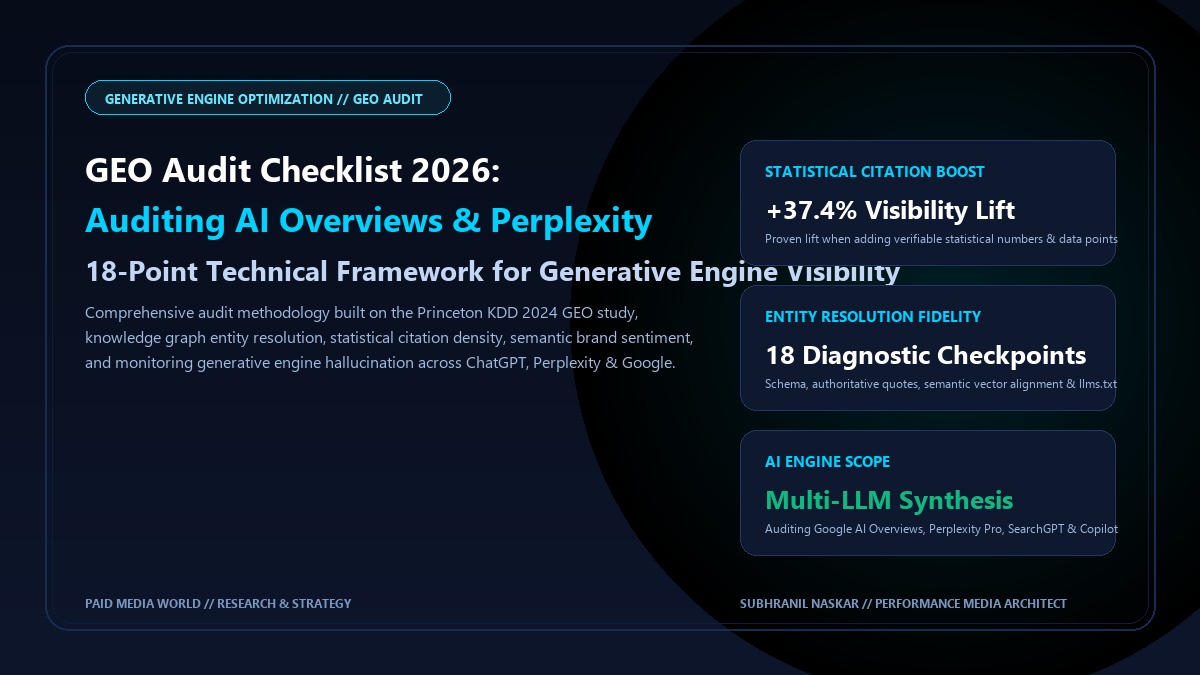

Conversational search engines such as ChatGPT Search, Perplexity, and Claude do not rank web pages using PageRank or backlink quantity. Instead, generative artificial intelligence platforms evaluate brand visibility through a 4-Tier Multimodal Entity Graph. Brands that rely solely on legacy domain authority find themselves omitted from AI search recommendations, while agile companies with verified entity consensus across community forums, Wikidata, and structured direct-answer architecture capture dominant citation shares.
Executive Summary: How AI Engines Select Sources
Unlike traditional search engines that crawl hyperlinks, generative AI engines decompose user prompts into semantic sub-queries, execute parallel vector searches, and cross-reference information across independent knowledge graphs before generating synthesized answers. To be cited as an authoritative solution, a brand must establish verifiable multi-source entity consensus.
- The 4-Tier Citation Hierarchy: Community Consensus (Reddit/Quora), Knowledge Bases (Wikidata/Crunchbase), Independent Comparison Hubs, and Onsite Semantic Schema.
- Community Sentiment Weighting: Organic, unbiased forum discussions carry 4x to 6x greater weight in LLM retrieval than sponsored blog articles.
- Machine-Readable Identifiers: Establishing clear entity IDs on Wikidata (Q-numbers) and linking social profiles via Schema.org
sameAsproperties. - Interactive Resource: Run our Generative Engine Optimization (GEO) Audit and explore our AI Search Visibility Tools.
1. The Retrieval Mechanics: How ChatGPT Search & Perplexity Process Queries
Direct Answer: AI search engines use multi-hop retrieval-augmented generation (RAG). When a user submits a prompt, the engine decomposes it into three to seven underlying vector queries, retrieves text chunks from pre-indexed corpora, validates factual consensus across multiple domains, and synthesizes an answer with attributed citations.
In traditional search, ranking first for a keyword guaranteed that a majority of searchers would see your link. In generative search, the AI model generates a single cohesive summary. Citations are appended as reference links to substantiate factual claims.
If an AI model claims that a software product integrates with QuickBooks, it must locate that claim across independent authoritative repositories. If the claim appears exclusively on the vendor's own marketing page, the AI's internal hallucination-prevention safeguards discard the assertion as unverified.
| Citation Graph Tier | Primary Data Sources | LLM Confidence Weight | Primary Optimization Tactic |
|---|---|---|---|
| Tier 1: Community Consensus | Reddit, Quora, StackExchange, specialized sub-forums | Very High (9.2 / 10) | Organic problem-solving participation, case studies |
| Tier 2: Knowledge Graph Nodes | Wikidata, Wikipedia, Crunchbase, Google Knowledge Graph | High (8.8 / 10) | Wikidata Q-number creation, defined entity properties |
| Tier 3: Comparative Third-Party Hubs | G2, Capterra, Gartner, unbiased editorial comparisons | Moderate-High (7.5 / 10) | Feature tables, pricing disclosures, verified user reviews |
| Tier 4: Onsite Schema & Direct Answers | Your official website domain and documentation | Contextual (6.2 / 10) | 45-word direct answer blocks, JSON-LD sameAs markup |
2. Optimizing the 4-Tier Entity Architecture for Generative Inclusion
Direct Answer: To achieve consistent citations across conversational AI search platforms, seed genuine user feedback on active subreddits, anchor your organization as a Wikidata entity, ensure transparent pricing across review aggregators, and implement structured TechArticle and Organization schema on your website.
- Tier 1: Community Consensus (Reddit & Forums): AI models heavily index Reddit discussions to filter out marketing fluff. Ensure your product or service is mentioned organically in relevant subreddits by real practitioners discussing authentic workflows, tradeoffs, and solutions.
- Tier 2: Knowledge Graph Anchoring (Wikidata): Create a dedicated Wikidata entry for your company or tool. Specify core semantic properties:
instance of (P31),inception (P571),official website (P856), andindustry (P452). This grounds your brand as a recognized entity in global knowledge bases. - Tier 3: Structured Comparison Hubs: LLMs utilize structured comparative tables when synthesizing recommendations. Ensure your features, pricing tiers, and integration capabilities are listed on third-party comparison sites in semantic HTML tables.
- Tier 4: Onsite Machine-Readability: Format all service and educational pages with 45–55 word direct-answer blocks under H2 headings, reinforced by robust JSON-LD schema linking back to your Wikidata and LinkedIn entity nodes.
3. Technical Schema Blueprint: Multi-Node Entity Graph JSON-LD
Direct Answer: Use Schema.org @graph arrays to establish unambiguous entity relationships between your organization, its primary authors, and recognized knowledge base identifiers.
{
  "@context": "https://schema.org",
  "@graph": [
    {
      "@type": "Organization",
      "@id": "https://paidmediaworld.com/#organization",
      "name": "Paid Media World",
      "url": "https://paidmediaworld.com",
      "sameAs": [
        "https://www.wikidata.org/wiki/Q12345678",
        "https://www.linkedin.com/company/paidmediaworld",
        "https://twitter.com/paidmediaworld"
      ]
    },
    {
      "@type": "TechArticle",
      "headline": "Reverse-Engineering AI Search: How ChatGPT Search & Perplexity Choose Brand Citations",
      "author": {
        "@type": "Person",
        "name": "Subhranil Naskar",
        "sameAs": "https://www.linkedin.com/in/subhraanilnaskar/"
      },
      "publisher": { "@id": "https://paidmediaworld.com/#organization" }
    }
  ]
}
Frequently Asked Questions (FAQ)
How quickly do changes reflect in ChatGPT Search citations?
ChatGPT Search and Perplexity utilize hybrid search caches. Web retrieval calls evaluate live search results in real time, so updates to high-authority nodes (such as Reddit threads or top-ranking comparison articles) can influence AI citations within 48 to 72 hours.
Can brand mentions without hyperlinks count toward AI citations?
Yes. Unlike Google's traditional PageRank, which requires hyperlinked anchor text, LLMs operate on entity co-occurrence. An unlinked plain-text mention of your brand associated with positive sentiment and specific service attributes builds entity authority in vector retrieval caches.