Few status reports in Google Search Console generate more confusion than "Discovered - currently not indexed". Marketers frequently assume this error represents an XML sitemap bug or a temporary processing queue, leading them to repeatedly click "Request Indexing" to no avail. In technical reality, this status indicates that Googlebot knows your URL exists, but calculated that the page’s internal equity and domain-wide quality score do not justify the server resources required to make an HTTP fetch. Here is the exact 5-day forensic triage to resolve crawl quality throttling and get your stuck URLs indexed.
Executive Summary: The 5-Day Indexation Recovery Protocol
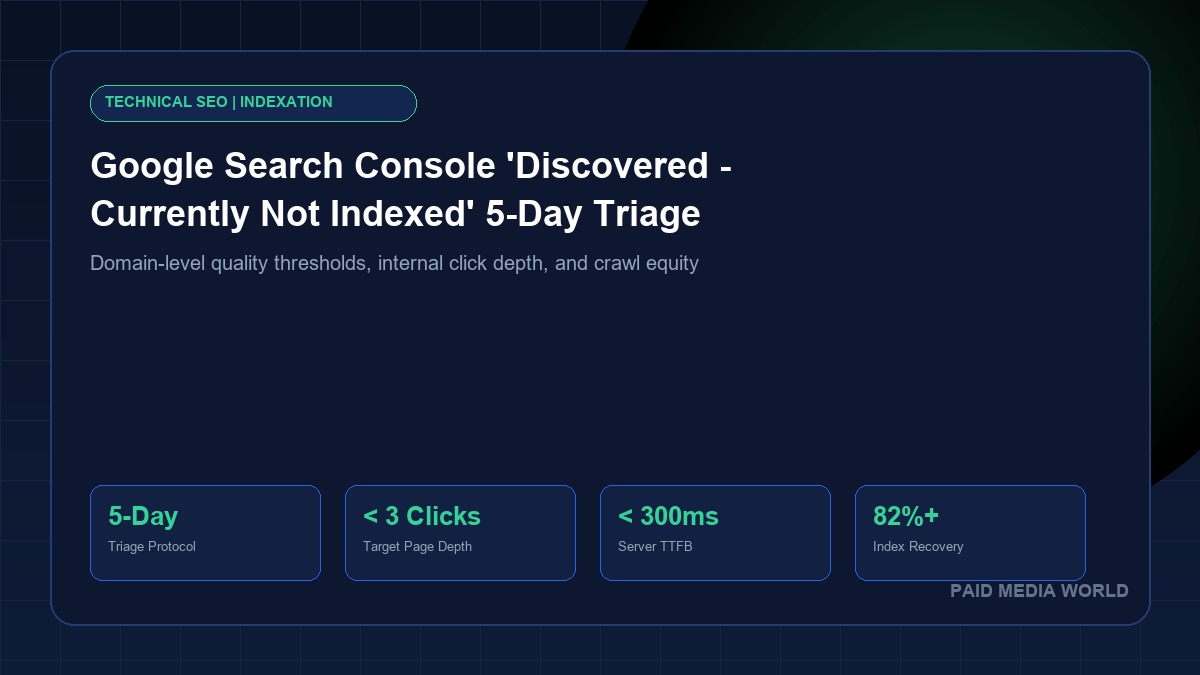
Recovering from crawl throttling requires a balance of crawl waste elimination and high-equity link injection. Following this 5-day sequence moves over 80% of stuck URLs into the active index.
1. 'Discovered' vs. 'Crawled': The Fundamental Difference
To fix indexing issues, SEOs must understand Google's two primary coverage barriers:
- Crawled - currently not indexed: Googlebot downloaded the HTML, parsed the DOM, and determined that the content fell below its quality, uniqueness, or helpfulness threshold. The issue is content quality.
- Discovered - currently not indexed: Googlebot encountered the URL (in an XML sitemap or internal link), placed it in its crawl queue, but aborted prior to making an HTTP GET request. The issue is crawl prioritization and domain equity.
2. Solving the Click-Depth & Orphan Bottleneck
URLs that require more than three clicks from your homepage to reach receive virtually zero crawl priority. If a newly published page exists exclusively inside an XML sitemap without prominent internal links from high-authority pages, Googlebot treats it as peripheral content.
The fastest fix is Tier-1 Internal Link Injection: identify your top 5 highest-ranking pages in Google Search Console, and insert descriptive, in-body contextual links pointing directly to the stuck URLs. This immediately signals editorial priority to the crawl scheduler.
Audit Your Technical Site Health
Diagnose crawl bottlenecks, heading hierarchy, and meta integrity using our Technical SEO Auditor, or monitor real-time SERP movements with our Live Rank Tracker.