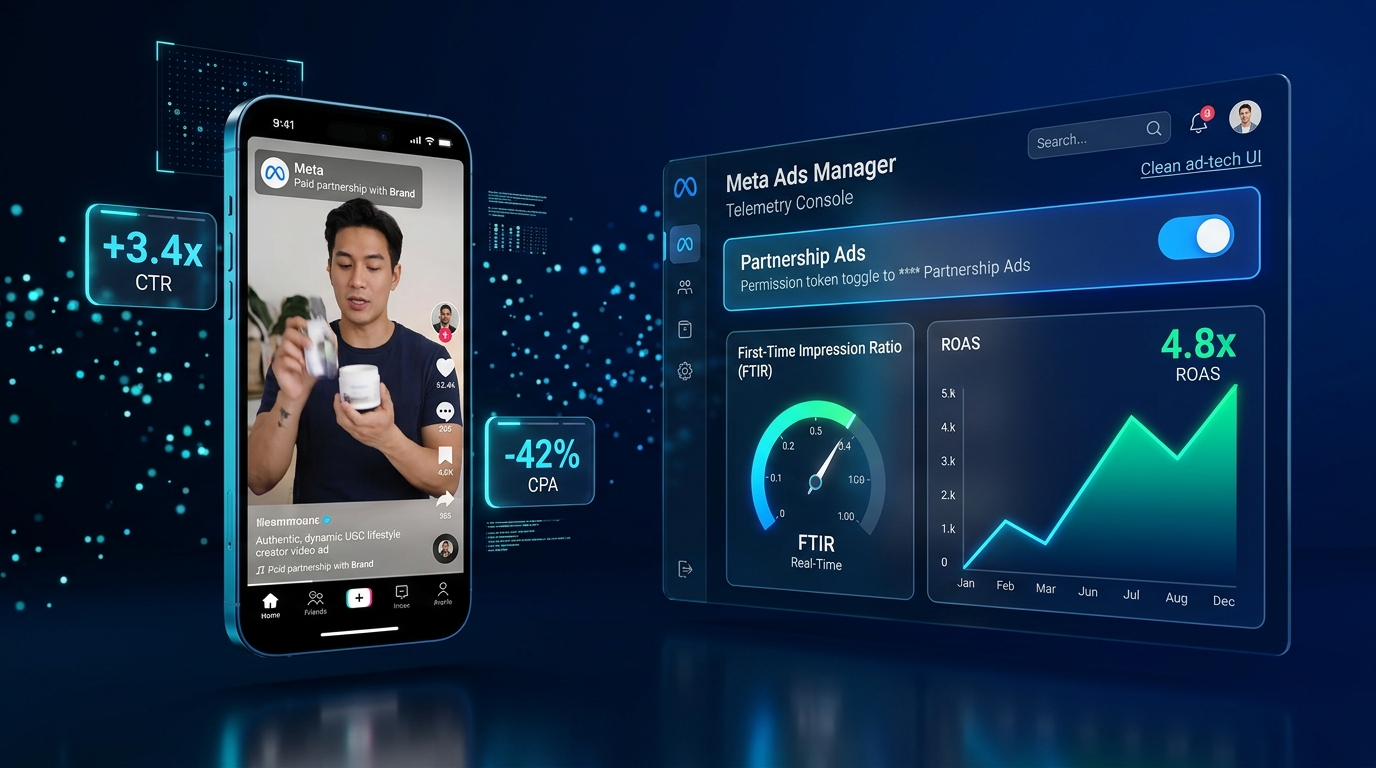
As Meta's auction algorithms increasingly favor authentic creative diversity over rigid ad group segmentation, traditional brand-handle sponsored ads are facing severe ad fatigue and banner blindness. In 2026, high-performing DTC and eCommerce brands no longer rely solely on brand-handle creative; they scale through creator whitelisting and Meta Partnership Ads (formerly Branded Content Ads). By deploying ads through verified creator handles with the official "Paid partnership with [Brand]" disclosure, performance media buyers consistently see a 25%–40% reduction in Cost Per Acquisition (CPA) and up to a 3.4x lift in Click-Through Rates (CTR).
Executive Summary: Creator Whitelisting & Partnership Ads
Creator whitelisting allows an advertiser to run paid ads through a creator's personal Instagram and Facebook profile rather than the brand's corporate page. In 2026, Meta streamlines this via Partnership Ads and Creator Ad Access Codes, bypassing legacy third-party permission tools.
1. What is Creator Whitelisting and How Does Meta Partnership Ads Work?
Historically, influencer marketing suffered from a major structural flaw: brands paid flat fees for organic posts that reached only 5%–10% of a creator's audience due to organic algorithmic compression. If an organic post succeeded, the brand had no direct mechanism to pour ad spend behind it.
Creator whitelisting solves this by granting the brand's Meta Ads Manager access to advertise through the creator's social handle. Under Meta's 2026 architecture, this is formalized as Partnership Ads.
The Three Core Advantages of Creator Whitelisting:
- Native Feed Seamlessness: Users scroll past corporate logos instinctively. A creator handle (@sarah_cleans) looks like authentic peer content, dramatically elevating initial watch time.
- Dark Posting Capability: Brands can create 20+ variations of hooks, calls-to-action, and copy without publishing any of them to the creator’s public Instagram profile grid.
- Custom Audience Retargeting: The advertiser can build custom audiences of users who engaged with the creator's Instagram account or watched their videos, unlocking hyper-receptive lookalike seed pools.
2. Step-by-Step Technical Setup in Meta Ads Manager (2026 Workflow)
In 2026, setting up Partnership Ads no longer requires cumbersome business manager partner requests or sharing credentials. There are two primary deployment pathways:
Method A: Partnership Ad Code (Fastest 1-Click Method)
- The creator opens their Instagram Mobile App and navigates to Settings & Privacy > Creator Tools > Partnership Ads.
- The creator taps Generate Partnership Ad Code for the specific Reel, Story, or Video post.
- The creator shares the 8-character alphanumeric code with your media buying team.
- In Meta Ads Manager, create a new ad at the Ad Level, select Partnership Ad toggle, and click Enter Partnership Ad Code.
- The ad creative, caption, and creator handle populate automatically, ready for your custom destination URL and UTM parameters.
Method B: Meta Business Manager Direct Permissioning
- In Meta Business Suite, navigate to Business Settings > Users > Partners.
- Add the creator's Business Manager ID or send an asset request for their Instagram account under Partnership Permissions.
- Once approved, select both your Brand Page and the Creator's Instagram Account as the dual identity in the ad identity selector.
- This unlocks full "Dark Posting" rights, allowing you to upload brand-new unreleased video cuts directly from your computer.
3. Creative Diagnostics: Hook Rate & Hold Rate Formulas
To scale creator whitelisting predictably, media buyers must abandon vanity metrics (likes, comments) and monitor algorithmic engagement drop-off points. In our agency audits, we track two non-negotiable ratios:
1. Thumbstop Rate (Hook Rate)
Thumbstop Rate (%) = (3-Second Continuous Video Plays / Total Video Impressions) × 100
Benchmark: Under 25% indicates a weak hook that triggers scroll-away. 30%–38% is solid. 40%+ is an elite viral hook.
2. Hold Rate (Body Engagement)
Hold Rate (%) = (ThruPlays [15s Plays] / 3-Second Continuous Video Plays) × 100
Benchmark: Indicates whether the creator delivers on the initial hook's promise. Aim for > 25%. A steep drop from hook to hold signals misleading clickbait that harms landing page conversion rate.
4. Scaling Architecture: Integrating Partnership Ads into ASC & CBO
Running creator ads in isolated, tiny ad sets causes audience overlap and rapid auction saturation. In 2026, follow this 3-tier campaign architecture:
- Sandbox Creative Testing (ABO): Test new creator concepts in standard Ad Set Budget Optimization using the 3:2:2 Dynamic Creative Testing framework. Run 3 hook variations, 2 primary texts, and 2 CTA angles under the creator handle.
- Advantage+ Shopping Campaign (ASC) Ingestion: Once a creator ad delivers 25+ conversions at target CPA in the testing sandbox, graduate the post ID directly into your primary ASC consolidation campaign alongside top brand-handle winners.
- First-Time Impression Ratio (FTIR) Monitoring: Track creative exhaustion using our ad creative fatigue & decay velocity diagnostic. When FTIR dips below 45%, swap the first 3 seconds of the creator video while retaining the proven body demonstration.
5. Creator Contracts, Licensing & Legal Guardrails
Never launch creator ads without explicit written usage rights. Key contractual clauses required in 2026:
| Contract Provision | Standard Agency Practice | Danger to Avoid |
|---|---|---|
| Paid Usage Term | 60 or 90 days with option to renew at 25% fee | Allowing creator to revoke access while an ad is actively scaling |
| Exclusivity Scope | Category exclusivity (e.g., no other skincare ads for 30 days) | Creator promoting a direct competitor 48 hours after your ad goes live |
| Whitelisting Multiplier | Base UGC fee + 20% to 40% whitelisting premium | Paying organic follower fees when using the ad solely for cold paid media |
Frequently Asked Questions: Creator Whitelisting & Partnership Ads
Do creators need to post the video to their organic Instagram grid?
No. With Dark Posting and Partnership Ad Codes, the creative runs purely as a sponsored ad in the feed and Reels stream. It does not appear on the creator’s permanent profile page unless both parties mutually opt into feed placement.
How does creator whitelisting impact Meta ad spend and budget pacing?
All ad spend is billed directly to the advertiser's Meta Ad Account. The creator is never charged, has no visibility into your total ad spend, and cannot see your proprietary conversion data.
Can you run creator whitelisted ads on TikTok as well?
Yes. On TikTok, the equivalent technology is called Spark Ads. The creator generates a 7-day or 30-day Spark Code from their TikTok video settings, which you paste directly into TikTok Ads Manager to boost under their handle.