
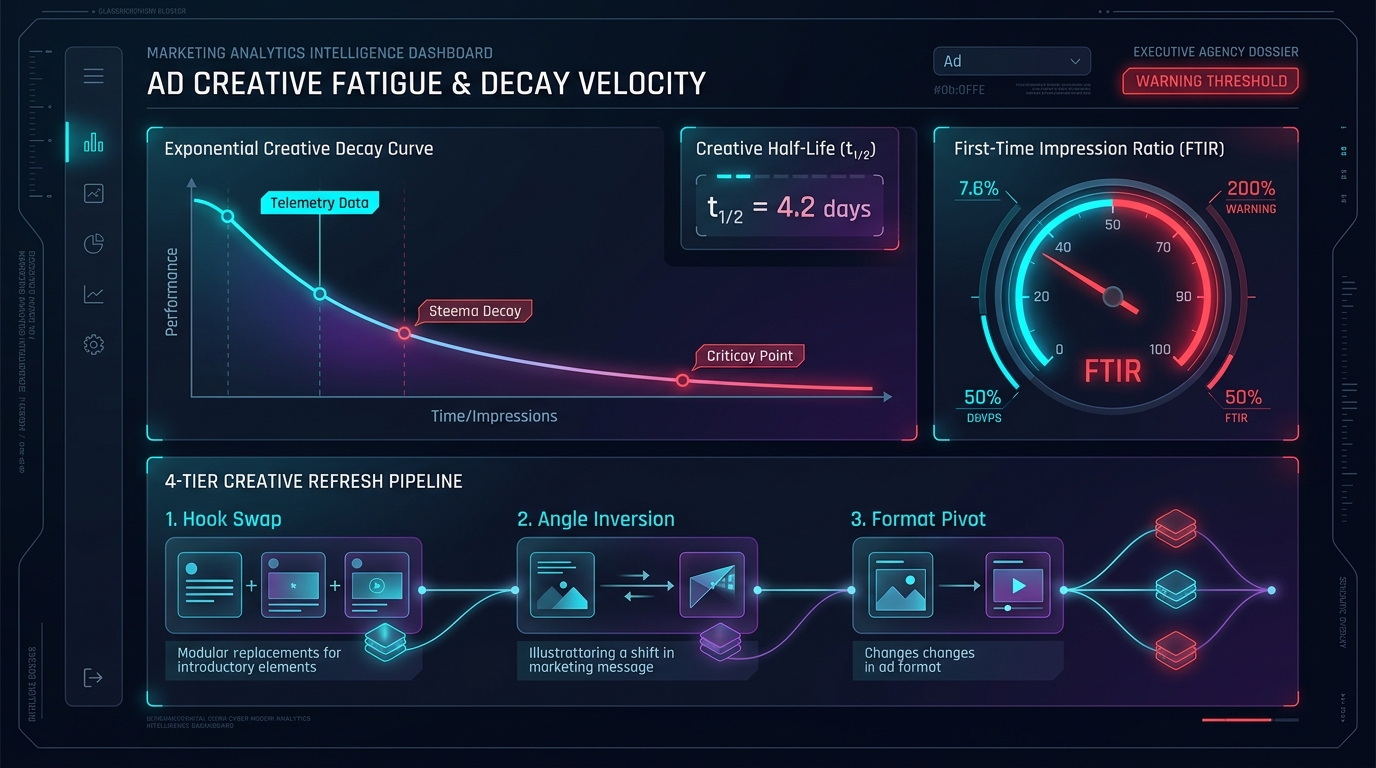
In the modern era of machine-learning ad auctions (Meta Advantage+ Shopping and TikTok Smart+), media buyers no longer battle algorithm bidding—they battle creative exhaustion. When an ad creative scales, delivery algorithms aggressively harvest the lowest-hanging conversions until the audience is saturated. Without mathematical tracking and structured creative refresh pipelines, ROAS collapses unexpectedly. This deep practitioner playbook provides the exact formulas for Creative Half-Life, First-Time Impression Ratio (FTIR), and our 4-tier asset refresh framework to sustain profitability.
How to Identify Ad Creative Fatigue Before ROAS Crashes
1. The Mechanics: Why Automated Delivery Accelerates Creative Burnout
Under legacy manual interest targeting, an ad fatigue curve was gradual: if you targeted "Yoga Enthusiasts", ad frequency increased slowly as budget was spent. Under modern algorithmic engines (Meta Advantage+ Shopping Campaigns and TikTok Smart+), targeting is determined by creative consumption semantics.
When an ad wins initial auctions, the machine learning algorithm routes up to 85% of your ad account's budget into that single creative asset. This creates the "Winner's Trap":
- The ad produces extraordinary ROAS for 7 to 18 days because it harvests the highest-propensity buyers in the total addressable market.
- Once that micro-cluster converts, the algorithm forces the same creative onto adjacent, colder prospect pools who require different persuasion angles.
- Click-through rates decline, user feedback drops, Meta's auction quality score degrades, and CPMs skyrocket—causing blended CAC to double within 72 hours.
2. The Mathematical Formulas of Creative Decay
Top-tier performance marketing teams track creative decay quantitatively using two core mathematical metrics:
Formula 1: First-Time Impression Ratio (FTIR)
First-Time Impression Ratio quantifies the percentage of ad impressions delivered to individuals who have never seen the ad before:
- FTIR > 70%: Prime scaling phase. Audience is receptive, creative is expanding into fresh demographics.
- FTIR 50%–65%: Saturation warning. The ad is beginning to recycle across the same viewers. Prepare replacement creatives immediately.
- FTIR < 45%: Critical burnout. The creative is suffering severe banner fatigue and dragging down total account delivery efficiency.
Formula 2: Creative Half-Life ($t_{1/2}$)
Creative Half-Life measures the elapsed calendar duration required for an ad's baseline conversion rate or ROAS to deteriorate by 50% at constant spend velocity:
- TikTok Ads Half-Life: 5 to 9 days. Rapid algorithmic velocity and native short-form consumption exhaust trends rapidly.
- Meta Video Ads Half-Life: 14 to 24 days for standard UGC video formats.
- Meta Static Image Ads Half-Life: 21 to 45 days. High-contrast static comparison charts and press quotes frequently outlast video assets because they carry less emotional saturation.
3. The 4-Tier Creative Refresh Protocol: Reviving Winners at 10% the Cost
When an ad creative fatigues, inexperienced media buyers discard the entire asset and spend thousands producing brand-new concepts from scratch. Senior growth practitioners execute the 4-Tier Creative Refresh Protocol, reviving winning concepts with modular iterations:
Tier 1: Hook Swaps (Top 0–3 Seconds)
Keep the remaining 85% of your winning video identical. Cut 5 new 3-second opening hooks testing contrasting emotional triggers:
- Negative Agitation Hook: "Stop making this $500 mistake when buying..."
- Visual Pattern Interrupt: Extreme close-up product destruction or shocking text overlay.
- Social Proof Hook: "Why over 14,000 dermatologists switched to..."
Recovery Rate: Revives 40%–55% of fatigued winners within 24 hours at minimal editing cost.
Tier 2: Persuasion Angle Inversion
Invert the psychological framework of your copy and narrative. If your winning creative relied on Aspiration & Status (e.g., "Look sharp at executive dinners"), test an inverted Fear of Inconvenience angle (e.g., "Never suffer from wrinkled shirts on business flights again").
Tier 3: Format & Medium Transposition
Take the exact spoken script and core value proposition of your top-performing UGC video and transpose it into completely different visual formats:
- A 3-part static swipeable Instagram carousel highlighting before-and-after metrics.
- A bold "Us vs. Them" side-by-side feature comparison table image.
- A simulated iPhone iMessage screenshot between customer and founder.
Tier 4: Offer & Entry Friction Mutation
When the audience knows the product but conversion velocity stalls, alter the entry offer: switch from a "15% First-Order Discount" to a "Free $35 Travel Case with Starter Kit" or "Buy 2 Get 1 Free Bundle".
4. Automated Burnout Guardrails in Meta & Google Ads
Never rely on manual daily inspection to catch creative fatigue. Set up automated platform rules to trigger notifications or throttle spend:
- Meta Automated Fatigue Rule:
IF Frequency (Last 7 Days) > 2.60 AND CPA > 1.35x Account Target CPA AND Spend > 2x Daily Budget → Send Slack Notification & Decrease Budget by 20%. - Google Ads Script Fatigue Guard:
Deploy automated scripts to monitor Performance Max asset group conversion share. If an asset group's 14-day conversion rate drops by >25% while impression volume remains static, trigger a webhook alert to deploy fresh video and static assets.
5. Frequently Asked Questions (FAQ)
How often should you launch new ad creatives on Meta?
For accounts spending $10k to $50k/month, launch 4 to 8 fresh creative iterations weekly. For enterprise accounts spending >$100k/month, maintain a production velocity of 12 to 20 new assets weekly using modular 3:2:2 dynamic testing engines.
Does duplicating a fatigued ad set reset creative fatigue?
No. Duplicating an ad set with identical creatives merely forces the algorithm to enter auctions with the same exhausted asset ID, competing against your own account. It resets machine-learning calibration without resolving audience saturation.
Where can I see First-Time Impression Ratio (FTIR) in Meta Ads Manager?
In Meta Ads Manager, select the campaign, click 'Inspect' on the right-hand panel, and scroll to 'Auction Overlap' and 'Audience Saturation'. Here, Meta graphs the First-Time Impression Ratio alongside Frequency curves.