
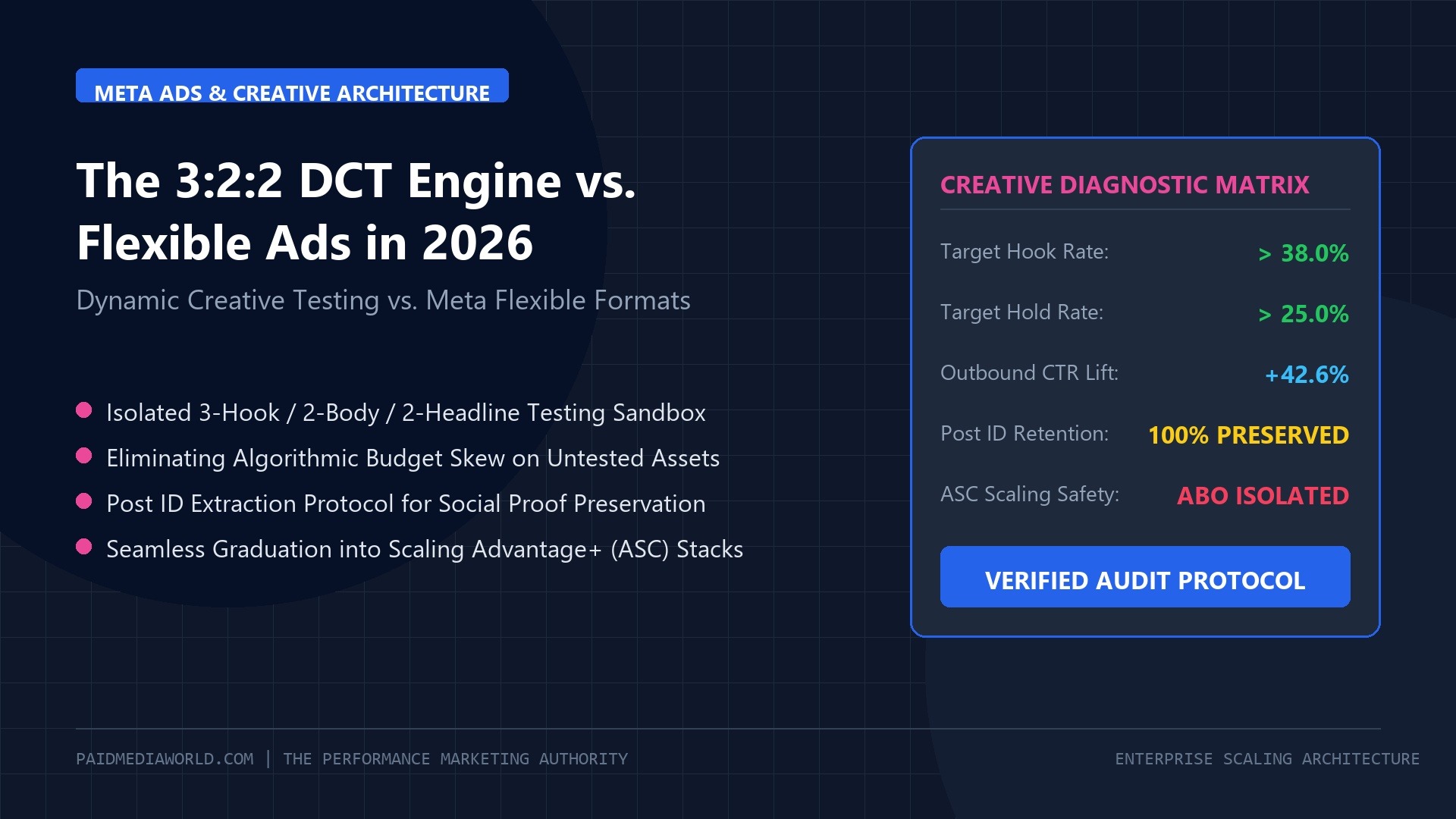
In 2026, the Meta advertising auction operates almost entirely as an algorithmic machine learning ecosystem. Audience targeting has shifted towards broad demographic signals, bid algorithms have consolidated into automated portfolio caps, and the true lever of scalable alpha has moved decisively to creative architecture. Yet, high-growth direct-to-consumer (DTC) and B2B brands continue to burn tens of thousands in monthly ad spend due to a foundational mistake: relying on Meta’s black-box Flexible Ad formats for creative validation instead of engineering an isolated, mathematically rigorous 3:2:2 Dynamic Creative Testing (DCT) Engine.
Table of Contents
- 1. The Fatal Flaw of Meta Flexible Ads in Enterprise Accounts
- 2. Anatomy of the 3:2:2 DCT Engine: Isolated Variable Methodology
- 3. The Creative Diagnostic Scorecard: Hook Rate, Hold Rate & Outbound CTR
- 4. Post ID Extraction Workflow: Preserving Social Proof into Scaling Campaigns
- 5. Bridging DCT Winners into Advantage+ Shopping Campaigns (ASC)
- 6. Weekly Creative Velocity & Testing Sprint Protocol
- 7. Technical Verification & Performance Review
1. The Fatal Flaw of Meta Flexible Ads in Enterprise Accounts
When Meta introduced the Flexible Ad format (allowing up to 10 images/videos, multiple text variations, and headlines within a single ad container), marketing generalists celebrated the simplification of campaign setup. However, in enterprise performance accounts spending \$50,000 to \$500,000+ per month, Flexible Ads exhibit three catastrophic architectural deficiencies:
- Algorithmic Spend Skew (The First 500 Impression Bias): Meta’s delivery algorithm allocates ad impressions based on early micro-signals within the first few hundred deliveries. In a Flexible ad containing 10 creatives, Meta frequently commits 80% to 90% of the ad budget to a single creative within hours—even if another asset possesses superior conversion economics. The remaining 9 assets are starved of statistical significance.
- Post ID Dilution and Engagement Fragmentation: Flexible ads generate dynamic combinations on the fly. Because there is no persistent, unified Page Post ID across every delivery variant, social proof (comments, shares, social validation) is scattered across ephemeral asset combinations rather than accumulating on a flagship scaling asset.
- Black-Box Diagnostic Blindness: While Meta Ads Manager displays aggregate metrics for the Flexible ad unit, extracting the granular interaction between specific hooks and primary copy bodies requires tedious breakdown analysis that often lacks conversion attribution parity. You cannot reliably discern whether a low CPA was driven by Visual Asset A paired with Copy B, or Visual Asset C paired with Copy A.
The Engineering Reality
Automated creative aggregation is engineered for Meta’s auction efficiency, not for your client’s net contribution margin. To build predictable revenue, media buyers must enforce variable isolation: testing exactly one hypothesis at a time under identical algorithmic delivery constraints.
2. Anatomy of the 3:2:2 DCT Engine: Isolated Variable Methodology
The 3:2:2 Dynamic Creative Testing Engine is a modular, structured framework designed to isolate and stress-test creative components in a controlled testing environment before graduating validated winners into high-budget scaling ad sets.
Campaign Hierarchy Configuration
To prevent auction cannibalization and budget monopolization, execute 3:2:2 DCT tests within a dedicated Ad Set Budget Optimization (ABO) campaign:
- Campaign Objective: Sales (Conversions – Purchase event).
- Budget Architecture: ABO with a daily budget calculated as
2x to 3x Target CPAper ad set. For a brand with a \$40 Target CPA, set the testing ad set budget to \$80–\$120/day. - Targeting: Broad / Open targeting (Age, Gender, Geo only) with zero interest or lookalike layers. Ensure strict exclusion of 30-day past purchasers and existing customer email lists.
- Dynamic Creative Setting: Toggle
Dynamic Creativeto ON at the Ad Set level (or use the Dynamic Creative element block). - Test Duration: 72 hours minimum or until reaching at least
50 unique conversionsor3,000 video impressionsto achieve statistical validity.
3. The Creative Diagnostic Scorecard: Hook Rate, Hold Rate & Outbound CTR
Never judge a creative test solely by its top-level ROAS during the initial 72 hours. Early ROAS is prone to small-sample variance. Instead, evaluate the test through a multi-tier quantitative scorecard:
// Meta Ads Creative Diagnostic Mathematical Formulas
Hook Rate (%) = (3-Second Continuous Video Plays / Total Video Impressions) * 100
Hold Rate (%) = (ThruPlays / 3-Second Continuous Video Plays) * 100
Outbound CTR (%) = (Outbound Clicks / Total Impressions) * 100
Conversion Rate Ratio = (Purchases / Outbound Clicks) * 100
Enterprise Benchmark Thresholds
4. Post ID Extraction Workflow: Preserving Social Proof into Scaling Campaigns
The single greatest operational bottleneck media buyers encounter when graduating DCT winners is social proof destruction. When you recreate an ad manually in a scaling campaign, comments, likes, and shares are wiped clean, resetting social validation to zero.
To preserve social proof in 2026, follow this exact step-by-step Post ID extraction protocol:
Step-by-Step Extraction via Meta Ads Manager & Page Posts
- Navigate to the DCT Ad Set in Meta Ads Manager and select the winning ad unit.
- Click Preview → Click Share (top right) → Select Facebook Post with Comments.
- In the resulting URL in your browser, locate the numeric string at the end of the URL (e.g.,
https://www.facebook.com/permalink.php?story_fbid=1029384756&id=123456789or/posts/1029384756). - Alternatively, open Meta Business Suite → Content → Published Posts / Ads Posts.
- Locate the post with the highest accumulated spend and engagement. Copy the exact Post ID (a 15- to 17-digit numerical identifier).
- In your scaling campaign (e.g., Advantage+ Shopping Campaign or CBO Scaling Ad Set), create a New Ad → Under Ad Setup, select Use Existing Post.
- Click Enter Post ID, paste your extracted ID, and click Submit.
Automated Graph API Post ID Extraction Script
For enterprise teams managing high creative velocity, manual extraction is inefficient. Deploy this Python script to query the Meta Marketing API and retrieve the exact effective_object_story_id of winning combinations:
# Python script to extract winning Post IDs from Meta Dynamic Creative ad sets
import requests, json

ACCESS_TOKEN = "EAAG..."
AD_ID = "1203847592837401"
API_VERSION = "v21.0"

url = f"https://graph.facebook.com/{API_VERSION}/{AD_ID}"
params = {
    "fields": "name,status,creative{id,name,effective_object_story_id,asset_feed_spec}",
    "access_token": ACCESS_TOKEN
}

response = requests.get(url, params=params)
data = response.json()

if "creative" in data:
    story_id = data["creative"].get("effective_object_story_id")
    print(f"[SUCCESS] Extracted Post ID: {story_id}")
    print("Ready to inject into ASC Scaling Campaign via 'Use Existing Post'.")
else:
    print("[ERROR] Could not extract creative story ID:", data)
5. Bridging DCT Winners into Advantage+ Shopping Campaigns (ASC)
Advantage+ Shopping Campaigns (ASC) excel at high-volume conversion matching when supplied with proven creatives, but perform poorly as testing incubators. The optimal 2026 account architecture segregates testing and scaling into two discrete engines:
3:2:2 ABO Sandbox
- Allocates 15%–25% of total paid media budget.
- Strictly tests new hooks, concepts, and customer angles.
- Kills underperforming assets within 72 hours.
- Zero algorithmic pollution from legacy winners.
Advantage+ Shopping (ASC)
- Allocates 75%–85% of total paid media budget.
- Houses exclusively validated Post IDs graduated from DCT.
- Pushes maximum auction volume without breaking social proof.
- Enforces 5% existing customer budget cap for clean prospecting.
6. Weekly Creative Velocity & Testing Sprint Protocol
Sustained performance marketing efficiency requires continuous creative throughput. Brands spending \$100,000+ per month must test between 4 to 8 new 3:2:2 DCT batches weekly to offset creative fatigue:
- Monday (Audit & Ideation): Review prior week’s DCT diagnostics. Identify fatigue signals (frequency > 2.8, Hook Rate drops > 20%). Draft 6 new hook hypotheses and 2 new script concepts.
- Tuesday (Asset Production): Produce video variations modifying only the first 3 seconds while keeping the proven product demonstration body intact.
- Wednesday (Launch Batch): Deploy 2–4 new 3:2:2 DCT ad sets in the ABO Sandbox. Set daily budgets to 2.5x Target CPA.
- Friday (Mid-Flight Check): Review Hook Rates and Hold Rates. Any asset with < 20% Hook Rate after 1,000 impressions is paused immediately.
- Sunday (Graduation & Scale): Extract winning Post IDs via Graph API. Inject into ASC and CBO scaling campaigns. Retire exhausted legacy ads.
7. Technical Verification & Performance Review
Authored & Validated by Subhranil Naskar
Lead Performance Media Buyer & Technical Growth Architect at PaidMediaWorld. Specializing in Meta Advantage+ algorithmic bid scaling, 3:2:2 dynamic creative testing pipelines, and programmatic media buying architectures.