
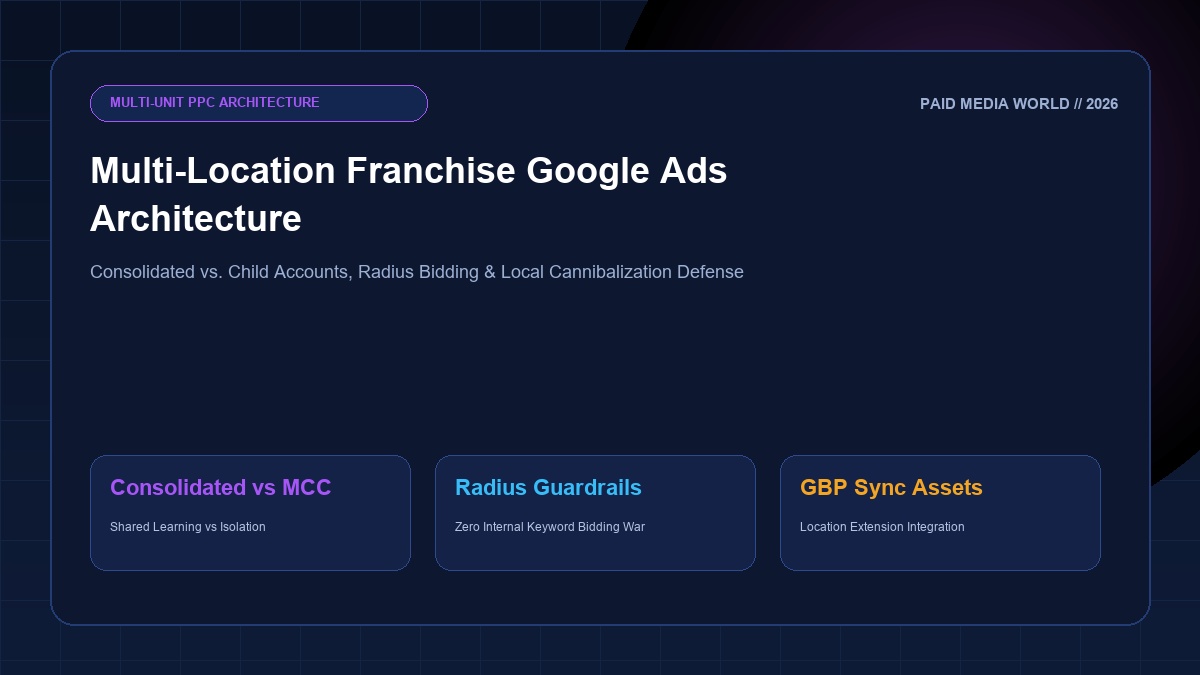
Scaling Google Ads for a franchise system or multi-location enterprise—whether managing 15 fitness centers, 80 dental clinics, or 500+ home service territories—presents architectural challenges that single-location businesses never face. How do you prevent neighbouring franchisees from bidding against each other and inflating CPCs? Should you manage ad spend in one centralized parent account or distribute it across hundreds of individual child accounts? In 2026, navigating Google Smart Bidding across fractured geographic territories requires a proven operational blueprint.
Executive Summary: Consolidated vs. Child Account Architecture
The fundamental decision in franchise advertising is choosing between a Consolidated Single-Account Architecture (maximum machine learning efficiency, unified billing) and a Child MCC Account Structure (strict franchisee budget autonomy, localized credit card billing, individual legal ownership).
1. Solving the Franchise Cannibalization Trap
When two franchisees operate in adjacent territories (e.g. North Dallas and Plano), running independent child accounts with overlapping 15-mile radius targeting triggers internal auction competition. Both accounts submit bids for "emergency AC repair"; Google's auction algorithm treats them as independent bidders, driving the clearing CPC up by 25% to 50% without increasing collective market reach.
In a Consolidated Architecture, Google automatically prevents your campaigns from competing against each other. When multiple ad groups in the same account match a query, Google evaluates Quality Score and Bid, entering only the single highest-ranking ad into the external auction.
2. Location Targeting Protocol: Radii vs. Postal Boundary Meshes
To eliminate territory disputes between franchise owners, professional PPC agencies implement strict geographic boundaries:
- Never Rely on Loose Proximity Radii Alone: Circular radius radiuses (e.g., 10 miles around each location) inevitably create overlapping Venn diagram slivers where multiple locations claim the lead.
- Deploy Exact Postal / ZIP Code Boundaries: Map each franchisee's legal franchise territory to exact postal codes. Configure location targeting by ZIP code lists.
- Negative Location Mutual Exclusions: In Franchisee A's campaign, explicitly add Franchisee B's ZIP codes as Negative Locations. This guarantees that mobile users near borderlines are never routed to the wrong store.
3. Google Business Profile (GBP) Linking & Location Assets at Scale
Capturing high-intent local searchers requires dominating local map packs and location extension assets:
- Create a centralized Google Business Profile Business Group containing all verified location profiles.
- Link the GBP Business Group to your Google Ads account under Assets > Location Assets.
- Apply Location Asset Groups / Labels: Tag GBP profiles by region or franchise ID, allowing campaigns to dynamically append only the physical address, phone number, and store hours of the specific location serving that geographic area.
4. Dynamic Local Landing Page Architecture
Sending local search traffic to a generic corporate homepage destroys conversion rates. High-performing franchise networks deploy programmatic localized landing pages:
Dynamic Elements: Local address, Google Map embed, direct franchise phone number, verified customer reviews from that specific zip code
Combine this with Dynamic Number Insertion (DNI) using CallRail or WhatConverts to attribute phone calls, form fills, and revenue back to the specific franchise location and ad group.
Explore High-Ticket Local PPC Playbooks
Compare search campaigns against Google Guaranteed leads in our Google Local Services Ads vs. Search Ads Guide, or review our High-Ticket Contractor Google Ads Blueprint.