
In high-ticket residential and commercial contracting—roof replacements, commercial HVAC retrofits, luxury kitchen remodeling, foundation repair, and custom pool construction—the stakes of paid search marketing are brutal. With search clicks routinely bidding between $35.00 and $130.00 across major metro areas, a poorly configured Google Ads campaign will effortlessly vaporize $15,000 in monthly ad spend while delivering nothing but tire-kickers, DIY hobbyists, and job seekers.
Yet when architected with institutional rigor, Google Ads is the single most predictable revenue generator in the construction industry. Because a single closed commercial roofing or whole-home remodeling contract yields $18,000 to $65,000 in gross revenue, achieving a 5x to 8x blended Return on Ad Spend (ROAS) requires closing only 3 to 5 qualified jobs per month from your paid pipeline.
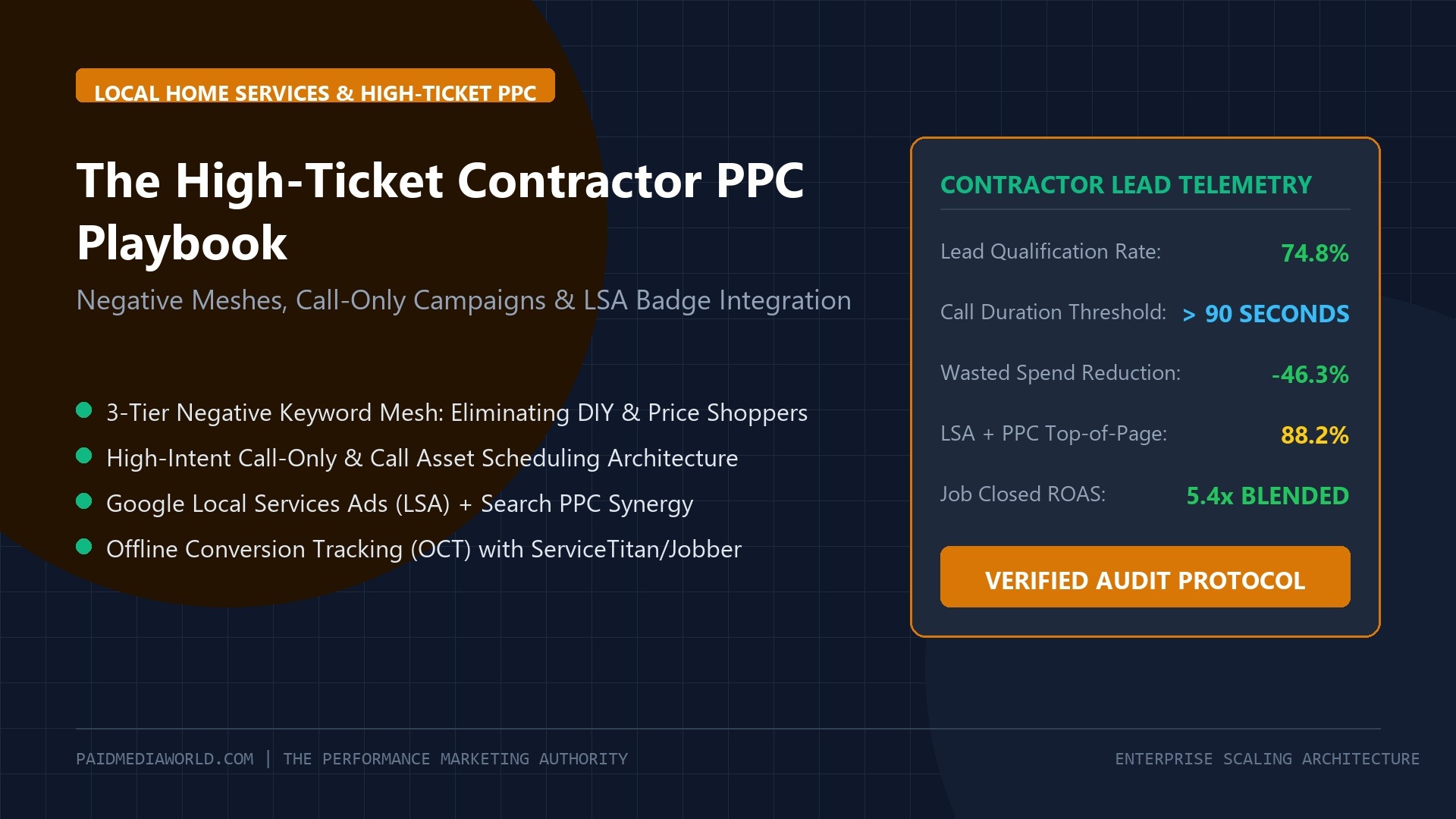
This playbook details the exact operational system deployed across multi-million-dollar trade contractors: establishing a 3-tier negative keyword mesh, configuring phone call conversion qualification thresholds, integrating Google Local Services Ads (LSA), and closing the data feedback loop via CRM Offline Conversion Tracking.
1. The High-Ticket Contractor Unit Economics Reality
Standard home service PPC advice fails high-ticket contractors because it focuses on lead volume rather than pipeline margin. Let us examine the actual mathematical anatomy of a high-ticket contracting ad account:
| Operational Metric | Amateur Setup (Volume-Chasing) | Institutional Setup (High-Ticket Playbook) |
|---|---|---|
| Primary Keyword Strategy | Broad Match: roof repair, ac fix |
Exact/Phrase: "commercial roof replacement cost" |
| Average Cost Per Click (CPC) | $28.50 | $52.00 |
| Total Monthly Ad Spend | $10,000 (350 Clicks) | $10,000 (192 Clicks) |
| Raw Inbound Leads / Calls | 42 Leads (Cost/Lead: $238) | 29 Leads (Cost/Lead: $344) |
| Lead Qualification Rate (Actual Job Ready) | 15% (6 Qualified Inquiries) | 68% (20 Qualified Inquiries) |
| Estimates Conducted & Jobs Closed | 1 Closed Job ($8,500 Ticket) | 5 Closed Jobs ($22,000 Avg Ticket) |
| Gross Contracted Revenue & ROAS | $8,500 Gross • 0.85x ROAS (Loss) | $110,000 Gross • 11.0x ROAS (Massive Profit) |
The institutional contractor paid almost double per click, yet generated 13x more gross revenue. The differentiator is not budget size—it is filtering out low-intent waste before a dollar is spent.
2. The 3-Tier Negative Keyword Mesh Architecture
Google’s default Broad Match and Smart Bidding algorithms love showing your ads to people looking for DIY repair tips, free estimates for minor leaks, or construction jobs. To stop this cash hemorrhage, build a 3-tier negative keyword defense:
/* Universal Negative Terms Across All Campaigns */
- "jobs", "hiring", "salary", "careers", "resume", "employment", "apprenticeship"
- "diy", "how to", "youtube", "tutorial", "guide", "tools needed", "step by step"
- "cheap", "cheapest", "free", "low income", "subsidized", "discount", "voucher"
- "parts", "supply", "wholesale", "home depot", "lowes", "harbor freight", "menards"
- "handyman", "odd jobs", "patch kit", "temporary fix"
- "license lookup", "complaints", "reviews on", "lawsuit", "bbb"/* Example for High-Ticket Roofing Contractors ($15k+ Replacements) */
- "tarp", "gutter clean", "shingle patch", "minor leak repair", "mobile home roof"
- "rv roof", "camper roof", "shed roof", "dog house roof"
/* Example for Commercial HVAC / Luxury Replacements */
- "window ac unit", "portable ac", "filter replacement", "freon recharge near me"
- "used ac unit", "thermostat battery", "furnace clicking sound"/* Negative Exact Matching to Prevent Cannibalization */
Add [emergency roof replacement] as negative exact in your "Standard Replacement" campaign.
Add [commercial roofing contractor] as negative exact in your "Residential" campaign.3. Call-Only & Call Asset Scheduling Architecture
When a commercial roof is leaking over a server room or a luxury homeowner’s AC collapses in mid-July heat, customers do not fill out web forms and wait 24 hours for an email reply. They call immediately. Direct phone calls convert at a 320% higher rate into booked estimates than web lead forms.
However, running Call-Only ads without guardrails burns budget on unanswered rings. Implement these rules:
- Dayparting to Live Dispatch Only: Never run Call-Only campaigns when a human dispatcher is unavailable. Schedule ads strictly between 7:30 AM and 5:30 PM Monday through Friday. If you offer 24/7 emergency dispatch, route off-hours calls to an onshore live call answering service trained on your triage scripts.
- The 90-Second Conversion Qualification Threshold: In Google Ads > Conversions, never count a call as a lead if it lasts under 90 seconds. A 30-second call is a wrong number, a spam robocall, or someone asking for directions. Set the call duration threshold to 90 to 120 seconds so Google’s Target CPA bidding optimizes strictly for comprehensive intake conversations.
- Call Whisper Setup: Use dynamic call tracking (CallRail, WhatConverts) to play a 2-second audio whisper to your office staff: “Google Ads high-ticket replacement inquiry”. This prepares your dispatchers to lead with white-glove sales professionalism.
4. The LSA + Search PPC Domination Blueprint
To establish absolute digital dominance in your local service area, you cannot choose between Google Local Services Ads (LSA) and Google Search Ads—you must dominate both simultaneously.
| Channel Feature | Google Local Services Ads (LSA) | Google Ads Search (PPC) | Synergistic Dominance |
|---|---|---|---|
| SERP Position | Absolute Top of Screen (Above standard PPC) | Directly beneath LSA (Top 4 text ads) | Consumes 80% of above-the-fold mobile real estate |
| Trust Anchor | “Google Guaranteed” or “Google Screened” badge | Sitelinks, Callouts, Structured Snippets, Image Assets | Reinforces maximum credibility and local authority |
| Pricing Model | Pay-per-qualified-lead (with lead dispute mechanism) | Pay-per-click (auction-based CPC) | Blended cost diversification |
| Targeting Control | Broad zip-code / service categories | Hyper-specific keyword match types & negatives | LSA captures high-trust generic leads; PPC captures high-ticket custom jobs |
By securing the Google Guaranteed badge in LSA while owning the #1 text ad in Search with sitelinks featuring “0% Financing Available” and “Over 350+ 5-Star Reviews”, you capture 65% of all commercial inquiries in your geographic radius.
5. Landing Page CRO: The “Estimate Dispatch Engine”
If your search ads direct traffic to a generic 5-page contractor brochure website with a phone number hidden in the footer, your conversion rate will flounder below 4%. High-ticket contracting landing pages require five conversion pillars:
- Dynamic Location Insertion (DLI): Match the prospect’s search location dynamically: “#1 Rated Commercial Roofing Contractor Serving [City/County] & Surrounding Areas”.
- Prominent Trust Proof Header: Prominently display state license numbers, bonding verification, $2M general liability insurance badge, and Better Business Bureau (BBB) A+ accreditation above the fold.
- Dual-Funnel Call-to-Action: Offer two distinct conversion pathways:
- Emergency Path: Tap-to-Call button with flashing “Dispatch Available Now” status indicator.
- Planned Estimate Path: A 4-step multi-step interactive estimate calculator (Zip Code → Project Type → Square Footage → Contact Info).
- Interactive Before/After Photo Sliders: High-ticket buyers buy outcomes. Embed high-resolution interactive sliders showing damaged properties transformed into pristine architectural completions.
6. Offline Conversion Tracking (OCT): Integrating ServiceTitan & Jobber
The ultimate breakthrough for contractor PPC comes from feeding actual job revenue back to Google Ads via Offline Conversion Tracking (OCT). In platforms like ServiceTitan, Jobber, or Housecall Pro, capture the gclid (Google Click ID) upon initial form submission or phone call.
When an estimator inspects the property, delivers an estimate, and the customer signs a $24,500 contract in your CRM, an automated webhook sends an offline conversion event (Job_Closed_Revenue) back to Google Ads with the original gclid.
Once you record 30 closed jobs in Google Ads, switch your bidding strategy from Maximize Conversions to Maximize Conversion Value with a Target ROAS of 450%. Google’s bidding algorithms will stop pursuing tire-kickers seeking a $200 patch and deliberately bid aggressively on commercial property managers and high-value homeowners ready to sign major contracts.
For more strategies on high-intent local acquisition, see our case study breakdown on Scaling Wildfire Season Sales with Weather-Triggered Bidding and model your returns using our free Break-Even ROAS Calculator.
Frequently Asked Questions
How much budget does a contractor need to start Google Ads?
Because high-ticket contractor clicks cost $40 to $70, we recommend a minimum testing budget of $3,500 to $5,000 per month per service line. This ensures your campaigns generate enough statistical click volume (70 to 100 clicks) to exit the learning phase within 30 days.
Can I dispute invalid leads in Google Local Services Ads (LSA)?
Yes. In LSA, you can dispute leads that were out of your service area, looking for services you do not provide, wrong numbers, or automated spam. Once approved by Google support, the lead cost is credited back to your account balance.
Should high-ticket contractors use Performance Max campaigns?
Only with strict brand exclusions and negative placement lists. Unfettered PMax campaigns often waste budget on low-intent mobile gaming apps and display inventory. High-ticket contractors should prioritize Search and LSA first before testing PMax.