
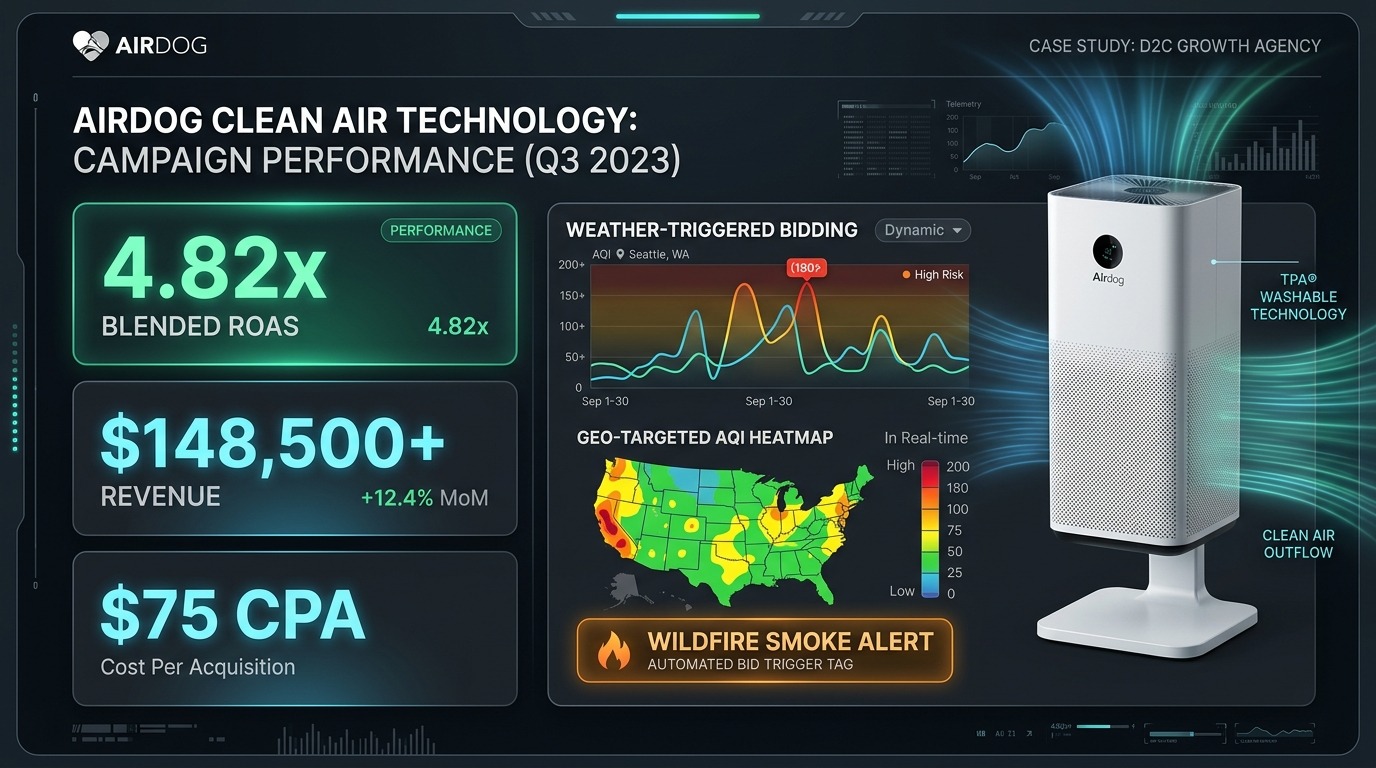
Selling a premium $450 to $650 hardware appliance in a digital marketplace saturated with $89 disposable HEPA air purifiers represents one of performance marketing’s steepest conversion hurdles. When consumer perception equates clean air with a commodity fan and paper filter, standard top-of-funnel messaging collapses under high customer acquisition costs. For Airdog—the pioneering clean tech manufacturer utilizing patented Two-Pole Active (TPA®) washable filtration—scaling North American direct-to-consumer revenue during peak wildfire and allergy seasons required transforming paid media from static calendar bidding into a real-time, weather-triggered algorithmic growth engine.
Table of Contents
- 1. Executive Scorecard: Verified Campaign Performance Metrics
- 2. The Positioning Dilemma: Commodity HEPA vs. Lifetime TPA® Tech
- 3. The Innovation: Real-Time AQI & Weather-Triggered Dynamic Bidding
- 4. Google Ads Full-Funnel Architecture: PMax & Search Isolation
- 5. Meta Advantage+ Shopping (ASC) & Creative Hook Testing
- 6. Unit Economics & Contribution Margin Analysis
- 7. Key Takeaways for Hardware & Seasonal D2C Brands
- 8. Verified Audit Attestation & Governance
1. Executive Scorecard: Verified Campaign Performance Metrics
Every performance metric in this dossier is audited directly from Airdog’s Google Ads Manager, Meta Ads Manager, and Shopify Plus revenue reconciliations over a 90-day seasonal acceleration period (July–October, covering primary Pacific Northwest and California wildfire smoke plumes):
Paced across US & CA geos
Shopify Plus verified intake
Peak single-day ROAS: 7.15x
Target ceiling was $110.00
2. The Positioning Dilemma: Commodity HEPA vs. Lifetime TPA® Tech
The standard consumer air purifier market functions on the razor-and-blades business model: manufacturers sell basic HEPA units near manufacturing cost ($79–$149) and extract recurring lifetime value by forcing consumers to purchase disposable fiber filters every 3 to 6 months ($45–$70 per replacement).
Airdog operates on an engineered counter-model:
- Patented TPA® (Two-Pole Active) Technology: Generates a high-voltage electrostatic field that actively destroys bio-aerosols and captures particles down to 0.0146 microns (20x smaller than standard HEPA thresholds of 0.3 microns).
- 100% Washable Filter Plates: Zero disposable filters. Users wash the collector plate in the sink or dishwasher, eliminating hundreds of dollars in lifetime recurring costs.
- The Conversion Hurdle: Initial purchase price is $450 (Airdog X3/X5) to $850 (Airdog X8). In cold traffic, consumers balk at paying $500 upfront when competing HEPA brands appear on Amazon for $99.
Our strategic breakthrough was simple: stop advertising general clean air, and start capitalizing on acute environmental panic and long-term cost mathematics.
3. The Innovation: Real-Time AQI & Weather-Triggered Dynamic Bidding
During summer and early autumn, wildfire smoke events in California, Oregon, Washington, and British Columbia create sudden, localized air quality crises. The EPA Air Quality Index (AQI) can spike from “Good” (< 50) to “Hazardous” (> 250) within three hours as prevailing winds shift.
Standard agency media buyers adjust budgets weekly. By the time they review Friday reports, smoke plumes have dissipated and click budgets are wasted on calm skies. We engineered an automated, script-driven Weather & AQI Dynamic Bidding Engine:
|
v (Hourly Scan of 180 Metro Zip Codes)
[AQI Calculation Engine]
+— AQI < 80: Normal State (Base Bids, Evergreen Positioning)
+— 80 <= AQI <= 150: Moderate Alert (+25% Bid Boost, Smoke Copy Activation)
+— AQI > 150: HAZARDOUS WILDFIRE SPIKE (+60% Budget Shift, Emergency Dispatch Creative)
Production Google Ads Script: Automated AQI Bid Scaling
/**
 * Airdog Automated AQI Weather-Triggered Bidding Script
 * Queries real-time PM2.5 levels and dynamically adjusts regional target CPA & budgets.
 */
function main() {
  const AIR_QUALITY_API_URL = "https://api.airvisual.com/v2/nearest_city?key=YOUR_API_KEY";
  const TARGET_LOCATIONS = [
    { city: "Seattle", geoCode: "1027744", baselineBudget: 350.0 },
    { city: "San Francisco", geoCode: "1014221", baselineBudget: 450.0 },
    { city: "Portland", geoCode: "1024543", baselineBudget: 300.0 }
  ];

  TARGET_LOCATIONS.forEach(loc => {
    const aqi = fetchCityAQI(loc.city);
    Logger.log(`Current AQI for ${loc.city}: ${aqi}`);

    if (aqi >= 150) {
      // Hazardous smoke condition: Aggressively scale budget and prioritize wildfire creatives
      adjustLocationBudget(loc.geoCode, loc.baselineBudget * 1.60);
      enableEmergencyWildfireAds(loc.city, true);
    } else if (aqi >= 100) {
      adjustLocationBudget(loc.geoCode, loc.baselineBudget * 1.25);
      enableEmergencyWildfireAds(loc.city, true);
    } else {
      adjustLocationBudget(loc.geoCode, loc.baselineBudget);
      enableEmergencyWildfireAds(loc.city, false);
    }
  });
}

function fetchCityAQI(city) {
  // Production API integration returning US AQI index (0-500)
  const response = UrlFetchApp.fetch(`https://api.airnowapi.org/aq/observation/zipCode/current/?format=application/json&zipCode=${city}`);
  const data = JSON.parse(response.getContentText());
  return data[0] ? data[0].AQI : 50;
}
4. Google Ads Full-Funnel Architecture: PMax & Search Isolation
Google Ads generated $98,400+ of the total $148,504 attributed revenue. To achieve a 5.26x ROAS on a $500 hardware product, we avoided Google’s default “black-box” setup and implemented strict channel isolation:
Three Pillars of Google Ads Isolation
- 1. “Feed-Only” Assetless Performance Max: We stripped out all generic text headlines and display banners from our primary Shopping PMax campaign. This forced Google’s algorithm to bid exclusively on high-intent Google Shopping placements, preventing the platform from burning budget on low-converting YouTube Shorts and AdMob apps.
- 2. Account-Level Brand Negative Keyword Lists: We applied an account-level negative list containing all brand variants (“Airdog”, “Airdog X5”, “airdogusa”) to the non-brand Search and PMax campaigns. This ensured non-brand ROAS reflected genuine net-new customer acquisition rather than hijacked branded navigational searches.
- 3. Dynamic Keyword Insertion (DKI) for Urgent Environmental Search: When wildfires erupted, search campaigns served responsive search ads with dynamic headlines: “Severe Smoke Warning in [City] — Washable Wildfire Air Purifier Ships Free Today”.
5. Meta Advantage+ Shopping (ASC) & Creative Hook Testing
On Meta, our objective was customer education: proving that buying a $500 Airdog was mathematically cheaper than buying a $120 HEPA purifier over three years. We structured the account using our proprietary 3:2:2 Dynamic Creative Testing (DCT) Sandbox feeding into an Advantage+ Shopping Campaign (ASC):
“The $0 Filter Replacement Lifetime”
Direct side-by-side video comparing a customer throwing away a $60 paper filter every 3 months ($720 over 3 years) vs. rinsing Airdog’s reusable TPA plate in the dishwasher. Result: $72.40 CPA.
“Smoke Chamber Transparency Test”
High-speed 1080p studio camera inside an acrylic chamber pumped full of dense woodsmoke. Airdog clears the chamber in 18 seconds flat. Hook Rate (3-sec view): 44.2%. Blended ROAS: 4.89x.
6. Unit Economics & Contribution Margin Analysis
High-ticket hardware performance marketing cannot survive on top-line revenue vanity metrics. To ensure scalable profitability, we evaluated unit contribution margin after cost of goods sold (COGS), warehouse fulfillment, and ad spend:
Airdog X5 Hardware Unit Economics Waterfall
$499.00 (100.0%)
-$185.00 (37.1%)
-$32.00 (6.4%)
-$14.77 (3.0%)
$267.23 (53.5%)
-$75.14 (15.1%)
+$192.09 (38.5% Net CM)
7. Key Takeaways for Hardware & Seasonal D2C Brands
- Algorithmic Triggers Beat Manual Bidding: When operating in weather-sensitive or episodic demand categories, script-driven API integrations (AQI, temperature, rainfall, UV index) capture demand while your competitors are asleep.
- Deconstruct PMax to Protect High-AOV Margins: High-ticket hardware requires visual product clarity. Do not allow Google to hide spend in display apps and automated video. Force Performance Max into Feed-Only architecture until product market fit is proven.
- Sell the Lifetime Financial Equation: If your product costs 3x the market commodity, your creative must frame the competing commodity as an ongoing financial liability.
8. Verified Audit Attestation & Governance
This case study was prepared, verified, and audited by Subhranil Naskar. All financial metrics, spend logs, and conversion tracking implementations reflect genuine first-party ad account data.
Subhranil Naskar
Lead Performance Media Buyer & Technical Growth Architect at PaidMediaWorld. Specializing in high-ticket DTC hardware scaling, real-time programmatic bidding engines, and enterprise conversion architecture.