
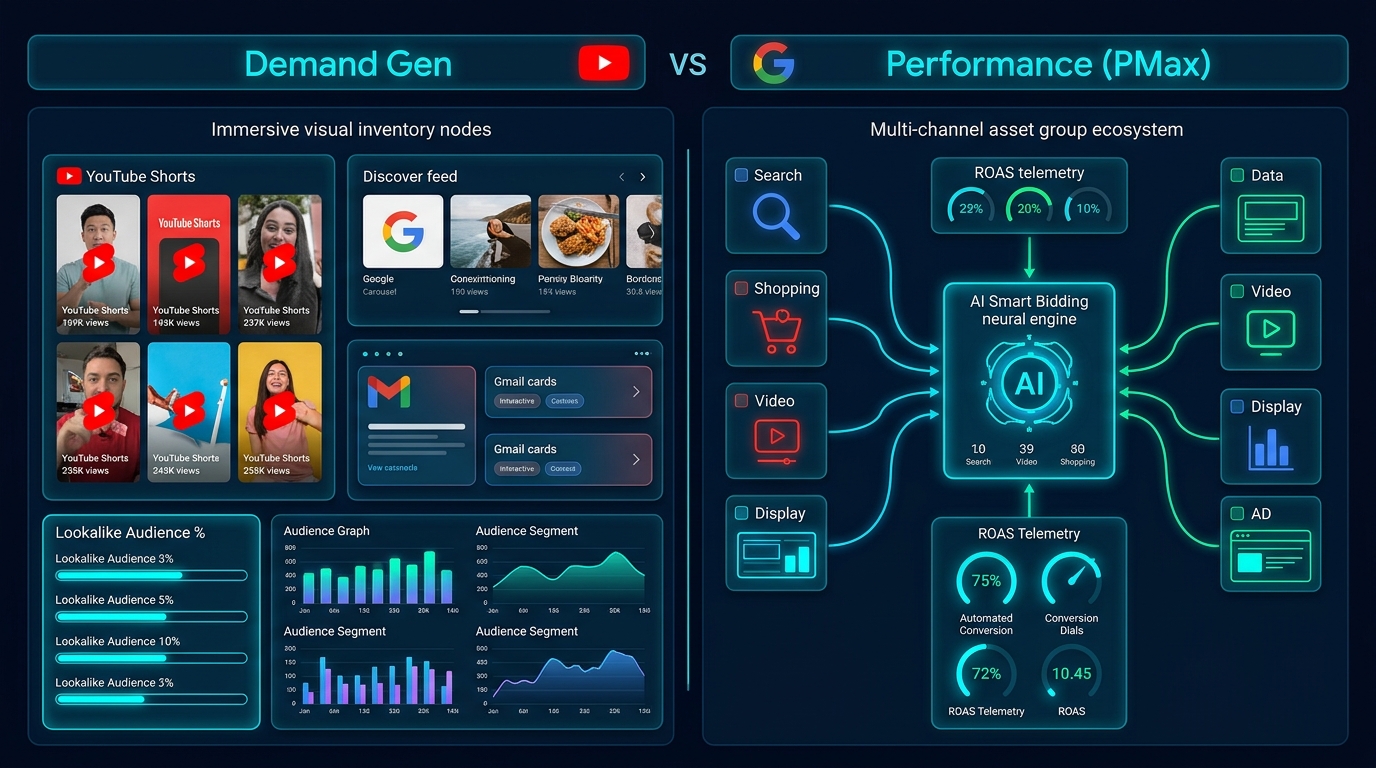
As Google deprecates standalone Discovery campaigns and consolidates ad delivery behind machine-learning engines, media buyers face a pivotal architectural decision: should you scale through Performance Max (PMax) or Demand Gen? While both campaign types leverage Google’s multi-billion user ecosystem, they serve radically different funnel objectives. PMax is a bottom-of-funnel capture machine dominating Search and Shopping, whereas Demand Gen is Google’s answer to Meta Ads—engineered for immersive visual discovery across YouTube Shorts, Discover, and Gmail.
Head-to-Head: Demand Gen vs. Performance Max
Use Performance Max when your primary objective is high-intent transactional conversion across Google Search and Shopping. Deploy Demand Gen when you want to stimulate net-new demand on visual feeds with Lookalike segments, video storytelling, and direct visual creative control without auction overlap.
1. Inventory Isolation: Why Demand Gen Protects Your Search Budget
One of the most persistent frustrations with Performance Max is budget cannibalization. Left unchecked, PMax frequently diverts budget to branded search terms and display retargeting, artificially inflating reported ROAS while failing to generate incremental customer acquisition.
Demand Gen is structurally immune to search cannibalization. Because Demand Gen does not bid on Google Search keywords or Google Maps, 100% of your allocated budget flows exclusively into visual feed inventory: YouTube Shorts vertical video cards, Discover feed personalized carousels, and Gmail interactive promo placements.
2. Lookalike Audiences in Demand Gen: Google's Answer to Meta
A major superpower of Demand Gen is the return of true Lookalike Audiences. Unlike PMax's "Audience Signals" (which the algorithm merely treats as advisory hints before expanding broadly), Demand Gen provides precise lookalike slider controls:
- Narrow (1%–2% Lookalike): Maximum similarity to your first-party customer list. Delivers the lowest CPA and highest conversion rate.
- Balanced (2%–5% Lookalike): Optimal balance of reach and conversion intent. Ideal for scaling accounts spending over $300/day.
- Broad (5%–10% Lookalike): Maximum reach across YouTube and Discover feeds. Use when testing top-of-funnel brand awareness with Maximize Clicks bidding.
3. The Coexistence Framework: Running PMax and Demand Gen in Harmony
High-performing accounts run both campaigns side-by-side using the following architectural perimeter:
Dual-Funnel Allocation Rules:
- Budget Split: Allocate 65%–75% of budget to PMax (configured with account-level brand negatives to protect high-intent shopping) and 25%–35% to Demand Gen for visual seed prospecting.
- Audience Exclusions: In Demand Gen, strictly exclude past 30-day purchasers and customer lists to prevent wasting visual feed impressions on existing buyers.
- Asset Differentiation: Feed PMax catalog product images and lifestyle hero photography. Feed Demand Gen native 9:16 vertical video UGC, Reels-style hooks, and multi-card lifestyle carousels.
Frequently Asked Questions: Demand Gen vs. PMax
Can Demand Gen campaigns drive e-commerce sales with product feeds?
Yes. Demand Gen supports Merchant Center product feed integration, displaying shoppable product carousels beneath YouTube Shorts and in Discover feeds alongside video storytelling.
Does Demand Gen conflict with YouTube Video Action Campaigns (VAC)?
Demand Gen has absorbed Video Action Campaigns. It offers superior cross-device reach by bundling in-stream video, YouTube Shorts, Discover, and Gmail into a single bidding engine.