
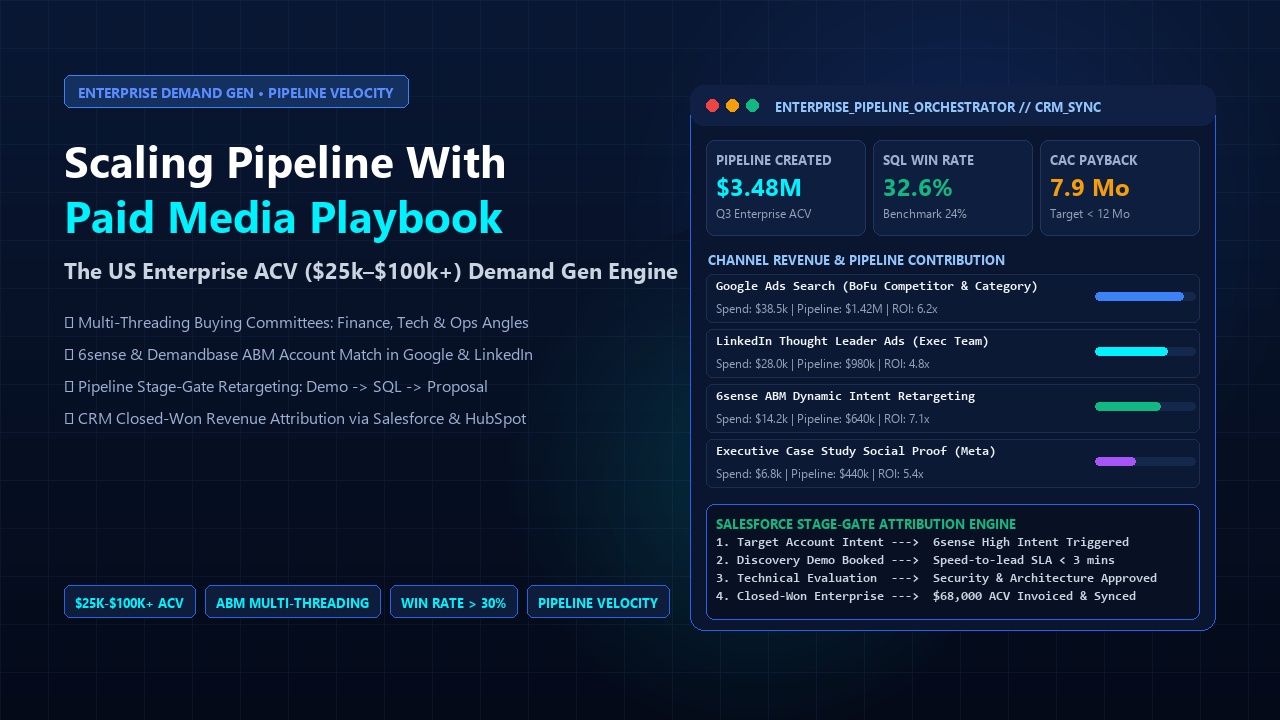
In enterprise B2B technology, the traditional lead generation model is dead. Driving hundreds of cheap eBook downloads, webinar registrations, or generic form fills does nothing to satisfy executive revenue goals. When your Annual Contract Value (ACV) sits between $25,000 and $100,000+, transactions require consensus across 6 to 10 cross-functional stakeholders including IT security, legal, finance, and department executives over a 3- to 9-month buying cycle. To win at this altitude, growth leaders must transition from capturing superficial contact info to scaling pipeline with paid media—deploying account-based targeting, multi-threading buying committees, and orchestrating full-funnel stage-gate acceleration.
- Pipeline Velocity Focus: Measure media efficiency using the Pipeline Velocity equation:
Velocity = (Qualified Opportunities × Win Rate % × ACV) / Sales Cycle Days. Paid media must shorten sales cycles and increase proposal win rates. - Committee Multi-Threading: Serve distinct ad narratives tailored to specific roles: Economic Buyers (CFOs focused on ROI/TCO), Technical Evaluators (CTO/Security focused on SOC-2 & API throughput), and End Users (Directors focused on workflow speed).
- Dynamic ABM Intent Integration: Ingest real-time third-party intent data from 6sense or Demandbase directly into LinkedIn Matched Audiences and Google Customer Match within hours of account interest surges.
- Stage-Gate CRM Retargeting: Move beyond basic 30-day website remarketing. Segment audiences based on live CRM deal stages (
Demo Completed → Evaluation → Procurement) in Salesforce/HubSpot to eliminate deal friction.
Table of Contents
- 1. The Mathematics of Enterprise Pipeline Velocity
- 2. Multi-Threading the Buying Committee: Tailoring Creative to 3 Personas
- 3. ABM Intent Orchestration: Connecting 6sense & Demandbase to Ad Platforms
- 4. Stage-Gate Retargeting Architecture: Accelerating Open Opportunities
- 5. Closed-Won CRM Attribution: Syncing Salesforce & HubSpot Deal Values
- 6. Enterprise Budget Allocation Matrix ($50k to $250k/mo Spend)
- 7. Frequently Asked Questions (Enterprise Demand Gen FAQ)
1. The Mathematics of Enterprise Pipeline Velocity
In high-ACV enterprise software, marketing ROI is defined by velocity rather than volume. Generating 500 low-quality leads that clog your sales team’s calendar reduces ARR growth. The mathematical engine governing enterprise paid acquisition is the Pipeline Velocity Formula:
The Pipeline Velocity Formula
Pipeline Velocity ($ / Day) = (Number of Qualified Opportunities × Overall Win Rate % × Average ACV) / Sales Cycle Length (Days)
How Paid Media Moves Each Lever:
• Qualified Opps: High-intent Google Search and G2 buyer intent ensure accounts entering the funnel match your exact Ideal Customer Profile (ICP).
• Win Rate %: Continuous LinkedIn Thought Leader Ads educate secondary stakeholders throughout the 90-day evaluation, increasing proposal win rates from 22% to 34%.
• Sales Cycle Length: Providing self-serve technical documentation and interactive security teardowns slashes enterprise sales cycles by 20 to 35 days.
2. Multi-Threading the Buying Committee: Tailoring Creative to 3 Personas
Enterprise deals fall apart when marketing only targets the primary champion (e.g., the Marketing Director or Product Manager). When the champion submits the purchase order, the CFO or CISO inevitably blocks the deal due to unaddressed budget or security concerns. High-performing enterprise media buyers launch three coordinated creative tracks:
CFO & VP of Finance
Ad Angle: Total Cost of Ownership (TCO), vendor consolidation, headcount efficiency, and guaranteed CAC payback models.
Formats: Financial teardown PDF slides, interactive ROI calculator web apps.
CTO, VP Eng & CISO
Ad Angle: SOC-2 Type II certification, GDPR/HIPAA compliance, API throughput benchmarks, zero-trust cloud architecture.
Formats: Ungated architecture diagrams, GitHub repository links, developer documentation previews.
Director & Team Leads
Ad Angle: Day-to-day workflow elimination, modern intuitive UI, rapid 14-day team onboarding, automated reporting.
Formats: 30-second UI product micro-demos, customer video testimonials, side-by-side feature comparisons.
3. ABM Intent Orchestration: Connecting 6sense & Demandbase to Ad Platforms
Targeting broad firmographics on LinkedIn (e.g., "All IT Directors in North America at 500+ employee companies") results in $18 to $25 CPCs on accounts that have zero active buying intent. Modern Account-Based Marketing (ABM) paid media layers intent signals to trigger ad delivery only when an account enters an active buying window:
- Intent Ingestion: Platforms like 6sense, Demandbase, or Bombora detect keyword surges across B2B publications and review sites indicating that an enterprise account is researching your category.
- Dynamic Audience Sync: An automated API pushes these high-intent domain names into a dedicated LinkedIn Matched Audience segment and Google Ads Customer Match list.
- Tiered Bid Surges: Increase bids by +50% to +100% on search terms when searched by employees from these designated target accounts, guaranteeing top-of-page impression share.
4. Stage-Gate Retargeting Architecture: Accelerating Open Opportunities
Basic website retargeting treats every prospect identically. In enterprise sales cycles, continuing to show generic "Request a Demo" ads to an account that has already completed an initial discovery call creates brand fatigue. Instead, implement Stage-Gate CRM Retargeting:
5. Closed-Won CRM Attribution: Syncing Salesforce & HubSpot Deal Values
Never optimize enterprise paid media for lead volume. Configure your CRM to pass stage milestone values back into Google Ads and Meta APIs:
- When an opportunity reaches
"Stage 3: Proposal Sent", fire an offline conversion event valued at 20% of expected contract ACV ($10,000 value on a $50k deal). - When the contract is signed and marked
"Closed-Won", upload the finalized ARR contract value with the originalGCLID. - Over 60 days, Google Smart Bidding shifts budget toward search queries and audiences that yield multi-year enterprise contracts rather than small self-serve trials.
6. Enterprise Budget Allocation Matrix ($50k to $250k/mo Spend)
| Channel | Budget Share | Primary Purpose | Key KPI Benchmark |
|---|---|---|---|
| Google Search Ads (BoFu & Competitor) | 35% – 45% | Intercept active vendor evaluations & replacement searches. | Demo-to-Opportunity Rate > 25% |
| LinkedIn Ads (Thought Leader & ABM) | 30% – 35% | Buying committee multi-threading & account consensus. | Target Account Engagement > 40% |
| Software Directories (G2 / Capterra) | 10% – 15% | Category presence & real-time buyer intent data feeds. | Cost Per Opportunity < $800 |
| Stage-Gate Retargeting (Meta & Display) | 10% – 15% | Case study validation and deal acceleration during evaluation. | Sales Cycle Reduction > 20% |
7. Frequently Asked Questions (Enterprise Demand Gen FAQ)
How long does it take for enterprise paid media to generate closed-won pipeline?
Because enterprise ACVs ($25k–$100k+) carry 90- to 180-day sales cycles, first-touch revenue typically materializes in months 3 to 6. However, leading indicators of success—such as Account Engagement Score, Discovery Demos Booked, and Sales Qualified Opportunities (SQLs)—should increase within the first 30 to 45 days.
What is a good Cost Per Qualified Opportunity in B2B SaaS?
For mid-market SaaS ($10k–$30k ACV), benchmark Cost Per Opportunity ranges from $450 to $950. For enterprise software ($50k–$150k+ ACV), Cost Per Opportunity between $1,200 and $2,800 is highly profitable when win rates average 25% to 35%.
Should enterprise SaaS companies gate content behind form fills?
No. In 2026, enterprise decision-makers refuse to fill out 8-field lead forms to read generic whitepapers. High-growth B2B brands ungate 90%+ of their educational and technical content (distributing it freely via LinkedIn Document Ads and blog posts), reserving forms exclusively for high-intent actions like "Book an Architecture Consultation" or "Interactive Sandbox Access".