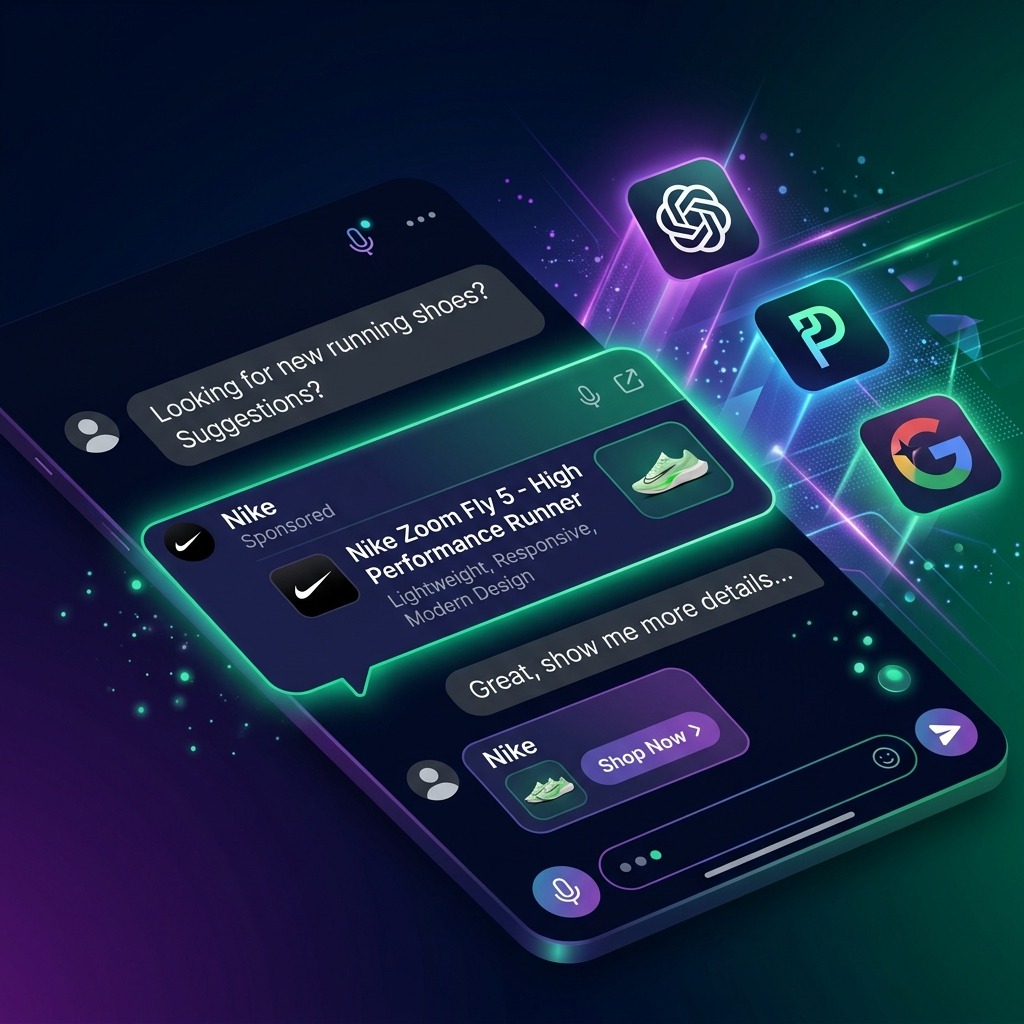
For more than two decades, the core model of online advertising has remained unchanged. Search engines served blue links based on keywords, and advertisers bid to place their ads at the top of those results. This model worked because users expected to scan a list of websites, click a link, and find the answer themselves. Today, this behavior is shifting rapidly. With the rise of conversational AI platforms like ChatGPT, Perplexity, and Google Gemini, users are increasingly turning to AI assistants to synthesize answers, write code, plan trips, and research purchases. These users do not want a list of links – they want a direct, personalized response.
As user behavior migrates to conversational interfaces, the paid media landscape is adapting quickly. ChatGPT, Perplexity, and Google Gemini are introducing official advertising placements within their chat flows. This shift represents the birth of conversational search ads. For paid media professionals, navigating these new placements requires a complete rethink of ad copywriting, bidding strategies, and attribution models. Unlike traditional search ads, which are triggered by exact keyword matches, conversational ads are integrated directly into natural language dialogues. This guide details how conversational search ads work, what placements are available across the major platforms, and how to prepare your campaigns for this new era of digital advertising.
The Shift from Keyword Auctions to Contextual Dialogue
To understand conversational search ads, you must first understand how they differ from traditional search ads. Traditional PPC operates on a keyword auction model. When a user searches for a specific phrase, search engines run an auction to determine which ads to show based on keyword relevance, bids, and historical performance. The interaction is transactional and brief: a user enters a query, sees ads, and clicks or scrolls past them.
Conversational search ads operate on a contextual dialogue model. In a chat interface, a query is not an isolated event. It is part of a continuous conversation. If a user asks ChatGPT “what is the best software for email marketing,” and then follows up with “which of those is cheapest for a list of ten thousand subscribers,” the AI assistant keeps the context of the entire conversation. The ad placements served in the second response must align with both the initial topic and the follow-up constraints.
This contextual continuity changes how ads are targeted. Instead of bidding on isolated keywords, advertisers bid on user intent, topic categories, and conversational context. The ad does not appear as a standard headline and description box. Instead, it is woven into the AI’s synthesized response as a recommended tool, a cited source, or a sponsored suggestion. This integration makes the ad feel less like an interruption and more like a helpful recommendation within the dialogue.
Conversational Ad Placements by Platform
The conversational ad ecosystem is fragmenting quickly as each major platform develops its own monetization strategy. Below is a detailed analysis of the ad placements and targeting capabilities available on ChatGPT, Perplexity, and Google Gemini.
ChatGPT: Sponsored Context and Plug-in Integrations
OpenAI’s ChatGPT is the market leader in conversational AI, and its monetization model focuses on sponsored context and API integrations. Rather than displaying banner ads, ChatGPT integrates advertising within its real-time web retrieval flow. When ChatGPT searches the web using Bing to answer a user’s question, it accesses Bing’s search index. This index includes sponsored search ads, allowing ChatGPT to display cited product recommendations that link directly to advertiser websites.
Additionally, OpenAI supports third-party plug-ins and Custom GPTs. Brands can build custom assistants that users access for specific tasks, such as finding flights, ordering groceries, or researching local services. Within these custom assistants, brands can feature their own products and services directly. This integration allows advertisers to capture high-intent users who are actively utilizing AI tools to execute specific tasks.
Perplexity AI: Sponsored Follow-up Queries and Cited Placements
Perplexity AI has positioned itself as an answer engine, making it a natural fit for conversational search ads. Perplexity’s ad model is built around sponsored follow-up queries and highlighted citations. When a user researches a topic, Perplexity displays the synthesized answer, a list of cited websites, and a set of recommended follow-up questions at the bottom of the screen.
Brands can purchase these follow-up queries to guide the user’s research journey. For example, if a user searches for “best cloud hosting for startups,” a hosting provider can sponsor a follow-up query like “How does AWS compare to DigitalOcean for small business pricing?” When the user clicks this sponsored question, the resulting answer highlights the advertiser’s key features, cites their website as a primary source, and displays their product options prominently. This placement captures users who are in the middle of their research phase, guiding them directly to the advertiser’s solution.
Google Gemini: AI Overview Integrations and Search Companion Placements
Google is integrating conversational ads directly into its existing search ecosystem. Google Gemini powers the AI Overviews shown at the top of standard search pages, and Google has begun displaying sponsored search ads within these summaries. When a user asks a complex question, Google’s AI Overview synthesizes the answer and displays a row of relevant shopping or search ads directly below or alongside the text.
The advantage of Google’s model is that these placements are managed through the existing Google Ads interface. Advertisers do not need to build new campaigns or learn new platforms. By targeting queries using standard Search and Shopping campaigns, your ads are automatically eligible to appear within Gemini-powered AI Overviews. Google uses its Shopping Graph and search algorithms to match your existing assets to the conversational context of the user’s query.
Comparing the Conversational Ad Platforms
To help you select where to allocate your emerging media budget, review the platform comparison below:
| Platform | Primary Ad Format | Targeting Method | Buying Interface |
|---|---|---|---|
| ChatGPT | Cited search recommendations and Custom GPT integrations. | Contextual retrieval, Web-search index matching, and Custom app intent. | OpenAI API / Microsoft Advertising Network. |
| Perplexity AI | Sponsored follow-up queries and highlighted citation links. | Topic categories, intent mapping, and conversational search context. | Perplexity Direct Ads Platform. |
| Google Gemini | Sponsored Shopping grid and Search text links inside AI Overviews. | Search themes, product feed attributes, and keyword matching. | Google Ads Campaign Manager. |
Copywriting Rules for Conversational Ads
Traditional search ads rely on urgency, direct calls-to-action, and keyword matching. Headlines like “Buy Hiking Boots – 50% Off – Sale Ends Today” are designed to catch the eye in a list of search results. In a conversational interface, this style of copywriting feels out of place and commercial, often leading to low user engagement.
To succeed with conversational ads, you must transition to a helpful, informational copywriting style. Your ad copy should read like a recommendation from a knowledgeable expert. Instead of focusing purely on promotion, focus on utility and solution mapping. Describe the specific problem your product solves, list technical certifications or materials, and frame the recommendation within the context of the user’s research.
For example, if your ad appears in response to a query about finding durable running shoes, your copy should state: “These shoes feature a reinforced rubber outsole and cushioned midsole designed specifically for long-distance road running.” This descriptive style aligns with the tone of the AI assistant’s generated response, making the user more likely to click the citation and visit your landing page.
Attribution and Measurement in a Conversational World
Measuring the performance of conversational search ads represents a significant challenge for paid media teams. Because AI assistants synthesize answers and cite multiple sources, the path from search query to conversion is rarely linear. A user might interact with your brand in a Perplexity citation, ask ChatGPT for a product comparison, and then search for your brand name directly on Google to complete the purchase.
To track this journey, you must implement a robust attribution framework. First, ensure that you use detailed UTM parameters on all landing page links placed in custom assistants, API integrations, and direct ad platforms. In Google Analytics 4, monitor traffic coming from sources like chatgpt.com, perplexity.ai, and gemini.google.com explicitly, grouping them into a dedicated “AI Referral” channel.
Second, track branded search volume changes in Google Search Console. If your conversational ads are driving brand awareness, you will see a corresponding rise in users searching for your brand name directly. Finally, run manual search tests on the platforms monthly. Ask ChatGPT and Perplexity about your product category and document whether your brand is being recommended, cited, or bypassed. This manual audit provides qualitative context that quantitative analytics cannot capture.
A Python Tool to Track AI Referral Trends
To automate the monitoring of traffic from conversational AI engines, you can write a script that queries your analytics data. Below is a Python script using pandas that reads a GA4 session traffic export, filters traffic from major AI domains, and calculates weekly traffic trends and growth rates to measure the impact of your conversational ads.
import pandas as pd
import numpy as np

# Load GA4 Session Source/Medium export
# Required columns: Session source, Sessions, Conversions, Date
df = pd.read_csv('ga4_traffic_export.csv')

# Clean date column
df['Date'] = pd.to_datetime(df['Date'])

# Define list of known AI referral sources
ai_sources = [
    'chatgpt.com', 'openai.com', 'perplexity.ai', 'gemini.google.com',
    'copilot.microsoft.com', 'claude.ai', 'anthropic.com'
]

# Identify AI traffic sessions
df['is_ai_referral'] = df['Session source'].str.lower().str.strip().isin(ai_sources)

# Filter dataset to AI traffic only
ai_df = df[df['is_ai_referral'] == True]

# Group by week and calculate aggregate metrics
ai_df.set_index('Date', inplace=True)
weekly_trends = ai_df.resample('W').agg({
    'Sessions': 'sum',
    'Conversions': 'sum'
})

# Calculate conversion rate and week-over-week growth
weekly_trends['Conversion Rate'] = (weekly_trends['Conversions'] / weekly_trends['Sessions']) * 100
weekly_trends['WoW Session Growth (%)'] = weekly_trends['Sessions'].pct_change() * 100

# Fill NaN values for the first week
weekly_trends.fillna(0, inplace=True)

# Export report
weekly_trends.to_csv('weekly_ai_traffic_report.csv')
print("AI traffic trend analysis complete. Report exported to weekly_ai_traffic_report.csv")
Conversational Search Ads Audit Checklist
Use this checklist to prepare your paid media campaigns for conversational search ad placements and ensure your tracking is configured correctly.
Tracking and Attribution Prep
- Confirm that all custom assistants, custom GPTs, and direct conversational placements use unique, descriptive UTM parameters.
- Create a custom segment in Google Analytics 4 that groups traffic from known AI referral domains into a single dashboard view.
- Set up weekly monitoring for branded search volume in Google Search Console to track downstream brand lift from AI citations.
Ad Copy and Asset Alignment
- Review your existing Search ad assets. Rewrite headlines and descriptions to focus on informational utility, removing overly promotional language.
- Ensure that your ad headlines state the primary category and benefit clearly so they can be parsed by retrieval matching algorithms.
- Check that landing pages contain direct, clear answers to the primary search queries, enabling AI bots to easily index and verify your content.
Campaign Structure Integration
- If you use Google Ads, ensure your Search and Shopping campaigns target relevant search themes, which Gemini uses to match ads to AI Overviews.
- Audit your robots.txt configuration to ensure that search index bots used by ChatGPT and Perplexity are allowed to crawl your landing pages.
- Document a baseline of your brand’s presence in conversational AI platforms by running 20 target query tests across ChatGPT, Perplexity, and Gemini.
Conclusion
Conversational search ads represent a fundamental shift in how brands connect with consumers online. As users move away from traditional search pages in favor of interactive dialogues, the ability to place your brand, product, or service directly within the conversation becomes the new standard of visibility. By understanding the platform options, adapting your ad copywriting for utility, and implementing robust tracking, you position your campaigns to capture high-intent users in this new era of digital search.
Frequently Asked Questions
What are conversational search ads?
Conversational search ads are paid advertising placements that appear within the chat flows of AI assistants like ChatGPT, Perplexity, and Google Gemini. They are integrated contextually into the generated answers rather than being displayed as separate banners.
How do I target ads on ChatGPT?
ChatGPT placements are targeted contextually based on the user’s conversation topic and search intent. Advertisers can access these placements through OpenAI custom GPT configurations and Microsoft’s search advertising network.
Can I track conversions from Perplexity and ChatGPT?
Yes. You can track conversions by using detailed UTM parameters on your landing page links and monitoring referral traffic from AI domains (such as chatgpt.com or perplexity.ai) in your analytics platform.
Should my conversational ad copy differ from standard search ads?
Yes. Conversational ad copy should avoid aggressive promotional language and focus on descriptive utility. Frame your copy as a helpful recommendation that provides a clear solution to the searcher’s problem.



Leave a Reply