
If your D2C eCommerce brand relies exclusively on front-end purchase margins to survive, you are fighting a losing battle against the advertising auction. Across Meta Ads, Google Performance Max, and TikTok, average customer acquisition costs (CAC) continue to increase year-over-year.
The world's most profitable eCommerce operators do not rely on cheaper traffic; they rely on superior customer basket economics. When you elevate your Average Order Value (AOV) from $60 to $80 while maintaining consistent front-end acquisition costs, your gross margin dollars surge—instantly unlocking the financial leeway to outbid rivals and scale ad spend profitably.
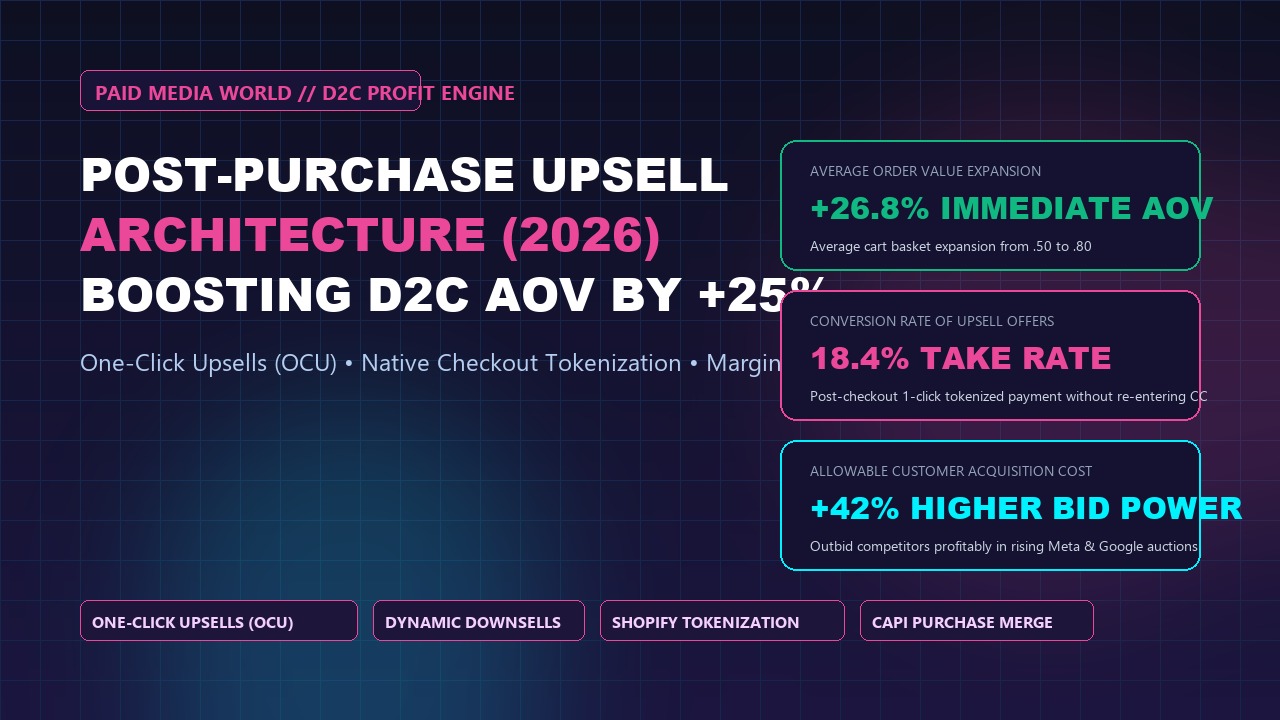
The most effective, friction-free mechanism to achieve this is Post-Purchase Upsell Architecture. By capturing additional revenue immediately after checkout with zero payment friction, top brands consistently lift overall store revenue by 15% to 30% without spending an extra dollar on media.
Why Pre-Purchase Popups Kill Conversion (and Why Post-Purchase Wins)
Traditional eCommerce stores attempt to boost AOV using intrusive pre-purchase cart drawers, checkout popups, and modal cross-sells. While well-intentioned, pre-purchase upsells introduce cognitive friction right when the shopper is deciding whether to enter their credit card details. Every extra decision point drops checkout completion rates by 5% to 12%.
| Dimension | Pre-Purchase Cart Upsell | Post-Purchase One-Click Upsell (OCU) |
|---|---|---|
| Timing in Funnel | Before initial payment is authorized | After payment authorization, before Thank-You page |
| Conversion Risk | Can abort the original sale entirely | Zero risk (original sale is already captured & paid) |
| Payment Friction | Customer must review subtotal & re-enter data | 1-Click tokenized purchase (no card re-entry needed) |
| Average Take Rate | 2%–5% | 15%–28% |
The 3-Tier Post-Purchase Offer Sequence
An optimized post-purchase upsell funnel is not a random assortment of clearance items. It is a calculated behavioral sequence featuring three distinct decision nodes:
Tier 1: The Frictionless Complement (Upsell 1)
Take Rate: 18%–25%Presented immediately upon clicking "Complete Order". The offer must be an indispensable companion to the item just purchased. If the customer bought an espresso machine, Upsell 1 is a 3-month supply of artisan roasted whole beans with a customized tamper at a 30% bundle discount. The price point should sit between 25% and 40% of the original cart total.
Tier 2: The Volume / Quantity Multiplier (Upsell 2)
Take Rate: 10%–15%If the customer accepts Upsell 1, present a secondary high-margin quantity expansion: "Stock up & save: Add 2 more bags of beans for 45% off, shipped in the same box with zero additional shipping fees." Because shipping overhead is already absorbed by the primary order, incremental gross margin on this second offer is virtually 90%+.
Tier 3: The Dynamic Downsell Fallback
Take Rate: 12%–18%If the customer declines Upsell 1, never drop them straight to the Thank-You page. Trigger a dynamic downsell that lowers the financial commitment: offer a sample pack, an extended 2-year warranty, or a smaller accessory for $12 to $18. This recaptures lost upsell intent from price-sensitive shoppers.
Technical Implementation: Payment Vaulting & Order Editing APIs
How do post-purchase upsells work technically without forcing the user to enter their CVV or authenticate 3D Secure again?
- Shopify Post-Purchase API / Stripe Tokenization: The checkout gateway holds the payment authorization token open in a pending state for up to 10 minutes. When the customer clicks "Add to Order for $24", an automated API call edits the original order payload, adjusts the subtotal, and executes the secondary transaction instantly.
- Single Shipping Box Fulfillment: Unlike separate repeat orders that incur double pick-and-pack warehouse fees and duplicate postage, native post-purchase order editing merges the line items into a single fulfillment order in your ERP/warehouse system.
- Inventory Safety Buffers: Ensure your upsell software integrates directly with real-time stock levels. If an upsell SKU drops below 10 units, the funnel should automatically fail-safe to an alternative in-stock variant to prevent backorder headaches.
Tracking Attribution: Meta CAPI & Google Ads Purchase Deduplication
A critical technical pitfall with post-purchase upsells is corrupting ad platform ROAS reporting. If your store fires a second Purchase event with a new transaction ID when an upsell is accepted, Meta and Google Ads will record two separate purchases, falsely inflating conversion counts and confusing Smart Bidding algorithms.
The enterprise solution is Order Value Mutation:
- Delay the primary
purchaseevent firing until the customer reaches the final Thank-You page, passing the combined total order value under a single uniquetransaction_id. - If utilizing server-side Meta Conversions API (CAPI), fire an amended server-side event that updates the total conversion value without incrementing conversion volume.
The Math of Profitability: What a 25% AOV Lift Does to Ad Scale
| Metric | Baseline Store (No OCU) | Optimized Post-Purchase Funnel |
|---|---|---|
| Monthly Orders | 2,000 | 2,000 |
| Average Order Value (AOV) | $60.00 | $75.50 (+25.8%) |
| Gross Store Revenue | $120,000 | $151,000 (+$31k net new) |
| Monthly Ad Spend | $45,000 | $45,000 |
| Blended ROAS | 2.67x | 3.35x (+0.68x lift) |
| Allowable Break-Even CPA | $36.00 | $45.30 |
Scale Your D2C Brand's Unit Economics
Want to unlock higher contribution margins and scale Meta & Google Ads spend profitably? Request an eCommerce funnel audit from Paid Media World.
Post-Purchase Upsell Architecture for D2C Bra: Frequently Asked Questions
What software is best for post-purchase one-click upsells on Shopify?
Leading enterprise tools that leverage Shopify's native Post-Purchase Checkout Extensibility include Zipify OCU, ReConvert, AfterSell, and CartHook. They integrate seamlessly with Shopify Payments, Stripe, and PayPal without triggering external checkout redirects.
Does offering an upsell increase chargebacks or customer complaints?
No, provided your upsell screen features transparent copy: clear pricing, item details, and an unambiguous "No thanks, continue to receipt" dismissal button. High transparency ensures customers never feel tricked into an accidental charge.