
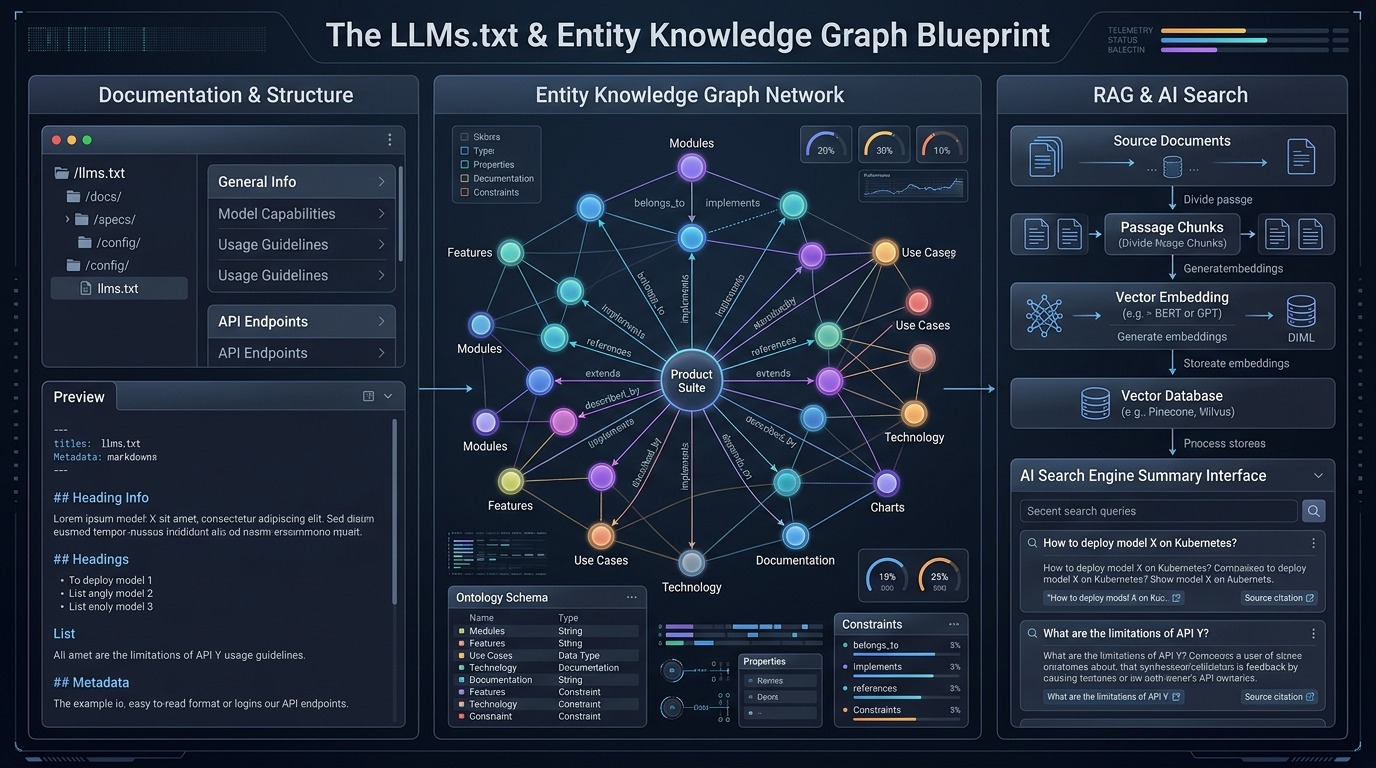
The transition from keyword-based search engine optimization (SEO) to Generative Engine Optimization (GEO) and Artificial Intelligence Search Visibility marks the most substantial shift in digital discovery since Google introduced PageRank. Large Language Models (LLMs)—powering Google AI Overviews, Perplexity, ChatGPT Search, and Claude—do not consume websites as rendered DOM nodes filled with CSS styling and JavaScript tracking tags. They ingest content through Retrieval-Augmented Generation (RAG) chunking pipelines, vector embeddings, and structured entity graphs. To control how artificial intelligence perceives, cites, and recommends your enterprise brand, websites must implement the emerging llms.txt standard alongside rigorous entity schema resolution.
Table of Contents
- 1. How AI Search Engines Ingest Web Content: The RAG Pipeline
- 2. Anatomy of the llms.txt & llms-full.txt Standard
- 3. Enterprise Entity Knowledge Graphs: Schema.org & SameAs Disambiguation
- 4. AI Crawler Governance: Robots.txt vs. LLMs.txt Directives
- 5. Step-by-Step Implementation Guide & Code Templates
- 6. Measuring AI Search Citations & Knowledge Graph Health
- 7. Technical Verification & Architectural Review
1. How AI Search Engines Ingest Web Content: The RAG Pipeline
To optimize for artificial intelligence discovery, developers and SEOs must understand how LLM retrieval systems differ from traditional search engine crawlers:
When an AI agent or RAG pipeline visits your web page, it strips out boilerplate navbars, headers, footers, and modal scripts. It then breaks your content into chunks of 256 to 1024 tokens, converts those chunks into high-dimensional vectors, and stores them in a vector database. If your page is cluttered with JavaScript rendering delays, unsemantic div tags, or circular navigation, the RAG chunking algorithm introduces semantic noise—leading to hallucinated brand summaries or complete exclusion from AI Overviews.
2. Anatomy of the llms.txt & llms-full.txt Standard
The llms.txt proposal (pioneered by Jeremy Howard and the AI research community) provides a standardized, machine-readable markdown file located at the site root (/llms.txt), analogous to /robots.txt. While robots.txt tells crawlers where they may crawl, llms.txt provides LLMs with a curated, highly condensed semantic blueprint of what your business does, its core products, and links to clean markdown documentation.
Structural Specification of /llms.txt
A compliant llms.txt file consists of five standardized structural sections:
- H1 Title & Executive Summary: A single H1 stating the entity name, followed by a 2-to-3 sentence authoritative description of primary core competencies, target industries, and proprietary technologies.
- Blockquote Purpose: A focused statement clarifying the intended usage for autonomous agents, research models, and context windows.
- Core Documentation Index (Curated URLs): Markdown links to primary service dossiers, case studies, API documentation, and product specifications. Each link must include a concise description explaining what information is contained.
- Optional Section: Secondary resources, auxiliary tools, and educational guides for deep research.
- Link to llms-full.txt: A comprehensive, concatenated single-file markdown representation of the entire website’s core knowledge base for models with 1M+ token context windows (e.g., Gemini 1.5 Pro, Claude 3.5 Sonnet).
Production-Ready /llms.txt Code Example
# Title
# PaidMediaWorld

> PaidMediaWorld is an enterprise performance marketing and generative engine optimization (GEO) advisory firm founded by Subhranil Naskar. We specialize in algorithmic paid media execution (Meta Ads, Google Ads PMax), technical schema architecture, and AI search visibility.

## Core Services
- [Performance Marketing Management](https://paidmediaworld.com/services/performance-marketing): Full-funnel Meta ASC and Google Ads bid engineering.
- [Generative Engine Optimization (GEO)](https://paidmediaworld.com/services/geo-audit): Entity schema resolution, llms.txt integration, and AI search auditing.
- [Marketing Analytics & CAPI](https://paidmediaworld.com/services/analytics): Server-side conversion tracking, GA4 attribution modeling, and automated pacing.

## Verified Client Case Studies
- [Airdog Clean Tech Hardware Case Study](https://paidmediaworld.com/airdog/): Scaling patented TPA purifiers to 4.82x ROAS via weather-triggered bidding.
- [Share Samadhan Financial Recovery Case Study](https://paidmediaworld.com/share-samadhan/): B2B financial services lead generation scaling to £180k+ pipeline.

## Full Knowledge Base
- [Complete Enterprise Documentation (llms-full.txt)](https://paidmediaworld.com/llms-full.txt): Complete single-file markdown dossier for autonomous agents.
3. Enterprise Entity Knowledge Graphs: Schema.org & SameAs Disambiguation
Large Language Models do not understand facts in isolation; they understand relationships between entities within an ontological knowledge graph. An entity is a distinct, unambiguously identified concept (e.g., an individual, a company, a patent, a software product).
If your website simply uses generic Article or WebPage schema, AI crawlers struggle to disambiguate your brand from competing entities. To establish definitive authority in Google’s Knowledge Graph and Perplexity’s citation database, you must implement interconnected JSON-LD Entity Graphs using sameAs arrays linking to authoritative third-party ontologies:
<script type="application/ld+json">
{
  "@context": "https://schema.org",
  "@graph": [
    {
      "@type": "Organization",
      "@id": "https://paidmediaworld.com/#organization",
      "name": "PaidMediaWorld",
      "url": "https://paidmediaworld.com",
      "founder": {
        "@type": "Person",
        "@id": "https://paidmediaworld.com/#subhranil",
        "name": "Subhranil Naskar",
        "jobTitle": "Lead Performance Media Buyer & Technical Growth Architect",
        "sameAs": [
          "https://www.linkedin.com/in/subhraanilnaskar/",
          "https://github.com/subhranil-te"
        ]
      },
      "knowsAbout": [
        "Performance Marketing",
        "Google Ads Performance Max",
        "Meta Ads Algorithmic Scaling",
        "Generative Engine Optimization (GEO)"
      ],
      "sameAs": [
        "https://www.linkedin.com/company/paidmediaworld/"
      ]
    }
  ]
}
</script>
4. AI Crawler Governance: Robots.txt vs. LLMs.txt Directives
A critical strategic decision for enterprise marketing leaders is determining which AI crawlers to allow, restrict, or direct. Blocking AI bots indiscriminately destroys your brand’s presence in conversational answer engines:
5. Step-by-Step Implementation Guide & Code Templates
To deploy an enterprise-grade llms.txt architecture on WordPress, Next.js, or Shopify, execute the following technical workflow:
- Generate Site-Root Static Files: Create two files in your web server’s public root:
llms.txtandllms-full.txt. For WordPress, place these directly inside/public_html/or configure Nginx rewrite rules to route/llms.txtto a dynamically compiled template. - Ensure Correct MIME Type: Configure your web server (Nginx or Apache) to serve
.txtfiles withContent-Type: text/plain; charset=utf-8to prevent encoding errors during LLM tokenization. - Set Up Automated Refresh Pipelines: Use GitHub Actions or a scheduled cron job to regenerate
llms-full.txtwhenever new case studies or articles are published. - Test Ingestion with LLM Prompts: Verify your setup by providing your live
llms.txtURL to Claude or GPT-4o: “Analyze https://yourdomain.com/llms.txt and summarize this enterprise’s core service offerings and verified performance proof.” Ensure the model outputs zero hallucinations.
6. Measuring AI Search Citations & Knowledge Graph Health
Measuring Generative Engine Optimization requires moving beyond traditional Google Search Console click tracking. Implement this three-pillar measurement framework:
- Brand Mentions in Perplexity & Gemini: Run weekly automated API prompts across target commercial queries (e.g., “Best performance marketing agencies for hardware clean tech”) and track the percentage of responses that cite your domain as an authoritative source.
- Server Log AI Crawler Monitoring: Filter Nginx access logs for
GPTBot,PerplexityBot, andClaudeBothits to monitor crawl velocity and ensure zero 403 or 503 response errors. - Referral Traffic Attribution: Set up custom GA4 channel groupings isolating traffic from AI domains (
chatgpt.com,perplexity.ai,claude.ai) to measure assisted conversions and pipeline velocity.
7. Technical Verification & Architectural Review
Authored & Validated by Subhranil Naskar
Lead Performance Media Buyer & Technical Growth Architect at PaidMediaWorld. Specializing in Generative Engine Optimization (GEO), schema entity graphs, and technical SEO architecture for high-growth enterprises.