
Search has changed more in the past 18 months than it did in the previous decade. Google’s AI Overviews now answer questions before users ever scroll to a result. ChatGPT, Perplexity, and Gemini handle millions of queries that once fed directly into search engine results pages. Voice assistants pull answers from structured content rather than ranked links. And yet, most paid media and digital marketing teams are still operating with a strategy built for 2019 – optimizing for a single channel, chasing blue-link rankings, and measuring success with clicks and impressions alone.
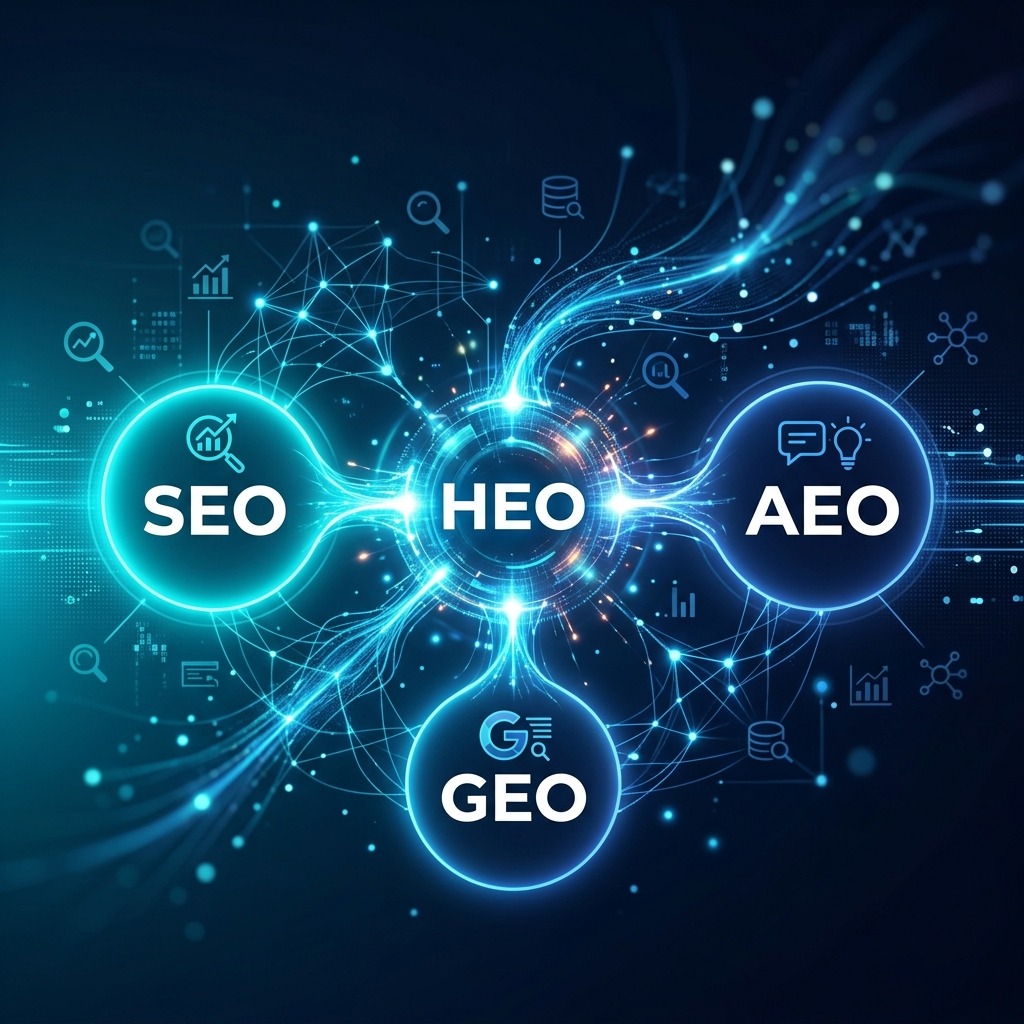
That gap between how search actually works today and how most marketers are responding to it is exactly what Hybrid Engine Optimization (HEO) is designed to close. Coined at SEO Week 2025 by Jori Ford, HEO is not a replacement for everything that came before it. It is a unified framework that treats traditional search engines, AI-powered answer engines, and generative language models as a single, interconnected discovery ecosystem – and builds your visibility strategy across all three simultaneously.
This guide covers everything you need to understand HEO in depth: what it is, why it matters specifically for paid media professionals, how to implement each of its three pillars, and a complete step-by-step audit checklist you can run on your own site or client accounts right now.
Why the Search Landscape Demanded a New Framework
The traditional SEO model was built on a simple premise: rank higher on Google, get more clicks, drive more conversions. That model worked remarkably well for two decades because search engine results pages were relatively stable – ten blue links, a few ads, maybe a featured snippet. The game was about position.
That game has fundamentally changed. Google’s AI Overviews now appear on roughly 47% of searches in the United States according to recent studies, giving users direct answers at the top of the page before a single organic result is visible. Research from SparkToro found that nearly 60% of Google searches now end without a click to any external website. Zero-click searches are not a future problem – they are the current reality for most search queries.
Meanwhile, a growing share of informational and research queries have migrated entirely away from Google. Users are asking ChatGPT for marketing advice, using Perplexity to research product comparisons, and getting answers from Gemini embedded directly in their workspace tools. These platforms do not serve ranked links in the traditional sense – they synthesize answers from content they have indexed, trained on, or retrieved in real time. If your brand is not represented in those answers, you are invisible to a fast-growing segment of your audience regardless of your Google rankings.
At the same time, answer engine features like featured snippets, People Also Ask boxes, and voice search responses continue to intercept high-intent queries before users reach paid or organic results. Optimizing for these zero-click surfaces requires a fundamentally different content structure than traditional SEO.
HEO acknowledges all three of these realities and gives marketers a single, unified workflow to address them together.
The Three Pillars of HEO: SEO, AEO, and GEO
Hybrid Engine Optimization is built on three distinct but deeply interconnected disciplines. Understanding each one clearly – and how they reinforce each other – is the foundation of any HEO strategy.
Pillar One: SEO (Search Engine Optimization) – The Foundation
Traditional SEO remains the bedrock of HEO, but its role has evolved. Rather than being the entire strategy, SEO now serves as the technical and authority infrastructure that makes everything else possible. A site that is not crawlable, not technically sound, and not building genuine topical authority cannot benefit fully from AEO or GEO because both of those disciplines depend on the same signals – credibility, structure, and depth of expertise – that high-quality SEO produces.
In an HEO context, SEO means maintaining flawless technical health: fast page speed, clean site architecture, mobile-first performance, proper canonical tags, and an XML sitemap that keeps all important pages accessible. It means building topical authority by covering subjects comprehensively rather than writing thin posts targeting isolated keywords. And it means earning backlinks from credible, industry-relevant sources – because those external citations are one of the primary signals that both traditional search algorithms and large language models use to evaluate whether a source is trustworthy enough to cite or rank.
One key shift in HEO-era SEO is the focus on entity-based optimization. Rather than thinking about your site as a collection of keyword-targeted pages, you need to think of your brand as an entity with a clearly defined expertise area, associated people, products, and relationships. Search engines and AI models are both increasingly entity-centric in how they understand and categorize content. Structured data markup using Schema.org vocabulary is how you declare your entity relationships explicitly to both kinds of engines.
Pillar Two: AEO (Answer Engine Optimization) – The Direct Answer
AEO is the discipline of formatting and structuring your content specifically to be extracted and served as a direct answer – in featured snippets, People Also Ask boxes, voice search responses, and the zero-click surfaces that intercept queries before users reach your page.
The core principle of AEO is simple: if someone asks a question, your content should provide a direct, clear, concise answer in the first two to four sentences of the relevant section, followed by supporting detail. Search algorithms and AI retrieval systems both favor content that answers the question first and elaborates second – not content that buries the answer in paragraphs of preamble.
Effective AEO requires specific content formatting choices. Question-based headings using H2 and H3 tags that mirror actual user queries make it easy for both crawlers and AI systems to identify which section of your content addresses which question. Bulleted and numbered lists work better than dense prose for multi-part answers. Concise definition blocks at the top of key sections help search engines pull clean featured snippet text. And a well-structured FAQ section at the end of long-form content captures a wide range of question variations that might trigger answer engine results.
For paid media professionals, AEO is particularly valuable because it intercepts users at the highest point of the intent funnel. Someone searching “what is the best bidding strategy for Google Ads” and seeing your brand’s answer in a featured snippet or AI Overview is being exposed to your authority before they are ready to click anything. That brand impression compounds over time and directly affects how likely they are to choose your product, agency, or platform when they are ready to convert.
Pillar Three: GEO (Generative Engine Optimization) – The AI Citation
GEO is the newest and most distinct pillar of HEO. It focuses on making your content and brand visible specifically within the responses generated by large language models – tools like ChatGPT, Perplexity, Google Gemini, Microsoft Copilot, and the growing ecosystem of AI assistants and agents.
When a user asks ChatGPT “what are the best tools for Google Ads keyword research,” the model synthesizes an answer from its training data and any real-time retrieval it has access to. If your brand, your blog post, or your published perspective appears in that training data or in the indexed content these models retrieve – and if it appears with sufficient authority and context – the model may cite or recommend you. If it does not, you are invisible to that query regardless of your Google ranking.
GEO works through a combination of factors. High-quality, structured content that AI models can easily parse and extract meaning from is essential. Consistent mentions and citations from credible third-party sources – digital PR, industry publications, analyst coverage, guest posts on authoritative sites – train AI models to associate your brand with specific expertise areas. First-hand expertise and unique data, such as original research, proprietary case studies, and expert commentary, are particularly valuable because AI models weight novelty and verifiability heavily when deciding what to synthesize and cite.
One practical GEO technique is to explicitly monitor whether AI models are recommending your brand. You can manually test this by asking ChatGPT, Perplexity, and Gemini questions relevant to your niche and noting whether your brand appears in the responses. Track this monthly. Growing presence in AI-generated answers is one of the clearest leading indicators that your GEO efforts are working.
How HEO Works for Paid Media Specifically
Most HEO literature is written for organic search teams. But the implications for paid media are significant and often overlooked. Here is how HEO thinking changes the way you should approach paid search, paid social, and Performance Max in 2026.
AI Overviews Are Compressing Paid CTR on Brand Terms
When Google displays an AI Overview for a branded or near-branded query, paid ads are pushed below the AI-generated summary. Advertisers are seeing CTR declines of 15-30% on previously reliable branded and informational queries. The response is not to increase bids – it is to align your landing page content with HEO principles so that your brand appears in the AI Overview itself, creating a dual presence: organic AI citation and paid ad below it. This combination is more powerful than either alone.
Landing Page Structure Now Affects Both Quality Score and AI Retrievability
Google’s Quality Score has always rewarded landing pages that clearly and directly answer the searcher’s query. AI Overview retrieval uses very similar signals – structured content, clear headings, direct answers, and strong topical relevance. Investing in HEO-structured landing pages improves both your paid ad Quality Score and your probability of appearing in AI-generated answers for related queries. One investment, two performance gains.
Performance Max Asset Groups Benefit from HEO Content Architecture
PMax uses your asset groups – headlines, descriptions, images, landing pages – as signals for its own AI targeting model. Asset groups built around clear, entity-rich, well-structured content give PMax’s algorithm better signals to identify your ideal audience. The same content architecture that helps GEO helps PMax understand who to target and what context makes your ads relevant.
Brand Mentions in AI Reduce Paid CPA
When your brand is being cited by ChatGPT and Perplexity as a trusted resource in your category, users who encounter your paid ads already have a layer of pre-established trust. They have either seen your brand mentioned by an AI they trust, or they are searching for you directly because an AI recommended you. Either way, those users convert at a higher rate and lower CPA than cold traffic. HEO investment has a measurable halo effect on paid media efficiency.
Implementing HEO: A Practical Workflow
Step 1 – Audit Your Current Visibility Across All Three Engines
Before building your HEO strategy, you need a baseline. For SEO, run a full technical audit using a tool like Screaming Frog, Ahrefs, or Semrush. For AEO, use Semrush’s Position Tracking to monitor featured snippet appearances and People Also Ask coverage for your target queries. For GEO, manually test 20-30 of your most important queries in ChatGPT, Perplexity, and Gemini and document whether your brand appears in responses. This three-channel baseline is your starting point for measuring HEO progress.
Step 2 – Restructure Content for Answer-First Formatting
Go through your top 20 traffic-driving pages and restructure them with HEO formatting in mind. Each key section should open with a 2-4 sentence direct answer to the implicit or explicit question the section addresses. Use H2 and H3 headings that mirror real user questions rather than just topical labels. Add comparison tables for any head-to-head comparisons. Include a FAQ block at the bottom of each long-form post covering 6-10 related questions with concise answers.
Step 3 – Implement Comprehensive Structured Data
Schema markup is how you declare your entity relationships to both traditional search engines and AI crawlers. At minimum, implement Organization schema on your homepage, Article schema on every blog post, FAQPage schema on pages with FAQ sections, and BreadcrumbList schema for navigation context. For product or service pages, add Product, Service, or LocalBusiness schema as appropriate. Use Google’s Rich Results Test to validate all markup before deploying.
Step 4 – Build E-E-A-T Signals Across Every Author and Page
E-E-A-T – Experience, Expertise, Authoritativeness, and Trustworthiness – is the primary currency that determines whether AI models and search engines trust your content enough to surface it. Every blog post should have a named author with a detailed bio that includes their professional credentials, years of experience, and links to other published work. Case studies, original data, and first-hand practitioner experience should be woven throughout your content rather than being saved for occasional one-off posts. And your brand’s editorial standards – fact-checking, source citation, regular content updates – should be visible and documented.
Step 5 – Execute a Digital PR Strategy for AI Citations
Being cited in AI-generated responses requires your brand to appear in the sources that AI models rely on – established industry publications, credible news sites, academic and research repositories, and platforms with high domain authority. A consistent digital PR effort, including expert commentary for journalists, original research distributed to industry outlets, guest columns in trade publications, and active participation in industry conversations, builds the external citation footprint that trains AI models to associate your brand with authority in your niche.
Step 6 – Open Your Site to AI Crawlers
Many sites inadvertently block AI crawlers through their robots.txt file or through Cloudflare bot protection rules. Check your robots.txt and ensure that GPTBot (OpenAI), ClaudeBot (Anthropic), Google-Extended, PerplexityBot, and Bingbot are not blocked. If you are using a CDN or WAF with aggressive bot filtering, whitelist these user agents explicitly. AI models cannot cite content they cannot crawl.
Step 7 – Build a New Measurement Framework
HEO requires new KPIs alongside your existing metrics. Track AI Overview appearance rate for your target queries monthly. Monitor branded search volume in Google Search Console as an indirect indicator of AI-driven brand awareness. Check your analytics for referral traffic from chatgpt.com, perplexity.ai, and other AI platforms. Track featured snippet coverage using Semrush or Ahrefs. And manually test your brand’s presence in AI-generated responses monthly using a consistent set of test queries. These metrics together give you a comprehensive picture of your HEO performance across all three pillars.
The Complete HEO Audit Checklist
Use this checklist to assess your current HEO readiness and identify the highest-priority gaps to address. Work through each section systematically, marking each item as complete, in progress, or not started.
SEO Foundation Audit
- Technical Health: Run a full site crawl and confirm zero critical errors – broken internal links, redirect chains, missing meta titles, duplicate H1 tags, or pages returning non-200 status codes.
- Page Speed: Test your Core Web Vitals using Google PageSpeed Insights. Largest Contentful Paint should be under 2.5 seconds, Cumulative Layout Shift under 0.1, and Interaction to Next Paint under 200ms on mobile.
- Mobile-First Performance: Confirm your site is fully functional and readable on mobile devices. Google indexes the mobile version of your site – any content that loads only on desktop is invisible to the crawler.
- XML Sitemap: Verify your XML sitemap is submitted in Google Search Console and includes all key pages. Confirm no pages in the sitemap return errors or redirects.
- Robots.txt: Confirm AI crawlers are not blocked. Explicitly allow GPTBot, ClaudeBot, Google-Extended, PerplexityBot, and any other AI crawler user agents relevant to your business.
- Internal Linking: Ensure your most important pages are linked from multiple internal locations. Deep pages should not require more than three clicks from the homepage to reach.
- Canonical Tags: All paginated, filtered, or duplicate content variations should have proper canonical tags pointing to the authoritative version.
- Topical Authority: Map your content to a defined topic cluster structure. Your pillar pages should be comprehensive and supported by a network of related subtopic posts with clear internal links connecting them.
AEO (Answer Engine Optimization) Audit
- Featured Snippet Coverage: Use Semrush or Ahrefs to identify which queries you currently own featured snippets for, and which high-value queries show a featured snippet that you are not winning. Create a priority list of snippets to target.
- Question-Based Headings: Review your top 20 content pages. Are H2 and H3 headings phrased as questions that mirror real user queries? If not, rewrite them to match how users actually ask the question, not just what the topic is.
- Answer-First Structure: Check whether each major section opens with a 2-4 sentence direct answer before expanding into detail. If sections begin with preamble or context rather than the answer, restructure them.
- FAQ Sections: Confirm that long-form content pages have a FAQ section covering related questions with concise, direct answers. Implement FAQPage Schema markup on all pages with FAQ content.
- People Also Ask Coverage: Research the PAA questions that appear for your target queries. Create content that directly addresses each PAA question that is not yet covered on your site.
- Voice Search Compatibility: Test whether your key content sounds natural when read aloud. Voice search results favor conversational, sentence-level answers rather than fragmented phrases or list items.
- Concise Definition Blocks: For any technical or industry-specific terms you write about, include a clear 1-2 sentence definition at the beginning of the relevant section. These definition blocks are highly extractable for featured snippets.
GEO (Generative Engine Optimization) Audit
- AI Presence Test: Manually test 20-30 target queries across ChatGPT, Perplexity, and Google Gemini. Document for each query whether your brand appears in the response, is cited as a source, or is completely absent. This is your GEO baseline.
- Crawl Log Analysis: If you have server log access, analyze whether AI bot user agents (GPTBot, ClaudeBot, PerplexityBot, etc.) are visiting your site and which pages they are prioritizing. Pages not being crawled by AI bots will not contribute to your GEO presence.
- Structured Data Coverage: Audit your Schema markup implementation. Every blog post should have Article schema. Your homepage should have Organization schema. Pages with FAQs should have FAQPage schema. Check for errors in Google Search Console’s Rich Results section.
- E-E-A-T Signals: Review author bios on all published content. Each author should have a detailed bio with professional credentials and verifiable expertise indicators. Content should cite credible external sources and include original insights, data, or case studies.
- Digital PR Footprint: Search for your brand name in Google News and across major industry publications. Document how many credible third-party mentions and citations exist for your brand. A thin external citation footprint is a major GEO gap.
- Original Research and Data: Assess whether your content library includes any original data, surveys, studies, or proprietary research. AI models heavily favor citing sources with unique data because it provides novelty value that synthesized or paraphrased content cannot offer.
- Content Freshness: AI models note publication and update dates. Audit your key content pages and confirm they have been reviewed and updated within the past 12 months. Add an “Updated on” timestamp to show recency.
- Brand Entity Definition: Check whether your brand is clearly defined as an entity on your website. Your About page, homepage, and Organization schema should clearly state what your brand does, who leads it, what expertise area it covers, and what geographic market it serves.
HEO Measurement and Reporting Audit
- AI Referral Traffic Tracking: Confirm that your analytics platform is capturing traffic from AI platforms. In Google Analytics 4, create a custom segment or channel group that includes referrals from chatgpt.com, perplexity.ai, bing.com/chat, and other AI sources.
- Branded Search Volume Monitoring: Set up a monthly tracking report in Google Search Console for branded query impressions and clicks. Sustained branded search growth in the absence of paid brand campaigns is a strong indicator that AI platforms are driving brand awareness.
- Featured Snippet Dashboard: Build a weekly or monthly tracking view in your SEO tool that shows the number of featured snippets you own and any gains or losses over time.
- AI Overview Appearance Rate: If you have access to tools that track AI Overview appearances (some enterprise SEO platforms now offer this), set up monthly tracking for your priority queries. If not, document manual tests monthly.
- LLM Brand Mention Log: Maintain a simple spreadsheet documenting the results of your monthly AI presence tests. Track which queries return your brand, which AI platform surfaced it, and whether the mention is favorable.
Common HEO Mistakes to Avoid
Treating HEO as Three Separate Projects
The most common implementation mistake is treating SEO, AEO, and GEO as three independent work streams with separate teams, budgets, and timelines. This defeats the entire point of HEO. The three pillars share infrastructure – content quality, structured data, E-E-A-T signals, and technical health all feed all three simultaneously. Run HEO as a unified program, not three parallel ones.
Chasing AI Optimization at the Expense of Genuine Content Quality
Some teams respond to GEO by mechanically adding FAQ blocks, structured data, and question-based headings to thin, low-value content. AI models are sophisticated enough to evaluate content quality, not just format. Poorly researched, shallow content with technically correct HEO markup will not earn AI citations. The format supports the quality – it does not replace it.
Blocking AI Crawlers Without Realizing It
Overly aggressive WAF rules, Cloudflare bot protection, or robots.txt configurations put in place to fight spam can inadvertently block every major AI crawler. This is one of the highest-impact and most easily fixable GEO gaps. Check your bot access settings before doing anything else in your GEO implementation.
Ignoring the Paid Media Connection
Paid search teams that operate entirely independently from the content and organic teams miss the compounding efficiency gains that HEO produces. When your landing pages are HEO-structured, your paid Quality Scores improve. When AI models cite your brand, your paid brand campaigns convert more efficiently. The integration between paid and HEO is not optional – it is where the biggest gains are available.
Measuring HEO with Old KPIs Only
If you are evaluating your HEO program’s success purely through organic traffic growth and keyword rankings, you will miss most of what HEO is actually doing. AI-driven brand awareness, featured snippet wins, direct AI referral traffic, and branded search volume growth are all leading indicators of HEO success that precede and predict downstream traffic and conversion gains. Build the new measurement framework from the start.
HEO Tools and Resources
The HEO toolkit spans traditional SEO platforms and newer AI monitoring tools. Here are the most useful resources for each pillar.
For the SEO foundation, Screaming Frog remains the gold standard for technical site audits, while Ahrefs and Semrush provide the most comprehensive backlink analysis and keyword tracking capabilities. Google Search Console is non-negotiable for monitoring crawl coverage, Core Web Vitals, and branded search performance.
For AEO implementation, Semrush’s Position Tracking tool includes featured snippet monitoring. AnswerThePublic and AlsoAsked are excellent for researching the question variants your audience is asking around any topic. Schema markup can be generated using Google’s Structured Data Markup Helper and validated with the Rich Results Test.
For GEO monitoring, manual testing in ChatGPT, Perplexity, and Gemini remains the most direct method. Emerging enterprise tools including BrightEdge, Conductor, and SearchMetrics are beginning to incorporate AI visibility tracking features. SparkToro is useful for understanding which publications and sources your audience trusts – those are the same sources you should be earning mentions from to improve your GEO footprint.
The HEO Roadmap: What to Do in Your First 90 Days
If you are implementing HEO from scratch, the following phased approach gives you the highest-impact actions in the right sequence.
Days 1-30 – Audit and Baseline. Complete the full HEO audit checklist above. Establish your AI presence baseline by testing 25-30 queries across ChatGPT, Perplexity, and Gemini. Fix any AI crawler blocks in robots.txt or WAF settings immediately – this is the fastest, highest-impact fix available. Set up AI referral traffic tracking in GA4 and start your branded search volume monitoring in Search Console.
Days 31-60 – Content Restructuring. Prioritize your top 15-20 pages by traffic and conversion value. Restructure each one for answer-first formatting: rewrite headings as questions, add direct answer opening paragraphs, build out FAQ sections, and implement or update Schema markup. Submit updated URLs to Google Search Console for re-crawling after each batch of changes.
Days 61-90 – Authority Building and Measurement. Launch your digital PR and E-E-A-T building program. Pitch original research or expert commentary to three to five industry publications. Update or create detailed author bios for all content contributors. Run your first monthly AI presence test comparison against your Day 1 baseline and document any changes. Review AI referral traffic in GA4 and check whether branded search impressions have moved.
Conclusion
Hybrid Engine Optimization is the answer to a search landscape that is no longer dominated by a single channel, a single algorithm, or a single user behavior. The marketers and brands that treat AI Overviews, generative chat tools, and traditional search engines as a unified ecosystem – rather than competing threats or separate problems – are the ones building durable, compounding visibility that does not collapse every time an algorithm updates.
For paid media professionals specifically, HEO is not an organic SEO concern that happens in a separate team meeting. It is the infrastructure that determines whether your landing pages earn high Quality Scores, whether your brand appears in the AI responses that influence buying decisions before a single ad is clicked, and whether your campaigns convert efficiently over the long term.
The audit checklist in this guide gives you a concrete starting point. The three-pillar framework gives you the strategic structure. The 90-day roadmap gives you the sequence. What comes next is execution – and in an environment where most of your competitors are still optimizing for 2019, the window to build a meaningful HEO advantage is open right now.

Leave a Reply