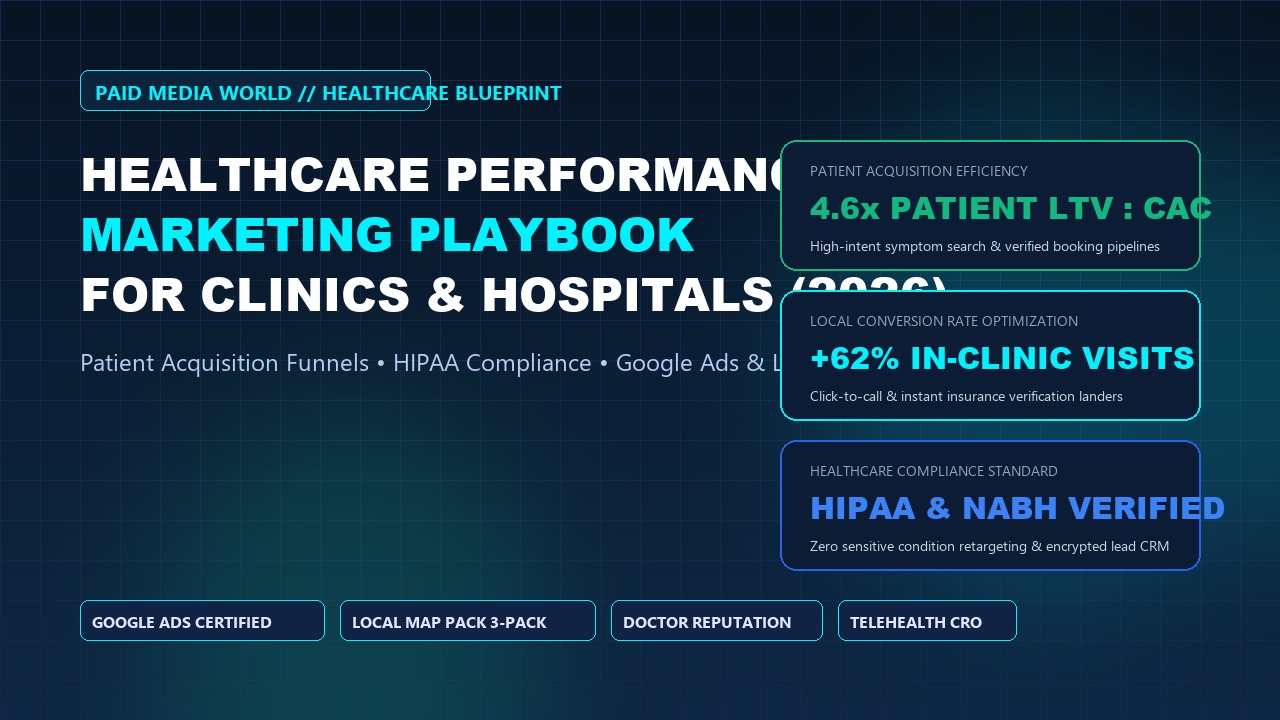
Healthcare marketing in 2026 is governed by an entirely different set of rules than standard B2B or D2C eCommerce. You are not selling impulse purchases; you are facilitating high-stakes, emotion-driven medical decisions where trust, clinical credibility, local accessibility, and regulatory compliance dictate patient volume.
Across private practices, dental clinics, fertility centers, and multi-specialty hospital chains, the traditional playbook of generic social media posts and superficial SEO has collapsed. With Google's stringent Healthcare and Medicines Advertising Policies, the expansion of Google AI Overviews for medical queries, and strict patient data privacy mandates (HIPAA in the US, Digital Personal Data Protection Act / NABH in India), growth requires a precision-engineered Patient Acquisition Funnel.
This guide details the exact operational framework Paid Media World uses to scale patient inquiry volume, maintain compliant ad account governance, and optimize blended cost per acquired patient (CPAP).
The 3 Distinct Patient Search Intent Archetypes
Every high-performing healthcare search campaign must segregate auctions by the patient's urgency and emotional state:
| Search Archetype | Example Query | Patient Psychology | Ad Strategy & Destination |
|---|---|---|---|
| 1. Acute & Emergency | "pediatric emergency near me" | High panic, immediate proximity decision (< 30 mins) | Call-Only Ads, Google Maps local pack, 24/7 hotline |
| 2. Specialist & Treatment | "robotic knee replacement surgeon" | High research, credential-driven, insurance-conscious | Doctor bio lander, success rates, procedure pricing range |
| 3. Symptom Investigation | "causes of persistent morning dizziness" | Top-of-funnel anxiety, looking for diagnosis | Educational symptom checker, specialist consult CTA |
Regulatory Compliance & Policy Guardrails in Healthcare PPC
Healthcare accounts face frequent account suspensions and policy disapprovals if media buyers treat them like standard commercial stores. Compliance requires strict adherence to three regulatory pillars:
1. Google Healthcare Certification & Restricted Terminology
Strict PolicyGoogle strictly regulates pharmaceutical terms, prescription drugs, clinical trials, and addiction treatment. Bidding on or including trademarked pharmaceutical names (e.g., Botox, Ozempic, Xanax) in ad copy or landing page metadata triggers instant disapproval unless the advertiser possesses LegitScript or Google Healthcare certification. Focus ad messaging on clinical expertise, practitioner qualifications, and medical conditions rather than drug trade names.
2. The Strict Prohibition of Personalized Remarketing
Privacy MandateUnder Google and Meta Personalized Advertising policies, you cannot build retargeting audiences based on sensitive health conditions. You cannot create a Facebook custom audience of users who visited your "Chemotherapy" or "IVF Treatment" page to serve follow-up ads. Attempting to deploy pixel-based health condition retargeting risks permanent ad account disabling. Retargeting in healthcare must be limited to generic institutional branding or patient portal login notifications.
3. Patient Data Privacy (HIPAA & DPDP Server-Side Architecture)
Technical SecuritySending unencrypted Protected Health Information (PHI) such as patient names, phone numbers, or selected medical specialties via standard browser JavaScript pixels violates HIPAA in the US and the Digital Personal Data Protection Act. Deploy a server-side Google Tag Manager (sGTM) proxy that scrubs sensitive query parameters and URL paths before syncing anonymous conversion value tokens (GCLID, WBRAID) to ad platforms.
The Local Monopoly Setup: Google Business Profile & Map 3-Pack
For in-person consultations, dental procedures, and surgical care, over 65% of high-intent patient inquiries originate from Google Local Map Pack results. Dominating local medical search requires synchronizing paid search ads with organic entity signals:
- Google Ads Location Assets (Local Extensions): Link your verified Google Business Profile to your Google Ads account to display "Promoted Pin" ads directly inside Google Maps search results when prospective patients search for specialists in their geographic radius.
- Medical Schema Structured Data: Implement comprehensive JSON-LD schema on doctor landing pages using
MedicalBusiness,Physician, andMedicalConditiontypes. Explicitly mark up doctor credentials (MBBS, MS, MD), hospital affiliations, consultation fees, and accepted health insurance panels. - Proactive Patient Review Harvesting: Google's local ranking algorithms heavily weight review velocity and sentiment. Establish automated SMS/WhatsApp workflows that prompt satisfied post-op patients to leave 5-star Google reviews within 48 hours of successful discharge.
High-Converting Healthcare Landing Page Architecture
Medical landing pages require high empathy and zero technical friction. When an anxious patient arrives on your page, five psychological validation elements must be visible immediately above the fold:
1. Click-to-Call Primary Floating CTA
Over 75% of healthcare PPC clicks occur on mobile devices. A prominent, persistent floating "Call Clinic Helpline" button with direct tap-to-dial functionality converts at 3x the rate of multi-field forms.
2. Lead Doctor Video & Clinical Credentials
Patients choose doctors, not corporate logos. Feature a 45-second high-definition introductory video from the chief surgeon explaining the procedure calmly, accompanied by degrees, years of surgical experience, and total successful cases.
3. Transparent Insurance & Cashless Panels
Financial ambiguity is the #1 drop-off factor in elective healthcare. Prominently display verified logos of accepted health insurance TPAs (Star Health, Care, HDFC ERGO, Medi Assist) and "0% EMI Financing" options.
4. Instant WhatsApp & Calendar Booking
Provide two clear pathways: immediate automated WhatsApp inquiry for patients seeking quick advice, or an interactive self-scheduling calendar widget for direct consultation slot booking.
Patient Lifetime Value (pLTV) & Unit Economics
Senior healthcare growth leaders do not evaluate performance solely on immediate front-end cost per lead. They model Patient Lifetime Value (pLTV) across clinical service lines:
In high-ticket surgical procedures (such as joint replacements, bariatric surgery, or IVF cycles), a single closed case generates between ₹1,50,000 to ₹4,00,000+ ($2,000 to $6,000 USD) in gross hospital revenue. An allowable inquiry CPA of ₹2,500 to ₹5,000 represents an extraordinary 15x to 30x return on paid advertising spend.
Scale Patient Inquiries with Senior Medical Marketers
Looking for a compliant, high-accountability growth partner for your clinic or hospital? Request a confidential healthcare marketing audit from Paid Media World.
Healthcare Performance Marketing: The Patient: Frequently Asked Questions
Can hospitals run Facebook & Instagram ads for patient acquisition?
Yes, but with strict policy safeguards. Meta Ads excel for educational patient awareness, doctor spotlight videos, health camp announcements, and maternity or dental packages. However, you cannot use lead forms that ask for sensitive medical conditions or deploy health-specific retargeting pixels.
What is a good conversion rate for medical landing pages?
High-performing healthcare landing pages tailored to specific treatments with prominent tap-to-call buttons typically convert between 8% and 18% of paid search traffic into inbound inquiries or phone calls.