
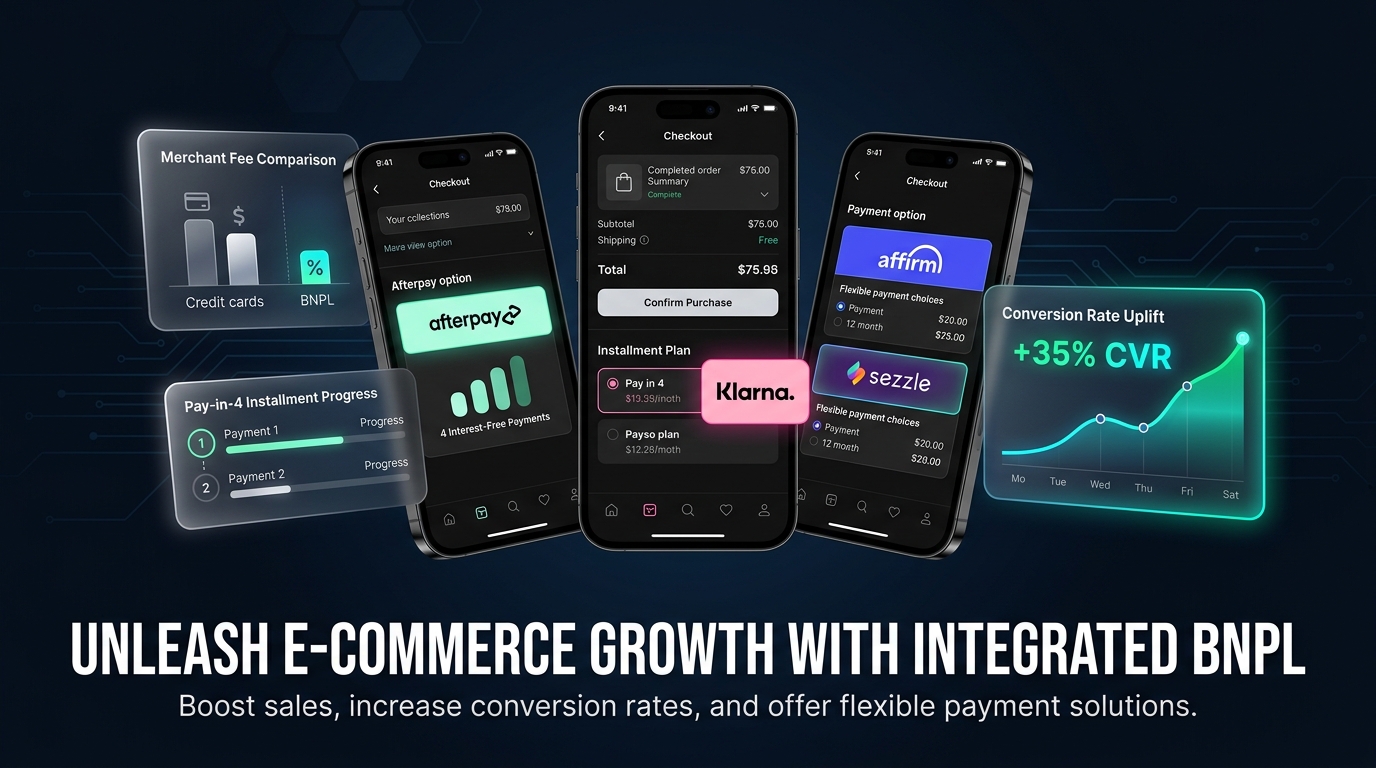
For modern direct-to-consumer (DTC) brands and multichannel retailers, Buy Now, Pay Later (BNPL) is no longer just a trendy checkout perk—it has evolved into a high-stakes conversion rate optimization (CRO) engine and a fundamental component of average order value (AOV) expansion. As customer acquisition costs (CAC) on Meta Ads and Google Ads remain elevated, converting mobile shoppers on the first visit is essential to maintaining profitable unit economics.
However, offering split-pay financing comes at a substantial cost. Unlike traditional credit card processing fees that hover between 2.2% and 2.9% + $0.30, BNPL merchant discount rates (MDR) range from 3.29% to 6.0% + $0.30 per transaction. In this exhaustive 2026 guide, we analyze the merchant economics, underwriting models, conversion rate impact, and technical integration requirements across the four dominant BNPL providers: Klarna, Afterpay, Affirm, and Sezzle.
Table of Contents
- 1. How BNPL Works: The Merchant Cash-Flow & Underwriting Cycle
- 2. The Economics of BNPL: MDR Fees vs. AOV & CVR Uplift
- 3. Head-to-Head Comparison: Klarna vs. Afterpay vs. Affirm vs. Sezzle
- 4. Detailed Provider Breakdown & Best Use Cases
- 5. Impact on Paid Media Creatives & Ad Badging
- 6. Returns, Cancellations, and Chargeback Protection Under BNPL
- 7. Technical Integration: Shopify Checkout Extensibility & APIs
- 8. How to Choose the Right BNPL Mix for Your Store
- 9. Frequently Asked Questions (PAA Breakdown)
1. How BNPL Works: The Merchant Cash-Flow & Underwriting Cycle
At its core, a Buy Now, Pay Later service operates as an automated point-of-sale micro-lender. When a customer selects a BNPL provider at checkout, the transaction follows a distinct four-step financial sequence:
- Instant Underwriting & Soft Credit Check: The provider runs a real-time risk assessment using algorithms that examine device fingerprinting, behavioral signals, and credit bureau data (typically soft inquiries that do not harm the shopper's credit score). Within 500 milliseconds, the customer is approved for a repayment schedule—most commonly Pay-in-4 (four equal bi-weekly installments over six weeks).
- Upfront Settlement to Merchant: The BNPL provider remits the full transaction amount (minus the agreed merchant discount fee) directly into the merchant's bank account within 1 to 3 business days. The merchant does not wait for the customer to complete their installments.
- Credit & Fraud Risk Absorption: The BNPL provider assumes 100% of the customer default risk. If the consumer fails to make their 2nd, 3rd, or 4th payment, the provider's collections infrastructure handles recovery. The merchant retains their payout without recourse.
- Post-Purchase Consumer Relationship: The consumer services their balance via the provider's mobile app or automated card deductions, exposing them to the provider's dedicated shopping marketplace for re-engagement.
2. The Economics of BNPL: MDR Fees vs. AOV & CVR Uplift
The primary objection eCommerce executives raise against BNPL is the premium merchant fee. Does a 5% transaction cut make economic sense when standard credit card processing is only 2.9%? To evaluate this objectively, consider the core unit economics:
| Metric | Standard Credit Card (Stripe / Shopify Payments) | BNPL Provider (Klarna / Afterpay / Affirm) | Net Variance / Impact |
|---|---|---|---|
| Merchant Fee (MDR) | 2.9% + $0.30 ($3.20 on $100 order) | 5.0% + $0.30 ($5.30 on $100 order) | +2.1% Higher Processing Cost |
| Average Order Value (AOV) | $85.00 | $115.00 – $135.00 | +35% to +58% Higher Basket Size |
| Mobile Checkout Conversion Rate | 1.85% | 2.45% – 2.90% | +32% to +56% Relative CVR Lift |
| Cart Abandonment Rate | 69.8% | 58.2% | -11.6% Reduction in Abandoned Checkouts |
| Fraud & Chargeback Liability | Merchant absorbs friendly fraud / chargeback fees ($15-$25) | BNPL provider covers 100% fraud & chargeback risk | Zero Chargeback Exposure |
The Contribution Margin Rule of Thumb
If your gross margin exceeds 50%, a 2%–3% higher processing fee is easily offset if BNPL delivers at least an 8% lift in checkout conversion rate or a 15% increase in AOV. However, for low-margin retailers (<25% gross margin), careful qualification rules must be implemented, such as only enabling BNPL for orders above a strict dollar threshold (e.g., $75+ minimum basket size).
3. Head-to-Head Comparison: Klarna vs. Afterpay vs. Affirm vs. Sezzle
While all four platforms offer split payments, their core demographic focus, financing horizons, underwriting models, and fee structures differ significantly:
| Feature / Dimension | Klarna | Afterpay | Affirm | Sezzle |
|---|---|---|---|---|
| Standard Merchant Fee (MDR) | 3.29% – 5.99% + $0.30 | 4.00% – 6.00% + $0.30 | 5.99% flat or custom tiered (3%–8%) | 6.00% + $0.30 (negotiable on volume) |
| Financing Products Offered | Pay in 4, Pay in 30 Days, Financing up to 36 mos | Pay in 4, Pay Monthly (up to 12 mos) | Pay in 4 (Adaptive Checkout), Monthly Financing up to 36 mos | Pay in 4, Pay in 2, Long-Term Financing up to 48 mos |
| Credit Check Type | Soft pull (Pay in 4); Hard pull only for long-term financing | Soft pull only (no impact on credit score) | Soft pull only (no hard credit check for consumer) | Soft pull (Sezzle Up allows reporting to bureaus) |
| Target Demographic & Strengths | Fashion, beauty, Gen Z / Millennials, global presence | Apparel, lifestyle, cosmetics, strong repeat usage | High-ticket retail ($250–$5,000+), electronics, furniture | Ethical commerce (B-Corp), omni-channel, budget-conscious |
| Consumer Late Fees | Up to $7.00 per late installment | Capped at 25% of order value | $0 Late Fees (Zero penalty fee policy) | $5–$15 rescheduling / late fees |
| Global Footprint | 45+ countries (US, UK, EU, Australia) | US, UK (Clearpay), Australia, New Zealand, Canada | US and Canada (primary focus) | US and Canada (expanding internationally) |
| Shopify Integration Status | Full Checkout Extensibility & Shopify Payments | Full Checkout Extensibility & Shopify Payments | Powers native Shop Pay Installments | Full Checkout Extensibility partner app |
4. Detailed Provider Breakdown & Best Use Cases
1. Klarna: The Global Lifestyle & Omnichannel Powerhouse
With over 150 million active global consumers and 500,000 retail partners, Klarna is the most widely recognized international BNPL brand. Beyond payment processing, Klarna operates as a shopping search engine and discovery platform. Its mobile app drives high-intent referral traffic directly to merchant storefronts.
- Best For: International brands, apparel, cosmetics, footwear, and consumer electronics with average cart values between $50 and $400.
- Key Advantage: Exceptional brand recognition in Europe and North America; flexible payment methods including Pay Now, Pay in 30 Days, and long-term financing.
- Watch Out For: Consumer late fees can occasionally lead to customer support tickets directed toward your brand rather than Klarna.
2. Afterpay: The Loyalty & Repeat-Purchase Leader
Acquired by Block (formerly Square), Afterpay built its empire on strict consumer guardrails and a zero-interest ethos. Afterpay freezes a consumer's account immediately if an installment is missed, preventing shoppers from spiraling into revolving debt. Because of this disciplined approach, Afterpay boasts an exceptionally loyal user base with customers averaging 15+ orders per year through the platform.
- Best For: Fast-fashion, beauty, indie DTC brands, and impulse lifestyle purchases between $35 and $250.
- Key Advantage: Deep integration with the Square POS ecosystem for seamless unified commerce (in-store and online).
- Watch Out For: Highly restrictive order caps for newly registered consumers, which can lead to initial checkout rejections on high-ticket orders.
3. Affirm: The High-Ticket & Enterprise Financing Giant
Founded by PayPal co-founder Max Levchin, Affirm was engineered specifically for larger purchases that require transparent, non-predatory credit. Affirm charges zero late fees, zero hidden penalties, and zero compounding interest. Through its Adaptive Checkout engine, Affirm dynamically presents the optimal payment schedule—whether Pay in 4 or 3-to-36 month financing with interest rates ranging from 0% to 36% APR based on the shopper's credit profile.
- Best For: High-ticket eCommerce ($300 to $10,000+), including home gym equipment, mattresses, luxury jewelry, furniture, and consumer tech.
- Key Advantage: Affirm is the exclusive backend technology powering Shop Pay Installments on Shopify, providing native 1-click checkout execution across millions of Shopify storefronts.
- Watch Out For: Complex pricing tiers where merchants may need to subsidize 0% APR promotional financing (which can push merchant fees up to 7%–9% on long-term loans).
4. Sezzle: The Certified B-Corp & Credit-Building Specialist
Sezzle differentiates itself through social responsibility and credit-building tools. Through its Sezzle Up program, consumers who pay installments on time can elect to have their payment history reported to the major credit bureaus, helping Gen Z and credit-invisible consumers build credit histories without holding a credit card.
- Best For: Gen Z focused retail, eco-friendly goods, sustainable apparel, and stores operating with average cart values between $40 and $300.
- Key Advantage: Competitive merchant fee negotiations for medium-sized retailers, and unique features like "Free Reschedule" that allow shoppers to defer one payment without penalty.
- Watch Out For: Smaller overall consumer user base in Western Europe compared to Klarna and Afterpay.
5. Impact on Paid Media Creatives & Ad Badging
Integrating BNPL is only half the battle; the real performance marketing dividend comes from advertising installment pricing directly in your top-of-funnel paid media campaigns:
Actionable Creative Playbook for Meta & Google Ads
- Product Detail Page (PDP) Dynamic Badging: Always place the dynamic installment widget directly below the product price. Seeing "or 4 interest-free payments of $24.75 with Klarna" anchors the consumer on $24.75 rather than $99.00, reducing bounce rate by up to 18%.
- Meta Advantage+ Catalog Overlay: For high-ticket catalogs ($150+), test dynamic image overlays displaying the Pay-in-4 installment price. Ads highlighting installment costs regularly outperform static price tags with a 15%–22% lower CPA.
- Ad Copy Hook Testing: Test explicit copy hooks in primary text: "Get it now, pay later. Select Afterpay at checkout for 4 interest-free payments." This directly addresses cash-flow constraints during mid-month or post-holiday purchase lulls.
6. Returns, Cancellations, and Chargeback Protection Under BNPL
One of the most valuable yet overlooked benefits of BNPL is chargeback insulation:
- Zero Fraud Chargeback Liability: Because the BNPL provider authenticates and underwrites the consumer, the merchant is completely protected from fraudulent unauthorized transaction chargebacks.
- Friendly Fraud & Item Not Received (INR): If a consumer claims non-delivery, the BNPL provider investigates. As long as the merchant supplies valid carrier tracking with delivery confirmation, the merchant retains their payout.
- How Refunds Work: When a merchant processes a return in Shopify or WooCommerce, the refund signal routes to the BNPL provider. The provider automatically cancels remaining future installments and credits any previously paid installments back to the consumer's card.
- Non-Refundable Processing Fees: Like modern credit card processors, BNPL providers generally do not return the merchant discount rate (MDR) when a customer returns an item. If your brand suffers a 25% return rate, high BNPL fees on returned merchandise will erode profitability unless restocking policies or store-credit alternatives are utilized.
7. Technical Integration: Shopify Checkout Extensibility & APIs
With Shopify deprecating legacy `checkout.liquid` scripts in favor of Checkout Extensibility, BNPL integrations must be deployed cleanly using modern Web Pixels and checkout app blocks:
// Example: Verifying BNPL Widget Placement in Shopify Liquid / Next.js Headless
// Ensure dynamic price calculation matches exact currency and cart total
document.addEventListener("DOMContentLoaded", function() {
const currentPrice = parseFloat(document.querySelector("[data-product-price]").innerText.replace(/[^0-9.-]+/g,""));
const installmentAmount = (currentPrice / 4).toFixed(2);
const bnplBadge = document.querySelector("#bnpl-pdp-callout");
if (bnplBadge) {
bnplBadge.innerHTML = `Or 4 payments of $${installmentAmount} with
 or
or
 `;
}
});
`;
}
});
8. How to Choose the Right BNPL Mix for Your Store
Should you install all four providers or select a single partner? Offering too many BNPL options clutters checkout UI and creates decision paralysis. Follow this proven framework:
- For Shopify-Centric Stores: Activate Shop Pay Installments (powered by Affirm) as your default backbone. It provides the lowest checkout friction because tens of millions of US consumers already have saved payment details in Shop Pay.
- For Fashion, Beauty & Apparel ($40–$250 AOV): Add Klarna or Afterpay. Both have immense lifestyle app traffic and strong Gen Z / Millennial loyalty.
- For Luxury, Furniture, Fitness & High-Ticket ($500–$5,000+ AOV): Choose Affirm standalone. Its adaptive checkout and 12-to-36 month financing terms handle enterprise order values that Pay-in-4 services cannot support.
- Rule of Thumb: Limit checkout to maximum 2 BNPL options (e.g., Shop Pay Installments + Klarna, or Shop Pay Installments + Afterpay) to keep checkout load speeds fast and cognitive load low.
9. Frequently Asked Questions (PAA Breakdown)
What is the difference between BNPL and a credit card?
BNPL splits a specific purchase into fixed installments (usually 4 bi-weekly payments over 6 weeks) with 0% interest and no compounding debt. Credit cards provide a revolving line of credit where unpaid balances incur compounding monthly interest (typically 18% to 29% APR).
Does Buy Now, Pay Later hurt the consumer's credit score?
For standard Pay-in-4 plans, Klarna, Afterpay, and Affirm perform a soft credit check that does not impact the consumer's credit score. However, if a customer applies for long-term monthly financing (6 to 36 months), a hard credit inquiry may be performed, and missed payments can be reported to credit bureaus.
How much do Klarna and Afterpay charge merchants?
Klarna generally charges merchants 3.29% to 5.99% plus a $0.30 fixed fee per transaction. Afterpay charges between 4.0% and 6.0% plus $0.30 per transaction. Rates can be negotiated down for high-volume merchants processing over $1M+ annually.
Does offering BNPL actually increase sales and conversion rates?
Yes. Industry data and merchant benchmarks show that integrating BNPL typically increases mobile checkout conversion rates by 20% to 35% and boosts Average Order Value (AOV) by 30% to 50%, particularly in fashion, luxury goods, and electronics.
What happens if a customer defaults on a BNPL payment?
The merchant keeps 100% of their upfront payout. The BNPL provider absorbs the loss and manages debt collection. The merchant is never charged back for customer installment defaults.
Can you offer multiple BNPL options on Shopify?
Yes. Through Shopify Checkout Extensibility and Shopify Payments, merchants can enable Shop Pay Installments alongside third-party apps like Klarna, Afterpay, or Sezzle. However, best practice is to limit options to no more than two to prevent checkout clutter.