
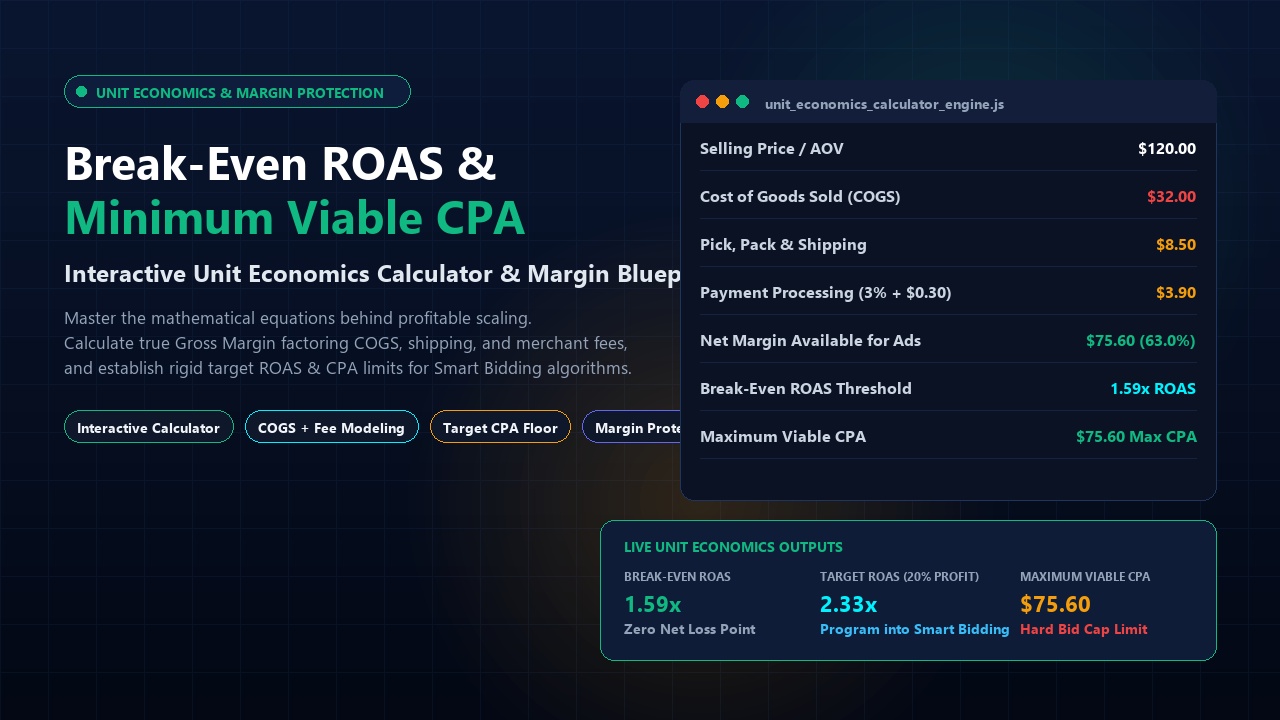
In direct response media buying, one of the most fatal operational traps is scaling campaigns based on arbitrary ROAS targets. Media buyers often brag about achieving a "3.0x ROAS" on Meta Ads or Google Ads, unaware that after factoring in Cost of Goods Sold (COGS), pick-and-pack shipping, merchant gateway fees, and operating overhead, the business is actually losing money on every order.
To scale profitably, you must understand your unit economics with mathematical precision. Below, you will find the complete foundational equations for Gross Margin, Break-Even ROAS, and Maximum Viable CPA, followed by our live interactive client-side calculator to compute your exact profitability thresholds in real time.
Table of Contents
- 1. The ROAS Fallacy: Why High ROAS Can Still Bankrupt You
- 2. The Mathematical Formulas: Deriving Break-Even Thresholds
- 3. Interactive Break-Even ROAS & Viable CPA Calculator
- 4. Master Unit Economics Matrix: Benchmarks Across 6 Sectors
- 5. How to Program Target ROAS & Target CPA into Ad Algorithms
- 6. First-Order Profitability vs. Blended LTV Scaling
- 7. Frequently Asked Questions (PAA Breakdown)
1. The ROAS Fallacy: Why High ROAS Can Still Bankrupt You
Return on Ad Spend (ROAS) is a simple ratio: Revenue / Ad Spend. It measures gross top-line cash collection relative to advertising outlay, but completely ignores expenses:
A Real-World Cautionary Tale
Imagine an eCommerce brand selling an item for $100. Their agency achieves a 2.5x ROAS (spending $40 in ads to generate $100 in revenue). The dashboard looks profitable! But review the true P&L:
- Product Selling Price: $100.00
- Ad Spend (2.5x ROAS): -$40.00
- Cost of Goods Sold (COGS): -$42.00
- Pick, Pack & Shipping: -$11.50
- Payment Processing Fee (3% + $0.30): -$3.30
- Returns & Breakage Reserve (5%): -$5.00
- Net Profit per Order: -$1.80 (Loss)
Despite a 2.5x ROAS, the company loses $1.80 on every conversion. The more they scale ad spend, the faster they burn cash.
2. The Mathematical Formulas: Deriving Break-Even Thresholds
Formula 1: True Gross Contribution Margin ($ and %)
Your Gross Margin represents the actual cash remaining from a sale to cover customer acquisition costs and net profit:
Gross Margin ($) = Selling Price - COGS - Shipping - Merchant Fees - Return Allowance
Gross Margin (%) = (Gross Margin ($) / Selling Price) * 100
Formula 2: Break-Even ROAS
Break-Even ROAS is the minimum ROAS required to cover all product and fulfillment costs, resulting in exactly $0 net profit and $0 net loss:
Break-Even ROAS = 1 / Gross Margin (in decimal form)
Example: If your Gross Margin is 50% (0.50), your Break-Even ROAS = 1 / 0.50 = 2.00x ROAS.
Example: If your Gross Margin is 25% (0.25), your Break-Even ROAS = 1 / 0.25 = 4.00x ROAS.
Formula 3: Maximum Viable CPA (Break-Even CPA)
The maximum dollar amount you can pay to acquire a paying customer without losing money:
Max Viable CPA ($) = Selling Price - COGS - Shipping - Merchant Fees
Formula 4: Target CPA for a Desired Net Profit Margin
Target CPA ($) = Max Viable CPA - (Selling Price * Desired Net Profit Margin %)
Target ROAS = 1 / (Gross Margin % - Desired Net Profit Margin %)
3. Interactive Break-Even ROAS & Viable CPA Calculator
Adjust the sliders and input fields below to compute your unit economics and target bidding parameters in real time:
Unit Economics & ROAS Engine
Real-time margin, break-even, and target bid calculator
4. Master Unit Economics Matrix: Benchmarks Across 6 Sectors
| Product Vertical | Typical Gross Margin (%) | Break-Even ROAS | Target ROAS (20% Net) | Unit Economics Health |
|---|---|---|---|---|
| Supplements & Nutraceuticals | 75% – 85% | 1.18x – 1.33x | 1.54x – 1.82x | Super High Margin (Scale Heavily) |
| Digital Courses & Info Products | 85% – 95% | 1.05x – 1.18x | 1.33x – 1.54x | Virtually Zero COGS |
| Beauty & Skincare DTC | 65% – 75% | 1.33x – 1.54x | 1.82x – 2.22x | Healthy Scale Zone |
| Apparel & Fashion Retail | 50% – 60% | 1.67x – 2.00x | 2.50x – 3.33x | Watch Return Rates closely |
| Consumer Electronics & Hardware | 30% – 45% | 2.22x – 3.33x | 4.00x – 6.67x | Thin Margins (High ROAS Required) |
| Heavy Goods / Home Furniture | 35% – 50% | 2.00x – 2.85x | 3.33x – 5.00x | Shipping Freight Eats Margins |
5. How to Program Target ROAS & Target CPA into Ad Algorithms
Once your unit economics are locked, translate your mathematical thresholds into your bidding strategies:
- Setting Target ROAS in Meta Advantage+: When configuring a Minimum ROAS floor on Meta Ads Manager, set it at least 10%–15% above your true Break-Even ROAS. For example, if your break-even is 1.60x, program a minimum ROAS of 1.85x.
- Setting Target CPA in Google Smart Bidding: In Google Ads, never set your Target CPA directly at your Max Viable CPA. Set it at your Target CPA (after desired margin). If your Max CPA is $75 and you desire a 20% net margin ($24), program your Target CPA to $51.00.
- The Bidding Cushion Rule: Ad networks optimize against average cohort performance. If you set your bid target exactly at the razor's edge of break-even, minor daily variance will push individual days into unrecoverable losses.
6. First-Order Profitability vs. Blended LTV Scaling
The unit economics framework above assumes first-order profitability. However, high-growth subscription and repeat-purchase brands (e.g., coffee, skincare, SaaS) often choose to acquire customers at a first-order break-even (or slight initial loss), relying on 60- and 90-day Customer Lifetime Value (LTV):
The 60-Day LTV Calculation
If your customer's 60-day repeat purchase rate is 35%, your effective 60-day revenue per acquired user is AOV * 1.35. If your gross margin is 60%, your 60-day allowable CPA expands from $60.00 to $81.00, allowing you to outbid competitors in Google and Meta auctions while capturing dominant market share.
7. Frequently Asked Questions (PAA Breakdown)
What is the formula for Break-Even ROAS?
Break-Even ROAS is calculated by dividing 1 by your Gross Profit Margin percentage: Break-Even ROAS = 1 / Gross Margin %. For example, if your product has a 50% gross profit margin, your Break-Even ROAS is 1 / 0.50 = 2.0x.
What is Minimum Viable CPA?
Minimum Viable CPA (also known as Maximum Allowable CPA) is the highest amount you can spend to acquire a customer without losing money on the transaction. It equals your Average Order Value minus all fulfillment costs (COGS, shipping, pick/pack, and credit card processing fees).
Can you be profitable with a 1.5x ROAS?
Yes, absolutely. If you sell high-margin goods (e.g., digital software, SaaS, or supplements with an 85% gross margin), your Break-Even ROAS is 1.18x. At a 1.5x ROAS, you generate substantial net profit. Conversely, a retailer with a 25% margin loses heavy money at 1.5x ROAS.
How do merchant payment fees affect Break-Even ROAS?
Payment processing fees (e.g., 2.9% + $0.30 for credit cards, or 4.5%–6.0% for Buy Now, Pay Later) directly reduce your gross margin. On a $100 product, a 5% BNPL fee reduces margin by $5.00, pushing your Break-Even ROAS higher.