
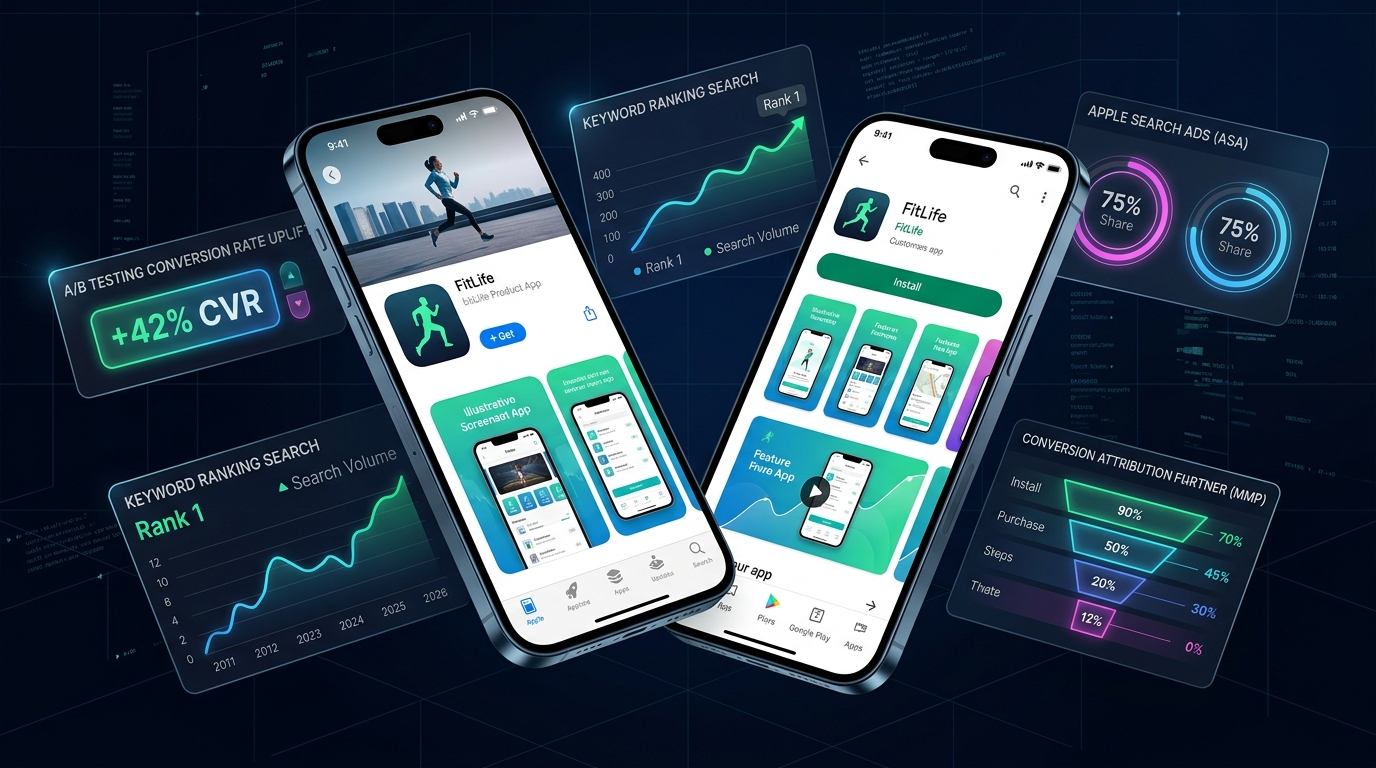
In the mobile app ecosystem, user acquisition has reached peak saturation. Across iOS and Android, over 5 million apps compete for attention, while privacy frameworks—Apple's SKAdNetwork and Google's Privacy Sandbox—have permanently driven up Mobile Cost Per Install (CPI).
Many app marketing teams treat App Store Optimization (ASO) as an afterthought—stuffing keywords into titles once a year and leaving generic screenshots untouched. This approach burns hundreds of thousands of dollars in wasted paid media.
Modern ASO is not just keyword metadata; it is the ultimate conversion engine for paid traffic. When your App Store listing conversion rate (CVR) increases from 18% to 28%, your effective blended Cost Per Install drops by 35% across every paid channel (Apple Search Ads, Meta App Campaigns, Google App Campaigns, and TikTok).
iOS App Store vs. Google Play Store Algorithm Mechanics
The two app store indexing algorithms operate on fundamentally different search and ranking mechanics:
| Attribute / Factor | Apple App Store (iOS) | Google Play Store (Android) |
|---|---|---|
| App Title Weight | 30 characters (Highest ranking weight) | 30 characters (Highest ranking weight) |
| Subtitle / Short Desc | Subtitle: 30 characters (High weight) | Short Description: 80 characters (Very high weight) |
| Hidden Keyword Field | 100 characters (Comma-separated, no spaces) | None (Extracted from description) |
| Long Description | Ignored for keyword indexing | Indexed! Target 2%–3% keyword density |
| Conversion Testing Native | Product Page Optimization (PPO) | Store Listing Experiments (SLE) |
| Audience Customization | Custom Product Pages (Up to 35 CPPs) | Custom Store Listings (Up to 50 CSLs) |
The iOS Keyword Field Math: Maximizing Every Byte
Apple gives you exactly 100 bytes in the hidden keyword field. Every misplaced character or duplicate word wastes valuable indexing real estate:
- Never repeat words: If a keyword is already in your Title or Subtitle, Apple already indexes it. Putting it in the 100-character field wastes space.
- Omit spaces after commas: Format keywords as
budget,finance,money,planner,trackerrather thanbudget, finance, money. Removing spaces saves 10 to 15 characters for extra keywords. - Skip category names and stop words: Apple automatically indexes words like "app", "free", and your primary category name.
- Combine singular and plural carefully: In English, Apple's NLP usually associates singular and plural, but irregular plurals or localized variations should be evaluated via search volume tools.
Custom Product Pages (CPP) for Apple Search Ads
The most powerful breakthrough in mobile paid acquisition is Custom Product Pages (CPPs). Rather than sending all paid ad traffic to your default product page, you can create up to 35 tailored landing pages with unique screenshots, preview videos, and promotional text.
The CPP Paid Acquisition Formula
Search Ad Intent: Keyword = "b2b expense tracking"
Default Page Conversion: 16.2% CVR (Generic screenshots showing family budgeting)
Custom Product Page: 29.8% CVR (Screenshots tailored exclusively to corporate credit card sync & receipt scanning)
Financial Impact: Effective Cost Per Install (CPI) reduced by 45.6% without increasing ad bid.
Mobile App CRO: The First 3 Screenshots Rule
Eye-tracking studies across the App Store show that over 70% of users make their download decision based entirely on the first 3 screenshots in portrait mode, without ever scrolling further or reading your long description.
- Screenshot 1 (The Core Hook): Must address the primary user pain point and unique selling proposition in 4 words or fewer (e.g., "Track Expenses in 1 Click").
- Screenshot 2 (Social Proof & Friction Eraser): Highlight an essential proof metric: "Trusted by 250,000+ Teams" or "Syncs Directly with Intuit & Xero".
- Screenshot 3 (The Hero Feature): Showcase the most intuitive, visually striking interface element (e.g., interactive dashboard or automated receipt scan).
The Complete App Store Optimization (ASO) & M: Frequently Asked Questions
How often should we update ASO keywords?
Review keyword rankings and search popularity every 4 to 6 weeks. Avoid updating too frequently (e.g. weekly), as Apple and Google need 2 to 3 weeks to stabilize indexing and recalculate conversion velocity.
Does ASO help paid Apple Search Ads?
Yes. Apple Search Ads determines keyword relevance based directly on your organic metadata. If a keyword is not indexed organically in your App Store listing, your ASA bids will require much higher bids to win auctions or may be disqualified entirely.