
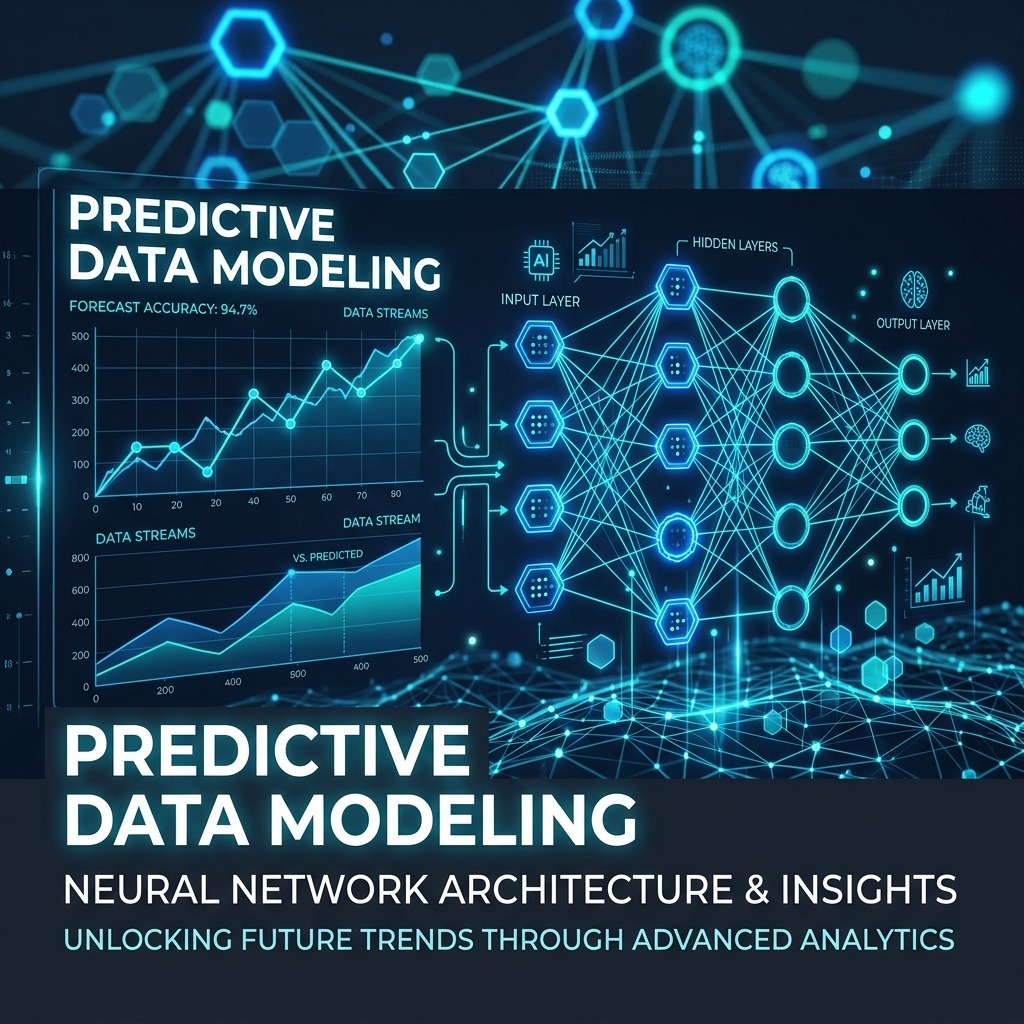
Beyond Historical Performance: The Predictive Shift
For the last decade, keyword research has been a backward-looking discipline. Marketers looked at search volume from the past 12 months, applied a generic multiplier for growth, and projected clicks. But with search patterns fragmenting under conversational search, voice assistants, and AI Overviews, historical volume is no longer a reliable indicator of future traffic.
To succeed in 2026, you must transition to Predictive Keyword Forecasting. By combining internal historical search data with external market trends, search engine API signals, and machine learning, you can model keyword behavior, CPC spikes, and conversion likelihood before you launch campaigns.
What is Google’s Lattice AI?
Google’s Lattice AI is the underlying machine learning architecture that powers modern Smart Bidding and broad match expansion. Rather than matching keywords purely by string alignment or synonyms, Lattice AI maps search queries to multidimensional intent spaces. It processes:
- Temporal intent: How search urgency changes by hour, day of the week, or seasonal patterns.
- Sequential search behaviors: The sequence of queries a user enters before finalizing their purchase journey.
- Cross-channel correlation: How Youtube views and Maps searches influence the probability of a conversion on search.
While you cannot access the raw weight vectors of Lattice AI directly, you can feed its predictions back into your media mix by utilizing Google’s Bid Simulator API signals and predictive modeling.
The Cost of Inaccuracy: Modeling CPC Volatility
Failure to predict CPC volatility leads to budget exhaustion before peak hours or overpaying for low-intent traffic during seasonal spikes. Below is a comparison of traditional keyword forecasting versus AI-enhanced forecasting:
| Forecasting Model | Data Inputs | Handling of Volatility | Forecast Horizon |
|---|---|---|---|
| Traditional (Static) | 12-Month Search Volume, Historical CPC | Applies uniform average CPC; misses peak competitive events | Poor (30-60 days accuracy decays) |
| AI-Enhanced (Predictive) | Google Trends API, Bid Simulators, Competitor Density, Seasonality Index | Simulates CPC curves across multiple spend thresholds using Lattice signals | Excellent (Models 180+ days with dynamically shifting baselines) |
Building a Keyword Forecasting Model in Python
Below is a production-ready Python workflow using scikit-learn and pandas. The model uses historical impression share, competitor density indexes, and seasonality scores to forecast expected Click-Through-Rate (CTR) and Cost-Per-Click (CPC) ranges.
import pandas as pd
import numpy as np
from sklearn.model_selection import train_test_split
from sklearn.ensemble import RandomForestRegressor
from sklearn.metrics import mean_absolute_error

# 1. Mocking structured historical dataset (simulating Google Ads + Trends data)
data = {
    'seasonality_index': [1.0, 1.1, 1.5, 1.8, 1.2, 0.9, 0.8, 1.0, 1.2, 1.7, 2.1, 1.3] * 10,
    'competitor_density': np.random.uniform(0.1, 0.95, 120),
    'historical_ctr': np.random.uniform(0.02, 0.08, 120),
    'avg_impression_share': np.random.uniform(0.3, 0.9, 120),
    'target_cpc': [0.50, 0.55, 0.75, 1.10, 0.65, 0.45, 0.40, 0.50, 0.60, 0.95, 1.40, 0.70] * 10
}

df = pd.DataFrame(data)

# Add target variables (incorporating minor noise to simulate market dynamics)
df['predicted_cpc'] = df['target_cpc'] * df['seasonality_index'] * (1 + df['competitor_density'] * 0.2) + np.random.normal(0, 0.05, 120)
df['predicted_ctr'] = df['historical_ctr'] * (1 - df['competitor_density'] * 0.1) * df['avg_impression_share']

# Features and target matrices
X = df[['seasonality_index', 'competitor_density', 'historical_ctr', 'avg_impression_share']]
y_cpc = df['predicted_cpc']

# Split data for training
X_train, X_test, y_train, y_test = train_test_split(X, y_cpc, test_size=0.2, random_state=42)

# Initialize and train random forest regressor
model = RandomForestRegressor(n_estimators=100, random_state=42)
model.fit(X_train, y_train)

# Evaluate predictions
predictions = model.predict(X_test)
mae = mean_absolute_error(y_test, predictions)
print(f"Model Mean Absolute Error for CPC Forecast: ${mae:.2f}")

# Example Inference: Forecast for Q4 Peak (Seasonality = 2.2, Competitor Density = 0.9)
q4_scenario = pd.DataFrame([[2.2, 0.9, 0.05, 0.75]], columns=X.columns)
predicted_q4_cpc = model.predict(q4_scenario)[0]
print(f"Forecasted Q4 CPC: ${predicted_q4_cpc:.2f}")
How to Feed Predictive Signals to Smart Bidding
Once you have generated your forecasted values, you must communicate these insights to Google’s bidding algorithm. The algorithm optimizes based on conversion history, but it cannot foresee external changes (e.g., product launches, new physical store openings, or sudden viral PR events).
1. Seasonality Adjustments
If your predictive model flags a 40% surge in conversions over a specific 3-day window, apply a Seasonality Adjustment in Google Ads. This tells the Smart Bidding algorithm to temporarily expect higher conversion rates and bid aggressively, then return to baseline immediately afterwards.
2. Value-Based Bidding Targets
If your model predicts that specific clusters of high-volume broad match queries will yield lower lifetime value (LTV) customers, adjust your conversion values dynamically. Assign a lower value weight to those leads so the algorithm shifts budget back to high-intent transactional search terms.
Best Practices to Avoid Data Overfitting
- Monitor Data Drift: Consumer trends change. Re-train your forecasting models every 30 days to capture shifts in macroeconomic behaviors.
- Include Search Query Reports (SQR): Do not rely only on keywords. Analyze search query patterns to discover zero-search-volume queries that are driving highly qualified conversions.
- Cross-reference with Google Trends: Always normalize your internal click metrics against search popularity indexes to verify if drops in performance are channel-specific or market-wide.
Conclusion
Predictive modeling turns keyword research from an administrative exercise into a strategic asset. By mapping future trends, understanding the behavioral signals under Lattice AI, and running python-driven forecasts, you can plan budgets with precision and maintain a competitive ROAS edge in any market climate.
Ready to build your predictive search strategy? Talk to us today.



Leave a Reply